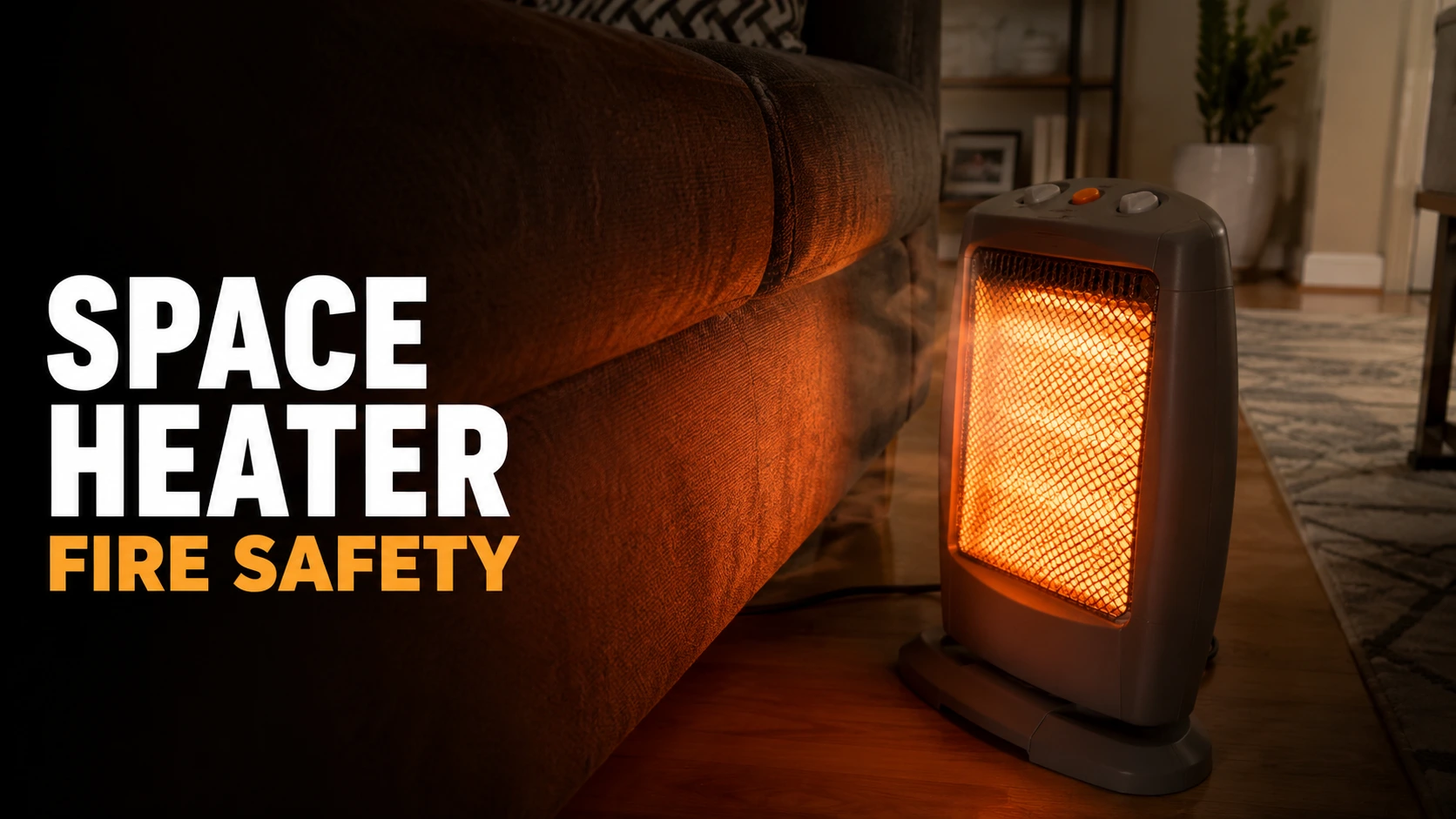

Space heaters are responsible for about 43% of all home heating fires in the United States, and about 85% of home heating fire deaths. Those numbers are disproportionate — they heat a fraction of American homes compared to central heating systems, yet they cause the overwhelming majority of heating-related fires. The reason is not that space heaters are inherently dangerous. The reason is how people use them.
Almost every space heater fire I have investigated had the same combination of factors: a heater that was left on without supervision, placed closer to something combustible than it should have been, and in some cases plugged into an extension cord or power strip that was not rated for it. Any one of those factors increases risk. All three together creates a predictable outcome.
In this article:
- How space heaters actually cause fires
- Placement: the three-foot rule and what it actually means
- Extension cords and power strips: the hidden hazard
- Leaving them on overnight or unattended
- Which types of space heaters are safer
- Safety features to look for when buying
- The daily habits that actually prevent fires
How Space Heaters Actually Cause Fires
There are three main ignition paths for space heater fires, and they are quite different from each other. Understanding which one you are most exposed to depends on how you are using your heater.
Radiant ignition of nearby combustibles
All space heaters emit radiant heat — infrared radiation that warms objects in line of sight. This radiation does not only warm objects to comfort temperature. Given enough time and proximity, it can raise the temperature of ordinary household materials to their ignition point. Upholstery fabric, curtains, bedding, carpet, clothing left on a chair — all of these can be ignited by sustained radiant exposure from a heater that is too close.
This process is slow enough that nothing seems obviously wrong. The heater runs for an hour or two, the nearby fabric has been warming the whole time, and at some point the temperature crosses the ignition threshold. The fire starts not from visible contact with the heater but from sustained radiant exposure to a material that is technically not touching the heater.
This is why the three-foot clearance rule is not arbitrary. It is based on the radiant output of typical residential space heaters and the ignition temperatures of common household materials. Three feet of air gap between the heater and any combustible is the distance at which radiant heat from most heaters cannot accumulate to ignition temperatures at the surface of the combustible.
Electrical overload and wiring failure
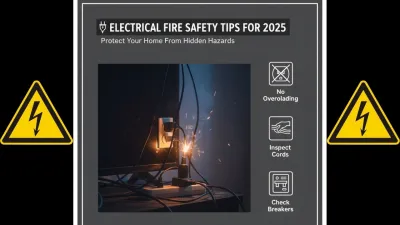
Most portable space heaters draw 1,500 watts — the maximum a standard 15-amp household circuit can handle with nothing else on it. When a 1,500-watt heater is plugged into an extension cord, a power strip, or a circuit that is already loaded with other devices, the potential for overload is real. Extension cord fires from space heaters are a documented and significant fire cause — the cord overheats at its weakest point, typically at the connection or at a kink, and ignites whatever combustible is near it. Which, because people tend to run cords along baseboards and under rugs, is often the carpet or wall material.
Tip-over ignition
A heater that falls over — knocked by a pet, a child, a person getting up during the night — can contact flammable floor material directly. Most modern heaters have tip-over switches that shut the unit off if it is not vertical. Older heaters often do not. A heater without a tip-over switch that falls onto carpet or a rug has direct contact with a combustible at operating temperature.
Placement: What Three Feet Actually Means in Practice
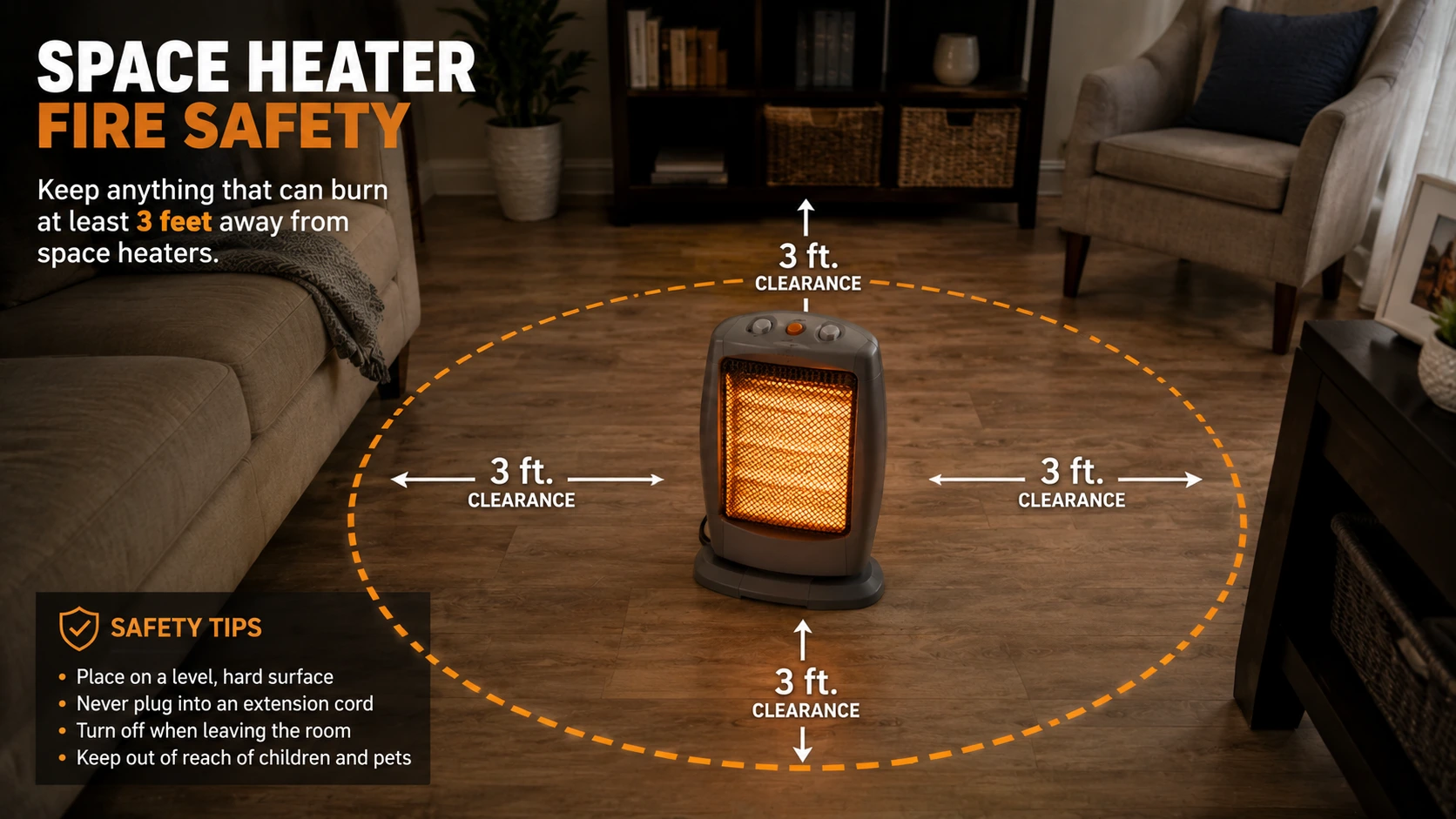
Three feet of clearance from all combustibles sounds simple. Walk into any room where someone is using a space heater and look at what is actually within three feet of it, and it becomes clear how rarely this is actually achieved.
The couch the heater is facing: typically two to three feet away. The curtains on the nearby window: within a foot if the heater is against a wall near the window. The carpet the heater is sitting on: zero feet, because the heater is on it. The clothes draped over the chair: close enough that a person sitting in the chair would feel the heat, which means the clothes definitely feel it too.
Three feet means:
- No furniture — no couches, chairs, bookshelves, dressers — within three feet on any side
- No curtains or window treatments within three feet
- No bedding, no pillows, no clothing
- No paper products, no cardboard, no plastic bags
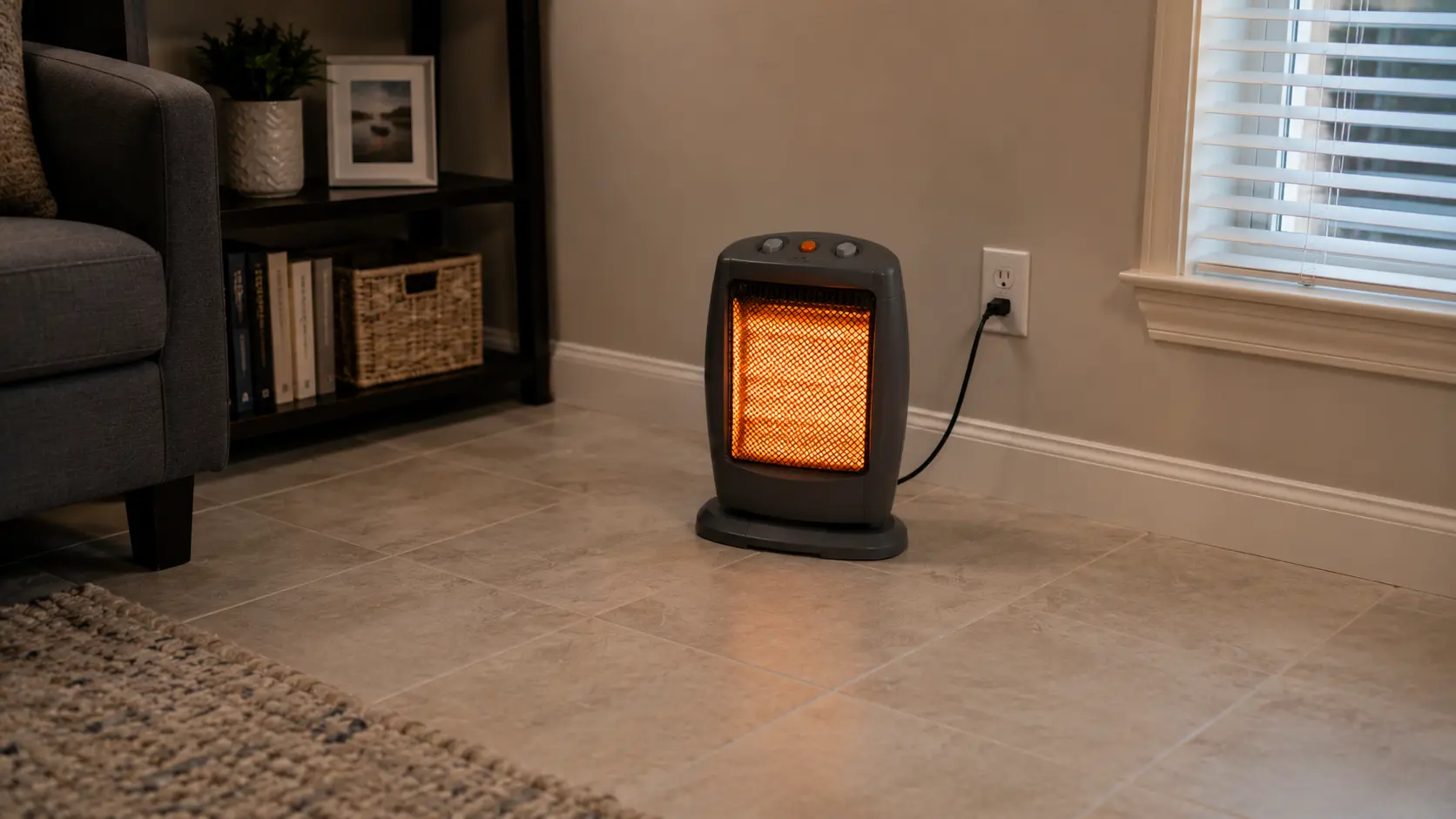
- No carpet or rugs directly under the heater — use hard floor surface under the unit
- Three feet from walls with wallpaper, wood paneling, or flammable wall treatments
In most bedrooms and living rooms as they are actually configured, maintaining three feet of clearance around a space heater means either significantly rearranging the room or accepting that the heater cannot safely be operated in that space. This is an honest conclusion. Many rooms are not safely configured for space heater use, and the answer is not to use one there, not to bend the clearance rule.
What surface to put it on
Hard, non-combustible floor surfaces only. Tile, hardwood, laminate, concrete. Not carpet. Not area rugs. Not hardwood with a rug under the heater. The base of the heater can get warm during operation, and sustained contact with carpet can initiate ignition in the carpet fibers over time. If you only have carpet in the room, place the heater on a ceramic tile or metal tray.
Extension Cords and Power Strips: Do Not Use Them
Never plug a space heater into an extension cord or power strip. Not a heavy-duty extension cord. Not a surge protector. Not a smart power strip. Never. Plug it directly into a wall outlet — ideally the only thing on that outlet.
Extension cords are rated for specific current loads. The standard extension cord available at most hardware stores is rated for 13 amps continuous. A 1,500-watt space heater draws 12.5 amps. That is at the absolute limit of what most extension cords can handle continuously, and continuous operation at rated maximum load is exactly the condition that causes extension cords to fail. The failure is heat — the cord resistance causes it to warm up, and at sustained load it can warm up enough to melt the insulation and ignite the jacket.
Power strips are not designed for high-continuous-draw appliances. They are designed for electronics — televisions, phone chargers, laptops — that draw modest power intermittently. A 1,500-watt space heater running for three hours while the power strip is also powering a lamp and a phone charger is a significant overload in most residential power strip configurations.
There is no safe extension cord for a space heater. The only safe configuration is a direct wall outlet connection. If your heater cord does not reach the wall outlet without an extension, move the heater closer to the outlet or use a different outlet.
Leaving Them On Overnight or Unattended
Space heaters should not be left running while you sleep and should not be left running in an empty room. This is the most consistently ignored piece of space heater guidance, and it is the most consistently present factor in fatal space heater fires.
The reason supervision matters has nothing to do with the probability of ignition per hour. It has to do with how quickly you can respond when something goes wrong. A space heater that causes ignition while you are awake in the same room gives you a response window that can prevent a small fire from becoming a large one. A space heater that ignites at 3am while you are asleep in the next room gives the fire 20–30 minutes of undetected growth before the smoke alarm wakes you. By that point you are not dealing with a small fire. You are dealing with a house fire.
The same logic applies to leaving the room. A heater left on while you go to another part of the house is unsupervised. If ignition begins, the fire has a head start determined by how long you were gone. For a heater in a bedroom with the door closed while everyone is in the living room — that head start can be substantial.
The habit is simple: when you leave the room or prepare to sleep, the heater goes off. Not on low. Not on a timer that turns it off in an hour. Off. Modern heaters that have a programmable thermostat can be set to come on shortly before you wake up — that is a reasonable use of the timer feature. Leaving a heater on through the night and hoping the tip-over switch saves you if something goes wrong is not a reasonable plan.
Which Types of Space Heaters Are Safer
| Type | How It Heats | Relative Fire Risk | Notes |
|---|---|---|---|
| Ceramic (convection) | Heats air that then circulates through the room | Lower — surface temperature is lower than radiant types | Most common residential type. Lower surface temperature means longer time to ignition of nearby materials, but three-foot clearance still required. |
| Oil-filled radiator | Heats oil that circulates through fins, warms surrounding air slowly | Lower — no exposed heating element, very low surface temperature on fins | Slowest to heat but safest configuration. Surface stays warm rather than hot. Still requires clearance and should not be left on unattended. |
| Infrared / quartz | Radiant heat directly from element — warms objects, not air | Higher — intense radiant output, faster ignition of nearby materials | Very effective for spot heating but requires strict clearance. Do not use near soft furnishings, curtains, or in bedrooms. |
| Baseboard electric | Convection heat, permanently installed | Lower when correctly installed | Permanently wired units are safer than plug-in units. Still require clearance from floor-level combustibles and furniture. |
| Fan-forced | Element heats air, fan circulates it | Moderate — faster heat distribution reduces run time needed | The fan can blow lightweight items (paper, fabric) toward the element. Keep area clear. |
Safety Features to Look for When Buying
If you are buying a space heater, these features are not nice-to-have extras. For a device you are going to use in your home with sleeping people, they are minimum requirements:
- Automatic tip-over shut-off. Shuts the unit off within seconds if it is not in an upright position. Test it before use — place the unit on its side and verify it shuts off. Not all tip-over switches work as reliably as marketed.
- Overheat protection. Shuts the unit off if the internal temperature exceeds a safe threshold. This protects against blocked airflow and electrical anomalies that would otherwise cause the unit to run hotter than designed.
- Cool-touch housing. The exterior surfaces of the unit remain at a safe-to-touch temperature during operation. Important if children or pets are in the home.
- UL or ETL listing. The unit has been tested by an independent safety laboratory (Underwriters Laboratories or Intertek). Do not buy a space heater without one of these listings. Unlisted heaters from unknown manufacturers have caused fires from manufacturing defects that a tested unit would not have.
- Programmable thermostat. Allows the unit to cycle off when the room reaches the set temperature rather than running continuously. Reduces both energy use and total operating time.
The Daily Habits That Actually Prevent Fires
- ✓Before turning it on: Verify three feet of clearance in all directions. Check what is on the floor around it. Check the plug for any damage or discoloration.
- ✓Every time you plug it in: Into the wall outlet directly. No extension cords. Confirm it is the only high-draw device on that outlet.
- ✓When leaving the room for any reason: Turn the heater off. Not on low. Off.
- ✓Before going to sleep: Turn the heater off. Confirm it is off. Do not rely on a timer to do this for you.
- ✓Monthly: Inspect the power cord for damage, kinks, or discoloration near the plug or connector. A damaged cord is a fire waiting for the right moment. Replace the unit if the cord is damaged — cords on most portable heaters are not user-replaceable.
- ✗Never: Leave it on overnight, in any room, under any circumstances.
- ✗Never: Use it to dry clothing — hanging clothes over or near a space heater to dry them is one of the more common causes of radiant ignition fires.
- ✗Never: Use it in a bathroom unless specifically rated for bathroom use (moisture-resistant, GFCI-protected outlet required).
- ✗Never: Use it if the unit has been dropped, damaged, or if the cord or plug feels warm to the touch during operation.
Space heaters are a useful tool for supplemental heating in specific situations. They are dangerous in proportion to how casually they are used. The people who use them without incident for years are the ones who treat the clearance rule and the supervision rule as non-negotiable. The people who had fires were usually the ones who had bent those rules for months without incident and assumed the risk was lower than it is.
The risk is not lower. The incidents just happen when the conditions align — and the conditions for a space heater fire are the same every time. Take the habits seriously and you will not have to find out what those conditions feel like.


Comments 0
No comments yet. Be the first to share your thoughts!
Leave a Comment