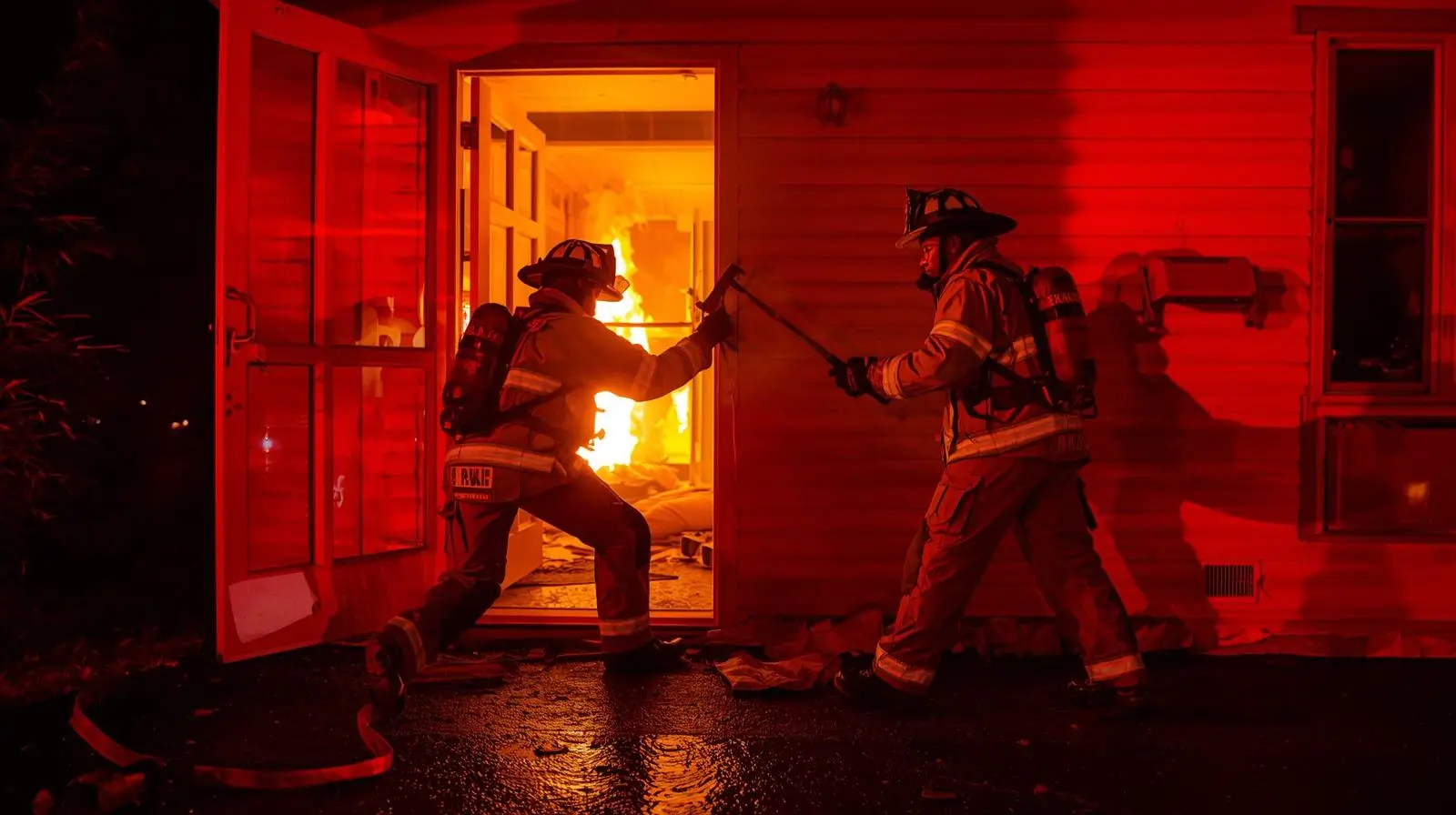

Forcible Entry Guide: Doors, Locks, Tools & Techniques for Structural Firefighting
Forcible entry is the skill that gets water on the fire. No matter how fast your crew stretches the line, if you cannot open the door, you cannot make entry. Forcible entry knowledge covers four areas: door construction (what you are dealing with), lock and hardware recognition (what is holding it), tools (what you will use), and technique (how to use them efficiently without destroying your egress). This guide covers all four.
Jump to:Try before you pry · Door construction types · Lock and hardware types · Forcible entry tools · Inward-swinging doors · Outward-swinging doors · Through-the-lock entry · High-security and through-the-door · Window entry · FAQ
Rule One: Try Before You Pry
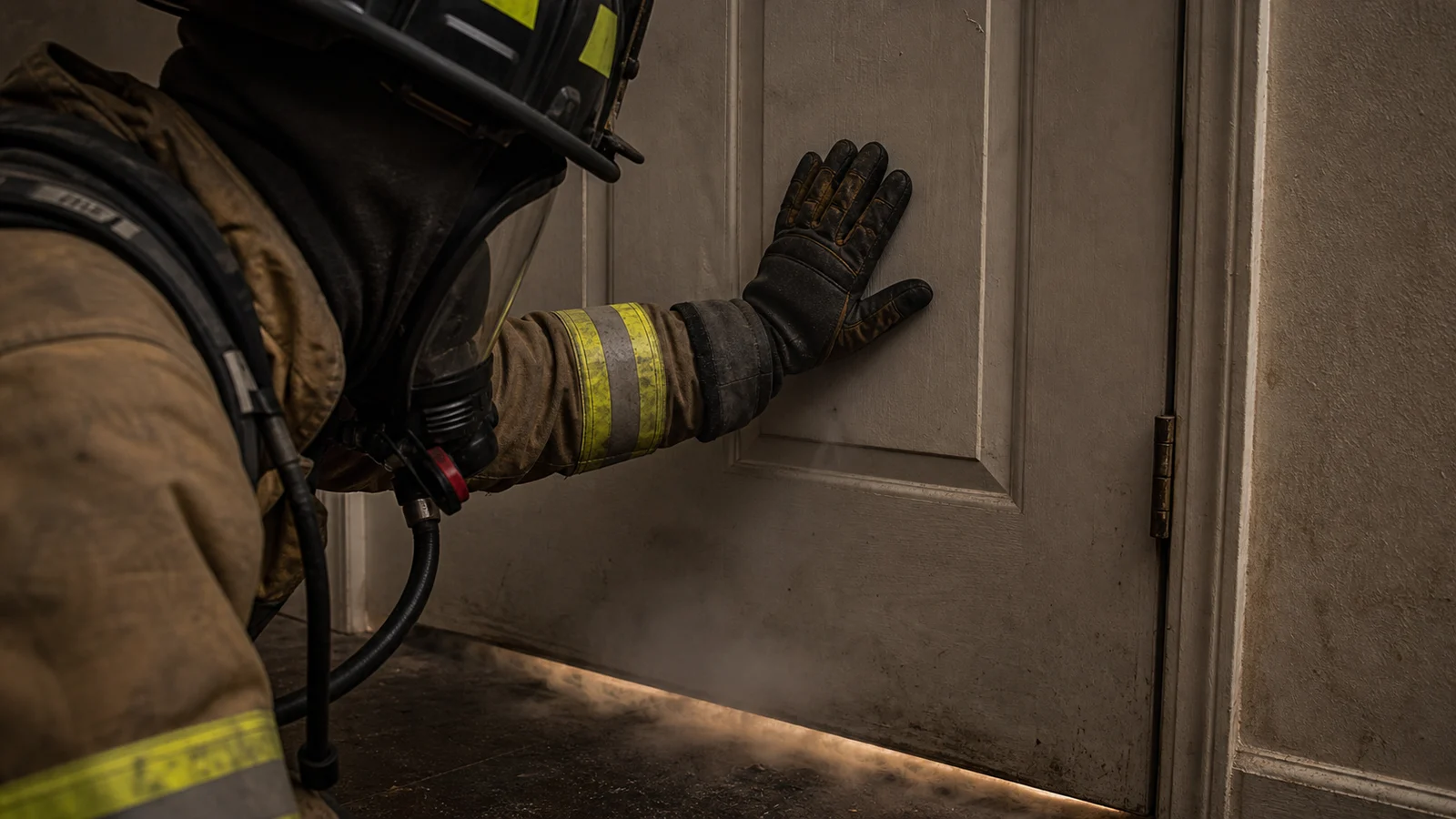
Before applying any tool to any door, try the handle. A meaningful percentage of residential structure fires are accessible through an unlocked door. Forcing a door that was unlocked wastes time, damages property unnecessarily, and creates a compromised entry point that cannot be secured after the incident.
The try-before-you-pry sequence:
- Back-of-hand temperature check on the door and door frame
- Check for smoke seeping around the frame or under the door
- Try the handle
- If locked, assess the door construction and lock type before selecting a tool
Door control during entry: Once you open the door, control it. An uncontrolled door allows full air track to the fire, accelerates combustion, and can create flashover conditions in seconds. Keep one hand on the door throughout entry so you can close it if conditions deteriorate.
Door Construction: Know What You Are Dealing With
| Door type | Construction | Resistance level | Typical location |
|---|---|---|---|
| Hollow core wood | Wood veneer over cardboard honeycomb core | Low — can be breached with a kick or Halligan strike | Interior residential doors, older construction |
| Solid core wood | Solid wood or composite core with wood veneer | Moderate — resists kicks, requires tool work at the lock | Exterior residential, modern interior doors |
| Steel/metal door (hollow) | Steel skin over hollow metal frame | Moderate — resists kick, tool work at lock or hinge required | Commercial buildings, apartments, schools |
| Steel door (solid/reinforced) | Heavy gauge steel with security reinforcement | High — may require multiple tool approaches or through-the-lock | High-security commercial, industrial |
| Glass storefront | Tempered or laminated glass in aluminum frame | Low (tempered) to high (laminated) | Retail, restaurants, commercial |
| Roll-up/overhead | Corrugated metal sections | Variable — depends on gauge and security | Warehouses, garages, commercial |
Lock and Hardware Recognition
The lock type determines which forcible entry technique is most efficient. Spending 3 minutes trying to gap a deadbolt that cannot be gapped wastes critical time. Recognizing the hardware before you start saves it.
Mortise lock
What it is: A complete lock mechanism (latch, deadbolt, sometimes both) housed in a single unit set into a mortised pocket in the door edge. Common in older commercial and residential construction.
Recognition: Single escutcheon plate covering the cylinder and knob/lever. No separate deadbolt visible above the knob.
Best approach: Gapping (Halligan at the lock seam) or through-the-lock. Resistant to kick-in due to integrated latch-bolt.
Rim cylinder / night latch
What it is: A spring-bolt lock mounted on the interior surface of the door. The cylinder is on the exterior. Common in older apartments and commercial doors.
Recognition: Visible lock body on the inside face of the door. Single cylinder on the outside with no handle below it.
Best approach: Gapping is highly effective — the spring bolt retracts easily with the Halligan fork.
Cylindrical deadbolt
What it is: A separate deadbolt with a thrown bolt 1 inch or more deep into the strike plate. The most common residential security lock.
Recognition: Separate lock cylinder above or below the doorknob, no lever or turn button on the exterior.
Best approach: Gapping if the door frame allows. High-security deadbolts with reinforced strike plates may require through-the-lock or door break.
Padlock (external hasp)
What it is: External padlock securing a hasp to a door or gate. Common on commercial roll-up doors, gates, and secondary entry points.
Recognition: Visible padlock body and hasp. The lock secures the hasp, not the door frame.
Best approach: Attack the hasp mounting screws, not the padlock itself. Most hasps are secured with screws that can be quickly defeated with the Halligan. Cut the shackle only if the hasp is heavy-duty welded.
Forcible Entry Tools: What You Carry and What Each Does
| Tool | Primary use | Secondary use |
|---|---|---|
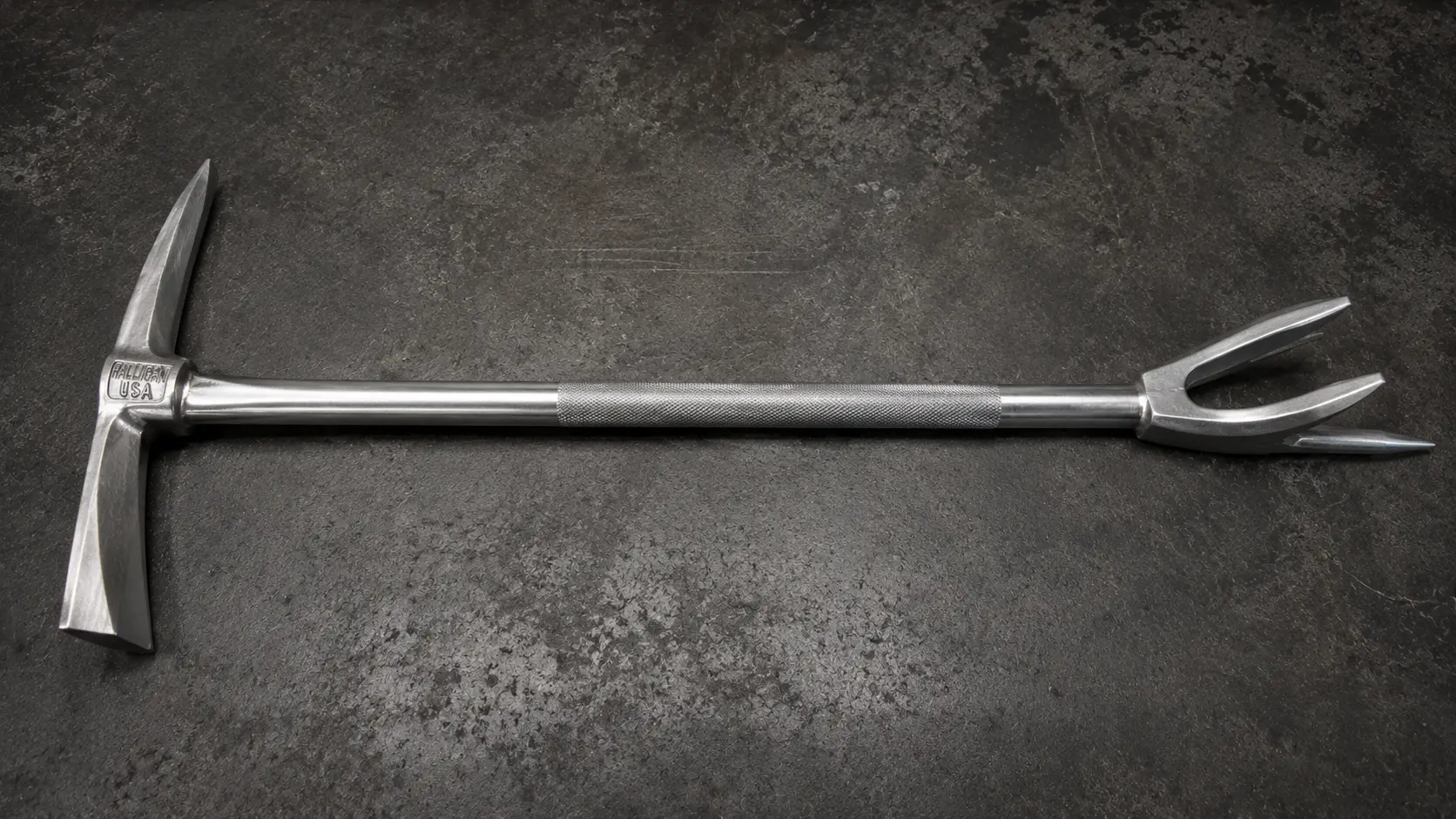
| Halligan bar (Hooligan tool) | Gapping doors at the lock; adze and pick for prying | Ventilation, utility shutoff, pulling ceilings |
| Flat-head axe | Driving the Halligan; chopping; cutting | Breaking glass; door panel breach |
| Irons (Halligan + flat axe) | The primary forcible entry combination for most situations | Carried together at all times by forcible entry team |
| K-tool / A-tool | Through-the-lock entry — pulls the lock cylinder out of the door | K-tool for most cylinders; A-tool for larger cylinders |
| Duck bill lock breaker | Shearing padlock shackles under hammer impact | Faster than bolt cutter on many padlocks |
| Bolt cutters | Cutting padlock shackles, chains, wire | Less effective on hardened shackles; heavy to carry |
| Reciprocating saw | Cutting through door panels, lock areas, bars | Slower than mechanical methods but handles materials others cannot |
| Hydraulic spreader (ram) | High-security doors, bars, gates resistant to Halligan | Requires carrying powered equipment to door |
Inward-Swinging Doors: Gapping Technique
The gap technique using the irons (Halligan + flat axe) is the most efficient and most widely taught method for inward-swinging doors with standard locks. The goal is to force the door jamb away from the lock bolt far enough for the bolt to clear the strike plate.
Two-person gap technique
- Assess the door: Which way does it swing? Where is the lock? Is the frame wood or metal? Is there a deadbolt above the latch?
- Set the fork: Firefighter 1 (the setter) places the forked end of the Halligan between the door and the frame at the lock level, beveled side against the door, fork tips against the door stop. The adze side faces out.
- Drive the fork: Firefighter 2 (the driver) uses the flat face of the axe to drive the Halligan fork into the gap. Three to four firm strikes are typically enough to seat the fork.
- Lever the Halligan: Firefighter 1 levers the Halligan handle toward the door, using the door stop as a fulcrum. This pushes the door frame away from the door, gapping the lock bolt past the strike plate.
- Force the door open: As the lock clears, push the door open. Maintain door control. Do not release the Halligan until the door is confirmed open.
Gap toward the hinges, not away. Levering the Halligan toward the hinges (closing the gap on the hinge side) is more effective than levering away from the door. The door frame has more give toward the hinge side in most residential construction.
Single-firefighter technique
When operating alone, the Halligan can be seated by striking the adze against the door frame edge to drive the fork in, then using body weight and the door stop as a lever. Less efficient than two-person but workable in confined access scenarios.
Outward-Swinging Doors
Outward-swinging doors cannot be gapped the same way — the lock bolt tightens when pressure is applied toward the frame. Techniques:
- Hinge attack: If hinges are exposed (on the exterior), attack the hinge pins with the Halligan pick and drive them out. The door can then be pulled free from the hinge side.
- Through-the-lock: K-tool or A-tool to pull the cylinder and use a key tool to operate the lock mechanism directly.
- Through-the-door: Cut or breach the door panel adjacent to the lock to reach the interior thumb turn. Effective on hollow-core doors where the panel can be breached quickly.
- Rabbeting (beveled door edge attack): On outward-swinging doors with exposed door edge, the Halligan adze can be driven behind the door edge to create leverage at the lock seam.
Through-the-Lock Entry
Through-the-lock entry removes or defeats the lock cylinder itself, preserving the door for reuse. This is the preferred technique for commercial occupancies and high-value structures where unnecessary damage is a concern, and for high-security doors that resist gapping.
K-tool technique
- Place the K-tool over the lock cylinder with the two blades positioned at the cam of the cylinder
- Drive the K-tool onto the cylinder with the flat axe until it is seated
- Use the Halligan adze inserted through the K-tool loop as a lever to pull the cylinder out of the door
- Insert the key tool (J-tool or screwdriver) into the exposed lock mechanism and operate the bolt
Practice K-tool on real hardware. The technique feels straightforward in description but requires feel for correct tool placement. Practicing on salvage doors with actual cylinders installed is essential before you need it at a working fire.
High-Security Doors and Bars
Security bars, gates, and reinforced doors are increasingly common in commercial occupancies, and present specific challenges:
- Security bars over windows: Reciprocating saw or rotary saw to cut bar mounting brackets at the frame, not the bars themselves. Cutting a bar mid-span requires two cuts and is slower.
- Roll-up doors: Cut the door at the bottom panel to create a breach point, or attack the hasp/lock on the exterior. A hydraulic door opener can spread the bottom of the roll-up if the gap technique fails.
- Magnetic locks (mag locks): Cut power. Mag locks are electrically operated and fail open on power loss. Locate the power supply or use a hydraulic spreader to overcome the holding force if power cannot be cut.
- Reinforced strike plates: Heavy-gauge steel strike boxes defeat gapping. Switch to through-the-lock or door break adjacent to the lock.
Window Entry
Windows are a secondary entry point when doors are not accessible or when conditions require an alternative approach:
- Tempered glass (side and rear windows of vehicles, some residential windows): Break at the lower corner with a spring-loaded center punch or Halligan pick tip. The entire pane shatters into small pieces. Clean the frame before entry.
- Annealed glass (older single-pane residential): Breaks with hammer or axe strike. Creates large sharp shards. Strike the upper corner and control the fall of glass before clearing the frame.
- Laminated glass (modern residential, some commercial): Resists single strikes. Requires multiple impacts or a glass saw/reciprocating saw. The plastic interlayer holds shards together even after the glass fractures.
- Window frame clearance: After breaking glass, clear the entire frame of all remaining glass before firefighters pass through. A shard in the frame cuts through turnout gear and causes serious lacerations.
Frequently Asked Questions
What is the most common forcible entry tool combination?
The irons — a Halligan bar and flat-head axe — are the standard forcible entry combination for virtually every fire department. Carried together, they handle the vast majority of residential and commercial door situations. The Halligan provides prying and gapping capability while the axe serves as a driver and backup cutting tool.
What does "try before you pry" mean in firefighting?
Try before you pry means always attempting to open a door normally before using forcible entry tools. Check if the door is unlocked, and perform a temperature and smoke assessment before touching the handle. A meaningful number of structure fires can be accessed through unlocked doors, saving time and avoiding unnecessary damage.
How do you force a door with a deadbolt?
For a standard deadbolt on an inward-swinging door: use the two-person gap technique with the Halligan fork placed at the lock level. Lever the Halligan toward the hinges to push the frame away from the bolt. If the deadbolt has a reinforced strike plate that resists gapping, use the K-tool to pull the cylinder and operate the lock with a key tool.
What is door control in forcible entry?
Door control means maintaining a hand on the door after opening it to prevent uncontrolled air flow to the fire. An open door to a working structural fire acts as a bellows, supplying oxygen and potentially triggering rapid fire progression. The firefighter who forces the door keeps a hand on it throughout entry so it can be closed immediately if conditions deteriorate.





Comments 0
No comments yet. Be the first to share your thoughts!
Leave a Comment