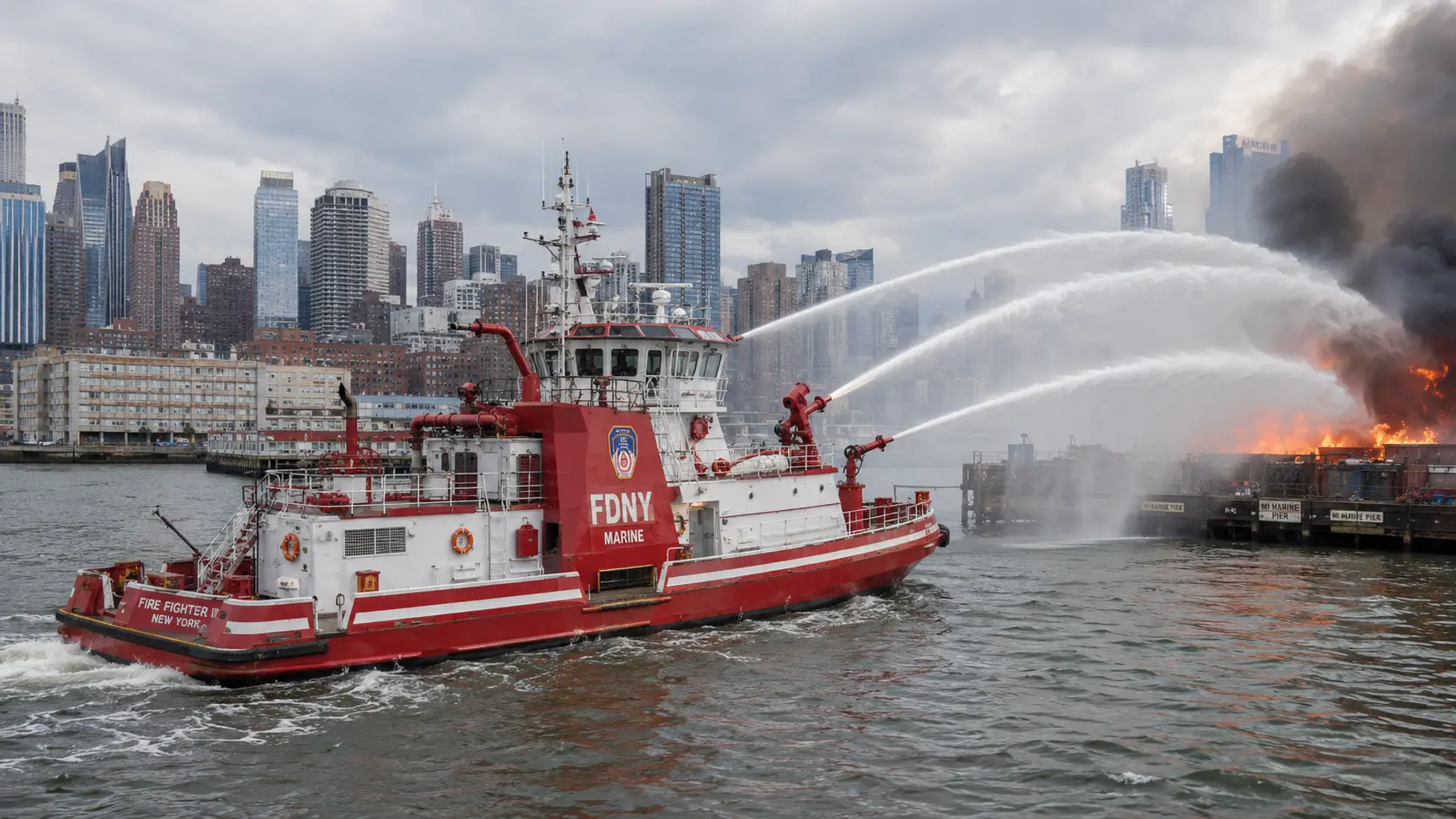

The argument against fireboats — that modern waterfront development has reduced pier and vessel fire risk to the point where boat-based response is an expensive anachronism — encounters the same counterargument every time a significant pier fire or vessel fire occurs in a major port city: the fireboat was there and the land apparatus was not. The specific access problem that fireboats solve does not go away because waterfront land use has changed. It changes character — less lumber yard fires, more marina and vessel fires — but the geometry remains: some fires are on the water side of the waterline, and land apparatus cannot cross the waterline.
In this article:
The Access Problem Fireboats Solve
Land-based fire apparatus can approach a waterfront structure from one direction: the land side. The water side of a pier, a dock, a vessel, or a waterfront building is inaccessible to any apparatus that requires pavement. When a fire develops in a pier structure and the fastest-spreading fire path is toward the water side, land apparatus can suppress from the street end while the fire extends toward the water — with no apparatus able to reach the fire from the opposite direction.
The fireboat eliminates this access asymmetry. Positioned in the harbor adjacent to a burning pier, the fireboat attacks from the water side simultaneously with land apparatus attacking from the land side. The fire is flanked from two directions rather than being approached from one side while it extends unchallenged toward the other. This positional advantage is the primary operational justification for fireboats, independent of their significant water supply capability.
Water Supply: Why Fireboats Are the Highest-Capacity Pumpers in the Fleet
A fireboat draws water directly from the surrounding body of water — harbor, river, bay — through intakes below the waterline. There is no hydrant required, no tanker shuttle needed, and no water supply limitation from distribution system capacity. The water supply is the harbor itself, which has a volume and yield that no municipal water system can approach.
FDNY's Fire Fighter II — the department's largest fireboat — is rated at 50,000 GPM total pump capacity, deliverable through multiple monitors on the vessel's deck. The largest land-based pumpers in FDNY's fleet are rated at 2,000 to 3,000 GPM. The Fire Fighter II can deliver 25 times the flow of a single land pumper. For a large vessel fire or a major pier fire requiring sustained high-volume suppression, this capacity is the difference between containment and unconstrained fire growth.
Fireboats can also function as floating pumping stations that supply land-based systems. At a major waterfront incident where the municipal hydrant system is inadequate or unavailable, a fireboat can pump large volumes from the harbor through large-diameter hose connections to the land-based distribution system, supplementing the hydrant supply for the engines working the structure.
FDNY's Marine Fleet
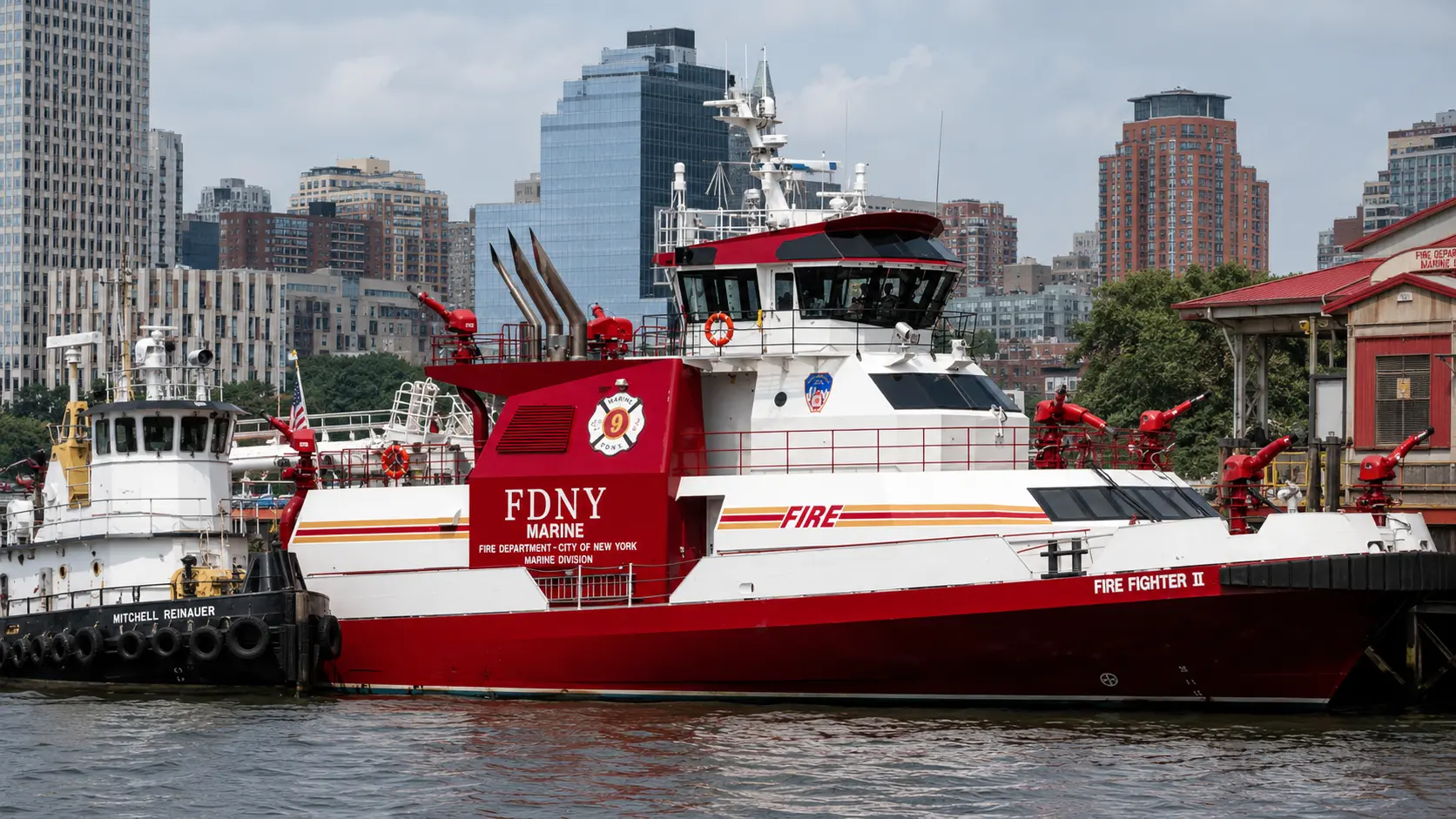
FDNY operates seven marine vessels across its Marine Division, quartered at marine stations in Manhattan, Brooklyn, and Staten Island:
- Marine 1 (Fire Fighter II): The department's primary fireboat, stationed at Pier 1 in Manhattan. Rated at 50,000 GPM total capacity across multiple monitors. Responds to major marine incidents, significant waterfront fires, and large vessel fires in New York Harbor.
- Marine 6 (John D. McKean): The Staten Island fireboat, positioned to cover the Kill Van Kull and Staten Island waterfront. Rated at approximately 22,000 GPM.
- Marine 9: A smaller fireboat covering Brooklyn waterfront and portions of the East River and Upper Bay.
- Marine 3, 9: Smaller vessels used for patrol, rescue, and support operations, capable of response to smaller incidents without deploying the major fireboats.
The coverage areas of the marine stations are designed to provide fireboat access to any point on New York City's 578 miles of shoreline within a reasonable response time. The distribution of station locations reflects the distribution of marine risk — the commercial ports, ferries, marinas, and waterfront neighborhoods that drive the response profile.
Pier and Waterfront Structure Fires
A pier fire presents a specific tactical problem: the pier extends out into the water, potentially for hundreds of feet, on a structure that has limited egress for apparatus at the water end and no hydrant supply for most of its length. A fire in the middle of a long pier or at the outboard end is not reachable by land apparatus without a long, resource-intensive hose lay — and the same land side approach that brings the attack line to the fire also positions the crew at the fire's only egress route.
The fireboat addresses this by approaching the burning section of the pier from the water side. The crew does not need to traverse the fire-exposed section of the pier from the land end. The suppression angle is from the water, the water supply is from the harbor, and the access problem of the pier's layout is bypassed entirely.
Waterfront structure fires — buildings built at or over the water, common in historic port cities where warehouse and commercial development extended to the waterline — present a similar access geometry. The fireboat provides the water-side suppression angle, the land apparatus provides the land-side angle, and the fire is compressed between the two lines of attack rather than being able to extend toward the one side that land apparatus cannot reach.
Vessel Fires: The Specific Challenge
A vessel fire — a boat or ship on fire in port or at anchorage — involves several specific challenges beyond normal structure firefighting. The vessel is surrounded by water but the fire is in the vessel's structure, which may include fuel tanks, cargo spaces, machinery compartments, and living quarters that are connected through passageways and ventilation systems. The vessel's structure channels fire spread differently from a building.
The fireboat's approach to a vessel fire: position to windward of the burning vessel to prevent crew exposure to smoke and steam, apply cooling water to the vessel's exterior to prevent structural failure and control radiant heat exposure to other vessels, and coordinate with the vessel's crew (if present and able) to identify the fire location within the ship and the safest boarding approach for interior attack if offensive operations are attempted.
Large vessel fires — tankers, container ships, cruise vessels — may require multiple fireboats plus shore-based resources, coordination with the Coast Guard and port authority, potential evacuation of adjacent vessels in the harbor, and extended operations lasting days rather than hours. The Bianca C fire in the Caribbean (1961), the Scandinavian Star fire (1990), and numerous other significant vessel fires have demonstrated the scale and complexity that large ship fires can reach.
Marine Rescue Operations
Water rescue — response to persons in the water from drowning, vessel accident, bridge jumps, and other causes — is a routine operational function for FDNY's marine units. The smaller marine vessels and rescue craft respond to most water rescue calls, with the larger fireboats available for incidents requiring their greater deck space, stability, or towing capability.
Surface water rescue by the marine units involves approaching the person in the water from the downwind side (to prevent the vessel from being pushed over the victim by wind), deploying a rescue swimmer if the victim is not responsive, using a rescue ring or throw line for conscious victims who can assist in their recovery, and getting the recovered person onto the vessel as quickly as possible for medical evaluation and treatment.
Underwater dive rescue — searching for victims who have gone under — is performed by FDNY's public safety dive team, which deploys from the marine units and from Rescue Company vessels. The combination of surface rescue capability from the marine units and subsurface capability from the dive team provides comprehensive water rescue coverage for New York's waterways.
Navigation in Port Environments
Navigating a fireboat to an incident in New York Harbor — one of the busiest commercial ports in the United States — requires navigating around commercial shipping traffic, ferries, recreational vessels, and the fixed infrastructure of piers, bridges, and underwater obstructions, often under emergency conditions at night or in reduced visibility. FDNY marine personnel hold Coast Guard licenses appropriate to their vessel and operating area, in addition to their fire department training.
Tidal conditions affect fireboat operations in ways that land operations do not encounter. Tide height changes the relative elevation between the fireboat's deck and a pier structure throughout the operation — a fireboat positioned at a burning pier at low tide may find its deck level dropping relative to the pier as the tide ebbs, changing the effective elevation of its monitor streams. Tidal current affects the vessel's position at a burning structure and requires continuous active navigation to maintain position against the current's push.
The Cost Argument and Why Cities Keep Them
Fireboat operations are expensive: vessel maintenance, fuel, docking facilities, marine-trained personnel, and the specialized maintenance requirements of large pump systems on marine platforms all add costs that land-based apparatus do not incur. In budget discussions, fireboats are frequently identified as candidates for decommissioning based on their apparent low utilization relative to land apparatus.
The argument for keeping them is the same argument that applies to any specialty resource: the incidents they address cannot be adequately addressed by anything else, and those incidents, when they occur, are typically high-consequence events where inadequate response produces significantly worse outcomes. The Harbor side of the pier fire that a land-apparatus-only department cannot address from the water is not an uncommon event in a port city — it is a regular operational scenario that, without the fireboat, is managed defensively from one side while the other side burns.
Port cities that have decommissioned fireboats have typically done so in periods where waterfront activity was low and then found themselves with significant marine incidents that the replacement capability — typically contracts with commercial marine response providers — could not address with the speed or volume of the fireboat they retired. Several cities that decommissioned fireboats in the 1980s and 1990s rebuilt marine capability after significant incidents demonstrated the coverage gap.
Comments 0
No comments yet. Be the first to share your thoughts!
Leave a Comment