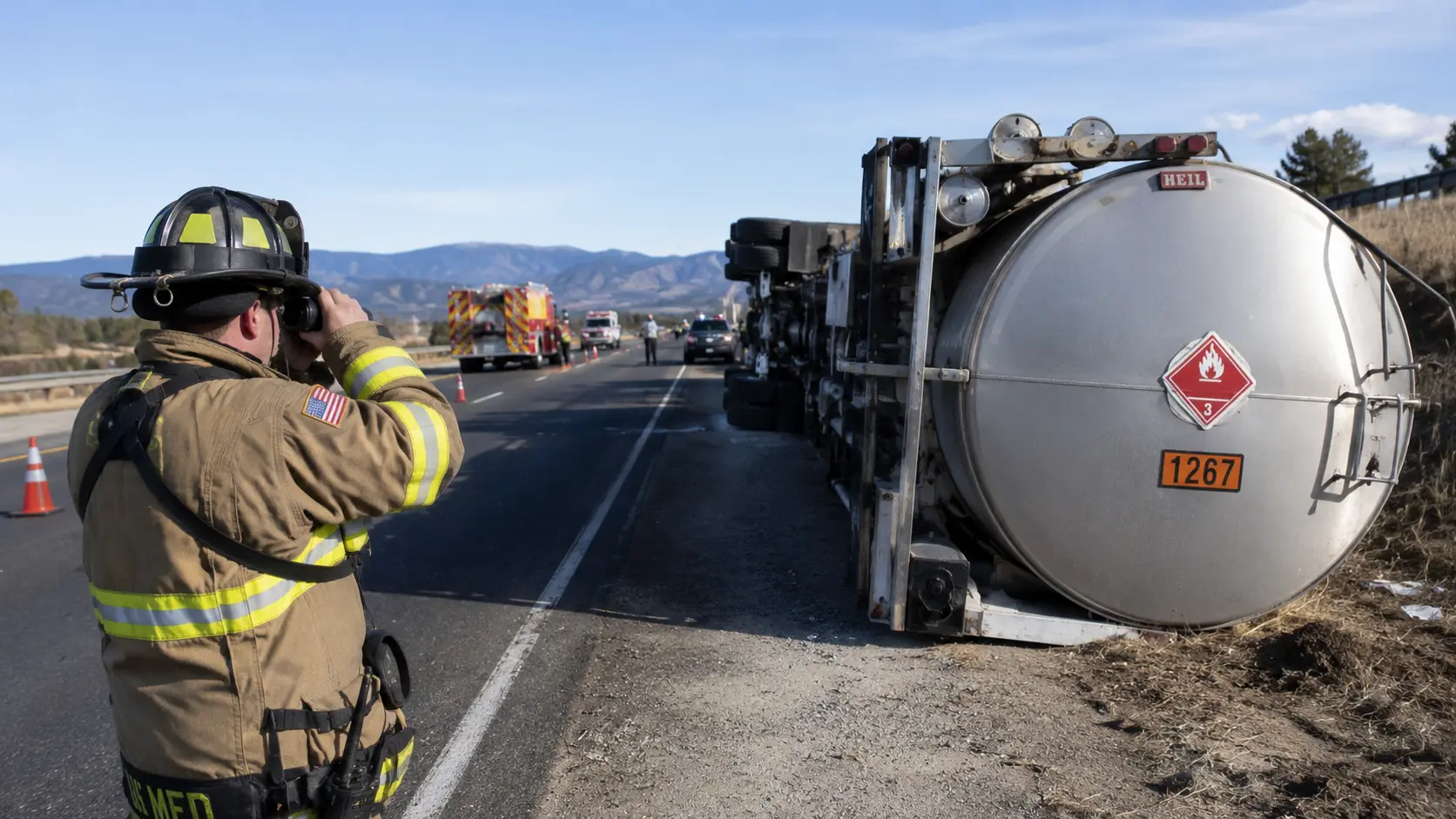
Every first responder who arrives at a truck accident on a highway has the same piece of information available before anything else: the placard on the trailer or tank. That placard was required by the Department of Transportation to be there, in a specific size, at a specific location, displaying specific information. The responder who can read it — who knows that a white square-on-point placard with a black propeller symbol means infectious substance, or that a red diamond with a "3" means flammable liquid — has made a critical initial hazard assessment in the time it takes to look at a sign. The responder who cannot read it is working without information they should have.
In this article:
The DOT Placard System Overview
The Department of Transportation (DOT) hazardous materials regulations (49 CFR Parts 100–185) require that hazardous materials shipments display placards that identify the hazard class of the material being transported. The placards are standardized: diamond shape, specific colors for each hazard class, specific symbols, and in most cases a class number. Large vehicles carrying hazardous materials above threshold quantities must display placards on all four sides of the vehicle.
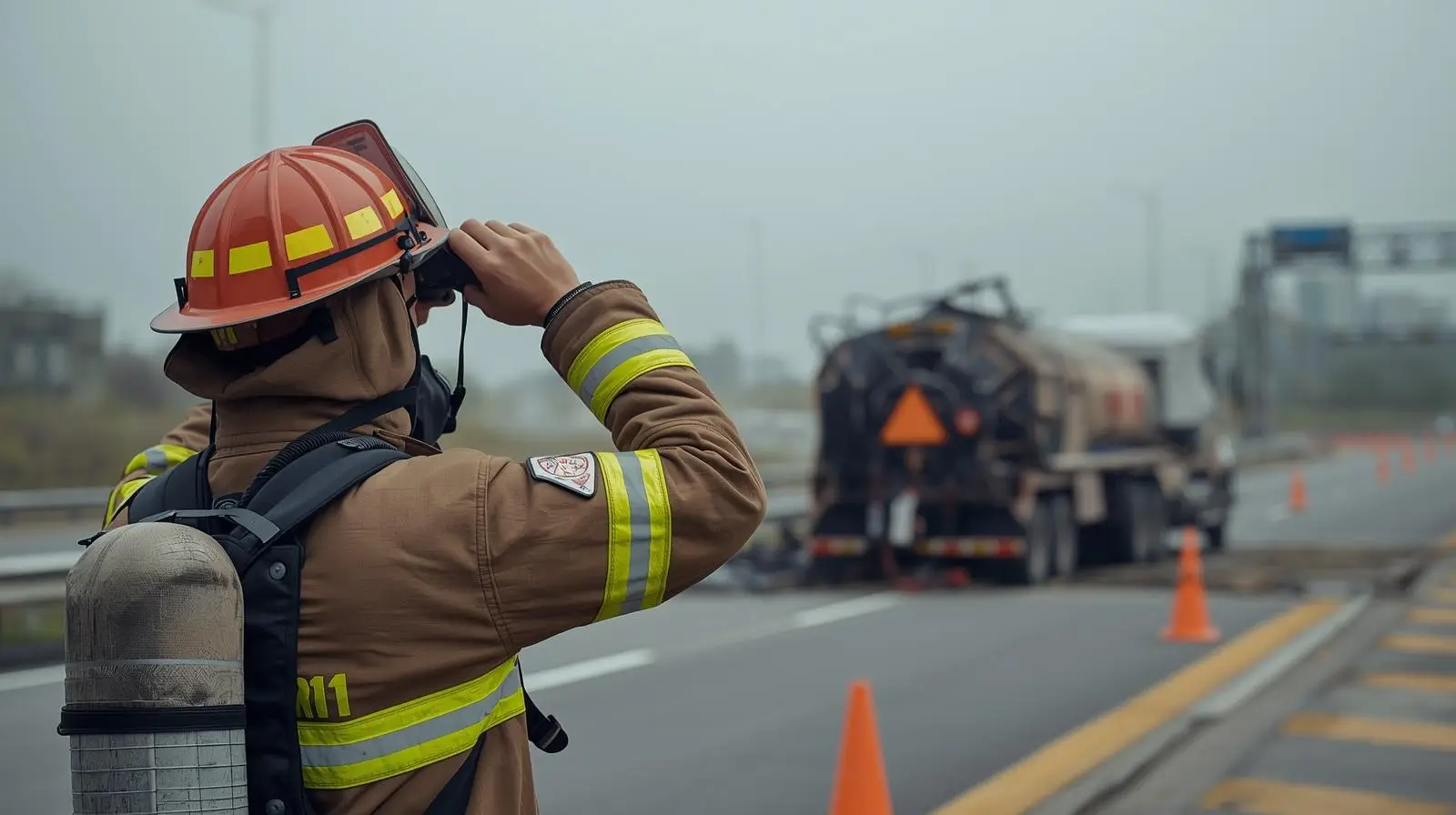
The placard system is designed for rapid identification from a distance — placards are required to be at least 250 square millimeters (approximately 10 inches per side) and mounted at specific locations for visibility. A first responder approaching a vehicle accident can read a placard from 50 to 100 feet with normal vision, and from further with binoculars — which should be the tool of choice for initial placard reading at any incident with potential hazmat involvement.
The Nine Hazard Classes
| Class | Hazard type | Placard color/symbol | Examples |
|---|---|---|---|
| 1 | Explosives (Divisions 1.1–1.6) | Orange; exploding bomb symbol | Dynamite, ammunition, fireworks, blasting agents |
| 2.1 | Flammable gas | Red; flame symbol | Propane, natural gas, hydrogen, acetylene |
| 2.2 | Non-flammable, non-toxic gas | Green; cylinder symbol | Compressed air, nitrogen, CO₂, helium |
| 2.3 | Toxic gas | White; skull and crossbones | Chlorine, anhydrous ammonia (high concentration), phosgene |
| 3 | Flammable liquids | Red; flame symbol | Gasoline, ethanol, diesel, acetone |
| 4.1 | Flammable solids | Red/white striped; flame | Matches, magnesium, sulfur |
| 4.2 | Spontaneously combustible | White/red split; flame | White phosphorus, some metal powders |
| 4.3 | Dangerous when wet | Blue; flame over W | Sodium metal, calcium carbide, lithium |
| 5.1 | Oxidizer | Yellow; circle with flame over O | Hydrogen peroxide, sodium hypochlorite, ammonium nitrate |
| 5.2 | Organic peroxide | Yellow/red split; flame over O | Benzoyl peroxide, cumene hydroperoxide |
| 6.1 | Toxic (poison) | White; skull and crossbones | Arsenic, cyanide compounds, pesticides |
| 6.2 | Infectious substance | White; biohazard symbol | Medical specimens, biological cultures, blood products |
| 7 | Radioactive material | Yellow; radioactive symbol | Medical isotopes, uranium ore, research sources |
| 8 | Corrosives | Black/white split; liquids on hand and metal | Sulfuric acid, hydrochloric acid, sodium hydroxide |
| 9 | Miscellaneous hazardous | White/black striped; seven stripes | Dry ice, lithium batteries, magnetized materials, elevated temperature materials |
UN Identification Numbers
Most hazardous materials shipments display a four-digit United Nations identification number — either on the placard itself (in a white panel at the bottom of the diamond) or on a separate orange rectangular panel adjacent to the placard. The UN number identifies the specific chemical or material — not just its hazard class but the specific product. UN 1017 is chlorine. UN 1993 is flammable liquid, not otherwise specified. UN 1202 is diesel fuel.
The UN number is the key that unlocks the Emergency Response Guidebook — the field reference that provides specific isolation distances, protective actions, and first response guidance for the identified material. A placard alone tells you the hazard class; the UN number tells you the specific substance and allows you to find the specific guidance.
Using the Emergency Response Guidebook
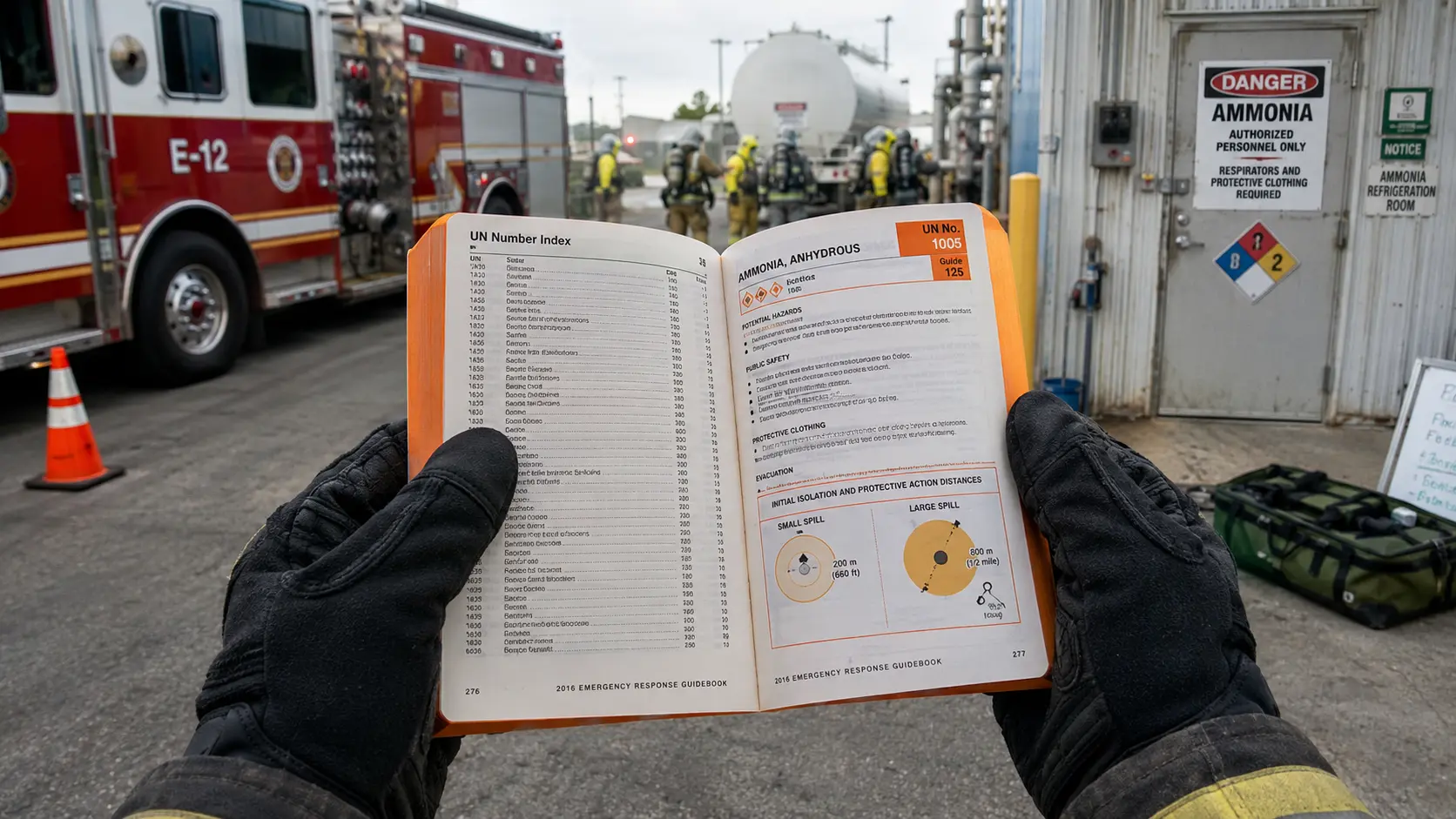
The ERG — published jointly by the US DOT, Transport Canada, and Mexico's SCT — is a pocket-sized reference designed for the first 30 minutes of a hazmat transportation incident. The lookup sequence:
- Identify the UN number from the placard or orange panel.
- Find the UN number in the yellow-page index (UN numbers in numerical order).
- The yellow-page entry shows the material name and the associated Guide number (a two or three-digit number).
- Find the Guide number in the orange Guide pages — each Guide provides initial isolation distances, first responder actions, fire and spill response guidance, and health hazard information.
- If the material is highlighted in the yellow pages (with a green highlight), it is a toxic-by-inhalation material — go directly to the green-page Table 1 or Table 2 for specific isolation distances for that material.
The ERG is a starting point, not a complete hazmat response plan. Its isolation distances are conservative estimates for worst-case conditions. Actual response — product control, decon, protective action decisions — requires the hazmat team with monitoring equipment and specific product knowledge. The ERG tells you what to do in the first 30 minutes while the hazmat team is en route.
Orange Panel Markings
The orange rectangular panel — distinct from the diamond placard — is a European ADR (Agreement on Dangerous Goods by Road) marking system that appears on many tank trucks, particularly those operated by internationally-linked carriers. The orange panel displays two numbers separated by a horizontal line: the top number is a hazard identification code (Kemler code), and the bottom number is the UN identification number.
The Kemler code uses a two or three-digit number where the digits indicate the primary and secondary hazards: 3 = flammable liquid, 33 = highly flammable liquid, 336 = highly flammable and toxic liquid. The number 33/1203 on an orange panel means highly flammable liquid, UN 1203 (gasoline). The Kemler system provides additional hazard information beyond what the standard DOT placard conveys, and responders who work in areas with significant international trucking should be familiar with both systems.
Rail Car Specific Indicators
Rail tank cars carry DOT placards on all four sides, but also have additional identifying information that is specific to rail operations. The car's stenciling — the identification numbers painted directly on the tank car body — includes the reporting mark (two to four letters identifying the car's owner) and the car number. These identifiers allow the railroad's CHEMTREC connection and emergency response team to pull the specific car's shipping documentation and content information.
Rail cars also display the car type designation — DOT-111, DOT-117, DOT-105, etc. — which indicates the tank car's construction standard and pressure rating. A DOT-111 car (a general-service tank car) has a lower pressure rating and different failure characteristics than a DOT-105 (a higher-pressure car). The car type is relevant to the BLEVE risk assessment — pressure cars under fire exposure behave differently from atmospheric-pressure cars.
TRANSCAER (Transportation Community Awareness and Emergency Response) and the Association of American Railroads provide training and reference materials specifically for rail hazmat response, including the AAR tank car identification chart that allows field identification of car type from the visible stenciling.
Placards That Require Immediate Distance
Certain placards — independent of their UN number — should trigger immediate maximum-distance positioning and ERG consultation before any further approach:
- ✗Class 1 explosives (orange background): Any placard with an orange background and explosion symbol requires maximum distance — the specific guide will indicate isolation distances, but any Class 1.1 through 1.3 material near a fire or heat source may detonate.
- ✗Class 2.3 toxic gas (white with skull): Toxic gas in transportation quantities can produce IDLH concentrations downwind within seconds of a tank failure. Approach upwind, maximum distance until monitoring confirms safe conditions.
- ✗Class 7 radioactive: All radioactive material requires monitoring before approach to determine dose rate at safe working distance.
- ✗Any placard on a vehicle or rail car that is on fire: The fire involvement changes the risk profile of every material. A non-toxic material on fire may produce toxic combustion products. A flammable material on fire near a pressurized vessel may produce a BLEVE.
- ✓Read the placard first, approach second. Every placard lookup in the ERG takes under 60 seconds. The information it provides may change where you park, how close you approach, and what PPE you put on before any further action.
The "Dangerous" Placard for Mixed Loads
A truck carrying multiple different hazardous materials in quantities below the individual placard threshold — but above the aggregate threshold — displays the word "DANGEROUS" on a diamond placard with a red upper half and a white lower half, with no class number. This placard indicates a mixed hazardous load but does not identify the specific materials present.
A "Dangerous" placard is operationally less useful than a specific class placard because it does not allow a specific ERG lookup. The correct response to a "Dangerous" placard is to request the shipping papers from the driver — these are required to be in the cab and list every hazardous material on the truck, its UN number, class, and quantity. If the driver is incapacitated, the shipping papers should be in the door pocket or under the seat, in a specific location required by regulation.
Comments 0
No comments yet. Be the first to share your thoughts!
Leave a Comment