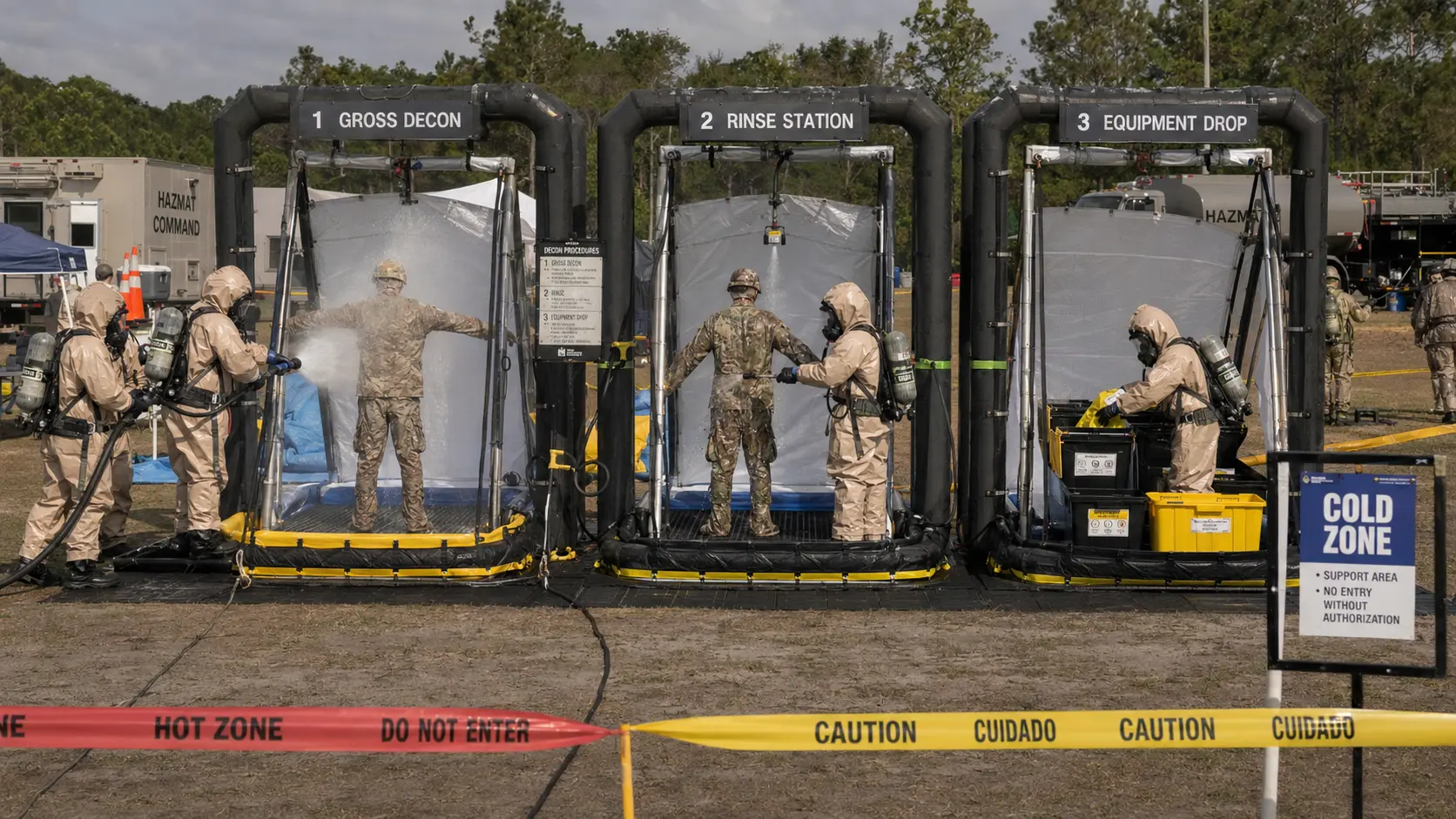
The decontamination corridor exists because the boundary between the hot zone and the cold zone is only as effective as the process that manages who and what crosses it. A hazmat technician who exits the hot zone and walks directly to the cold zone without decontamination carries the contamination on their suit, their gloves, their SCBA, and potentially on their skin, into the area that was supposed to be free of the hazardous material. Secondary contamination — transferring hazardous material from the hot zone to the cold zone on the bodies and equipment of responders — is one of the most consistent failure modes at poorly managed hazmat incidents.
The decon corridor is the physical and procedural mechanism that prevents this. When it is set up correctly, staffed appropriately, and followed without exception, the contamination stays in the hot zone and the cold zone remains genuinely safe. When it is bypassed because of time pressure, staffed by personnel who do not know the correct sequence, or set up in the wrong location, the corridor creates the appearance of safety without the substance of it.
In this article:
Corridor Location and Orientation
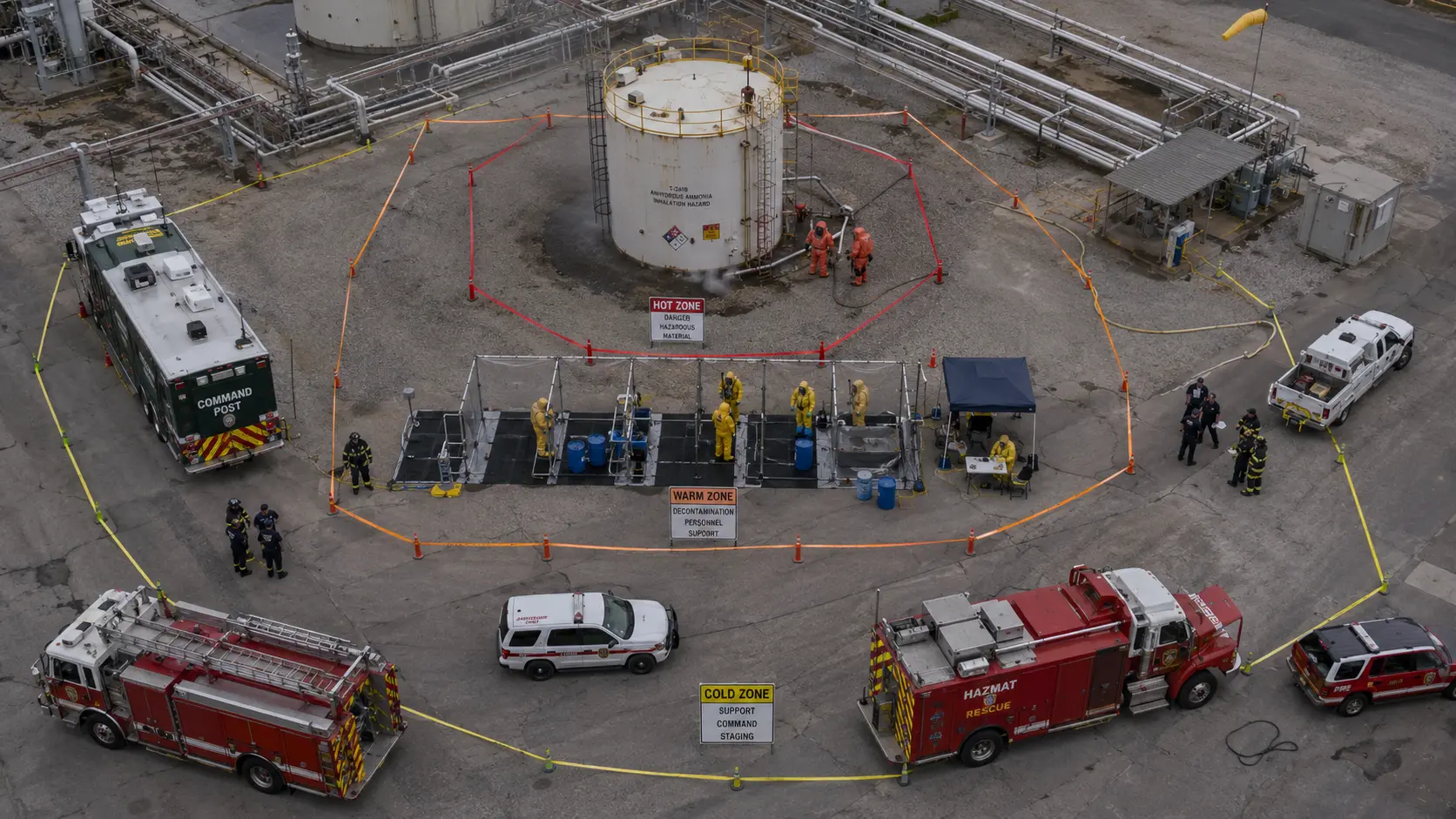
The decon corridor is positioned in the warm zone — between the hot zone boundary and the cold zone. It must be:
- Upwind of the hot zone so that wind does not carry vapors from the hot zone through the corridor into the cold zone area.
- Downhill where possible so that decon water runoff flows away from the cold zone rather than toward it.
- Accessible from the hot zone exit without requiring personnel to cross the cold zone perimeter before decon is complete.
- Large enough for the entry team size plus station operators — a corridor that is too narrow forces personnel to crowd together, increasing cross-contamination between individuals being processed.
The corridor is established before any entry team enters the hot zone. This is not optional — if there is no decon corridor in place when an entry team finishes work, the entry team cannot exit the hot zone properly. The sequence is always: establish decon, then send entry team in, not the reverse.
The Three-Zone Layout
A basic decon corridor has three distinct zones that personnel move through sequentially from hot zone exit to cold zone entry:
Contamination reduction zone (warm zone): Where the gross decon and technical decon stations operate. Personnel enter this zone from the hot zone boundary and proceed through each station in sequence. Everyone in this zone must wear appropriate PPE — Level B at minimum, Level C if atmospheric monitoring confirms sub-IDLH conditions — because they are handling contaminated personnel and equipment.
Support zone (cold zone boundary): Where medical monitoring, replacement PPE, and cold zone support personnel are positioned. Personnel who have completed the full decon sequence are assessed here before entering the cold zone.
Physical delineation: Hot zone tape (typically red or orange) marks the hot zone boundary. Decon corridor markers define the processing pathway. Cold zone tape (typically yellow or green) marks the cold zone boundary. The physical barriers are part of the system — they prevent personnel from accidentally bypassing the corridor by taking a shortcut.
Station Functions
Station 1 — Equipment drop: The first stop after crossing the hot zone boundary. Non-essential equipment — tools, sampling devices, non-reusable items — is dropped here and bagged for separate disposal. Only equipment that is being taken through the full decon process continues. The equipment drop station reduces the contamination load that the subsequent stations must process.
Station 2 — Gross decon: The primary removal of contamination from the outer surface of the protective suit. Gross decon typically involves a thorough wash of the suit exterior with appropriate decon solution and water, applied with brushes or spray systems while the person stands on a collection pad. The objective is removing the bulk of surface contamination before the suit is removed. For some chemical classes, a specific decon solution is required; for others, large volumes of water are the primary gross decon agent.
Station 3 — Secondary rinse: A thorough rinse of the suit exterior with clean water to remove the decon solution and any remaining surface residue. The secondary rinse station uses a separate water supply from the gross decon station to prevent cross-contamination between the two processes.
Station 4 — PPE removal: Protective suit, gloves, and boots are removed in a specific sequence (covered below) with assistance from station operators who handle the contaminated outer surfaces so that the person being decontaminated does not touch them with bare hands.
Station 5 — SCBA removal and final assessment: The facepiece and SCBA backframe are removed here, after the outer suit has been removed and the person is wearing only their station wear or inner garments. The facepiece is the last respiratory protection item removed, maintaining respiratory protection through all previous stations.
PPE Removal Sequence
The PPE removal sequence is designed around the principle of removing the most contaminated items first, without the person removing them touching the contaminated outer surfaces. Station operators assist with each step:
- Outer boot covers removed and dropped in contaminated waste
- Outer chemical protective gloves removed (double-gloved; inner gloves remain)
- Tape seals at wrists and ankles cut and removed
- Chemical protective suit unzipped and removed by rolling outward (contaminated surface stays outward) — station operators hold the suit away from the person's body and guide it down and off without skin contact with the outer surface
- Inner chemical gloves removed
- Station wear or inner garments assessed — if visibly contaminated, additional decon may be required
- SCBA backframe removed while facepiece remains in place
- Facepiece removed last — maintaining respiratory protection until this final step
The rolling-outward technique for suit removal is the step that most commonly fails under time pressure: personnel pull the suit off quickly and the contaminated outer surface contacts their skin or station wear as it passes by. Station operators who know the technique perform this step on the exiting person rather than allowing self-removal.
Emergency Decon vs. Technical Decon
Emergency decon is a rapid, abbreviated process used when a team member needs immediate exit from the hot zone for medical reasons — incapacitation, SCBA failure, or acute symptom onset. The emergency decon objective is getting the person out quickly enough to address the medical emergency, with decon thoroughness as a secondary priority.
Emergency decon typically involves gross rinse with large volumes of water at the hot zone boundary — a fire hose at close range over the full suit — followed by rapid suit removal at the corridor. The complete technical decon sequence is compressed into the minimum steps required to get the person to medical care. Secondary decon and final assessment can follow once the immediate medical situation is stabilized.
Technical decon is the full sequence described above — used for all planned exits from the hot zone when there is no time pressure from a medical emergency. Technical decon takes 10 to 20 minutes per person depending on the chemical class and the thoroughness required. Entry teams plan their working time around the decon interval — if the corridor can process one team simultaneously, the second team cannot enter until the first has cleared the corridor.
Decon Solutions by Chemical Class
| Chemical class | Primary decon agent | Notes |
|---|---|---|
| Most industrial chemicals, unknowns | Large-volume water flush | Dilution is the primary mechanism for most water-soluble chemicals |
| Corrosives (acids and bases) | Copious water; some protocols add dilute neutralizing solution | Water dilution is critical; avoid adding strong base to acid (exothermic reaction) |
| Organophosphates (nerve agents, pesticides) | Dilute hypochlorite (0.5% bleach) followed by water rinse | Hypochlorite hydrolyzes organophosphate compounds |
| Radiological contamination | Soap and water; RSDL for skin | Physical removal of particles, not chemical neutralization |
| Biological agents | 0.5% bleach solution; soap and water | Disinfection rather than neutralization |
Mass Decon for Civilian Casualties
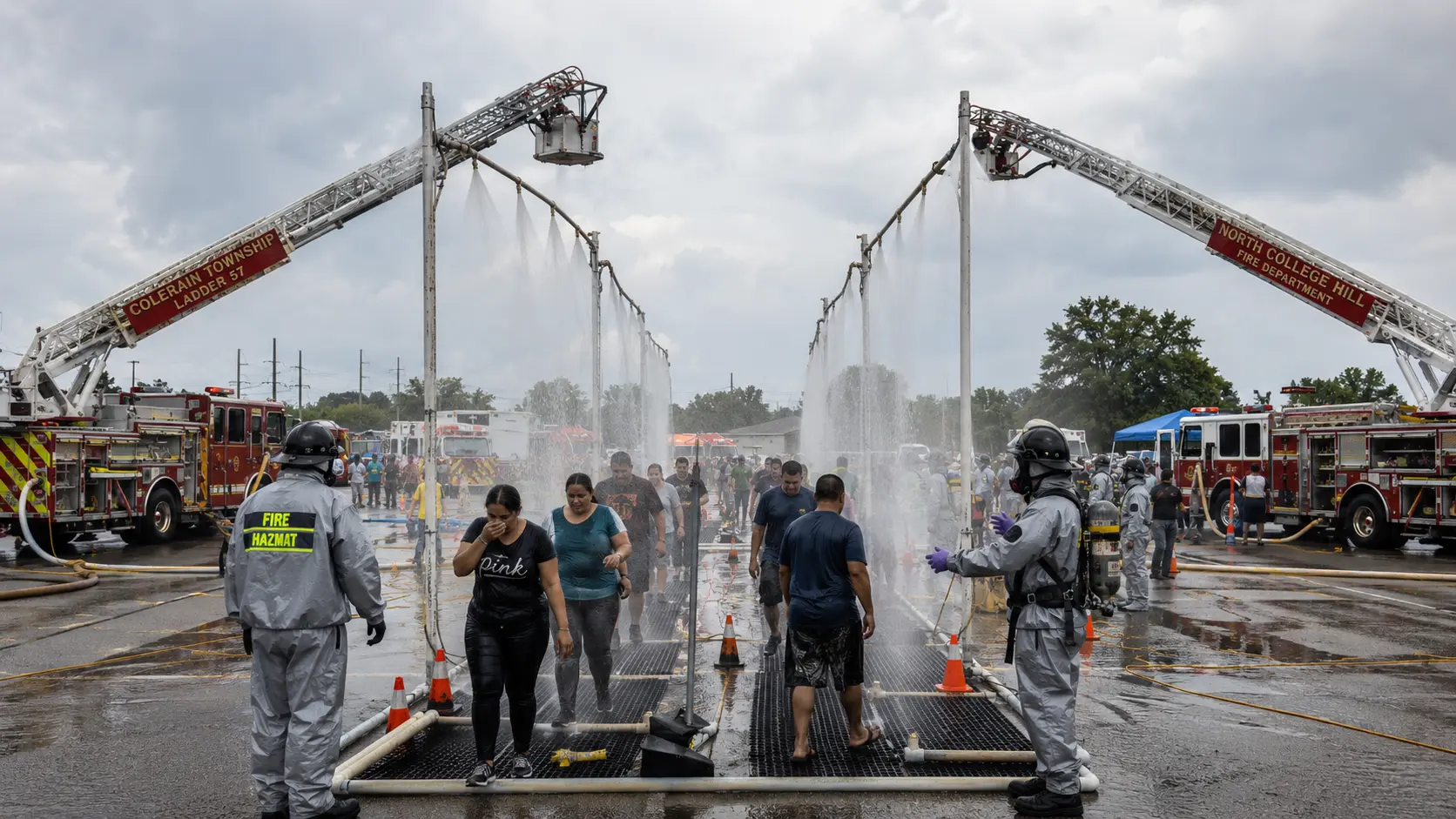
When a hazmat incident produces civilian casualties — a chemical release at a transit station, a terrorism event, a major industrial accident in a populated area — the decon system must process large numbers of people without specialized training or PPE, at a pace that prevents the contamination from traveling with them to hospitals and beyond.
Mass decon uses large-volume water application systems — typically created from engine master streams or ladder pipes directed to create a water corridor — that non-technical personnel can walk through in a controlled sequence. The process:
- Clothing removal prior to the water corridor — this single step removes 80 to 90 percent of surface contamination for most exposure scenarios
- Water walk-through — large-volume rinse of the entire body
- Towel dry and emergency clothing issue in the cold zone
- Medical triage and assessment as people exit the corridor
Mass decon is not thorough decontamination — it is a reduction in contamination sufficient to prevent large-scale secondary spread. People processed through mass decon may require secondary technical decon at a hospital facility for more thorough processing. The mass decon system buys time and reduces contamination spread while the more thorough processes are organized.
Decon Water Containment
Every gallon of water used in decontamination becomes contaminated water that must be contained and properly disposed of. A multi-person technical decon sequence may use 500 to 1,000 gallons of water. Mass decon operations use tens of thousands of gallons. All of this water must be prevented from entering storm drains, waterways, or soil.
Decon corridors are set up on impermeable ground or with portable containment pools under each station — the same approach used for fire suppression runoff at hazmat incidents. The pools collect decon water as it runs off the suits and persons being processed, holding it for later recovery and disposal. In operations on permeable ground (grass, gravel), impermeable plastic sheeting under the corridor stations provides containment.
Documentation and Monitoring
Every person who enters the hot zone is logged at the entry point with their entry time, the PPE level they entered with, and the atmospheric conditions at entry. Every person who exits through the decon corridor is logged with their exit time and any symptoms observed during or after processing. This documentation creates a record that the incident commander, EMS, and ultimately treating physicians can use to assess exposure duration and exposure level for each person who was in the hazardous atmosphere.
Post-decon medical monitoring — checking vital signs, SpO2, and CO saturation (or chemical-specific symptoms as appropriate) — is performed at the cold zone boundary as each person exits the corridor. Anyone showing acute symptoms of chemical exposure receives immediate medical assessment and is not released into the cold zone general population. The decon corridor exit is a final filter for identifying delayed symptom onset before it becomes a secondary emergency.
Comments 0
No comments yet. Be the first to share your thoughts!
Leave a Comment