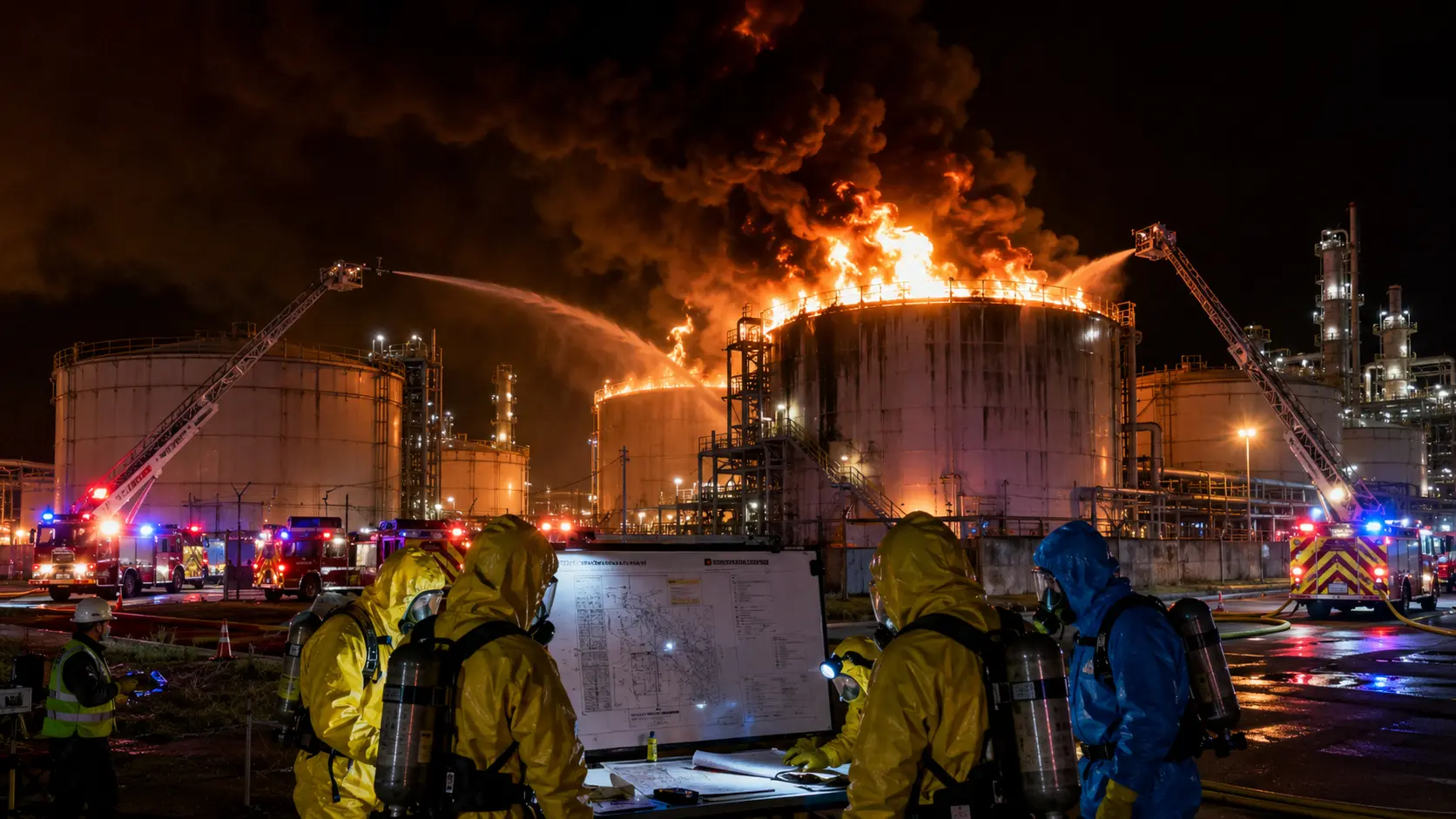
An engine company arriving at a working structure fire does not ask what is burning. They ask where the fire is, who might be inside, and whether conditions support an offensive interior attack. Those are the right questions for a house fire. At a chemical plant, they are the wrong questions. Arriving at a chemical facility fire without knowing what products are stored, whether pressurized vessels are involved, what the reactivity and toxicity profile of the burning material is, and whether applying water to this fire makes it better or worse is not aggressive firefighting — it is uninformed engagement with a hazard that can kill a crew before they understand what happened.
Chemical plant fires require an inverted priority sequence: identify first, then commit. The identification process — product identification from placards, MSDS sheets, plant operators, and pre-incident plans — drives every tactical decision that follows.
In this article:
Product Identification: The First Operation
Product identification at a chemical facility fire runs through several parallel channels simultaneously:
- Placards and markings: NFPA 704 diamonds on buildings and DOT placards on tanks and vehicles provide the initial identification framework. They tell the first-arriving company what hazard classes are present before anyone speaks to a plant representative.
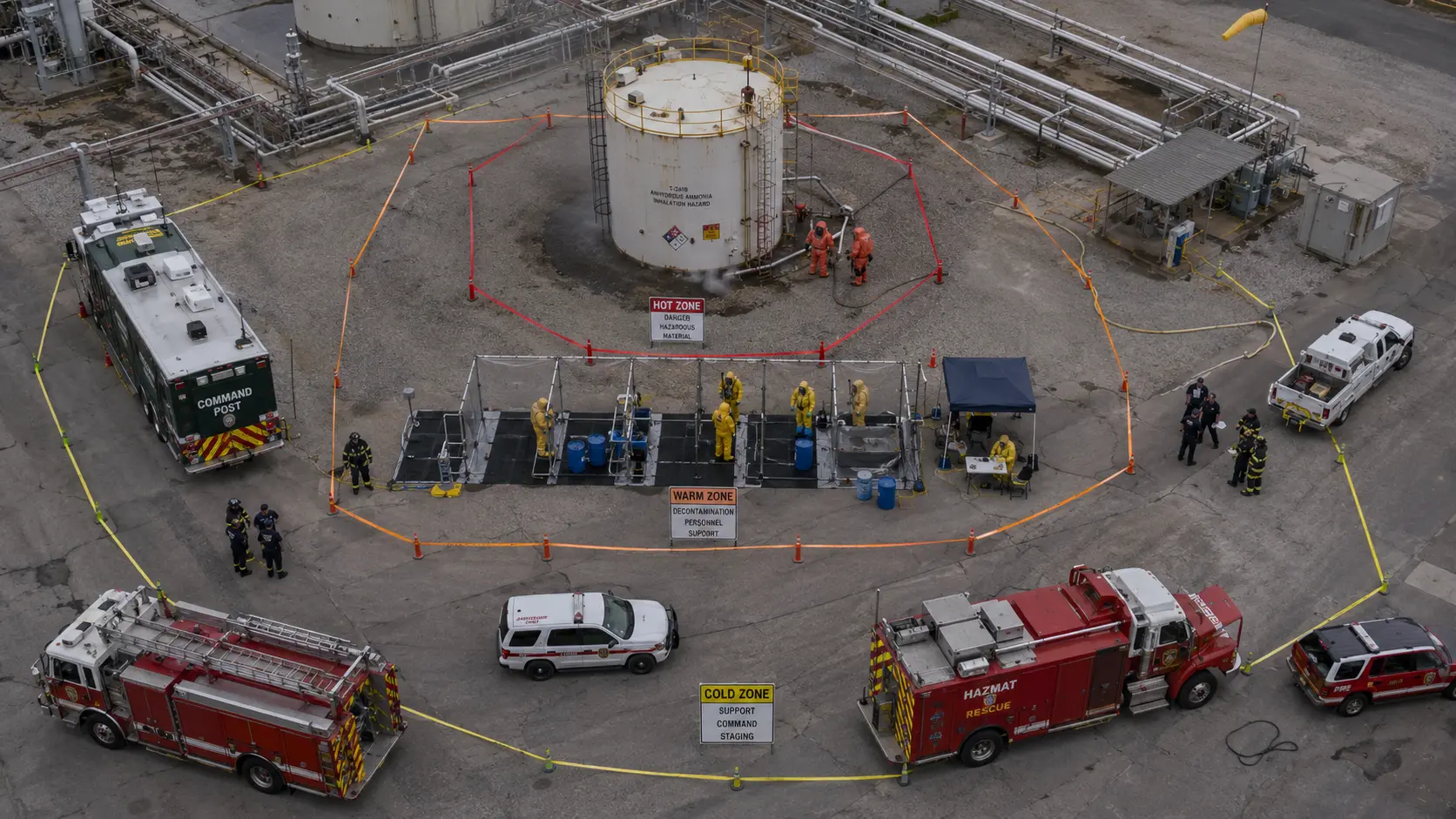
- Plant operators and safety officers: Every chemical facility has a process safety or emergency response team whose primary role in a fire event is to provide product identification, P&ID (process and instrumentation diagram) information, and knowledge of what vessels are connected to what systems. Getting a plant representative to the incident command post is the highest-priority action after establishing a perimeter.
- Emergency Response Guidebooks: The DOT ERG provides initial isolation and protective action distances for specific hazardous materials. It is a starting point, not a complete response guide.
- CHEMTREC: The Chemical Transportation Emergency Center — 1-800-424-9300 — provides 24-hour technical guidance on specific chemical emergencies from manufacturers and chemical manufacturers' associations. CHEMTREC is particularly valuable when the product is not in the ERG or when the specific formulation differs from the generic chemical entry.
Unified Command With Plant Management
ICS at a chemical plant fire is not a single incident commander — it is a unified command structure that includes the senior fire officer, the plant's emergency response coordinator or plant manager, and potentially representatives from state environmental agencies and law enforcement. The plant's emergency response coordinator knows things the fire service commander does not: which tanks contain what, which pipes connect which vessels, what systems are interlocked, where the emergency shutoffs are, and what will happen if specific actions are taken.
The fire commander knows things the plant coordinator may not: fire behavior in those specific products, suppression agent compatibility, the structural performance of the building elements under fire conditions, and crew safety requirements. Neither can make fully informed tactical decisions without the other. Unified command is not a courtesy arrangement — it is the mechanism that combines the knowledge bases required to operate safely at a chemical plant incident.
The plant coordinator's highest immediate value is identifying which vessels are at risk. At a refinery or chemical plant, a fire in one unit may be heating adjacent vessels through radiant heat and direct flame impingement. Knowing which vessel contains which product — and whether that vessel has pressure relief, how it is vented, and what its current temperature and pressure readings are — determines whether the fire department's resources should be focused on suppression or on protecting adjacent vessels from involvement.
BLEVE: When Pressurized Vessels Are Involved
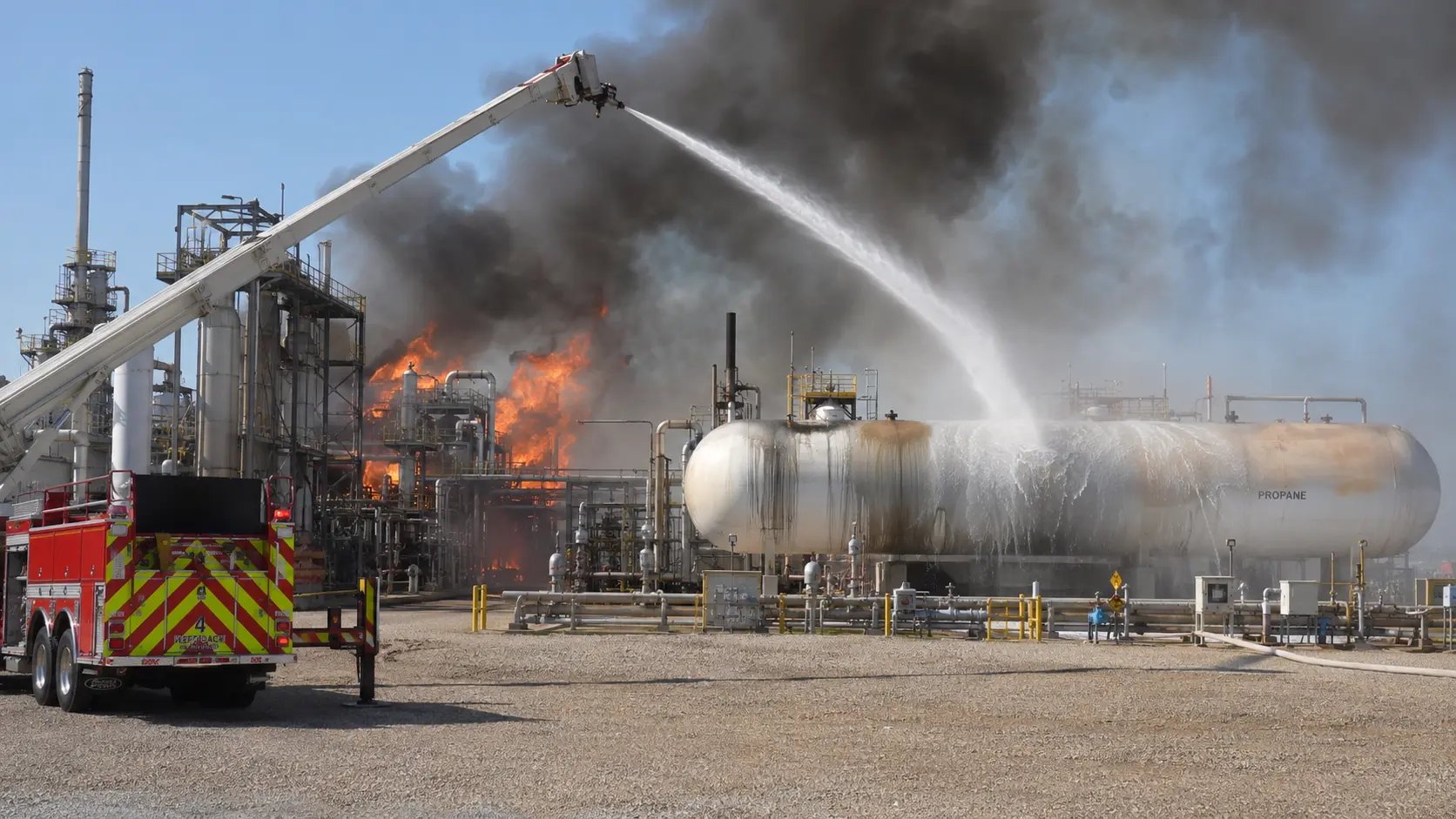
A BLEVE — Boiling Liquid Expanding Vapor Explosion — occurs when a pressurized vessel containing a liquefied gas is exposed to heat that raises the liquid temperature above its boiling point at atmospheric pressure, while the vessel remains pressurized. The pressure relief valve may be venting, but the heat input exceeds the relief valve's capacity to prevent temperature and pressure rise. When the vessel wall weakens and fails catastrophically, the superheated liquid instantly flashes to vapor at a volume 200 to 300 times its liquid volume. The expansion is explosive.
A BLEVE from a large LPG storage tank or a rail tank car projects fragments of the vessel at distances of 300 to 600 meters, produces a fireball that can exceed 300 meters in diameter, and generates a pressure wave. The Texas City explosion of 1947 — ammonium nitrate, not LPG, but similar catastrophic failure mechanism — killed 581 people. The BLEVE events documented in the fire service have killed multiple firefighters who were applying water to the vessel from too close when the failure occurred.
The tactical rule for BLEVE risk: cool the vessel with water to prevent temperature rise, but do so from behind cover or at maximum distance with unmanned monitor nozzles if the flame impingement on the vessel has been sustained. A vessel with a sustained flame impingement heating the liquid space above the liquid level — the vapor space — is in the highest BLEVE risk condition. A vessel being cooled by water flowing continuously over all surfaces, with the water preventing the vessel wall from reaching critical temperature, is in a managed condition. A vessel making a high-pitched hissing sound from the relief valve is venting — do not approach for any reason. A vessel that was venting and has gone silent while still exposed to fire has either relieved pressure or its relief valve has failed — treat it as a BLEVE precursor and increase distance.
The Let-It-Burn Decision
Not every chemical fire should be extinguished. Some fires should be allowed to burn under controlled conditions because extinguishment creates hazards more dangerous than continued combustion.
The primary scenario is a flammable gas fire where the supply cannot be shut off. A natural gas pipeline fire, for example, is burning the gas as it escapes — the alternative to controlled burning is an unburned gas release that accumulates to a concentration that can detonate. The let-it-burn decision in this scenario: do not extinguish the fire until the gas supply is shut off. Maintain water cooling of exposed structures and vessels. Prevent the fire from spreading to adjacent fuel. Wait for the supply isolation.
Certain chemical fires also produce less hazardous combustion products than the alternative — some toxic materials are more dangerous in liquid or vapor form than as combustion products, and allowing controlled combustion under managed conditions with emissions monitoring is less hazardous than the suppression alternatives. These decisions require specific chemical knowledge and cannot be made from general fire principles alone.
The let-it-burn decision is not passive — it is an active defensive posture that requires continuous monitoring, exposure protection, and readiness to transition to suppression if conditions change. It is often the correct decision at a chemical plant fire that the first-arriving company has not yet been trained to make.
Foam Operations at Chemical Fires
Aqueous Film-Forming Foam (AFFF) and Alcohol-Resistant AFFF (AR-AFFF) are the primary suppression agents for flammable liquid fires at chemical facilities. Foam works by forming a continuous blanket over the fuel surface that separates the fuel vapors from the air — eliminating the oxygen interface necessary for combustion — and cooling the fuel surface to reduce vapor production.
Foam application technique matters as much as foam concentration. Plunging foam directly into a burning liquid breaks the foam blanket and reduces effectiveness. The correct technique is gentle application — banking foam off a retaining wall so it flows gently onto the burning surface, or using rain-down application from above to let foam settle onto the surface without disruption. A foam blanket that is applied correctly and covers the entire fuel surface can extinguish a flammable liquid fire in minutes. A foam blanket applied with plunging technique that mixes the foam into the burning fuel may use three times the foam quantity for the same result.
Compatibility is critical. Protein-based foams are not compatible with dry chemical agents — simultaneous application destroys both agents. AFFF and dry chemical can be used together. Polar solvents (alcohols, ketones, acetone) destroy standard AFFF — alcohol-resistant foam is required for these products. Using the wrong foam type on a polar solvent fire produces a non-existent foam blanket and no suppression effect while consuming foam concentrate.
Boilover in Petroleum Storage Tanks
Boilover is a specific phenomenon in large petroleum storage tank fires that produces a sudden, violent overflow of burning oil that can project burning material hundreds of feet from the tank — overwhelming any suppression resources in the immediate area and creating a life-safety hazard for any personnel who have not evacuated the area.
The mechanism: crude oil and heavy fuel oils contain water trapped in the product. When the burning oil at the surface layer reaches the bottom water layer after hours of burning — the "heat wave" progresses downward through the oil at approximately 1 to 3 feet per hour — the water flashes to steam at the oil-water interface. The steam expansion forces the burning oil upward and outward with enough force to exceed the tank rim. The resulting burning oil wave can travel hundreds of feet in all directions.
Boilover can be predicted roughly by the heat wave progression rate and the estimated oil depth above the water layer. Fire departments at petroleum tank fires that have been burning for several hours calculate the estimated time to boilover and establish an evacuation perimeter that accounts for the potential projection distance. The boilover perimeter is maintained throughout the incident regardless of suppression progress.
Exposure Protection
At a chemical plant fire where the burning unit cannot or should not be directly attacked, exposure protection — keeping adjacent structures, vessels, and equipment cool enough to prevent involvement — is the primary fire department function. Water application to exposed surfaces prevents heat transfer to adjacent fuel, buys time for evacuation of personnel from adjacent areas, and maintains the integrity of vessels and structural elements that would create additional hazards if they failed.
Exposure protection water rates are calculated based on the area of exposed surface and the heat flux from the fire. A large atmospheric storage tank at 50 feet from a significant flammable liquid fire receives radiant heat flux that requires continuous water application of several hundred gallons per minute to prevent temperature rise. This water application is not suppression — it is thermal management of the exposure, and it continues for the duration of the incident regardless of whether the primary fire is being suppressed.
Runoff Containment
Every gallon of water applied at a chemical plant fire produces contaminated runoff — water that has contacted burning chemicals, foam agent, chemical storage containers, and process equipment, and that carries those contaminants into drainage systems, storm sewers, and ultimately to waterways. A major industrial fire can produce tens of thousands of gallons of contaminated runoff per hour of suppression operations.
Runoff containment — keeping contaminated water on the facility property rather than allowing it to enter the drainage system — is both a legal requirement and an environmental protection priority. Most chemical facilities have secondary containment berms, diking systems, and retention ponds specifically designed to capture fire suppression runoff. The incident commander coordinates with plant management and environmental authorities to ensure that available containment capacity is not exceeded and that diversions are opened or closed appropriately as runoff accumulates.
In the absence of adequate site containment, fire departments use portable berms, sandbags, and soil diking to redirect runoff away from drainage inlets. Environmental agency personnel typically arrive at significant chemical facility fires to monitor runoff and to direct or oversee containment operations in coordination with the fire department.
Pre-Incident Planning
The chemical plant fires that are managed best are the ones that have been pre-planned — where the local fire department has conducted pre-incident planning visits, reviewed the facility's chemical inventory and hazard profiles, walked the access routes, identified the water supply systems, located the emergency shutoffs, and met the plant's emergency response team before any emergency occurs.
Pre-incident planning for a chemical facility produces a facility-specific fire response plan that the incident commander can reference in the first minutes of a response — before plant representatives are on scene, before full product identification has been completed. A first-arriving officer who knows from the pre-plan that the east tank farm contains propane and the west unit contains chlorine has a fundamentally better tactical starting position than one who arrives with no pre-plan and must wait for product identification before making any approach decisions.
NFPA 1620 provides the standard for pre-fire plans. OSHA's Process Safety Management standard (29 CFR 1910.119) requires facilities with significant quantities of hazardous chemicals to maintain process safety information and emergency response procedures — documentation that the fire department can request access to during pre-incident planning visits.
Comments 0
No comments yet. Be the first to share your thoughts!
Leave a Comment