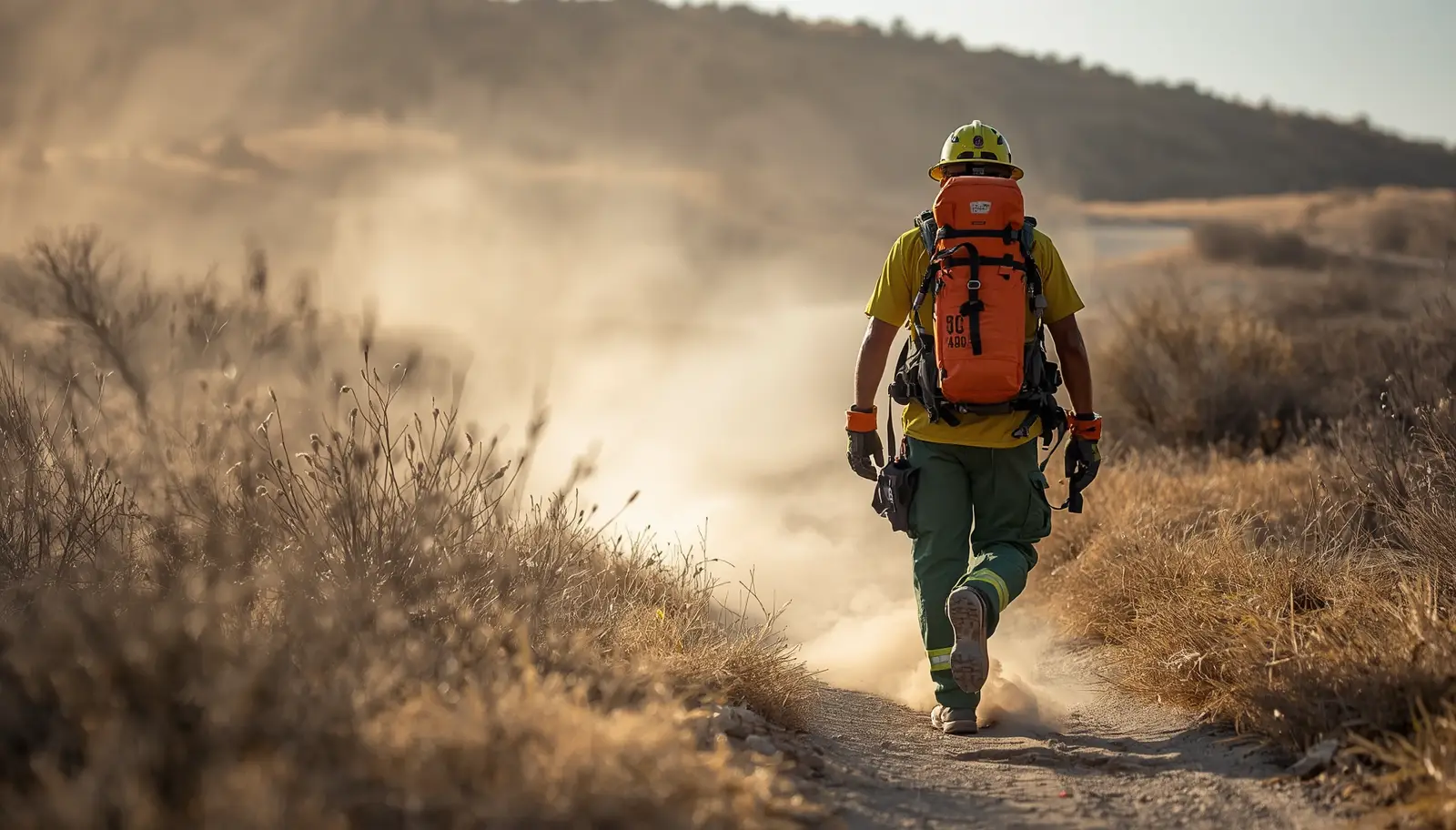

Wildland Firefighter Pack Test: Training Plan, Standards & How to Pass the Work Capacity Test
The Pack Test (officially the Work Capacity Test or WCT) is the mandatory fitness test for federal wildland fire positions. If you want to work for the Forest Service, BLM, NPS, or most state wildland fire agencies, you must pass this test annually. This guide covers all three test levels, the exact standards, how to train specifically for the Pack Test, and the fitness principles that carry you through a wildland fire season.
Jump to:What is the Work Capacity Test · Arduous level · Moderate level · Light level · Training to pass the arduous level · 12-week training plan · Test day tactics · Staying fit through fire season · FAQ
What Is the Work Capacity Test (Pack Test)?
The Work Capacity Test was developed by the National Wildfire Coordinating Group (NWCG) as a standardized fitness qualification for wildland firefighters. It is required for all federal and most state wildland fire positions, and must be passed annually to maintain a Red Card (Incident Qualification Card). The test has three levels based on job classification:
| Level | Distance | Weight | Time limit | Positions requiring this level |
|---|---|---|---|---|
| Arduous | 3 miles | 45 lbs | 45 minutes | Engine crew, handcrew (hotshot, type 2), helitack, smokejumper, most fire operations positions |
| Moderate | 2 miles | 25 lbs | 30 minutes | Some aviation, logistics, and support positions |
| Light | 1 mile | No pack | 16 minutes | Administrative and minimal field exposure positions |
Most firefighting positions require the Arduous level. If you are pursuing a career in wildland fire operations, train for Arduous from day one.
The Arduous Level: 3 Miles, 45 Pounds, 45 Minutes
Three miles in 45 minutes with a 45-pound pack is a 15-minute-per-mile pace. That sounds moderate on paper. On a dirt track or trail, in heat, after an early wake-up, with a pack that digs into your shoulders — it is a genuine fitness test. Candidates who have trained specifically for this test complete it with a comfortable margin. Candidates who trained generally (running without a pack, gym workouts without hiking) frequently struggle with the final mile.
The specific demands of the arduous test
- Cardiovascular endurance: 45 minutes of sustained moderate-intensity effort. Your aerobic base must support this comfortably or you will be working at too high a percentage of your VO2 max to sustain pace.
- Load-bearing muscular endurance: 45 pounds compresses your shoulders, loads your hip flexors, and increases the metabolic cost of each step. Gym fitness does not translate directly — you must train with weight.
- Hip, knee, and ankle stability: Carrying 45 pounds while walking fast on uneven terrain stresses the joints more than running without weight. Ankle sprains on test day are a real risk for undertrained candidates.
- Pace discipline: Going out too fast in the first mile and dying in the third is the most common arduous test failure mode. Pace control is a specific skill to practice.
The Moderate Level: 2 Miles, 25 Pounds, 30 Minutes
Two miles in 30 minutes with a 25-pound pack is a 15-minute-per-mile pace, same as arduous. The reduced distance and weight make this significantly more accessible than arduous, but it still requires specific preparation. Candidates who can comfortably complete the arduous test should have no difficulty with moderate. Train for arduous if you want margin on moderate.
The Light Level: 1 Mile, No Pack, 16 Minutes
One mile in 16 minutes without a pack is a brisk walking pace. This is the most accessible level and can be completed by most people with moderate fitness. If your assigned position requires the light level, consistent walking is sufficient preparation.
Training to Pass the Arduous Level
The most important training principle: you must train with a loaded pack on your back. Cardiovascular fitness built through running, cycling, or gym cardio does not transfer completely to pack-loaded hiking. The specific combination of load, posture, and gait used in loaded hiking engages muscle groups and joint positions that unloaded training does not develop.
Loaded hiking (most important exercise)
- Start with 25–30 pounds and build to 45+ pounds over the training period
- Train on surfaces similar to your test surface: most tests are on a flat dirt track; if yours is on trails, train on trails
- Build session distance from 1.5 miles up to 4–5 miles to build a comfortable margin over the test distance
- Practice the 15-minute-per-mile pace until it is automatic — do not rely on feel alone
- Train in the footwear you will wear on test day. New boots on test day produce blisters.
Supporting fitness work
- Aerobic base: 3–4 days per week of zone 2 cardio (cycling, hiking without pack, swimming) builds the aerobic base that sustains the pack test pace. Zone 2 = conversational pace, not intense.
- Lower body strength: Squats, lunges, Romanian deadlifts, and step-ups develop the leg and hip strength needed to maintain pace under load for 45 minutes.
- Core stability: Planks, dead bugs, and anti-rotation exercises stabilize the spine under pack load and reduce energy waste from pack sway.
- Ankle strengthening: Single-leg balance, calf raises, and lateral band walks reduce ankle injury risk on uneven terrain.
12-Week Training Plan Overview
| Phase | Weeks | Focus | Key sessions per week |
|---|---|---|---|
| Base | 1–4 | Build aerobic base; introduce pack load; joint adaptation | 2× loaded hike (25 lb, 1.5–2 mi), 2× zone 2 cardio, 2× lower body strength |
| Build | 5–8 | Increase pack weight and distance; pace work; sport-specific conditioning | 2× loaded hike (35–40 lb, 2.5–3.5 mi), 1× interval cardio, 1× strength, 1× long zone 2 |
| Peak | 9–11 | Full test simulations at 45 lb; pace locking; confidence building | 2× full 3-mile at 45 lb at test pace, 1× strength maintenance, 1× easy recovery hike |
| Taper | 12 | Recovery; no heavy sessions after day 3; fresh legs for test day | 1 easy loaded walk (30 min), rest, mental preparation, gear check |
Complete the test simulation at least twice before the actual test. Walking 3 miles with 45 pounds on your back for the first time on test day is a planning failure. Run full simulations in your training weeks 9–11 so the test is a familiar event, not an unknown one.
Test Day Tactics
- Arrive early and warm up. A 5–10 minute easy walk before the test starts gets your joints and cardiovascular system ready. Starting cold with 45 pounds makes the first quarter-mile harder than it needs to be.
- Control your pace from the start. Most failures happen because candidates go out too fast in the first half-mile. If you feel comfortable, you are probably on pace. If you feel like you are working hard in the first mile, slow down — you will not maintain that effort for 45 minutes.
- Know your splits. At a 15-minute-per-mile pace, you should hit the 1-mile mark at approximately 15:00 and the 2-mile mark at approximately 30:00. If you are at 13:00 at mile 1, slow down.
- Pack fit matters. Adjust your pack so the hip belt carries most of the weight (not your shoulders). A properly fitted pack significantly reduces fatigue over 3 miles compared to a shoulder-loading pack.
- Hydrate the night before, not just on test day. Showing up dehydrated because you drank 2 liters of water on the morning of the test is not the same as arriving well-hydrated. Start hydrating 24 hours before.
Staying Fit Through Fire Season
Fire season is physically demanding in ways that degrade fitness as much as build it. Extended shifts, irregular sleep, limited food options, and weeks of hard physical work create cumulative fatigue that must be managed:
- Prioritize sleep when it is available. Sleep is non-negotiable for recovery. When you are off shift, sleep takes priority over social activities.
- Eat enough calories. Fire line work burns 3,500–5,000+ calories per day. Chronic under-fueling on fire assignment degrades physical and cognitive performance within days.
- Maintain strength work during the off-season. The Pack Test is annual. The fitness needed to pass it comfortably in April requires training through the winter, not just in the 8 weeks before the test.
- Manage the weight of your gear. Every pound you reduce from your personal gear is a pound less you carry on the line all day. Weigh your line gear and cut weight where possible while maintaining safety.
Frequently Asked Questions
What is the Pack Test for wildland firefighters?
The Pack Test (officially the Work Capacity Test) is an annual fitness requirement for federal and most state wildland fire positions. The arduous level requires walking 3 miles with a 45-pound pack in 45 minutes or less. It must be passed annually to maintain a Red Card (Incident Qualification Card). Running is not permitted.
How hard is the arduous Pack Test?
For a candidate who has specifically trained with a loaded pack, the arduous test is challenging but manageable. For someone who has done only running or gym fitness without pack training, it is significantly harder than expected. The specific combination of loaded hiking pace for 45 minutes requires training that transfers directly from loaded hike workouts, not from unloaded cardio alone.
Can you run during the Pack Test?
No. Running is explicitly prohibited during the Pack Test. Candidates who run risk disqualification. The test is designed to assess the ability to perform sustained loaded hiking, not running. Walkers who maintain a consistent 15-minute-per-mile pace pass comfortably.
How much weight is in the Pack Test pack?
The arduous level uses a 45-pound pack. The moderate level uses a 25-pound pack. The light level has no pack. Pack weight is standardized and provided at the test site. The weight must be fully carried — setting the pack down or reducing weight during the test is disqualifying.



Comments 0
No comments yet. Be the first to share your thoughts!
Leave a Comment