

How Dangerous Is Your Home Right Now?
Most Americans believe their homes are safe. They have a smoke alarm in the hallway. They know not to leave candles unattended. They think they know where the risks are. But the leading causes of home fire deaths in the United States are not dramatic oversights — they are quiet, everyday conditions that develop gradually and go unnoticed until something ignites.
The National Fire Protection Association (NFPA) estimates that a home structure fire is reported every 89 seconds in the United States. In 2022, residential fires caused approximately 2,620 civilian deaths, 11,200 injuries, and $9.1 billion in property damage. The majority of those fires were preventable — and many originated from hazards that families did not know they had.
This guide walks through every major zone in your home — room by room — and identifies the specific hazards fire departments respond to most often. Each section includes the why behind the risk, not just the tip, because understanding how a hazard becomes a fire is what makes prevention stick.
The Big Picture: Where Home Fires Start
Before going room by room, it helps to understand the national pattern. NFPA data consistently shows the same leading causes across residential fire incidents:
| Cause Category | Share of Home Fires | Share of Home Fire Deaths | Most Common Scenario |
|---|---|---|---|
| Cooking | 49% | 21% | Unattended cooking; grease ignition |
| Heating equipment | 13% | 19% | Space heater too close to combustibles; chimney not cleaned |
| Electrical distribution & lighting | 9% | 15% | Arc faults in old wiring; overloaded circuits; extension cord misuse |
| Intentional | 8% | 9% | Arson; deliberate ignition |
| Smoking materials | 5% | 23% | Cigarette dropped on upholstered furniture; smoldering fire while sleeping |
| Candles | 3% | 3% | Left unattended; knocked over; near combustible materials |
| Other/unknown | 13% | 10% | Child play, appliances, other equipment |
Note that smoking materials cause only 5% of fires but 23% of home fire deaths — the highest lethality rate of any category. This is because smoking-related fires typically ignite smoldering fires in upholstered furniture or bedding, often when the occupant is asleep or impaired. By the time the fire is detectable, escape may already be compromised.
Room-by-Room Hazard Map
Kitchen
- Unattended cooking
- Grease buildup in range hood
- Toaster crumb tray
- Flammable items near burners
- Microwave — metallic containers
Bedroom
- Overloaded power strips
- Charging devices overnight
- Candles left unattended
- Smoking in bed
- Space heater near bedding
Living Room
- Fireplace without screen
- Extension cords under rugs
- Old or frayed appliance cords
- Candles near curtains
- Overloaded entertainment outlets
Garage
- Gasoline and fuel storage
- Oil-based paints and thinners
- Propane tank storage indoors
- Lithium battery charging (e-bikes)
- Dryer vent blockage (if nearby)
Utility/Basement
- Furnace dust buildup
- Dryer lint trap neglect
- Water heater sediment buildup
- Knob-and-tube wiring
- Combustible storage near furnace
Outdoor
- Grill too close to structure
- Dry mulch and landscaping
- Unattended fire pit
- Propane tank near ignition sources
- Deck furniture near grill
Hazard #1 — Kitchen: The Highest-Risk Room in Your Home
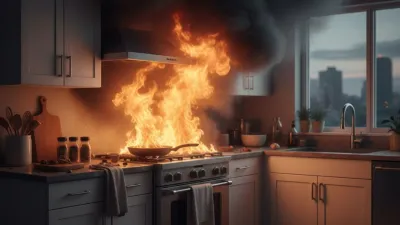
Nearly half of all U.S. home fires start in the kitchen, and the cause is almost always the same: unattended cooking. Walking away from the stove — even briefly — is the single most common ignition scenario fire departments respond to. Grease fires, in particular, escalate with extreme speed: a pan of cooking oil left on a hot burner can ignite in minutes, and an established grease fire can flash to the range hood and surrounding cabinetry within seconds.
| Kitchen Hazard | Risk Level | Why It Ignites | Prevention |
|---|---|---|---|
| Unattended cooking | HIGH | Oil overheats past flash point (~600°F for cooking oils); food residue ignites | Stay in the kitchen while cooking on stovetop; use a timer for oven cooking; turn off burners before leaving room |
| Grease buildup in range hood | HIGH | Accumulated grease is directly above open flame; small stovetop fire can immediately involve hood filters | Clean range hood filters monthly; degrease interior of hood quarterly |
| Flammable items near burners | HIGH | Paper towels, dish towels, wooden utensils, and cardboard packaging within radiant heat range of active burner | Keep a clear 18-inch radius around any active burner; store items away from stove |
| Toaster and toaster oven | MED | Crumb tray accumulation; bread lodged in heating element; placed under upper cabinets | Empty and clean crumb tray weekly; position away from cabinetry; never leave toaster unattended |
| Microwave with metallic containers | MED | Metal arcs in microwave field; dried food residue on interior walls can ignite | Never use metal containers; clean interior regularly; do not run empty |
Hazard #2 — Electrical Systems: Visible and Hidden Risks
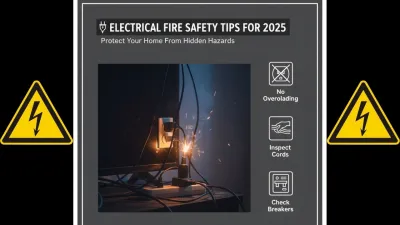
Electrical fires are particularly dangerous because they often originate inside walls, in attic spaces, or within electrical panels — locations where smoke alarms may not detect them until the fire has grown significantly. The National Electrical Code (NEC) is updated every three years, and homes built under older code versions may have wiring systems not designed for modern electrical loads.
For a deeper understanding of how electrical fires ignite — including arc faults, conductor failures, and how investigators determine whether electricity caused or was damaged by a fire — see our detailed guide on electrical fire investigations and arc mapping.
| Electrical Hazard | Risk Level | Who Is Most Affected | Action Required |
|---|---|---|---|
| Knob-and-tube wiring | HIGH | Homes built before 1950 | Licensed electrician assessment; replacement recommended |
| Aluminum wiring on branch circuits | HIGH | Homes built 1965–1973 | Inspect all device connections; use CO/ALR-rated devices or full rewire |
| Overloaded circuits and outlets | HIGH | All homes; especially older with limited circuits | Calculate circuit load; add circuits for high-draw appliances; never daisy-chain power strips |
| Extension cords as permanent wiring | HIGH | All homes | Extension cords are temporary only; have permanent outlets added |
| Frayed or damaged cords | HIGH | All homes; pets often chew cords | Replace immediately; never tape damaged insulation as a repair |
| No AFCI protection on bedroom circuits | MED | Homes without modern panels | Arc Fault Circuit Interrupters (AFCIs) required by NEC in bedrooms; retrofit older homes |
| No GFCI protection in wet areas | MED | Kitchens, bathrooms, garages, outdoors | Ground Fault Circuit Interrupters (GFCIs) required in wet locations; test monthly |
Hazard #3 — Heating Equipment: The Winter Threat
Heating equipment is the second leading cause of home fire deaths in the U.S. and the leading cause during December, January, and February. Space heaters alone are involved in about 1,700 home fires per year, causing roughly 80 deaths annually. The failure mode is almost always the same: a heater left running near combustible materials, or left on while occupants slept or left the room.
- Space heaters: The three-foot rule is non-negotiable — nothing combustible within three feet in any direction. Plug directly into a wall outlet only; never use an extension cord. Purchase only units with automatic tip-over shutoff and thermal cutoff protection. Never run while sleeping or out of the room.
- Fireplaces and wood stoves: Install and use a spark screen on every use — even a single ember landing on carpet or a nearby rug can establish a smoldering fire that activates minutes after you've gone to bed. Have the chimney inspected and swept by a CSIA-certified chimney sweep at least once a year. Creosote buildup in the flue is the primary cause of chimney fires, which can burn at temperatures exceeding 2,000°F inside the flue and spread to the surrounding structure.
- Furnaces and forced-air systems: Replace air filters every 1–3 months; a clogged filter forces the system to overheat. Have the furnace professionally serviced annually. Keep a three-foot clearance around the furnace unit itself and ensure combustible materials are not stored in the mechanical room.
- Dryers: Dryer fires are a persistent and underappreciated hazard. The Consumer Product Safety Commission estimates dryers cause approximately 2,900 home fires annually. The cause in the majority of cases: failure to clean the lint trap and lint buildup in the dryer vent duct. Clean the lint trap before every load; inspect and clean the vent duct annually; never run the dryer while away from home or sleeping.
Hazard #4 — Flammable Materials in Garages and Storage Areas
The garage and basement are where flammable and combustible materials accumulate over years — often without any organized storage strategy. These spaces frequently lack smoke alarms, are unoccupied for extended periods, and contain ignition sources (vehicles, power tools, water heaters) in close proximity to fuel sources.
| Material | Flash Point | Storage Rule |
|---|---|---|
| Gasoline | –45°F (extremely low) | Approved metal safety can only; outdoors or detached storage; never inside living space or near ignition sources |
| Oil-based paint and primer | ~104°F | Sealed containers; cool, dry location; away from electrical panels and water heaters |
| Paint thinner/mineral spirits | ~104°F | Original container; metal cabinet preferred; dispose of solvent-soaked rags in sealed metal container — spontaneous combustion risk |
| Propane (tank) | Gas, not a flash point — ignites at ~920°F | Store outdoors only; upright; minimum 10 ft from any structure opening; never in basement or garage |
| Aerosol cans (hairspray, spray paint) | Varies; typically flammable propellant | Away from heat sources; do not store in vehicles in summer heat; do not puncture or incinerate |
| Lithium-ion batteries (e-bikes, scooters) | Thermal runaway at ~300°F | Never charge unattended or overnight; charge on non-combustible surface; do not charge damaged batteries; store in cool location |
Hazard #5 — Bedrooms: Where Fire Kills While You Sleep
Bedroom fires are disproportionately fatal because they occur at night when occupants are asleep. Smoke from a small bedroom fire can incapacitate a sleeping person before the fire is large enough to trigger an alarm in a distant hallway. This is why interconnected smoke alarms with an alarm inside every bedroom are one of the highest-impact safety measures available.
- Charging devices: Lithium-ion batteries in phones, tablets, and laptops generate heat during charging. Charging on or under a pillow or in bedding traps heat and significantly increases thermal runaway risk. Charge on a hard, flat surface — ideally a nightstand — not in bed.
- Overloaded power strips: A typical bedroom power strip supports a phone charger, alarm clock, lamp, and laptop. Adding a space heater or electric blanket to a power strip pushes well past its rated capacity. Devices with heating elements should always be plugged directly into a wall outlet.
- Candles: The NFPA reports that December is the peak month for candle fires. Falling asleep with a candle burning is one of the most common bedroom fire scenarios. Use battery-operated flameless candles for ambiance; reserve real candles for supervised use with a stable, non-combustible holder placed away from any fabric.
- Smoking in bed: Smoldering upholstery and mattress fires kill more people than any other smoking scenario because the fire develops slowly, fills the room with toxic gas before visible flame, and the occupant is often asleep or intoxicated. This is a non-negotiable prohibition: no smoking in bed, ever.
Hazard #6 — Outdoor Areas: When Exterior Fire Comes Inside
Fires that originate outdoors — on decks, in garages, at grills, or in landscaping — are particularly dangerous because they can reach the structure before anyone inside is aware. An attached garage fire can involve the living space within minutes. A deck fire reaching vinyl siding or a soffit vent can introduce fire into a wall cavity or attic space with no visible warning inside the home.
- Grills and barbecues: Keep the grill at least 10 feet from the structure, deck railings, and overhanging branches. Clean the grease trap regularly — grease fires in the drip pan are a leading grill fire cause. Never use a charcoal or gas grill in an enclosed space, including a garage — CO poisoning risk is severe.
- Deck and outdoor furniture: Treated wood decks, composite decking, and synthetic outdoor furniture are all combustible. A discarded ember from a fire pit or cigarette is sufficient to ignite these materials. Keep a fire-safe zone around any outdoor flame source.
- Dry landscaping near the structure: Mulch, dry leaves, ornamental grasses, and certain native plants in direct contact with or within a few feet of the structure create a continuous fuel pathway to the building. This is the same defensible space principle that applies to wildfire-prone areas but is relevant everywhere. For families in fire-prone regions, our wildfire evacuation guide covers this in detail.
Your Home Fire Prevention Checklist
Use this checklist as a starting point for a room-by-room safety review. Schedule this review at the start of each season — four times a year — as a household routine.
- Test every smoke alarm in the home — replace batteries annually, replace units every 10 years
- Install a smoke alarm inside every bedroom and on every level of the home, including the basement
- Ensure interconnected alarms — when one sounds, all sound
- Place a working fire extinguisher (Class ABC minimum) in the kitchen; check pressure gauge quarterly
- Install a Class K extinguisher specifically in the kitchen if you cook with oil regularly
- Clean the dryer lint trap before every load; inspect and clean the vent duct annually
- Clean range hood grease filters monthly
- Check all appliance cords for damage — replace anything frayed, cracked, or kinked
- Remove extension cords used as permanent wiring; schedule outlet additions
- Test GFCI outlets in kitchens, bathrooms, garage, and outdoor locations monthly
- Have AFCI breakers installed on bedroom circuits if your panel does not already have them
- Schedule annual furnace and chimney inspection and cleaning
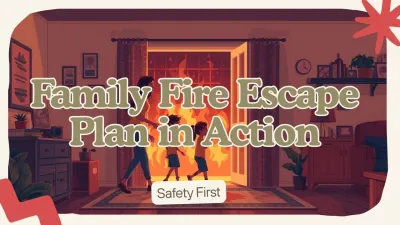
- Establish and practice a two-exit home fire escape plan with all household members
- Designate a meeting point outside the home — across the street, not in the driveway
- Ensure all bedroom windows can be opened from the inside without a key
- Clear combustibles within 3 feet of the furnace, water heater, and dryer
- Store gasoline, solvents, and flammable liquids in approved containers in detached storage
Smoke Alarms: The One Investment That Saves the Most Lives
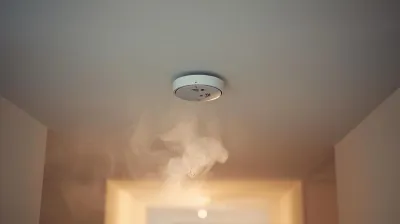
The NFPA's data on smoke alarm effectiveness is unambiguous: the death rate in home fires is more than twice as high in homes without working smoke alarms compared to homes with working alarms. Yet roughly three out of five home fire deaths occur in homes with no smoke alarm or a non-functioning alarm — most commonly due to missing or dead batteries, or alarms removed because of nuisance activations.
| Alarm Type | How It Detects | Best For |
|---|---|---|
| Ionization | Detects tiny particles from fast-flaming fires via ionized air current | Fast-flaming fires (kitchen, paper); generally less sensitive to slow, smoldering fires |
| Photoelectric | Detects larger smoke particles from smoldering fires via light-scatter principle | Smoldering fires (upholstery, mattress, electrical); less prone to nuisance alarms from cooking |
| Dual-sensor (both) | Combines ionization and photoelectric | Best overall protection; recommended by NFPA and USFA for all locations |
| CO combination alarm | Detects both smoke and carbon monoxide | Required near sleeping areas in most state codes; essential in any home with gas appliances, attached garage, or fireplace |
For operational reference on fire behavior — including how heat, smoke, and toxic gases move through a structure and what that means for occupant survival time — see our complete guide to fire behavior for fire science students. Understanding the science behind why smoke alarms save lives reinforces the habit of maintaining them.



Comments 0
No comments yet. Be the first to share your thoughts!
Leave a Comment