
Firefighter Pension and Retirement Benefits Explained
Firefighter retirement benefits are among the most valuable components of a fire service career — and among the most misunderstood. A well-structured public safety pension can provide a firefighter with 50–90% of their final salary for the rest of their life after 20–30 years of service. Understanding how these systems work before you choose a department can be worth hundreds of thousands of dollars over your career and retirement.
Jump to:Defined benefit pensions · How the benefit formula works · Vesting periods · Employee contributions · Social Security · DROP programs · Disability retirement · Post-retirement health insurance · How to evaluate a pension · FAQ
Defined Benefit Pension Plans
The vast majority of career firefighters in the United States are covered by defined benefit (DB) pension plans — a type of retirement plan that guarantees a specific monthly payment for life based on a formula, regardless of market performance. This is fundamentally different from the 401(k)-style defined contribution plans common in the private sector, where your retirement income depends on investment returns.
Defined benefit pensions for firefighters are typically administered by:
- State-level public safety retirement systems (e.g., CalPERS in California, TRS in Texas)
- City or county pension boards (e.g., FDNY Pension Fund, Chicago Firemen's Annuity and Benefit Fund)
- State firefighter-specific retirement systems (in states with dedicated fire pension programs)

How the Pension Benefit Formula Works
The defined benefit formula has three components: years of service, a benefit multiplier, and the salary base. The formula typically looks like this:
Years of service
The total number of years you worked for the department. Most public safety pension systems require a minimum of 20–25 years for full retirement eligibility, though some allow retirement after 20 years regardless of age.
Benefit multiplier
A percentage applied for each year of service. For public safety employees, multipliers typically range from 2.0% to 3.0% per year. A 2.5% multiplier means 25 years of service yields a pension of 62.5% of final salary. A 3.0% multiplier with 25 years yields 75%.
Salary base
Most plans use either the highest single year of salary or the average of the highest 1, 3, or 5 years (called "final average salary" or FAS). Plans using the single highest year are more generous to firefighters who work significant overtime in their final years.
Example calculation: A firefighter with 25 years of service, a 3.0% multiplier, and a final year salary of $85,000 would receive:
25 × 3.0% × $85,000 = $63,750 per year ($5,312.50/month) for life.
| Years of service | 2.0% multiplier | 2.5% multiplier | 3.0% multiplier |
|---|---|---|---|
| 20 years | 40% of salary | 50% of salary | 60% of salary |
| 25 years | 50% of salary | 62.5% of salary | 75% of salary |
| 30 years | 60% of salary | 75% of salary | 90% of salary |
Vesting Periods
Vesting is the point at which you have a guaranteed right to pension benefits, even if you leave the department before retirement eligibility. Most public safety pension plans vest after 5–10 years of service. Leaving before vesting means forfeiting your employer contributions to the pension. Leaving after vesting means you are entitled to a deferred pension benefit when you reach retirement age, even if you leave the fire service.
Employee Contributions
Unlike 401(k) plans where contributions are optional, most firefighter pension plans require mandatory employee contributions — typically 7%–14% of salary deducted from every paycheck. These contributions fund the pension alongside employer contributions and investment earnings from the pension fund's portfolio.
Factor contributions into your salary comparison. A department offering $75,000 with a 12% pension contribution leaves you $66,000 in take-home base pay. A department offering $70,000 with a 7% contribution leaves $65,100. The higher-paying department may not actually put more money in your pocket once pension contributions are factored in.
Social Security and Firefighter Pensions
This is one of the most important and least understood aspects of firefighter retirement planning. Many public safety pension systems — particularly in states like California, Texas, Ohio, Illinois, Massachusetts, and others — do not participate in Social Security. Firefighters in these systems do not pay Social Security taxes and do not earn Social Security credits during their fire service years.
The implications are significant:
- If you have prior Social Security credits from other employment, the Windfall Elimination Provision (WEP) will reduce your Social Security benefit when you reach Social Security age
- If your spouse receives Social Security, the Government Pension Offset (GPO) may reduce or eliminate spousal Social Security benefits you might otherwise be entitled to
- You are not building Social Security credits during your fire service years, which affects your long-term Social Security benefit calculation
Before accepting a fire department job, ask specifically whether the department participates in Social Security. If it does not, factor the WEP and GPO into your long-term retirement planning with a financial advisor who understands public safety pension systems.
Deferred Retirement Option Programs (DROP)
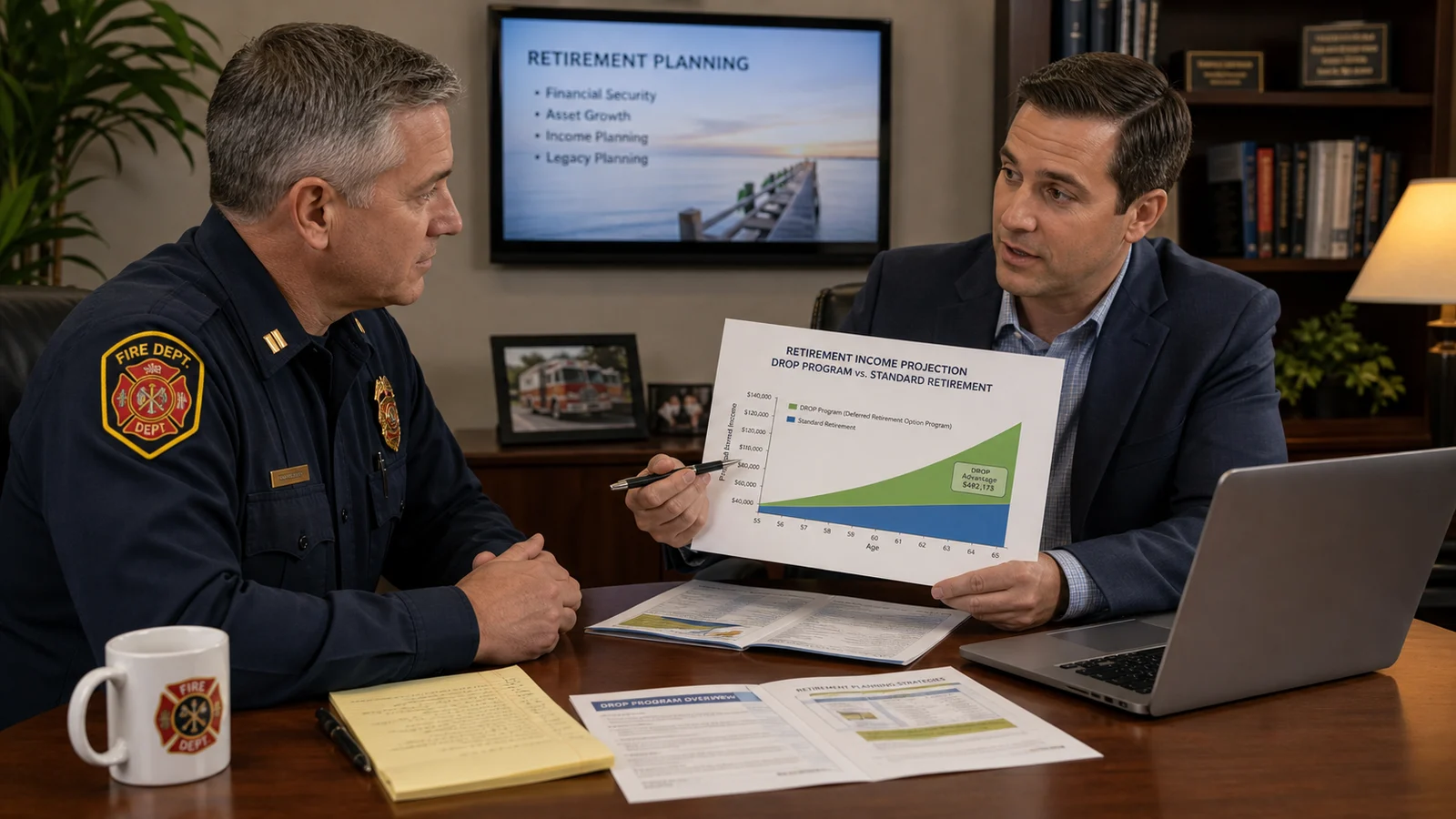
A Deferred Retirement Option Program (DROP) allows a firefighter who has reached retirement eligibility to continue working while simultaneously accruing their pension benefits into a separate interest-bearing account. When they eventually retire, they receive both their ongoing pension payments and the lump sum accumulated in the DROP account.
Key DROP features:
- Participation periods typically range from 3–5 years
- DROP accounts earn a guaranteed interest rate (often 5%–8%) regardless of market performance
- The lump sum at DROP exit can represent several hundred thousand dollars depending on salary and participation period
- DROP participants do not continue accruing additional pension years — their benefit is frozen at the rate when they entered DROP
Not all departments offer DROP. Departments with DROP programs are significantly more attractive from a financial planning perspective for firefighters who intend to serve the maximum eligible period. Ask specifically about DROP availability and terms when evaluating a job offer.
Disability Retirement
Firefighting is a physically dangerous occupation. Most public safety pension systems include disability retirement provisions for firefighters who are injured or become medically unable to perform their duties. Two categories typically exist:
| Category | Definition | Typical benefit |
|---|---|---|
| Duty disability (line-of-duty injury) | Injury or illness directly caused by firefighting duties | 50–75% of final salary, tax-advantaged, often without minimum service requirement |
| Non-duty disability (off-duty injury) | Injury or illness not related to job duties | Typically lower benefit, often requires minimum years of service |
Many states also have presumptive illness laws that presume certain cancers, cardiovascular diseases, and respiratory diseases to be duty-related for firefighters, making duty disability benefits more accessible for occupational diseases that develop over years of exposure.
How to Evaluate a Department's Pension Before Accepting a Job

When evaluating a job offer, do not focus only on the starting salary. Calculate the total compensation picture including pension quality:
- Multiplier rate: Higher is better. The difference between 2.0% and 3.0% per year is enormous over a 25-year career.
- Salary base method: Single highest year vs. 3-year average vs. 5-year average — single year is most favorable if you plan overtime in final years.
- Minimum retirement age/service: Retirement after 20 years regardless of age is far more flexible than requiring age 55 with 30 years.
- Social Security participation: Note whether WEP/GPO will affect your benefit.
- DROP program availability: Significant multiplier on total career earnings.
- Post-retirement health insurance: Some departments provide health coverage in retirement; others do not. This can represent $800–$2,000/month in real value.
- Pension fund health: Check the funding ratio of the pension system. Underfunded systems (below 80%) carry higher risk of future benefit reductions.
Frequently Asked Questions
How much is a typical firefighter pension?
A firefighter retiring after 25 years with a 2.5% multiplier receives 62.5% of their final salary for life. For a firefighter earning $80,000 in their final year, that is $50,000 per year ($4,167/month) for life, beginning at whatever age they retire, with no market risk.
Can firefighters retire after 20 years?
Many can, depending on their department's pension system. Some plans allow retirement after 20 years of service with no minimum age requirement — meaning a firefighter hired at 22 could retire at 42 with full pension benefits. Others require age 50 or 55 combined with years of service. Check your specific pension plan's terms.
Do firefighters get Social Security?
It depends on whether their department participates in Social Security. Many public safety pension systems opt out of Social Security, meaning firefighters in those systems do not pay into or receive Social Security benefits from their fire service years. The Windfall Elimination Provision (WEP) may also reduce any Social Security credits earned in other employment.
What happens to my pension if I leave the fire department early?
If you leave after vesting (typically 5–10 years of service), you retain the right to a deferred pension benefit when you reach the plan's retirement age. If you leave before vesting, you typically receive only your own contributions back (sometimes with interest) and forfeit the employer-funded portion of the benefit.
Are firefighter pensions taxed?
Regular firefighter pension income is generally subject to federal income tax. However, disability retirement benefits — particularly duty-related disability benefits — may be partially or fully tax-exempt depending on the circumstances. Consult a tax professional familiar with public safety retirement income for specifics in your state.




sweet dude