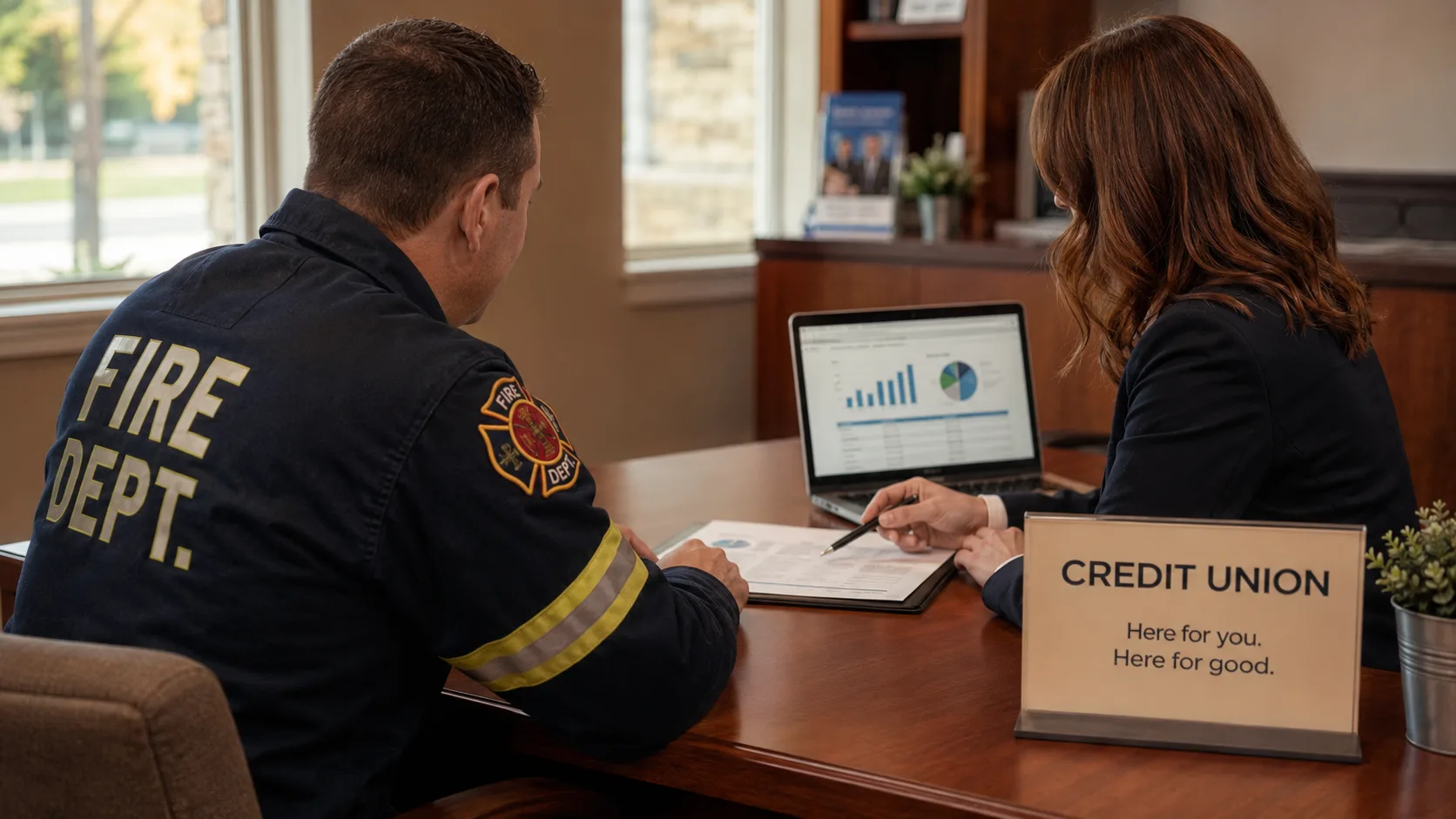

Short answer: A firefighter credit union is a member-owned, not-for-profit financial cooperative built around fire departments — some tied to a single city, some open to firefighters nationwide. Because they're owned by their members rather than shareholders, they typically return profits as lower loan rates, higher savings yields, and annual dividends instead of quarterly earnings reports. Nearly all of them also extend membership to immediate family, which is often the part people miss.
The fire service has a long tradition of firefighters pooling resources to look after each other financially, going back to the earliest mutual aid and burial societies attached to volunteer companies. That tradition is still alive in the dozens of credit unions across the U.S. built specifically around fire departments. Whether that's worth switching your banking to depends on what your local (or a national) option actually offers — this guide walks through how these institutions work, which ones exist, and what to actually compare.
Why a Credit Union Instead of a Bank?
The structural difference matters more than the marketing. A bank is a for-profit company owned by shareholders; a credit union is a not-for-profit cooperative owned by its own depositors. When a credit union earns more than it costs to operate, that surplus doesn't go to outside investors — it gets returned to members, typically through lower interest rates on loans, higher dividend rates on savings and certificates, and fewer or lower fees.
That's not a marketing claim unique to fire-service credit unions — it's true of the credit union model generally, and it's backed by lending data: in the run-up to the 2008 financial crisis, credit unions originated a fraction of the subprime mortgages that commercial banks did, and were far less likely to fail. Deposits at both are protected the same way — the National Credit Union Administration (NCUA) insures credit union deposits up to $250,000 per member, the same coverage limit the FDIC provides at banks.
What a firefighter-specific credit union adds on top of the general co-op model is a field of membership built around the fire service, staff who understand shift schedules and department pay structures, and often direct financial ties to state and national firefighter associations (IAFF locals, state PFF chapters) that get built into loan discounts or bundled benefits.
Firefighters First Credit Union: The Largest National Option
If you search for a firefighter credit union, this is almost always the first result, and for good reason — it's the largest and most nationally accessible option. Founded in 1935 (originally as the Los Angeles City Fire Department Credit Union), Firefighters First Credit Union has grown into a nationwide institution serving the "Fire Family" regardless of what state or department you work for, with in-person branches concentrated in California, Nevada, and a handful of other states, plus full online and mobile banking everywhere else.
Who Can Join
Eligibility extends well beyond active-duty career firefighters. Membership is generally open to:
- Active, retired, and volunteer firefighters
- IAFF members
- Employees of non-profit foundations organized to support firefighters
- Spouses of members who died while eligible for membership
- Immediate family of any current member — spouse, children (including step- and adopted), parents, siblings, grandparents, and grandchildren
That last point is worth underlining: once one person in a family qualifies, everyone in that immediate family can join and stays eligible for life, even if they never work in the fire service themselves.
What It Offers
- Annual profit sharing returned directly to members — the credit union reported returning more than $5 million to members in 2025 alone.
- New-member incentives that regularly include a 0.50% APR discount on fixed-term consumer loans (autos, motorcycles, boats, RVs, signature loans) for the first 12 months, and a rate bump on new share certificates.
- Direct-deposit bonuses for new checking accounts (recent offers have paid $250 for setting up qualifying direct deposit).
- Cashback credit cards, including a Visa Platinum card earning 1% back on purchases.
- Mortgage rate lock portability — members can carry their current mortgage rate to a new home purchase for up to three years, which matters in a rate environment where locking in early can be worth more than the home itself.
- Investment and insurance services through an affiliated LPL Financial partnership (Firehouse Financial), separate from the credit union's own NCUA-insured deposit products.
- Member discounts on theme parks, hotels, and rental cars through a TicketsatWork partnership.
Worth checking before you assume: Investment and insurance products offered through a credit union's third-party partner are not NCUA-insured the way deposit accounts are. Ask specifically which products carry deposit insurance and which don't before moving significant money.
Regional and Local Firefighter Credit Unions
Firefighters First is the largest, but it isn't the only option, and depending on where you work, a smaller local credit union tied to your own department or state may offer better in-person service, deeper local knowledge (a loan officer who actually knows shift pay), or membership terms your national option can't match. The National Council of Firefighter Credit Unions (NCOFCU) maintains a directory of dozens of these institutions across the country. A few examples of the range:
| Credit Union | Where | Notable for |
|---|---|---|
| Firefighters Community Credit Union (FFCCU) | Northeast Ohio | Started for firefighters but now open to anyone who lives, works, worships, or studies in its home counties |
| Houston Texas Fire Fighters FCU | Houston, TX | City-specific, full consumer lending lineup including mortgages and club savings accounts |
| Firefighters Credit Union (Utah) | Statewide, UT | Serves Utah firefighters and family members statewide |
| Firefighters Credit Union (La Crosse/Onalaska/Holmen) | Coulee Region, WI | Operating for the local fire service community for over 95 years |
| Firefighters & Company FCU | Dayton, OH | Kasasa free checking with monthly cash rewards; large shared-branch network |
| Chicago Firefighters Credit Union / Chicago Fireman's Association CU / Chicago Bravest CU | Chicago, IL | Several distinct department-affiliated options in the same city — worth comparing directly |
| DC Fire Dept Credit Union | Washington, DC | Serves DC Fire & EMS personnel |
| Boston Firefighter's Credit Union | Boston, MA | Long-running department-affiliated credit union |
This is a small sample — there are dozens more organized around individual departments, from Baton Rouge to Buffalo to Denver. If your department doesn't have its own credit union, ask around at the station or check with your state's professional firefighters association; some maintain informal partnerships with regional credit unions even without a dedicated "firefighter" brand name.
What to Actually Compare
"Firefighter credit union" in the name doesn't automatically mean it's the best deal available to you — some regional credit unions open to the general public post better rates than a national fire-specific option, and vice versa. Before switching, compare on:
- Auto and personal loan APRs against your current bank and at least one other credit union, especially if you're financing a vehicle soon — a 0.5–1 point difference on a multi-year auto loan adds up.
- Mortgage products, including whether the credit union services loans in-house or sells them, and any rate-lock or portability perks tied to membership.
- Share certificate (CD) rates, since these are where the profit-sharing structure often shows up most clearly relative to big banks.
- ATM and branch network — many smaller credit unions participate in shared branching networks (like CO-OP or Allpoint) that give members surcharge-free access to thousands of ATMs and branches nationwide, which matters if you transfer departments or move states.
- Fee schedule, especially overdraft and monthly maintenance fees, which tend to run lower at credit unions but still vary institution to institution.
- Digital banking quality — smaller local credit unions sometimes lag on mobile app features compared to a larger national option; if you rarely visit a branch, this matters more than the name on the door.
How to Join
The process is largely the same across firefighter credit unions:
- Confirm eligibility — active, retired, or volunteer firefighter status; IAFF membership; employment with an affiliated fire-service nonprofit; or immediate family of an existing member.
- Apply online or in person with a valid photo ID (a driver's license is standard).
- Open a share (savings) account with a small minimum deposit — this is your "membership share" and is what technically makes you a part-owner of the credit union, usually as little as $5–$25.
- Add checking, direct deposit, loan products, or certificates once membership is active.
Membership at almost every one of these institutions is for life once established — if you transfer departments, retire, or even leave the fire service entirely, you generally keep your account and your family's eligibility intact.
Common Questions
Is my money as safe at a credit union as at a bank?
Yes, for deposit accounts. The NCUA insures credit union deposits up to $250,000 per member, per institution, matching the FDIC's coverage at banks. Confirm any specific account you're opening is NCUA-insured, since investment and insurance products sold through a credit union's third-party partner typically are not.
Do I have to work for a fire department to join?
No. Most firefighter credit unions extend eligibility to immediate family members of anyone who qualifies, and some (like FFCCU in Ohio) have broadened membership to anyone in their service area regardless of occupation.
Can volunteer firefighters join?
Generally yes. Most firefighter credit unions, including Firefighters First, explicitly include registered volunteer firefighters in their field of membership alongside career personnel.
What if I move to a state where my credit union has no branches?
Check whether your credit union participates in a shared branching network. Many members of nationwide fire-service credit unions do all their day-to-day banking through mobile deposit and a shared ATM/branch network without ever visiting a home-state branch.


Comments 0
No comments yet. Be the first to share your thoughts!
Leave a Comment