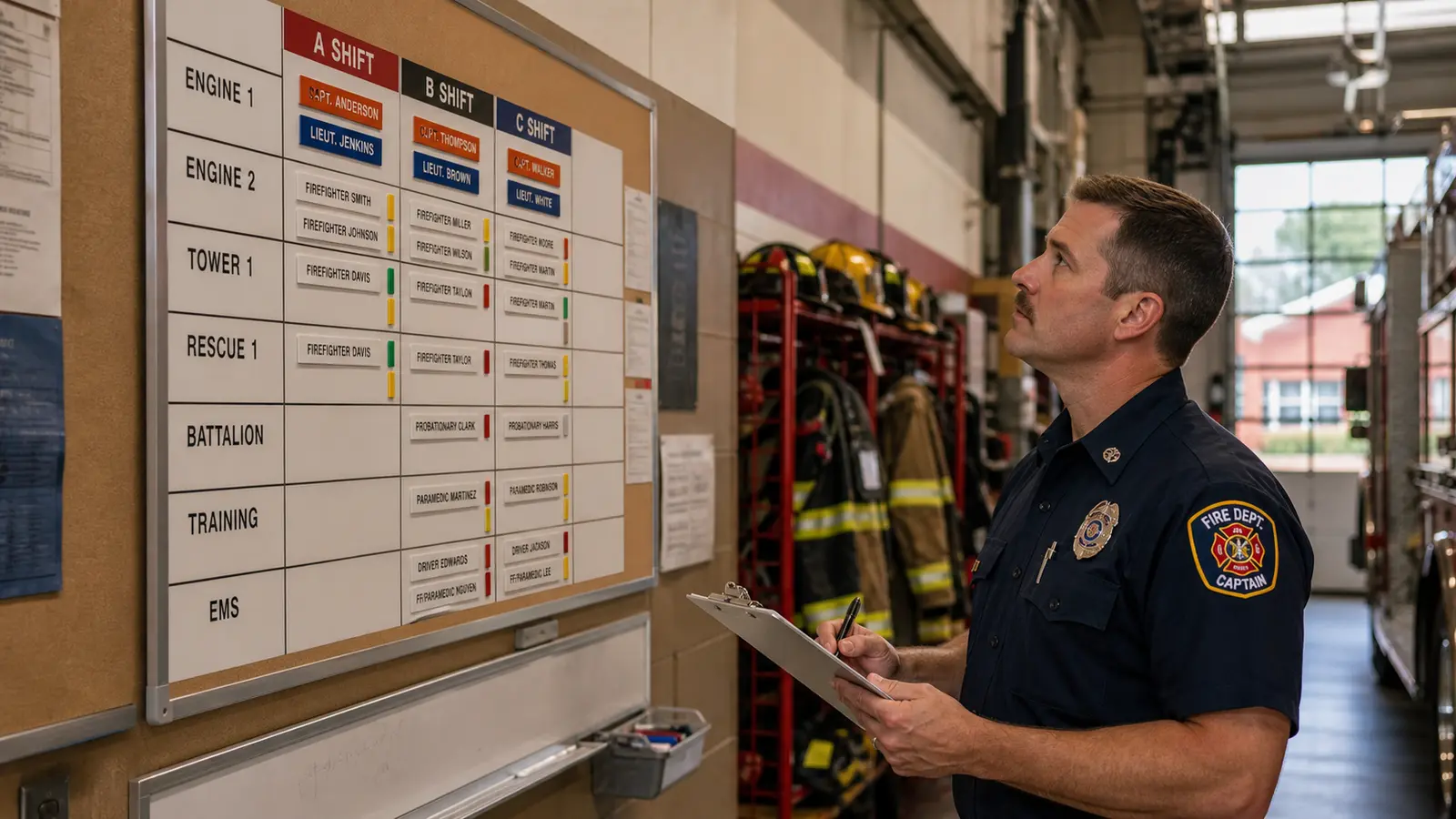

How a firefighter spends their career is determined, to a significant degree, by a process most people outside the fire service have never heard of: shift bidding. The annual or periodic ritual in which firefighters select their station assignments, shift rotations, and in some departments their apparatus positions based on seniority rank is one of the most consequential and most contested elements of fire department labor relations.
For a firefighter, the difference between a bid that places them at a busy downtown engine company and a bid that puts them at a quiet suburban station can mean thousands of hours of call experience, access to specialty training, proximity to family, and a career trajectory that diverges significantly from the alternative. For departments, the shift bidding system determines whether the most experienced personnel are deployed where the highest risk and complexity exist, or whether they cluster in the most desirable assignments regardless of operational need.
Shift bidding is also changing. Departments that have operated the same seniority-based bid system for 40 years are navigating workforce changes — the retirement of large senior cohorts, the influx of new firefighters who arrived during major hiring pushes in 2022–2025, and shifting union-management dynamics — that are producing the most significant changes to bid systems in a generation. Here is how the system works, what is changing in 2026, and what it means at every stage of a firefighter's career.
In this article:
- What shift bidding is and how it works
- How seniority is calculated — and why it's more complicated than it sounds
- What firefighters bid for
- Management override authority — when seniority doesn't decide
- What shift bidding means for a new firefighter
- What's changing in 2026 — and why
- Bid strategy: what experienced firefighters actually think about
What Shift Bidding Is and How It Works
In most career fire departments across the United States, firefighters do not simply receive a station and shift assignment — they bid for it. The bid is a competitive selection process in which firefighters choose from available positions in order of their seniority ranking. The most senior firefighter in the department bids first, selecting from all available positions. The second-most-senior bids next from the remaining positions. This continues down the seniority list until all positions are filled.
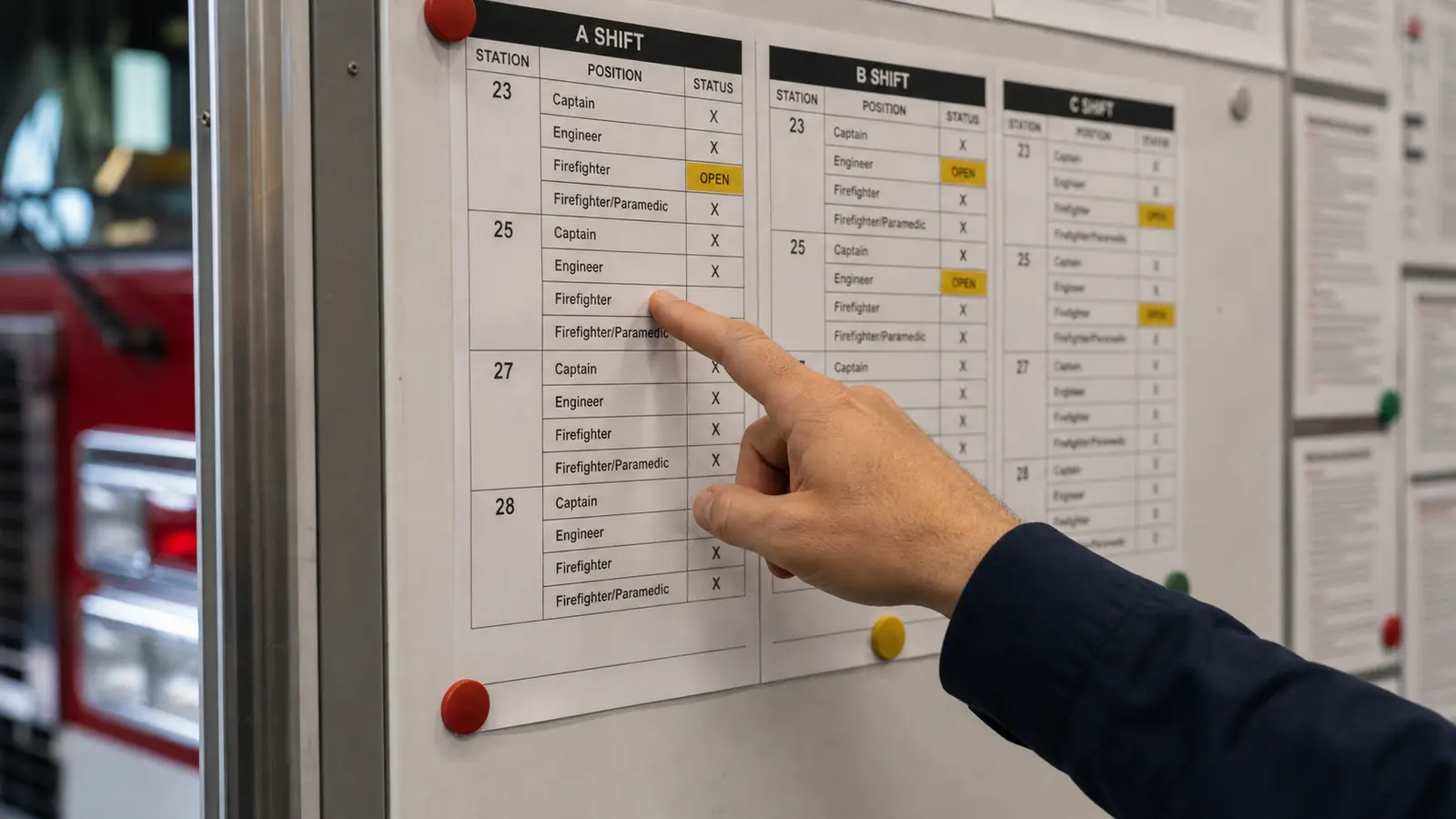
The positions available in a bid typically represent every station assignment, shift rotation, and designated role in the department for the coming bid period. Station 7 B-shift engineer. Station 12 A-shift firefighter. Ladder 3 C-shift tillerman. HazMat 1 B-shift. Each of these is a discrete position that goes on the bid list, and each will be filled by the firefighter who chooses it first.
The bid process itself varies by department. Some departments conduct bids in person at a scheduled bid day where firefighters appear in seniority order and make their selections. Others run the process electronically, with firefighters submitting ranked preference lists and software generating assignments based on seniority. Some departments run a pure open bid; others run a modified bid where certain positions are filled by qualification rather than seniority (specialty units, driver positions that require specific certifications, etc.).
The governing document for all of this is the collective bargaining agreement between the department and the union — in most cases the local IAFF affiliate. The CBA specifies how seniority is calculated, what positions are available for bid, how long a bid period runs, what management override authority exists, how mid-bid vacancies are filled, and the grievance process if a firefighter believes their bid rights were violated. Departments without collective bargaining use department policy in place of a CBA, but the structural logic of the bid is similar.
How Seniority Is Calculated — and Why It's More Complicated Than It Sounds
The basic principle — more time in service means higher seniority — conceals a significant amount of variation in how departments actually calculate it.
Continuous service date is the most common seniority anchor — the date the firefighter was hired into a career position. Firefighters hired on the same date (as is common during large academy classes) may have their relative seniority determined by their performance ranking in the academy, their oral board score, a coin flip, or lottery, depending on department policy. The method for resolving same-date ties is specified in the CBA and matters enormously for the firefighters involved.
Departmental seniority vs. classification seniority. Some departments maintain separate seniority lists for different ranks or classifications. A firefighter who promoted to engineer may have high departmental seniority but low engineer seniority if engineers bid their assignments against other engineers only. A promotion can reset the seniority clock for classification-specific bids while preserving overall departmental seniority for other purposes.
Prior service credit. Some CBAs credit prior fire service with another department toward seniority calculation — particularly relevant during lateral hire programs where departments recruit experienced firefighters from other agencies. Whether and how lateral hire credit counts in the seniority ranking is a negotiated provision that varies significantly and affects how lateral hires integrate into the bid pool.
What Firefighters Bid For
The variables that make some positions highly sought and others consistently available at the bottom of the bid list:
Call volume and incident complexity. Busy urban engine companies — high call volume, complex structure fires, large EMS load — are typically highly sought by firefighters who want operational experience and career development. They are also the most physically and mentally demanding assignments. Some firefighters with family responsibilities or approaching retirement bid away from high-volume stations toward quieter assignments as their priorities change.
Specialty units. HazMat, Technical Rescue, Air Operations, Marine — specialty unit assignments typically require specific qualifications and may run separate bid processes within the qualification pool. For firefighters who have invested in specialty training, bidding into the unit that uses those skills is a career objective that can take years to achieve depending on vacancy and competition.
Shift rotation and days off pattern. The 24/48, 24/72, and Kelly schedule rotations produce different days-off patterns that affect quality of life, second-job compatibility, family scheduling, and commute burden. For many firefighters, particularly those with young families, the shift rotation is as important as the station in the bid decision.
Geographic location relative to home. Station location relative to where the firefighter lives is a practical factor in commute time, fuel cost, and the ability to respond if called back during off-time. In large jurisdictions with stations spread across significant geographic areas, a bid that places a firefighter 45 minutes from home rather than 15 minutes is a material quality-of-life difference across a full bid period.
Management Override Authority — When Seniority Doesn't Decide
Pure seniority-based bidding produces assignments based entirely on time in service, without regard for whether the most senior firefighter is actually the most capable person for a specific position. Most CBAs incorporate some management override authority — the ability for the department to fill certain positions based on qualifications, performance, or operational need rather than seniority alone.
Override authority is typically limited and specifically defined in the CBA. Common override provisions: the department may require specific certifications as a prerequisite for bidding into driver/engineer positions. The department may designate a percentage of positions — often 5 to 15 percent — as management assignments that are filled without the bid process. Specialty unit positions may be filled through a combination of qualification screening and bid preference within the qualified pool.
Override authority is one of the most consistently contested areas in fire department labor relations. Management argues that the ability to place qualified, effective personnel in critical positions is an operational necessity that seniority alone cannot guarantee. Unions argue that override authority, if broadly interpreted, undermines the bid system's primary function: protecting firefighters from arbitrary or discriminatory assignment decisions. The balance between these positions, and how it is defined in the CBA, varies significantly by department and reflects the specific history of labor-management relations in that jurisdiction.
What Shift Bidding Means for a New Firefighter
A new firefighter entering a department during or after one of the large hiring cohorts of 2022–2025 finds themselves at or near the bottom of the seniority list in a department that may have hired several hundred firefighters in recent years. The practical consequence: at their first bid, they will receive whatever positions remain after every more-senior firefighter has made their selection. In large departments, this typically means the least desirable stations, the least preferred shifts, and the positions that experienced firefighters chose not to take.
This is not a malfunction of the system — it is how the system is designed to work. The logic is that firefighters who have served longer have earned the right of first selection. The problem for new firefighters is the timeline: in departments with large senior cohorts, the wait to bid into a preferred assignment can extend from one to five years or more.
The counterintuitive advice that experienced firefighters consistently give new hires: the positions that new firefighters are assigned to by default — busy urban stations, high-volume EMS-heavy companies — are often the assignments that produce the most rapid development. A new firefighter working 1,200 calls a year at a downtown station develops operational experience and clinical judgment faster than one working 300 calls a year at a suburban station of their choosing. The bid positions that senior firefighters compete for are often the same positions that the most senior and experienced firefighters self-select out of.
What's Changing in 2026 — and Why
Three converging pressures are producing the most significant changes to fire department bid systems in years:
Large senior retirements. The baby boomer cohort of firefighters hired in the 1980s and early 1990s is completing its retirement transition. Departments that have had the same senior firefighters at the top of the bid list for years are watching those positions become vacant simultaneously. The seniority compression that results — when a large chunk of the top third of the seniority list retires within a few years — changes the bid dynamics for every firefighter below them.
Large recent hiring cohorts. The 2022–2025 period saw major hiring pushes in departments across the country, driven by post-pandemic funding (federal SAFER grants), retirements creating vacancies, and cities investing in fire service capacity. New York City, Los Angeles, Houston, Chicago, and dozens of mid-sized departments ran large academies that produced hundreds of new firefighters. These cohorts are now completing probation and entering the bid pool simultaneously, creating seniority compression at the bottom of the list that is pushing mid-career firefighters toward higher relative seniority faster than historical patterns.
Qualification-based bid modifications. Several major departments have negotiated or are negotiating CBA modifications that incorporate qualification thresholds into the bid process for specific position types. The argument — which is gaining traction in departments that have experienced incidents where under-qualified personnel were placed in critical positions by seniority alone — is that the bid should incorporate demonstrated competency as a prerequisite, with seniority determining selection within the qualified pool. This is a significant philosophical shift from pure seniority and is generating substantial union debate.
Bid Strategy: What Experienced Firefighters Actually Think About
Firefighters with significant bid experience think about their selections across a longer time horizon than a single bid period. The considerations that experienced firefighters weigh:
- Career stage alignment. What the optimal assignment is for a firefighter with 3 years of service is different from what it is at 12 years or 22 years. Early career, the experience-maximizing strategy often points toward high-volume stations regardless of shift preference. Mid-career, specialty unit access may be the priority. Late career, quality-of-life factors — shift rotation, location, physical demand — tend to dominate.
- Promotion pathway implications. Station assignments that expose a firefighter to complex incidents, diverse apparatus, and a range of operational scenarios accelerate the development that promotion exams and oral boards assess. Firefighters planning to promote think about their bid in terms of what experience it will produce over the bid period, not just what it provides in terms of shift and location preference.
- Specialty unit prerequisites. Bidding into specialty units often requires prerequisite certifications or training that must be completed before the bid. Firefighters who know they want to bid into HazMat or Technical Rescue in two bid cycles are working on those certifications now, not when the bid opens.
- The value of flexibility at the margin. When two positions are roughly equivalent on the major factors, experienced firefighters often bid for the position that provides more future flexibility — better access to training, a captain known for developing firefighters, a station where specialty assignments rotate through.
The shift bid is the mechanism through which a fire department's personnel policy becomes a firefighter's lived career. Everything abstract about seniority, labor relations, qualification systems, and workforce planning becomes concrete when a firefighter sits down with the bid list and decides what the next year of their professional life looks like.
The system is changing. The retirement cliff, the large recent hiring cohorts, and the push for qualification-based modifications are producing bid environments that differ meaningfully from what the same department looked like five years ago. Understanding the system — how seniority is calculated, what the CBA actually says, what management override authority applies and where, and how bid strategy interacts with career trajectory — is as important for a new firefighter as any technical skill they develop in the academy.




Comments 0
No comments yet. Be the first to share your thoughts!
Leave a Comment