
Firefighter Age Limits: Minimum and Maximum Age Requirements by State
Age is one of the most searched topics among people considering a firefighting career — and one of the most misunderstood. The short answer: most U.S. fire departments require candidates to be at least 18 years old and under a maximum age at the time of hire, but that maximum varies enormously by state, department, and pension system. This guide breaks it all down.
Jump to:Minimum age · Maximum age limits · Age limits by state · Federal law and age discrimination · Applying over 30 or 40 · Age and physical standards · FAQ
Minimum Age Requirements
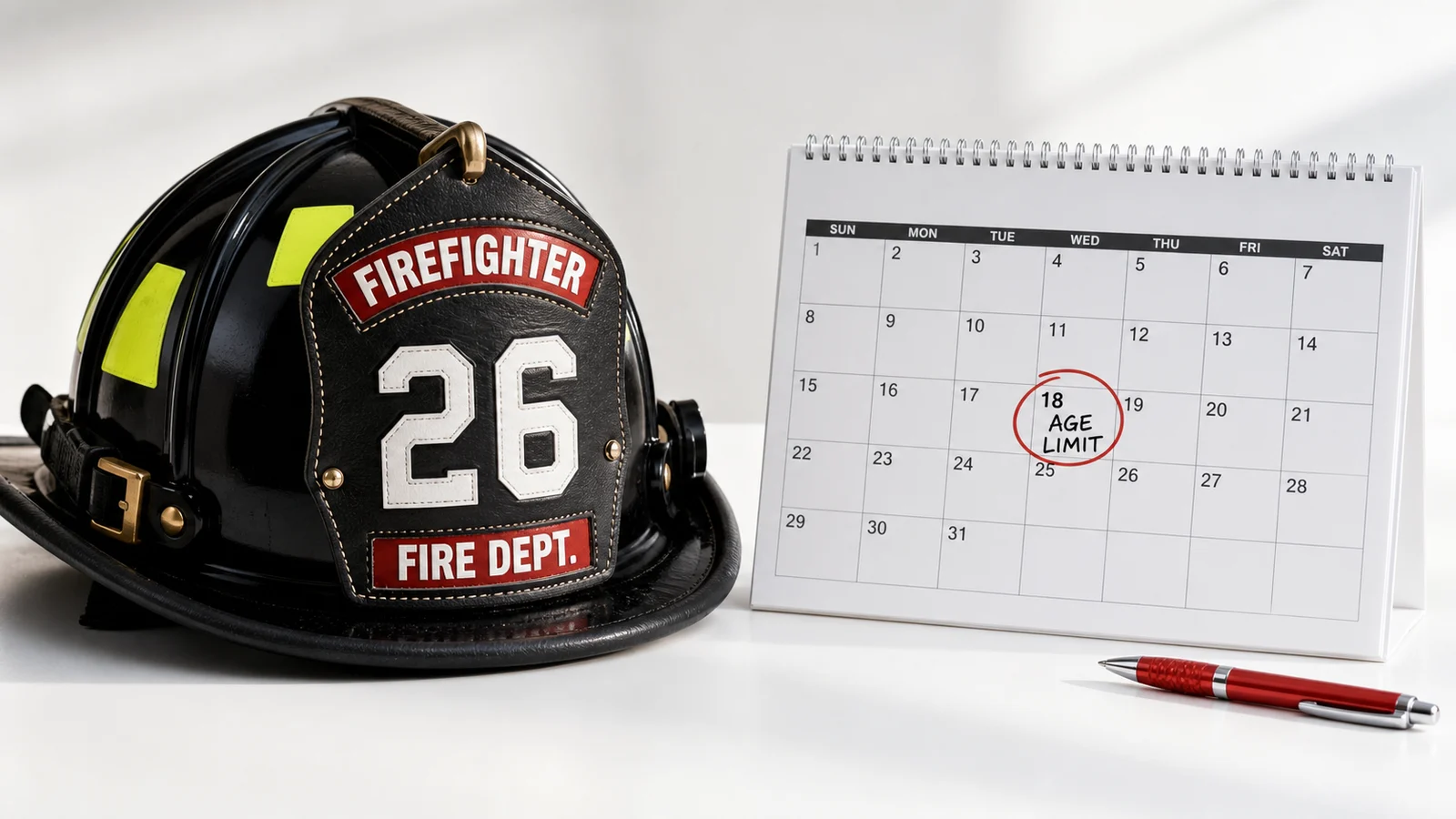
The minimum age to become a career firefighter is 18 years old at virtually all U.S. departments. Some departments set the minimum at 21, particularly when the position requires driving a fire apparatus (as some state driver licensing laws require age 21 for commercial vehicles) or when the department is part of a combined fire/law enforcement agency.
For volunteer firefighting, minimum ages are often lower — many state volunteer fire associations allow members as young as 14 or 16 in junior firefighter or explorer capacities, with full operational participation beginning at 16 or 18 depending on state law.
Junior firefighter and explorer programs accept candidates as young as 14–16 in most states and are an excellent way to build experience, earn certifications, and establish relationships within departments before you reach hiring age. See our Fire Explorer Program guide for details.
Maximum Age Limits
Maximum hiring age limits are where the real variation lies. These limits exist primarily because of pension and retirement system requirements — a firefighter hired at age 40 in a system requiring 25 years of service to retire with full benefits could not reach full retirement before age 65, creating actuarial problems for the pension fund. They also exist because of the demanding physical nature of the job and concerns about long-term career viability.
Common maximum hiring ages in the U.S.:
| Maximum age category | Common in | Notes |
|---|---|---|
| No maximum age | Several states including TX, FL, many smaller departments | Medical and physical standards still apply; pension math may limit practical hiring |
| Age 40 maximum | CA (many departments), NY, IL, MA, many civil service states | Most common upper limit; tied to pension system requirements |
| Age 35 maximum | Some departments in OH, PA, NJ, and others | More restrictive; often in older civil service systems |
| Age 21–30 maximum | Some federal firefighting positions and a handful of local departments | Rare in municipal fire service; more common in federal wildland firefighting |
Maximum age limits are set by individual departments or state civil service laws — not by federal law. Always check the specific job announcement for the department you are targeting. Two departments in the same county can have different maximum ages.
Age Limits at Major Departments by State
| Department / State | Min. age | Max. hiring age |
|---|---|---|
| FDNY (New York) | 17.5 (at exam) | 29 (at appointment) |
| LAFD (California) | 18 | No maximum (per CA law) |
| Chicago Fire Department | 21 | 40 |
| Houston Fire Department | 18 | No maximum |
| Phoenix Fire Department | 18 | No maximum |
| Philadelphia Fire Department | 18 | 40 |
| Boston Fire Department | 19 | 32 |
| Miami-Dade Fire Rescue | 18 | No maximum |
| Denver Fire Department | 18 | No maximum |
| Seattle Fire Department | 18 | No maximum |
Always verify current requirements directly with each department — age limits change when pension systems are modified.
Federal Law and Age Discrimination
The Age Discrimination in Employment Act (ADEA) generally prohibits age discrimination against workers age 40 and older. However, fire departments are specifically permitted to set maximum hiring ages and mandatory retirement ages under a ADEA exemption for state and local public safety officers. This means a department can legally refuse to hire a 45-year-old firefighter applicant, even if that applicant is fully qualified, if their civil service rules set a maximum hiring age of 40.
Applying Over 30, 35, or 40

If you are in your 30s or early 40s and considering a firefighting career, here is an honest assessment:
In your early-to-mid 30s
You are well within the hiring window at the majority of U.S. fire departments. Many of the most competitive candidates are in their late 20s and early 30s — old enough to have relevant life experience, professional background, military service, or EMS experience, but young enough to have a full 25–30 year career ahead. Do not let age discourage you at this stage.
In your late 30s
You need to check the specific maximum age for every department you target. Many large departments (Houston, Phoenix, Denver, Seattle, LAFD) have no maximum age and regularly hire candidates in their late 30s. Others with age 40 caps give you a narrow window — apply now, not later. Your physical preparation needs to be at its absolute peak.
In your 40s and beyond
Career firefighting positions at departments with maximum age limits are closed to you once you exceed their cutoff. However, departments with no maximum age limit are legitimate options if you can pass the CPAT and NFPA 1582 medical standards. Volunteer firefighting has no age limit at most organizations and is an extremely meaningful way to serve your community. Wildland firefighting with federal agencies has specific age considerations but no universal maximum.
Age matters far less than fitness. The CPAT is pass/fail and uses the same standards for a 20-year-old and a 45-year-old. The NFPA 1582 medical exam evaluates your actual cardiovascular and physical health, not your birth year. Candidates in their late 30s who are genuinely fit regularly outperform candidates a decade younger who are not.
Age and Physical Standards
Physical ability requirements (CPAT) and medical standards (NFPA 1582) are the same regardless of age at most departments. There is no age-adjusted CPAT scoring. A 40-year-old candidate must complete the same 8 events in the same 10 minutes 20 seconds as a 22-year-old candidate.
The NFPA 1582 medical standard does become more relevant with age — cardiovascular screening, stress testing, and certain age-related conditions receive more scrutiny for candidates over 40. This is not discrimination; it is evidence-based occupational medicine recognizing that certain cardiovascular risks become more prevalent with age in a physically demanding profession.

Frequently Asked Questions
What is the maximum age to become a firefighter?
It depends entirely on the specific department and state. Maximum hiring ages range from 29 (FDNY) to no maximum at all (LAFD, Houston, Phoenix, and many others). The most common upper limit at departments that have one is age 40. Always check the specific job announcement for each department you apply to.
Can I become a firefighter at 40?
Yes, at many departments. Hundreds of U.S. fire departments have no maximum hiring age. You must pass the CPAT physical agility test and the NFPA 1582 medical examination, which are the same standards applied to all candidates. If you are physically fit and medically cleared, age 40 does not disqualify you at these departments.
Can I become a firefighter at 35?
Absolutely. Age 35 is within the hiring window at the vast majority of U.S. fire departments. Even departments with age 40 maximum limits give you a five-year window. Focus your applications on departments with no maximum or high maximums and ensure your physical preparation is serious and current.
Is there an age limit for volunteer firefighting?
Most volunteer fire departments have no maximum age for active membership. Physical fitness standards and annual medical evaluations typically apply, but these are based on your actual physical capabilities, not a birth year cutoff. Volunteer firefighting is a legitimate and rewarding path for candidates of any age who are physically capable.
Does the FDNY have an age limit?
Yes. FDNY requires candidates to be at least 17.5 years old at the time of the written exam and no older than 29 at the time of appointment. This is one of the most restrictive age policies among major U.S. departments, tied to New York City's pension system requirements.
Florida: The statewide certification minimum is only part of the picture; departments can add their own employment requirements. See the full Florida firefighter certification and hiring guide.




Comments 0
No comments yet. Be the first to share your thoughts!
Leave a Comment