Firefighter Hearing Loss: Why It Happens, How Bad It Gets, and What Stops It
Walk into any fire station and ask the veterans how their hearing is. You will get a lot of "what?" jokes — and then a genuinely uncomfortable conversation about tinnitus that does not go away, about having to turn the TV up too loud, about asking family members to repeat themselves. Hearing loss in the fire service is so common that it has been normalized. It should not be.
According to the CDC and occupational health researchers, firefighters are at significantly elevated risk for noise-induced hearing loss (NIHL) compared to the general working population. Studies have found that career firefighters have measurably worse hearing at every age bracket than age-matched controls — and the gap widens with years of service. The most troubling part is that this damage is almost entirely preventable with equipment and protocols that already exist. It just requires the fire service to treat hearing protection with the same seriousness it gives to SCBA and turnout gear.
This guide explains the mechanism of noise-induced hearing loss, identifies the specific sources of dangerous noise exposure in the fire service, walks through what NFPA 1500 requires, and lays out the practical hearing protection strategies that can be realistically used in operational conditions.
Jump to:How hearing damage works · Fireground noise sources · Decibel levels on the job · Tinnitus and its impact · NFPA 1500 requirements · Types of hearing protection · Why firefighters don't wear it · Department hearing conservation program · Audiometric testing · FAQ
How Hearing Damage Actually Works
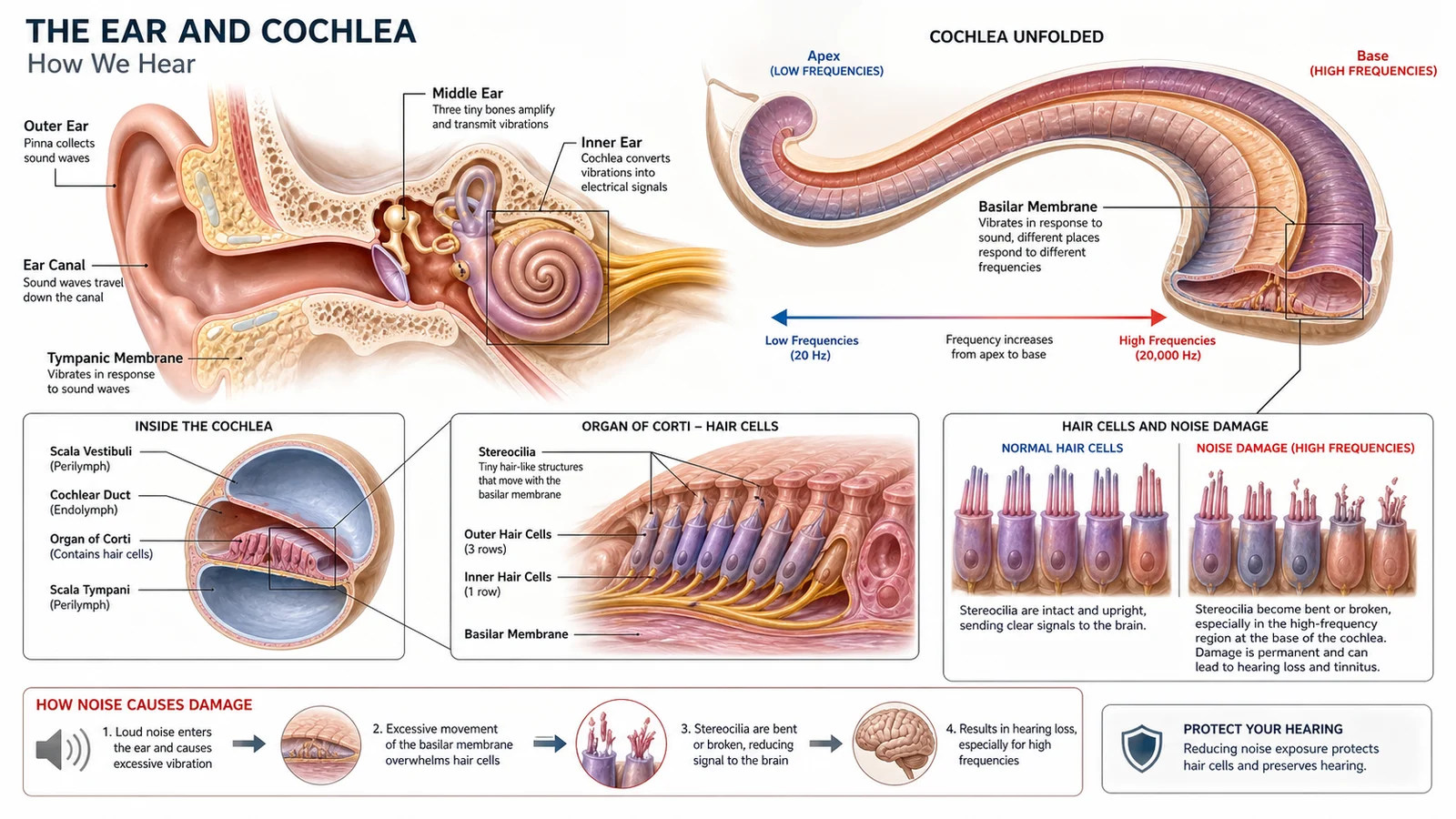
The inner ear contains thousands of tiny hair cells — stereocilia — lining the cochlea. These cells convert sound vibrations into electrical signals that the auditory nerve carries to the brain. They are exquisitely sensitive and completely irreplaceable. Once damaged, they do not regenerate. Ever.
Noise damages these hair cells through two mechanisms. High-intensity, brief exposures — like a structure explosion or a very close siren — can physically rupture cells acutely. More commonly, cumulative moderate-to-high noise exposure over time produces a progressive, metabolic injury: the cells are overstimulated, exhaust their energy reserves, accumulate toxic metabolic byproducts, and die gradually over years. This is why noise-induced hearing loss sneaks up on firefighters — there is often no single dramatic moment of damage. There are just thousands of small exposures that add up to permanent loss.
The frequencies damaged first are typically in the 3,000–6,000 Hz range — the exact range where speech intelligibility is most critical. This is why people with NIHL often say they can hear that someone is talking but cannot understand the words. And on the fireground, where radio communications, crew commands, and situational awareness cues all depend on clear hearing, this specific type of loss is operationally dangerous, not just personally inconvenient.
There is no treatment for noise-induced hearing loss. Hearing aids can help compensate for it, but they cannot restore the original sensitivity and frequency resolution of healthy cochlear hair cells. Every exposure that damages hearing is permanent. Prevention is the only cure.
The Sources of Dangerous Noise Exposure in the Fire Service
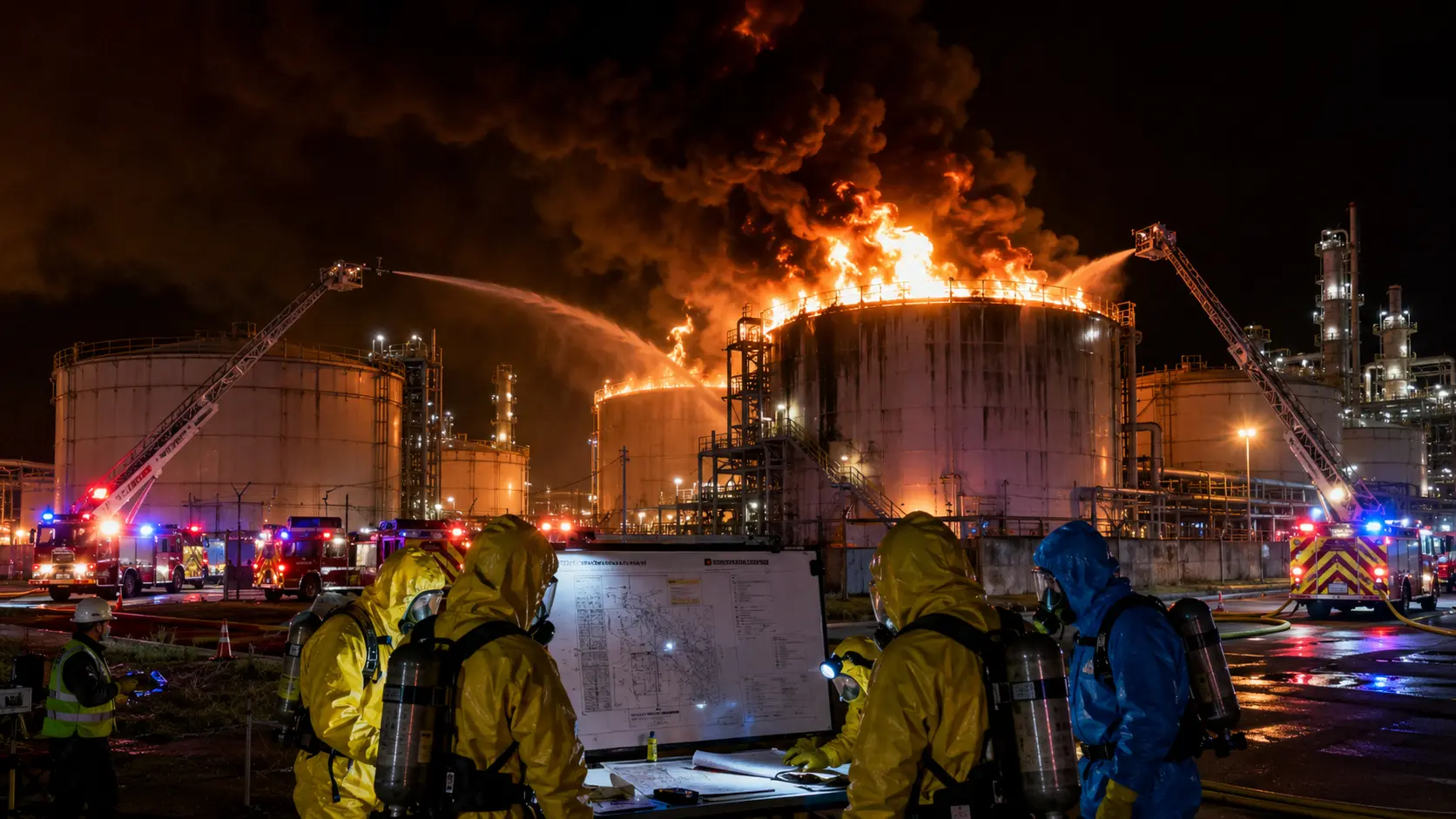
Most firefighters think of sirens as the main noise hazard. Sirens are a problem — but they are far from the only one, and in some ways not even the worst one. A thorough accounting of fireground noise sources reveals that firefighters face hazardous noise exposure from the moment they leave the station through the last minutes of overhaul.
Fire apparatus sirens and air horns
This is the most obvious source. The siren on a modern fire apparatus produces 110–120 dB at the operator position — a level at which NIOSH recommends no more than 1 minute of unprotected exposure per day. Firefighters riding in apparatus cabs are exposed to siren noise for the entire response, often 5–15 minutes per call, multiple calls per shift, hundreds of calls per year. Over a 25-year career, this adds up to a staggering cumulative dose.
Air horns are even louder — up to 130 dB at close range. The driver operating the air horn while simultaneously listening for traffic and monitoring the radio is receiving simultaneous exposure from multiple high-noise sources.
Power tools and extrication equipment
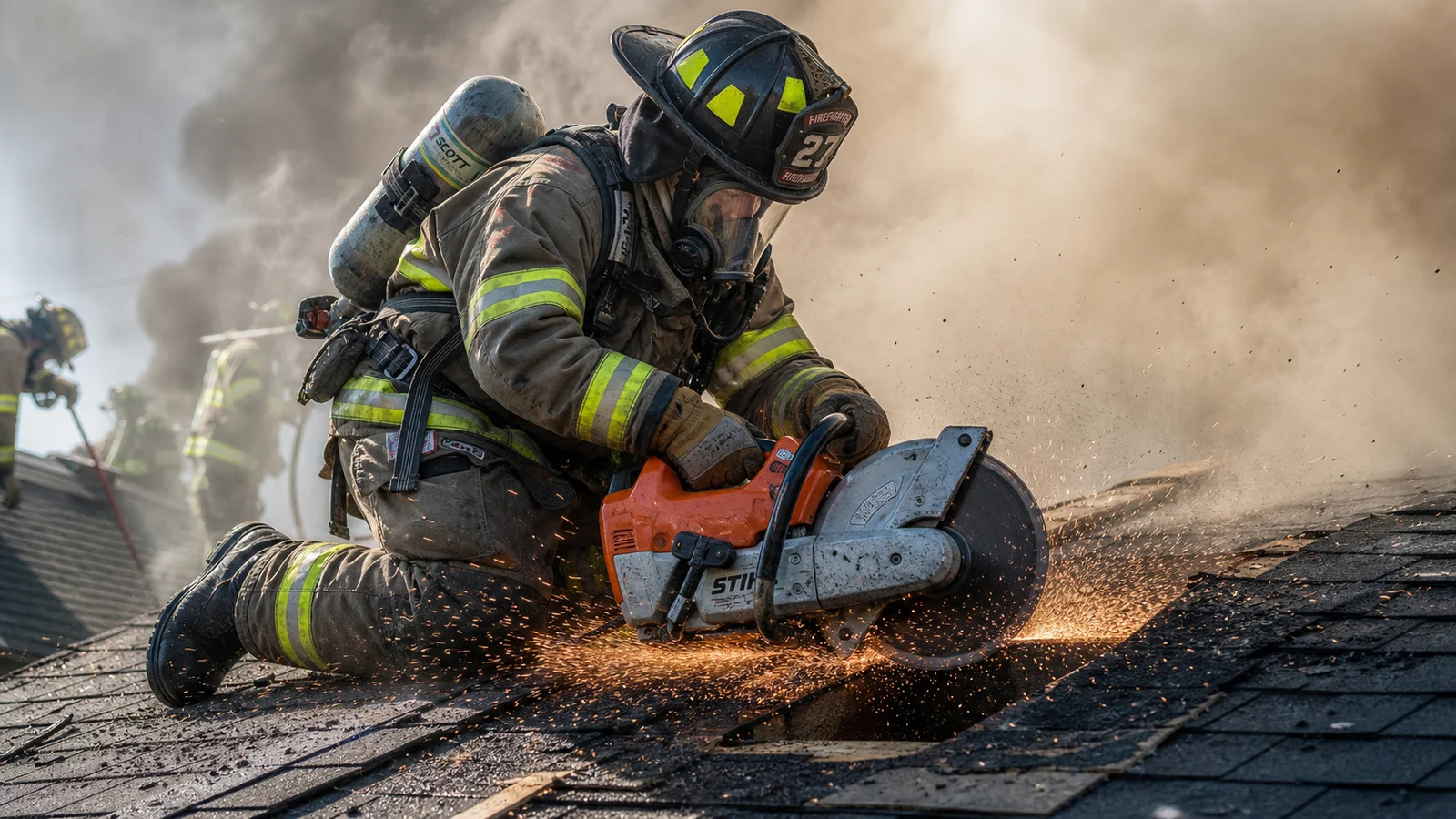
Hydraulic rescue tools (spreaders, cutters, rams) produce 95–105 dB. Rotary saws used for ventilation or forcible entry produce 100–115 dB at the operator. Reciprocating saws and angle grinders used during overhaul run 98–108 dB. These tools are used for extended periods — sometimes 30–45 minutes at a vehicle extrication — while the firefighter is typically wearing nothing but their structural helmet, which provides little acoustic attenuation.
Fire behavior sounds
Active fire produces noise — crackling, snapping, the sound of structural elements failing. In a well-involved structure fire, ambient noise levels inside the structure can reach 85–100 dB. This is not the dramatic, explosive noise that causes acute damage, but it is a sustained exposure at levels that, combined with everything else, contributes to cumulative damage.
SCBA alarm and PASS devices
The low-air alarm on an SCBA activates at approximately 95–100 dB at ear level. A PASS (Personal Alert Safety System) device in full alarm produces 95 dB. These are safety devices and their function is non-negotiable, but firefighters working near an activating PASS device or during a mayday with multiple PASS alarms active are receiving significant acute noise exposure on top of their baseline fireground exposure.
The station environment
The fire station itself is not quiet. Apparatus engines warming up, power tools in the shop, the apparatus bay with its reverberant concrete surfaces, and the dispatch tones — the piercing alert that wakes sleeping firefighters multiple times a night — all contribute to a noise environment that is meaningfully louder than a typical office workplace. Dispatch tones in particular produce brief 90–110 dB spikes that can acutely startle the auditory system.
Decibel Levels: What the Numbers Mean
The decibel scale is logarithmic, which means the differences between levels are not intuitive. A 3 dB increase doubles the sound energy. A 10 dB increase represents a 10-fold increase in sound intensity. This has direct implications for permissible exposure time:
| Noise level (dB) | Source example | NIOSH permissible exposure | OSHA permissible exposure |
|---|---|---|---|
| 85 dB | Heavy traffic, lawn mower | 8 hours | No limit (action level) |
| 88 dB | Noisy restaurant kitchen | 4 hours | 8 hours |
| 94 dB | Power tools, hand saws | 1 hour | 2 hours |
| 100 dB | Hydraulic rescue tools | 15 minutes | 2 hours |
| 106 dB | Rotary saw at operator | 3.75 minutes | 30 minutes |
| 112 dB | Fire apparatus siren close range | 56 seconds | 7.5 minutes |
| 120 dB | Air horn | 9 seconds | — |
Cross-referencing these numbers with a typical working fire reveals that firefighters regularly exceed safe exposure limits within the first few minutes of any significant incident — even before accounting for cumulative career dose. This is not a minor compliance issue. It is a public health problem occurring every day in departments across the country.
Tinnitus: The Noise That Never Stops
Tinnitus — the perception of sound (ringing, buzzing, hissing, roaring) with no external source — affects an estimated 30–50% of career firefighters in various studies. For many, it is a constant companion. The ringing does not go away when they leave the station. It does not go away when they retire. It follows them to bed, wakes them at 3 a.m., makes quiet rooms feel loud, and contributes significantly to the anxiety and sleep disruption that already affect firefighters at elevated rates.
Tinnitus also has a direct operational safety implication: it masks environmental sounds. A firefighter with significant tinnitus may have difficulty detecting faint sounds of structure distress, faint calls for help, or subtle changes in fire behavior sounds that an unimpaired crew member would notice. Hearing is a safety tool on the fireground, not just a quality-of-life issue.
Tinnitus is not always permanent after a single acute exposure — short-term tinnitus following a loud event may resolve over hours or days. Persistent tinnitus following repeated exposures is typically a sign of cumulative cochlear damage and should prompt both audiometric evaluation and a commitment to hearing protection going forward.
What NFPA 1500 Requires
NFPA 1500 (Standard on Fire Department Occupational Safety, Health, and Wellness Program) addresses hearing conservation in Chapter 7. The key provisions require departments to:
- Establish a hearing conservation program for members exposed to noise at or above the action level (85 dB TWA)
- Conduct baseline audiometric testing within 6 months of a member joining and periodic annual audiograms thereafter
- Provide hearing protection devices to all members exposed to hazardous noise
- Train members on the effects of noise exposure, proper use and care of hearing protection devices, and the purpose of audiometric testing
- Evaluate and redesign equipment or procedures where engineering controls can reduce noise exposure at the source
NFPA 1500 is a consensus standard, not a federal regulation — it does not carry the force of OSHA law for most fire departments. However, it represents the recognized best practice standard for fire department safety programs, and departments that follow it both protect their members and establish a defensible occupational health framework.
Hearing Protection Options for Firefighters
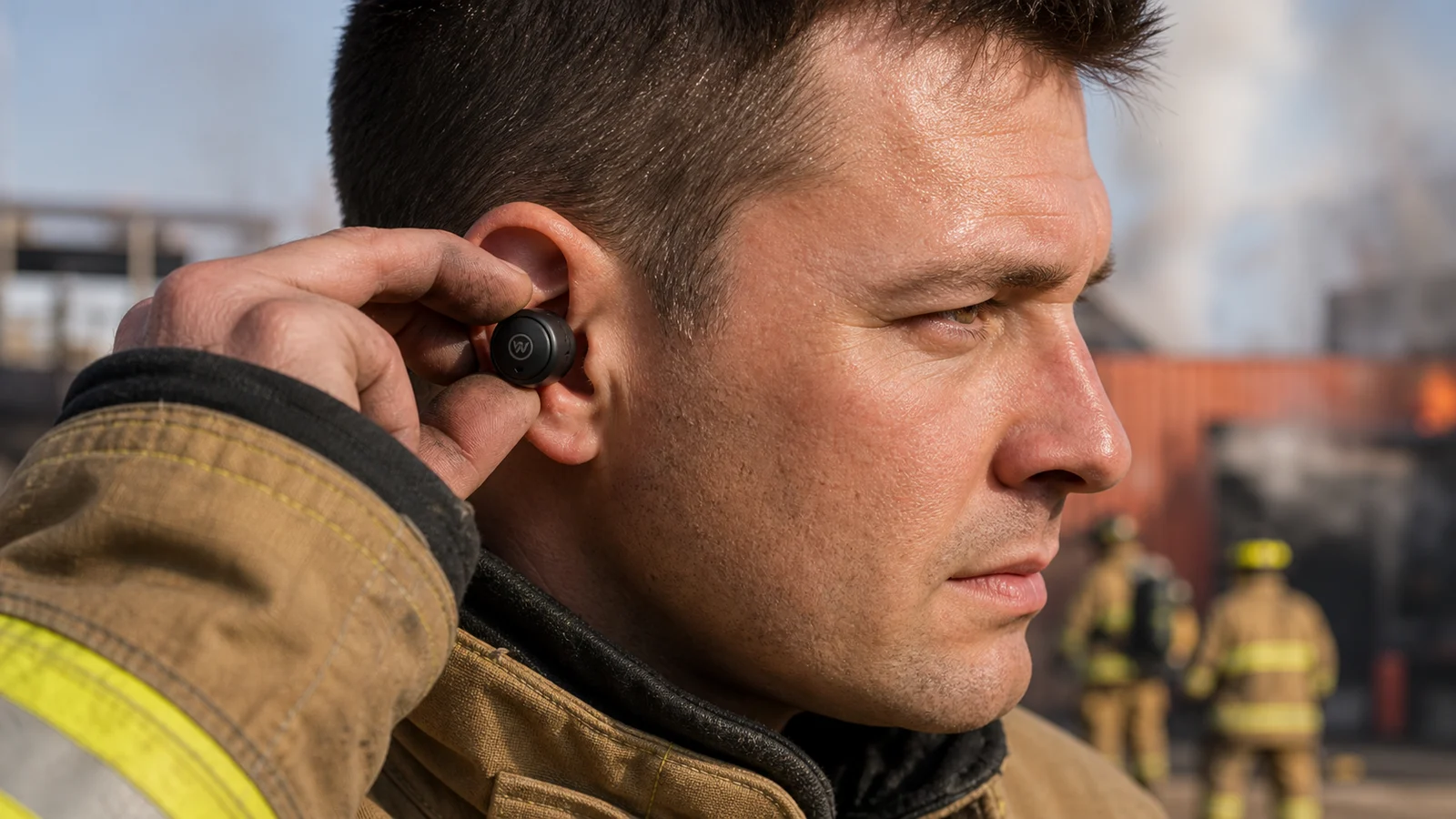
The challenge with hearing protection in the fire service is that conventional hearing protection — foam earplugs or standard earmuffs — can make firefighters unsafe by blocking the situational awareness sounds they need to hear: crew communications, radio traffic, fire behavior cues, and PASS alarms. This is the core dilemma, and it has driven the development of electronic hearing protection specifically for tactical and emergency response applications.
Standard foam earplugs
Noise reduction rating (NRR) of 25–33 dB. Highly effective at reducing absolute noise levels but block all sound equally, including communications. Appropriate for high-noise non-operational tasks: running the saw during training, working in the shop, riding in the apparatus with no communication needed. Not appropriate as sole protection during active operations where communications and situational awareness are required.
Level-dependent (electronic) earplugs
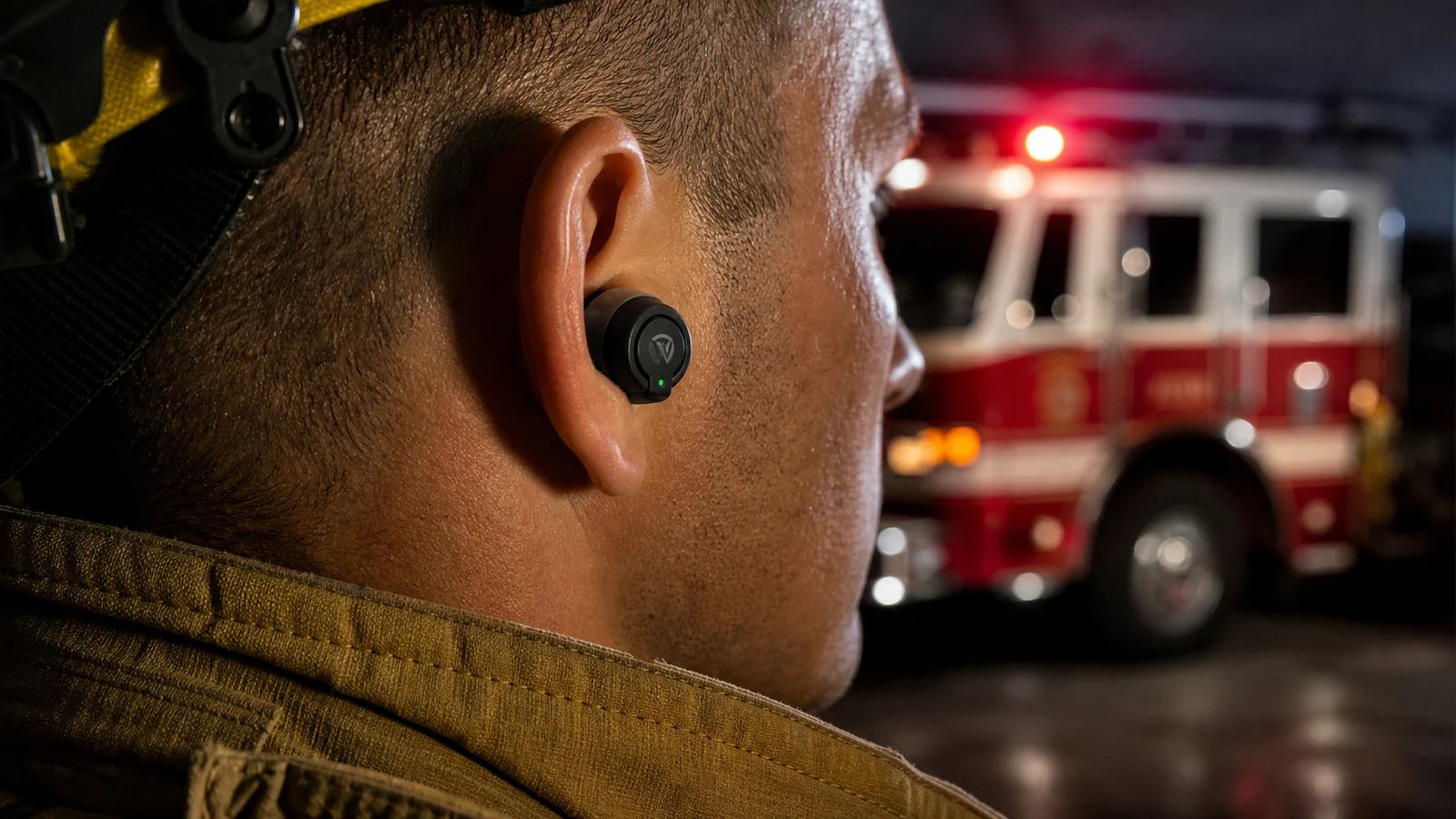
These devices use microphones and speakers to pass ambient sounds at a safe volume (typically capping at 82–85 dB) while suppressing sounds above the threshold. In quiet conditions, they amplify ambient sounds and actually improve situational awareness. During loud events, they clip the exposure at a safe level. They are the gold standard for operational use in environments where both hearing protection and situational awareness are required simultaneously.
Products like the 3M PELTOR line, Etymotic Research GuardianPRO, and similar tactical hearing protection devices are now used by military, law enforcement, and fire service members who have committed to operational hearing protection. The cost (typically $150–$500) is modest compared to the lifetime cost of hearing aids and the quality-of-life impact of significant hearing loss.
Electronic communication earmuffs
Helmet-mounted or over-ear designs that integrate with fire department radio systems. These protect against noise while allowing radio communications through the device's speaker, eliminating the need to remove protection to hear the radio. Several are compatible with structural firefighting helmets. These are particularly valuable for drivers and apparatus operators who have the highest siren exposure.
Custom molded earplugs with communication integration
Audiologist-fitted custom earplugs that can integrate with in-ear radio receivers. Higher cost but better fit, better attenuation, and more comfortable for all-day wear. Increasingly adopted by fire departments that have committed to comprehensive hearing conservation programs.
Why Firefighters Don't Wear Hearing Protection (And How to Change That)
If the solution is as straightforward as wearing hearing protection, why is NIHL still epidemic in the fire service? The honest answer involves culture, practicality, and a gap between what is recommended and what is integrated into standard operating procedures.
Culture: The fire service has historically normalized hearing loss as part of the job — evidence of experience rather than evidence of preventable injury. Veteran firefighters who have significant hearing loss sometimes inadvertently convey the message that it is normal. Changing this requires leadership from chief officers and union representatives who frame hearing conservation as what it is: occupational injury prevention.
Practicality: Standard earplugs are genuinely a problem on the active fireground. Telling firefighters to wear foam earplugs during structure fire operations without providing electronic alternatives is not a realistic solution and is perceived — correctly — as prioritizing compliance over safety. Departments that provide level-dependent protection and integrate it into SOPs see much higher adoption.
Time: Putting in hearing protection takes time that firefighters in emergency response feel they do not have. Electronic earplugs can be kept in the ear throughout the shift. Pre-positioned hearing protection on the apparatus seat means it is available to put in during response rather than requiring a separate step.
Building a Department Hearing Conservation Program
A functional hearing conservation program does not require a large budget. The essential components are:
- Baseline and annual audiometric testing. Establishes each member's starting point and tracks changes over time. Significant threshold shifts (10+ dB at key frequencies) trigger investigation and intervention.
- Hearing protection provision. Every member should have access to level-dependent electronic hearing protection. This is the department's responsibility, not the individual's.
- SOP integration. Specify when hearing protection is required: during apparatus response (driver always), during power tool operations, during training exercises with sustained power tool use.
- Noise mapping. Identify the highest noise exposure points in the department's operations and target engineering and administrative controls there first.
- Education. One training session per year on hearing loss mechanism, the department's program, and proper hearing protection use and maintenance.
Audiometric Testing: What to Expect
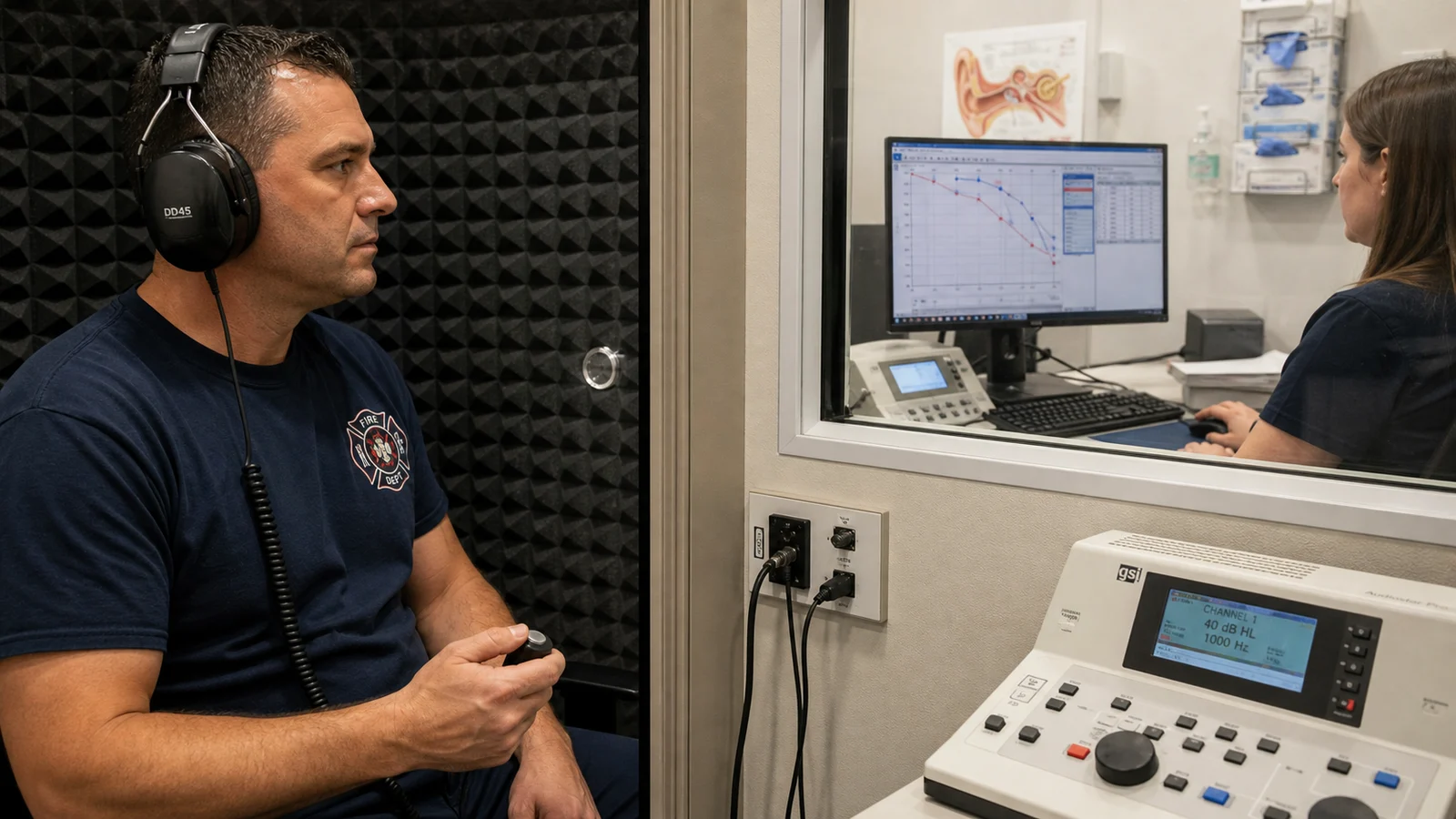
Annual audiometric testing is both a regulatory requirement under NFPA 1500 and a personal health tool. A standard occupational audiogram takes 15–30 minutes and involves sitting in a sound-treated booth and responding to tones played at different frequencies and volume levels through headphones. The audiologist or technician plots your hearing thresholds across frequencies and compares them to your baseline.
What a normal firefighter audiogram often shows: normal or near-normal thresholds at low and high frequencies, with a characteristic "notch" — reduced sensitivity — at 4,000 Hz. This notch pattern is the classic signature of noise-induced hearing loss and distinguishes it from age-related hearing loss, which affects high frequencies broadly. If you have a 4,000 Hz notch at age 35, it is almost certainly from noise exposure, not aging — and it will worsen with continued unprotected exposure.
Frequently Asked Questions
Do firefighters commonly get hearing loss?
Yes — significantly more commonly than the general population. Studies consistently find that career firefighters have measurably worse hearing at every age bracket than age-matched non-firefighters, and the difference grows with years of service. Noise-induced hearing loss is one of the most prevalent occupational injuries in the fire service, though it is underreported because it develops gradually and is often dismissed as "just getting older."
What is the loudest noise source for firefighters?
Air horns and sirens at close range top the acute exposure list at 110–130 dB. For cumulative daily exposure, apparatus siren riding time is often the largest contributor to total career noise dose. Power tools (rotary saws, hydraulic rescue equipment) produce similar peak levels but are used for shorter durations per incident.
Can firefighters wear hearing protection during a structure fire?
Yes, with the right equipment. Standard foam earplugs are not appropriate because they block communications and situational awareness. Level-dependent electronic hearing protection passes ambient sounds at safe volumes and suppresses hazardous peaks, allowing firefighters to hear radio, crew commands, and fire behavior cues while protecting against noise damage. This technology is the reason hearing protection on the active fireground is now practical.
Does tinnitus go away after firefighter career ends?
Not for most firefighters with established noise-induced tinnitus. Tinnitus from cochlear hair cell damage is typically permanent. Removing the noise exposure source (retirement) may prevent further worsening but rarely resolves existing tinnitus. Some individuals find that tinnitus becomes less intrusive over time as the brain partially adapts, but the underlying neural changes do not reverse.
What should a firefighter do if they notice hearing changes?
Report it to your department's occupational health provider and request an audiogram. Document the onset and any suspected acute exposures that may have contributed. Begin consistent hearing protection use immediately if you have not already. A significant threshold shift — even if not yet disabling — is a signal that your cochlear reserve is being depleted, and future exposures will produce greater damage than they would in an uninjured ear.
Comments 0
No comments yet. Be the first to share your thoughts!
Leave a Comment