LOS ANGELES WILDFIRE CASE | UPDATED NOVEMBER 21, 2026
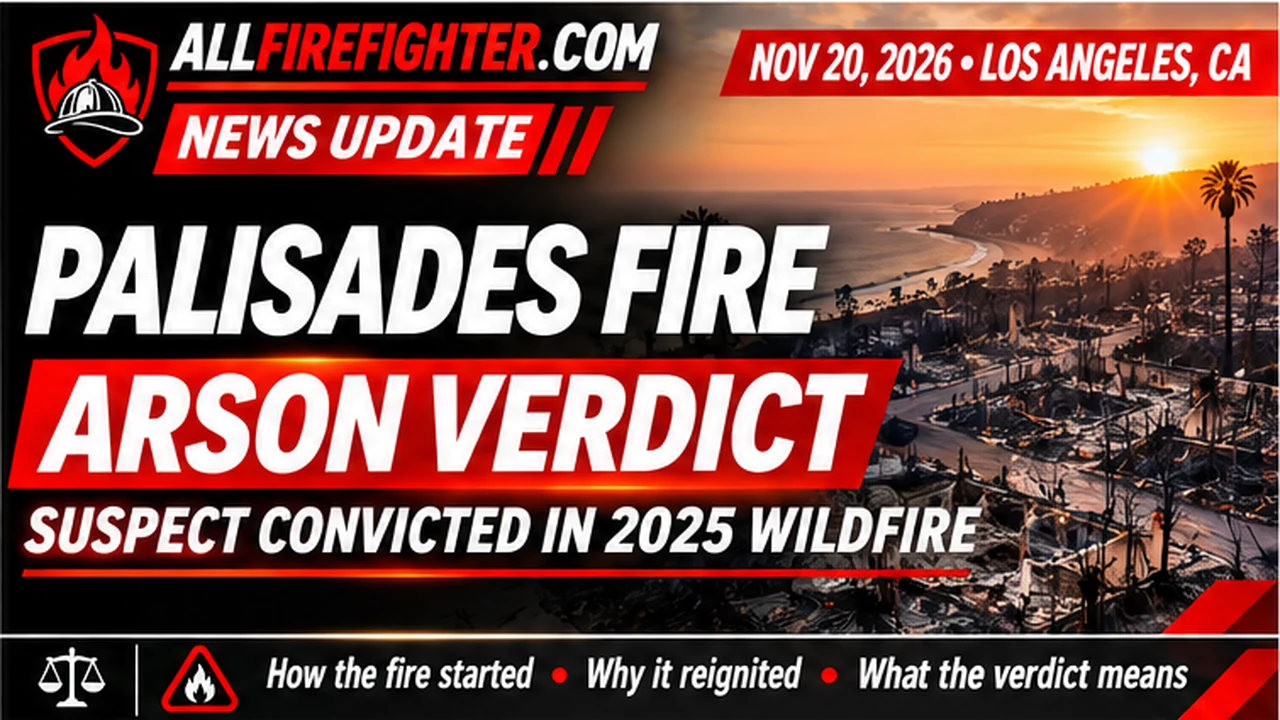
A federal jury in Los Angeles convicted Jonathan Rinderknecht on November 20, 2026, on two fire-related federal counts in a case arising from the 2025 Palisades Fire. Prosecutors connected a smaller blaze known as the Lachman Fire, ignited shortly after midnight on January 1, 2025, to a fire that continued smoldering beneath the surface and emerged during extreme winds on January 7. The verdict makes the prosecution's account of that sequence a central part of the criminal record; it does not answer every operational and civil question about the disaster.
What we know now
- Verdict: Guilty of destruction of property by means of fire and arson affecting property used in interstate commerce.
- Defendant: Jonathan Rinderknecht, 30, according to the U.S. Department of Justice.
- Critical dates: Lachman Fire began January 1, 2025; the Palisades Fire erupted January 7, 2025; the federal verdict was delivered November 20, 2026.
- Impact cited by DOJ: 12 deaths and 6,837 structures destroyed in the Palisades Fire.
- Next court date: Sentencing was scheduled for March 17, 2027.
What was the Palisades Fire verdict?
The U.S. Attorney's Office for the Central District of California announced that the jury convicted Rinderknecht of one count of destruction of property by means of fire and one count of arson affecting property used in interstate commerce. This was a guilty verdict, not a sentencing announcement. DOJ said the defendant faces a statutory maximum of 40 years in prison and a five-year mandatory minimum, with sentencing scheduled for March 17, 2027. Actual sentencing will be determined by the court.
The jury's decision followed a retrial. Reporting by NBC Los Angeles and The Associated Press describes how the prosecution traced the smaller January 1 fire and argued that underground remnants survived until the much larger January 7 disaster. Defense lawyers challenged the prosecution's case; the guilty verdict is the jury's decision on the charges, not a substitute for independently investigating every aspect of the fire response.
Lachman Fire to Palisades Fire: the documented timeline
- Just after midnight, January 1, 2025: The Lachman Fire began in a clearing on Hidden Buddha Hill near the Pacific Palisades. Prosecutors said environmental sensors registered its start at approximately 12:12 a.m.
- January 1: Firefighters suppressed the visible fire. Investigators later concluded combustion had continued underground in the root structure of dense vegetation.
- January 1–6: The public-facing flames were no longer apparent, while the prosecution's reconstruction held that a smoldering component persisted below the surface.
- January 7: Strong winds enabled the underground fire to surface and spread into the catastrophic Palisades Fire.
- November 20, 2026: A federal jury returned the two-count guilty verdict.
- March 17, 2027: Sentencing date announced by DOJ; this is a scheduled future proceeding, not a completed sentence.
Chronology source:DOJ news release dated November 20, 2026. The dates describe the criminal case's publicly documented reconstruction, not a minute-by-minute operational incident report.
What is a holdover fire—and how can a fire reignite days later?
A holdover fire is combustion that persists after the visible portion of a wildfire appears to be out or contained. Heat can remain in porous fuels, organic material, roots, stumps, duff, or buried accumulations. Depending on fuel, moisture, airflow, and surrounding conditions, low-visibility smoldering can continue before renewed oxygen flow and favorable weather permit surface flames. The term does not establish that every reignition has the same mechanism.
In the Lachman/Palisades case, federal investigators described heat persisting within the root structure of dense vegetation. The DOJ's release says the smoldering fire surfaced January 7 during heavy winds. That is the documented mechanism in the federal criminal account. The record cited here does not establish exactly what every suppression crew could or should have detected on January 1, and it would be inappropriate to infer firefighter negligence solely from the fact of later rekindling.
Why hidden combustion complicates wildfire mop-up
In vegetated terrain, visible flame knockdown can happen sooner than complete cooling of buried hot spots. Heat can penetrate organic layers and root systems where visual inspection alone may be incomplete. Firefighters may use probing, grubbing, water application, thermal imaging where conditions permit, and follow-up monitoring, but each method has limitations. Terrain, accessibility, resource availability and the size of the incident affect tactics. This is a general fire-behavior explanation, not an assertion that particular equipment or procedures were used or omitted by LAFD in the Lachman incident.
What role did wind play?
Wind can increase oxygen supply, dry exposed fuels, accelerate flame spread and transport embers. During a major wind event, a small ignition can grow rapidly across connected vegetation and into developed areas. The prosecution's account links January 7 winds to the surfacing and expansion of the holdover fire; it does not mean wind alone explains the disaster's full extent. Built-environment conditions, topography, fuel continuity and simultaneous emergency demands all warrant careful case-specific assessment.
How extensive was the 2025 Palisades Fire?
The Justice Department reported 12 people killed, 6,837 structures destroyed and approximately $25 billion in damage in its November 20, 2026 statement. These are figures reported by that federal office for this prosecution. Wildfire loss totals can vary among agencies and reporting periods depending on definitions and updates; readers should preserve the source and date when quoting them. The destruction affected homes, livelihoods, local services and the social fabric of Pacific Palisades.
What did investigators say about the evidence?
DOJ said evidence presented at trial included environmental sensing-platform timestamps, mobile-phone geolocation, videos and statements about the defendant's movements. Prosecutors said the defendant was near the starting area and subsequently gave investigators a misleading description of where he first observed the fire. The jury considered evidence and arguments during a 14-day trial before returning the verdict. For detailed pleadings and future court updates, consult the official federal case information page.
What the verdict does—and does not—settle
It establishes the jury's guilty finding on the charged federal offenses. It does not mean the defendant has already been sentenced. It also does not, by itself, resolve private insurance claims, public-agency liability, civil litigation, or the many separate operational questions raised by the fire's devastation. Responsible coverage must distinguish a criminal jury finding from ongoing investigations and other legal proceedings.
Fire service lessons: how to read this case responsibly
There are three evidence-based questions for fire-service readers: What fuel layers could retain heat after visible knockdown? How was the potential for undetected combustion assessed? And what weather changes could transform a low-visibility hot spot into rapid spread? The DOJ statement supports asking these questions, but not answering them on behalf of responding crews without complete incident logs and authoritative after-action findings.
A separate broader lesson concerns public understanding of wildfire control. A fire that appears extinguished from a distance may require extensive mop-up and monitoring at the perimeter. Conditions can change dramatically between the first incident and a later extreme-weather event. That is why precise language—suppressed, contained, controlled, extinguished—matters in both public alerts and retrospective reporting.
Frequently asked questions
Who was found guilty in the Palisades Fire case?
Jonathan Rinderknecht was convicted by a federal jury on November 20, 2026, of two federal fire-related offenses, according to DOJ.
Did the Palisades Fire start on January 1 or January 7?
The smaller Lachman Fire began January 1. Investigators say smoldering combustion persisted and surfaced on January 7 as the Palisades Fire. The dates refer to different phases of what federal investigators treated as a connected fire.
What is the Lachman Fire?
It is the smaller fire first detected in the Pacific Palisades area early January 1, 2025. The federal prosecution connected it to the later catastrophic blaze.
How many people died in the Palisades Fire?
The November 20, 2026 DOJ announcement cites 12 deaths.
Has Jonathan Rinderknecht been sentenced?
No. As of this article's November 21 update, DOJ lists March 17, 2027 as the scheduled sentencing hearing.
Could firefighters see the fire smoldering underground?
The publicly cited record does not establish what personnel could see at any given moment. Underground root combustion can be difficult to identify. Detailed operational conclusions require specific evidence, not inference.
Sources and reporting note
- U.S. Department of Justice — November 20 verdict release (primary source)
- DOJ case page for court updates (primary source)
- NBC Los Angeles — trial coverage
- Associated Press — jury verdict reporting
Editorial transparency: This article synthesizes published court information and explains general fire behavior. It is not an independent forensic determination, an official LAFD after-action report, or eyewitness reporting. Featured image is an illustration, not a photograph of the incident.
Comments 0
No comments yet. Be the first to share your thoughts!
Leave a Comment