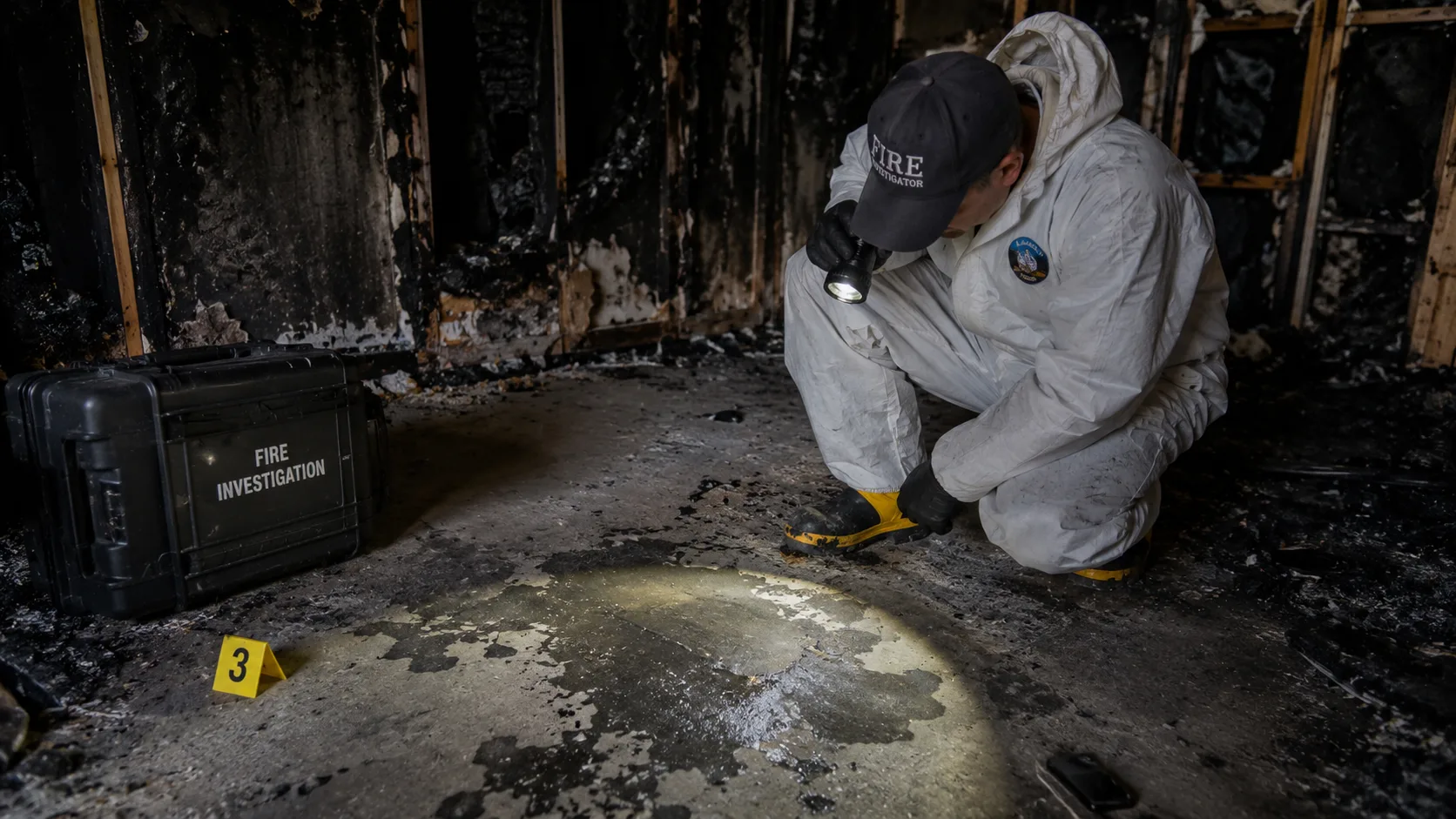

Every structure fire gets an investigation. In most cases, the cause is accidental — unattended cooking, electrical failure, a candle left burning. But roughly 15 to 20 percent of residential fires are ruled incendiary — intentionally set. The investigation that distinguishes between an accident and an arson is a scientific process built on fire behavior physics, chemical analysis, and a systematic methodology that fire investigators have developed and refined over decades.
The common assumption that a fire destroys all evidence is wrong. Fire consumes fuel, but it leaves traces. Accelerant vapors absorb into concrete, into soil, into subfloor material, in patterns that survive both the fire and the firefighting water. Burn patterns on walls, floors, and structural elements tell the investigator where the fire was hottest, where it burned longest, and where multiple ignition points might exist. The science of fire investigation has advanced significantly — and so has the rate at which arson is detected and prosecuted.
In this article:
- Origin and cause: the two questions every investigation answers
- The systematic elimination methodology
- Burn patterns and what they indicate
- Physical indicators of accelerant use
- Accelerant detection canines
- Laboratory analysis: GC-MS and what it finds
- Common arson mistakes investigators detect
- Fire investigators and law enforcement
Origin and Cause: The Two Questions Every Investigation Answers
Every fire investigation begins with two fundamental questions: where did the fire start (origin), and what started it (cause). These are answered in sequence — you cannot reliably determine cause without first determining origin, because the burn pattern evidence that establishes cause is most concentrated at the point of origin.
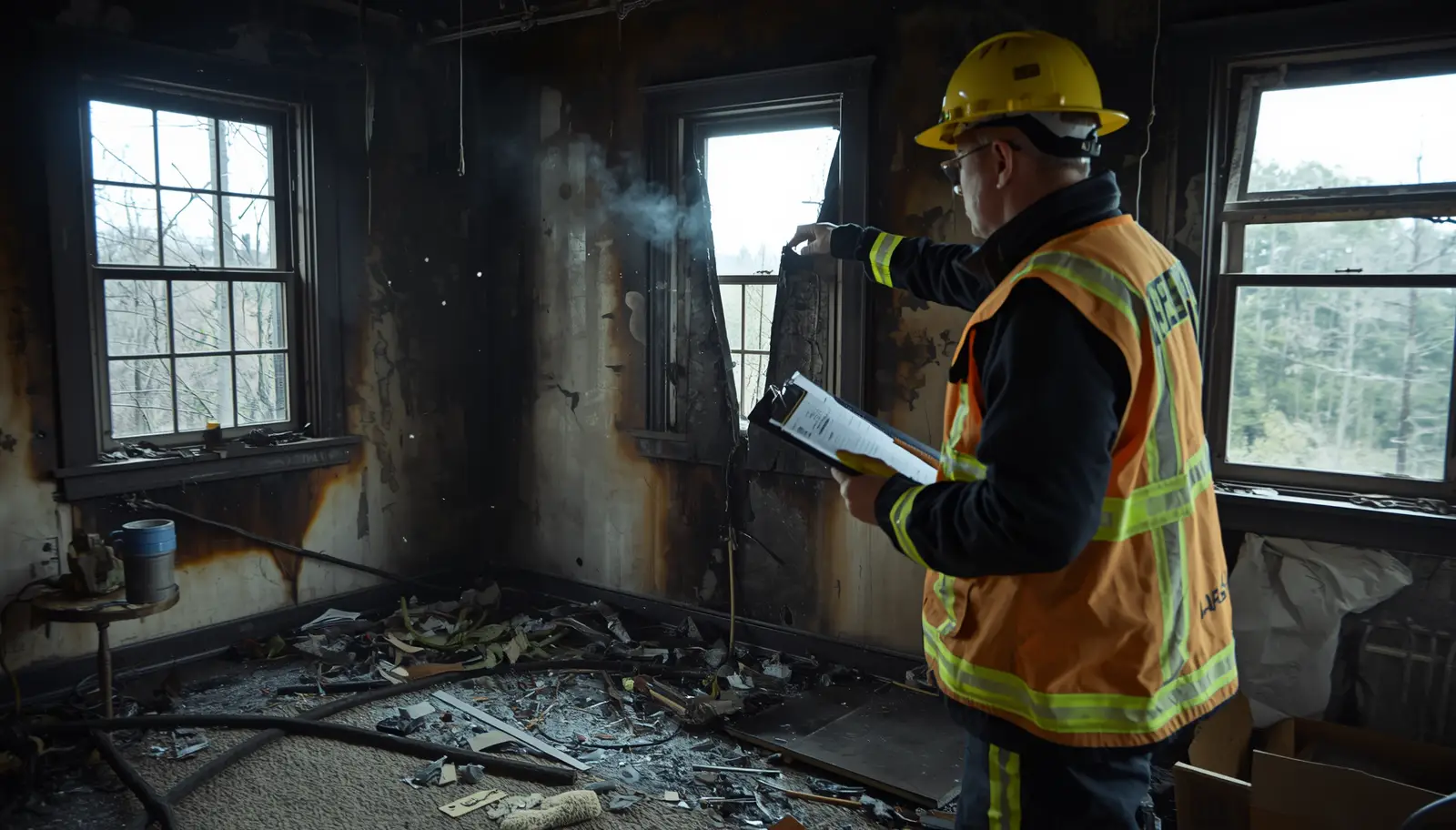
The origin determination begins at the exterior of the structure and works inward. Investigators read the fire's progression from the outside — smoke staining patterns, window failure patterns, and structural damage distribution all indicate the general area where the fire was most intense and burned longest. Working inward, they identify the area of origin within the structure, then the point of origin within that area, down to a specific location on the floor where the fire started.
Cause is determined from what the investigator finds at the origin: the remains of an ignition source (an electrical component, a candle, a heating element), evidence of an ignition-competent condition (an overloaded circuit, a frayed wire touching combustible material), or the absence of any accidental ignition source — which, combined with other physical evidence, supports an incendiary classification.
The Systematic Elimination Methodology
NFPA 921 — the Guide for Fire and Explosion Investigations — is the document that governs fire investigation methodology in the United States. Its central framework is the scientific method applied to fire scenes: formulating hypotheses about cause, testing each hypothesis against the physical evidence, and eliminating hypotheses that are inconsistent with the evidence until the most probable cause is identified.
Systematic elimination means that before a fire is classified as incendiary, every accidental and natural cause must be considered and addressed by the evidence. An investigator who finds pour patterns and multiple ignition points but has not verified that the electrical system was functional and cannot account for the ignition source does not have a complete incendiary classification — they have evidence that is consistent with incendiary and inconsistent with the accidental causes they have tested. The classification emerges from that process of elimination, not from a single indicator.
This methodology distinction matters legally because investigators who rely on folklore — outdated "indicators" of arson that have been scientifically discredited — can produce wrong classifications and wrongful prosecutions. The field has undergone significant reform since the 1990s, driven partly by conviction reviews that found innocent people had been convicted based on "investigative indicators" that did not hold up to scientific scrutiny. NFPA 921 codifies the science-based approach that replaced indicator-based methodology.
Burn Patterns and What They Indicate
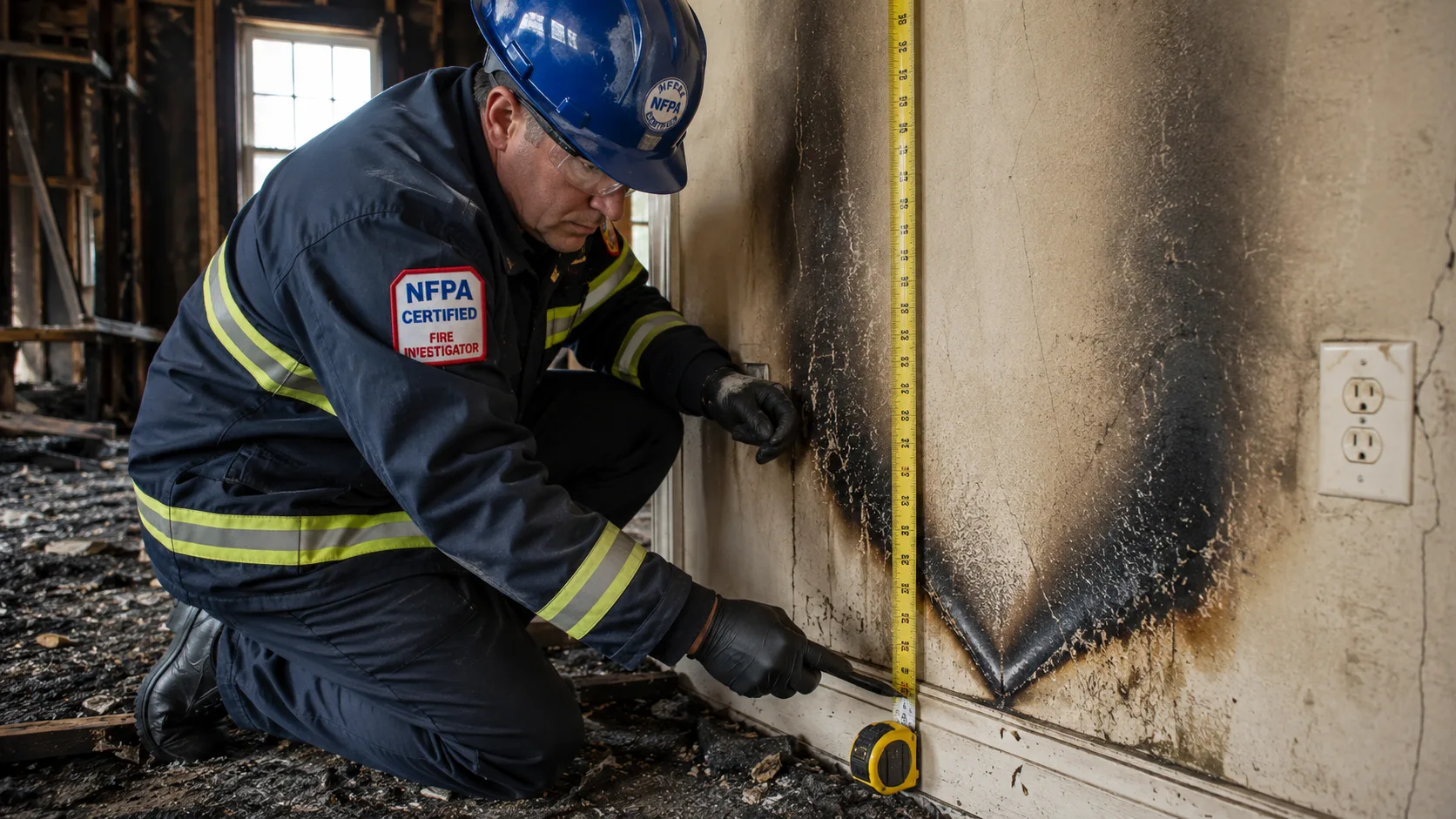
Fire moves in predictable ways governed by physics. Heat rises, fire moves toward available oxygen, and it burns materials at different rates depending on their composition, moisture content, and exposure time. These patterns leave a record in the char, in the smoke staining, and in the structural elements that survived.
V-patterns
When fire burns upward from a low point of origin, it leaves a V-shaped char pattern on adjacent walls — narrower at the origin, wider higher up. The angle and characteristics of the V provide information about the fire's intensity and origin height. A very narrow, steep V suggests a fast, hot fire. A wider, more open V suggests a slower-building fire. A V-pattern that begins at floor level — below where most accidental ignition sources are located — is a notable finding that warrants careful examination of the origin area.
Low burn indicators
Accidental ignition sources in residential fires tend to be at or above counter height — stovetops, outlets, appliances, candles on surfaces. Fire that originates at floor level without an identifiable accidental source at that height — burn damage concentrated at the baseboard, charring under furniture, irregular floor-level patterns — is a finding that supports additional investigation. It does not by itself establish arson, but it is inconsistent with the most common accidental causes and requires explanation.
Multiple areas of origin
A single fire, starting from a single ignition point, produces a single area of origin. Physical evidence of multiple separate ignition points — burn patterns that cannot be explained by fire travel from a single source — is among the strongest physical indicators of intentional setting. If the fire data shows that the fire was burning simultaneously in the living room, the bedroom, and the basement at levels of intensity inconsistent with fire spread from a single origin, multiple ignition points must be considered.
Physical Indicators of Accelerant Use
Accelerants — flammable liquids poured or distributed to enhance fire spread — leave physical evidence in the burn pattern and in the substrate they contacted. The most significant physical indicator is the pour pattern: an irregular, non-geometric burn pattern at floor level that follows the path of a poured liquid.
A poured accelerant flows across a floor surface and pools in low points — under doors, at carpet edges, in corners, along baseboard gaps. When it ignites, it burns most intensely where the liquid concentrated, producing a floor-level burn pattern that differs from the overhead burn patterns typical of furniture-originated fires. The edges of pour patterns can be sharply defined, particularly on non-porous surfaces like vinyl or concrete, where the accelerant boundary is preserved in the char.
Protected areas — a term for surfaces that were shielded from direct fire and heat by an object resting on them — are another accelerant indicator. If a rug, a piece of furniture, or a door was lying on the floor over an accelerant, the accelerant saturated the area underneath while the protective object prevented some of the thermal damage from above. The result is a reverse pattern: the area under the object is more heavily burned than adjacent areas, which is the opposite of what fire from above would produce.
Accelerant Detection Canines
Accelerant detection canines — dogs trained to detect the presence of ignitable liquid residues — are among the most sensitive tools available to fire investigators. A well-trained and certified ADC can detect accelerant residue at concentrations far below what human olfaction can identify, and at concentrations below the detection threshold of portable field instruments. They are used to identify specific sampling locations within a fire scene for laboratory collection, rather than providing definitive evidence themselves.
The canine's alert — a sit or a specific trained indication behavior at a location — tells the investigator where to collect debris samples. Those samples go to a laboratory for confirmatory chemical analysis. The canine's alert alone is not evidence of arson; it is evidence of something worth sampling. Laboratories provide the definitive identification of the specific compound present and its chemical profile.
False positives — a canine alerting to a location with no accelerant present — occur with some natural combustion byproducts that share chemical characteristics with ignitable liquids. This is one reason the canine alert leads to laboratory confirmation rather than standing as evidence on its own. Programs that certify ADCs under NFPA 921 standards include rigorous testing specifically for false positive rates.
Laboratory Analysis: GC-MS and What It Finds
Debris samples collected from fire scenes — carpet, flooring material, soil, subfloor wood — are submitted to forensic laboratories for chemical analysis. The standard analytical technique is gas chromatography-mass spectrometry (GC-MS), a method capable of detecting and identifying specific compounds at concentrations in the parts-per-billion range.
The process: the debris sample is heated in a sealed container, and the volatile compounds driven off are collected and concentrated. This concentrate is injected into the gas chromatograph, which separates compounds by their boiling points. Each separated compound then enters the mass spectrometer, which identifies it by its molecular fragmentation pattern — a chemical fingerprint. The result is a chromatogram that shows which compounds are present and at what concentrations.
Common ignitable liquids — gasoline, lighter fluid, charcoal starter, acetone, paint thinner — each produce characteristic patterns in the chromatogram. Gasoline, for example, contains hundreds of hydrocarbon compounds in a specific ratio pattern that is recognizable even when the gasoline has been partially burned or weathered. A laboratory report identifying the presence of gasoline residue in a fire debris sample, along with the chromatogram showing the characteristic pattern, is strong scientific evidence of accelerant use at that specific sampling location.
The analysis also reveals when no ignitable liquid is present — which is equally important. If a pour pattern interpretation is not supported by laboratory findings, the interpretation is wrong and must be reconsidered. The laboratory is the quality control on the scene interpretation.
Common Arson Mistakes Investigators Detect
People who set fires — whether for insurance fraud, to destroy evidence, or for other motives — typically make mistakes that experienced investigators recognize. Not because arsonists are unintelligent, but because fire behavior under accelerant conditions produces evidence that contradicts expectations based on how fires appear from the outside.
The most common: believing that more accelerant means a more complete burn with less evidence. The opposite is often true. Large quantities of accelerant produce deep absorption into porous materials — concrete, wood, carpet backing — that survives the fire and provides clean samples for laboratory analysis. A small, careful accelerant application may be harder to detect than a large, careless one.
Removing or disabling smoke detectors before setting a fire is a recognized pre-fire behavior that investigators note — a house fire with disabled or missing detectors in a pattern inconsistent with renovation or battery failure is an anomaly worth examining. Similarly, the absence of electrical equipment that should have been present, removal of personal items of value before the fire, or accelerant container remains that did not originate from any legitimate source in the structure are all findings that contribute to the overall investigation picture.
Fire Investigators and Law Enforcement
Fire investigation and criminal investigation are separate but coordinated functions. Fire investigators — who may be employed by fire departments, insurance companies, or independent forensic firms — establish the technical origin and cause findings. Law enforcement investigators handle the criminal investigation: motive, opportunity, witness statements, financial records, and the legal evidence assembly required for prosecution.
In most jurisdictions, when a fire investigation produces findings consistent with incendiary cause, the case is referred to the local fire marshal's office or to a law enforcement agency with arson investigation capacity. The fire investigator may serve as an expert witness in subsequent prosecution, presenting the technical findings and methodology to a jury.
The expert witness role requires not just technical expertise but the ability to explain fire investigation science to non-specialists clearly enough that it can be evaluated and weighed. NFPA 921's emphasis on the scientific method and systematic elimination is particularly important in court because it provides a framework that can be explained, tested against the specific evidence, and defended under cross-examination. The era of arson convictions based on indicators like "alligatoring" — a char pattern that was once considered an accelerant indicator and is now understood to be a normal combustion product — is documented history that courts are aware of.
Comments 0
No comments yet. Be the first to share your thoughts!
Leave a Comment