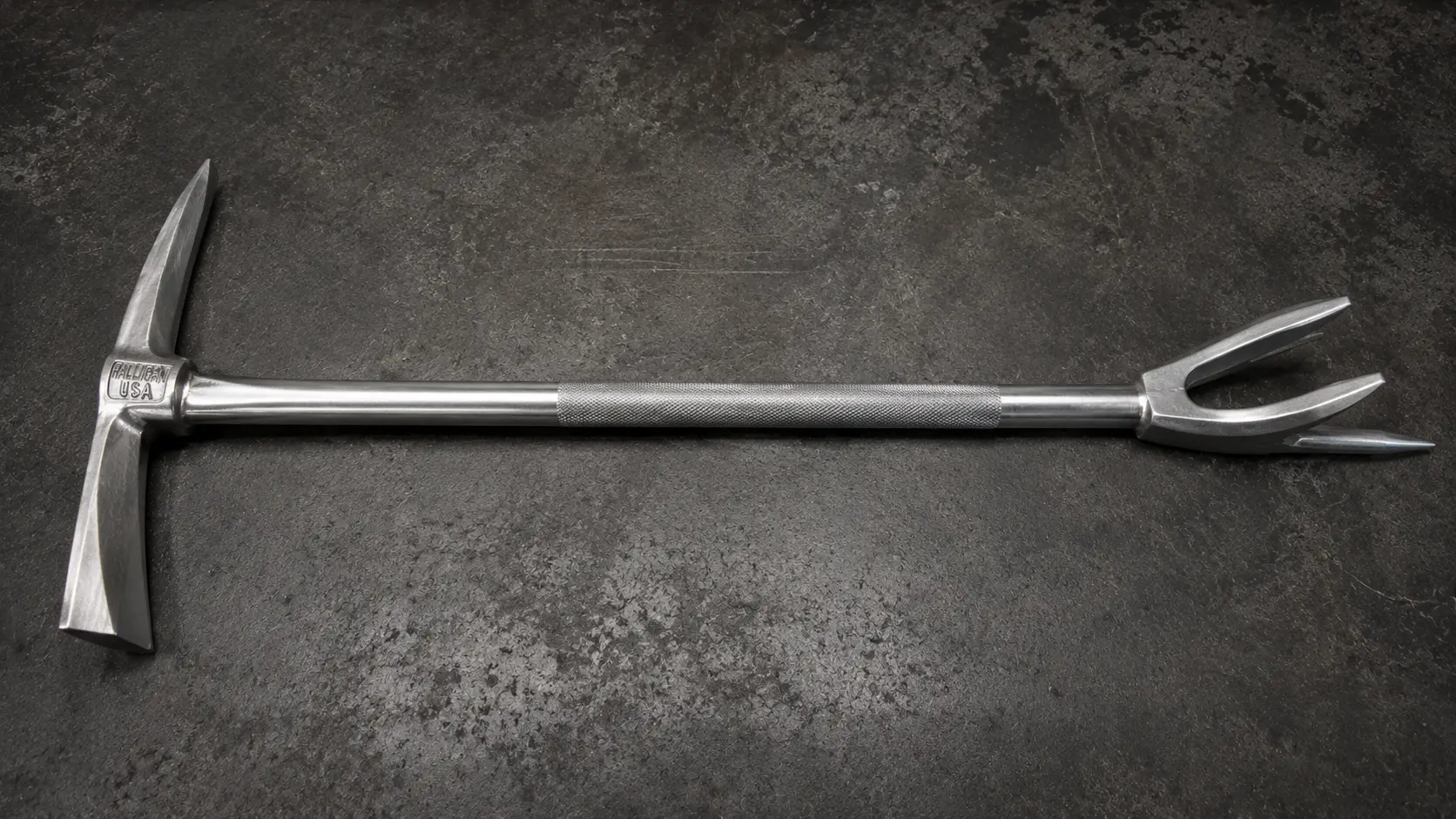

The Halligan bar has been on every structural fire apparatus in the United States for over 75 years. It was designed by a New York City firefighter who was dissatisfied with the tools available for forcible entry, built a better one, and had it adopted by FDNY within a few years. The design has changed almost nothing since 1948 — not because nobody tried to improve it but because the geometry that Hugh Halligan arrived at works so well across such a wide range of applications that modifications have generally made it worse, not better.
A standard Halligan is 30 inches long, weighs approximately 6 pounds, and has three working ends. With those three ends and a flathead axe to drive it, a firefighter can force most residential and commercial doors, breach drywall, remove windows, control utilities, and assist with vehicle extrication. No other hand tool in the fire service offers that breadth of function at that weight.
In this article:
Origin: Why Hugh Halligan Designed a New Tool
In the 1940s, FDNY used a combination of tools for forcible entry: a claw bar, a kelly tool, and a hux bar among them. Each had specific applications and limitations. Entry through a locked residential door required selecting the right tool for the lock type, which required assessment under stress, and frequently required carrying multiple tools to cover the range of door constructions encountered.
Hugh Halligan was a Deputy Chief with FDNY who concluded that a single tool with multiple working surfaces could replace the collection and perform better across the range of applications. He developed the design over several years, incorporating the fork and adze geometry that made the tool effective for both prying and striking applications, and had it manufactured in the early 1950s. FDNY adopted it, other departments followed, and by the 1960s it was standard equipment on structural fire apparatus across the country.
The Halligan bar is now manufactured by multiple vendors, in steel and in chrome-vanadium alloy, in sizes ranging from 24 to 36 inches. The basic geometry has not changed materially in 75 years.
The Three Working Ends
The adze
The adze end is the curved, flat, chisel-like working surface that performs the primary prying function of the tool. In a door entry application, the adze is driven into the gap between the door and the door frame at the lock point — creating a gap, developing purchase, and leveraging the door away from the strike plate or through the lock cylinder failure. The curve of the adze converts the straight driving force of a flathead axe blow into a rotational prying moment that multiplies the effective force applied to the lock point. The adze is also used for breaching drywall, lifting manhole covers, and prying apart materials in overhaul operations.
The fork
The fork end — sometimes called the claw end — has two curved tines that wrap around door frames, jam locks, and structural elements, providing a pulling grip that the adze cannot develop. Where the adze pushes into a gap, the fork wraps around something and pulls. In a door entry application, the fork end is used to pull the door away from the frame after the adze has created the initial gap — or as the primary entry tool on outward-swinging doors where the adze cannot be positioned effectively. The fork is also used for pulling ceiling material during overhaul, removing nails and staples, and gripping structural elements in collapse rescue.
The pike
The pike is the pointed tip at the end of the fork end of the bar. It penetrates materials that resist the flat surfaces of the adze and fork: drywall, rotted wood, hollow-core doors, glass, and thin metal panels. The pike is driven into a surface to create an entry point for the fork or adze, or used to punch through material that is blocking access. In vehicle extrication, the pike is used to initiate metal deformation at a specific point before the fork or adze widens the opening.
The Irons: Halligan and Flathead Axe as a Pair
The Halligan bar is designed to be used with a flathead axe — a flat-bladed axe with a poll (flat back face) rather than a pick on the opposite side of the blade. The flathead axe serves as the driving tool for the Halligan: its flat poll face drives the Halligan's adze into gaps with controlled force. The combination is called "the irons," and a two-firefighter irons team — one placing and holding the Halligan, the other striking with the axe — can force most residential doors in under 30 seconds using the set-and-hit technique.
The irons are carried as a pair, typically in a specific arrangement that allows both to be grabbed simultaneously: the Halligan stored with the fork around the axe head, the two tools held together in one hand or in a dedicated bracket. The ability to carry both in one load leaves one hand free for a door, a flashlight, or communication — a practical advantage in the entry sequence when both hands are not available for carrying tools.
The Set-and-Hit Technique
The set-and-hit is the standard Halligan entry technique for inward-swinging residential and commercial doors with conventional knob or lever locks. Two steps, executed together as a team:
Set: The Halligan firefighter places the adze end of the bar into the gap between the door edge and the door frame at the lock — either at the deadbolt level or the knob lock level depending on the door configuration. The adze is oriented with the flat face against the door and the curved face against the frame. Light hand pressure holds it in place at the target point.
Hit: The axe firefighter delivers a sharp, controlled strike to the top of the Halligan bar — not to the middle, but to the top of the bar above the adze, which drives the adze deeper into the frame gap and develops the leverage moment that forces the door. Two to four well-placed strikes on most residential door frames are sufficient to drive the adze to the depth where the door's lock cylinder or strike plate fails. The door opens.
The common mistake is using many light taps rather than fewer hard strikes. Light taps move the adze minimally and distribute the force over many blows without developing the leverage needed to fail the lock. Hard, controlled strikes at the correct angle — directly along the bar's axis, not at an angle — develop the force efficiently.
Through-the-Lock Entry
Set-and-hit works on most residential lock hardware but may not work on heavy security doors with reinforced frames, Abloy or high-security lock cylinders, or bars that cannot be driven into a reinforced frame gap. Through-the-lock entry is the technique for these situations: rather than forcing the door by frame failure, the entry team defeats the lock cylinder directly.
The pike end of the Halligan is used to punch through the lock cylinder face, destroying the key pins and allowing the cylinder to rotate freely (a technique called "picking" or "spinning" the cylinder using a specialized key tool). Once the cylinder is disabled, the Halligan's fork is used to rotate the cylinder as if it were a key, retracting the bolt and allowing the door to open. Through-the-lock entry takes longer than set-and-hit and requires more technique, but it is less destructive to the door frame — important when the door provides fire barrier function and needs to be closed again after entry.
Other Applications: Vehicles, Windows, Utilities
Vehicle extrication: The Halligan's pike is used to initiate deformation at a specific point on a vehicle door or pillar before hydraulic rescue tools finish the cut or spread. The adze is used to pry door hinges and to create working gaps for rescue tool placement. The Halligan is not a replacement for hydraulic tools in complex extrication but is frequently used as the first tool on scene while hydraulic tools are being set up.
Window removal: The adze end is effective for clearing glass from a window frame after a window is broken — running the adze around the frame to remove remaining glass fragments that could injure a firefighter or victim during egress. The pike can breach windows that cannot be reached by gloved fist.
Utility control: The adze can be used to close gas meters by positioning it against the gas shutoff valve handle and leveraging the valve to the closed position without requiring a separate shutoff key. This is useful when the gas shutoff tool is not immediately at hand and requires quick utility control at a fire scene.
Overhaul: The fork is used to pull ceiling material, wall sections, and flooring during overhaul — checking for hidden fire extension in wall and ceiling cavities without requiring firefighters to cut with a saw in a potentially gas-compromised environment. The Halligan's length provides reach into ceiling cavities from a standing position.
How to Select the Right Size
| Size | Best for | Trade-offs |
|---|---|---|
| 24-inch | Tight spaces, vehicle extrication, confined area work | Less leverage than standard — more strikes required for heavy doors |
| 30-inch (standard) | General structural firefighting — residential and light commercial | Best balance of leverage and maneuverability for most applications |
| 36-inch | Heavy commercial and industrial doors, steel doors requiring maximum leverage | Heavier and harder to position in tight door frame gaps |
Most departments standardize on the 30-inch bar. Individual assignments or specialty applications may call for a shorter or longer bar — rescue company members who work in confined spaces carry 24-inch bars alongside their 30-inch standard equipment. The 36-inch bar is less common but provides meaningful leverage advantage on the heavy steel security doors found in commercial occupancies in urban environments.
Alloys and Materials
Early Halligan bars were made from high-carbon steel — strong, but susceptible to rust and requiring maintenance. Modern production uses chrome-vanadium alloy, which provides improved hardness, wear resistance, and corrosion resistance without the weight penalty of heavier steel grades. Some manufacturers offer titanium Halligans that are significantly lighter at equivalent strength — useful for firefighters who carry the tool through extended interior operations where every pound of gear weight matters.
The working ends of a Halligan bar take significant repeated stress — the adze in particular is repeatedly driven with a striking force of 20 to 40 pounds per blow during entry operations. Cracks at the adze base or fork tine roots are the primary failure mode. Halligan bars should be inspected after any significant impact operations for crack initiation at these stress concentration points. A cracked Halligan bar should not be placed back in service — the failure mode under load can produce a fracture that leaves the firefighter without the tool at the moment of maximum application.





Comments 0
No comments yet. Be the first to share your thoughts!
Leave a Comment