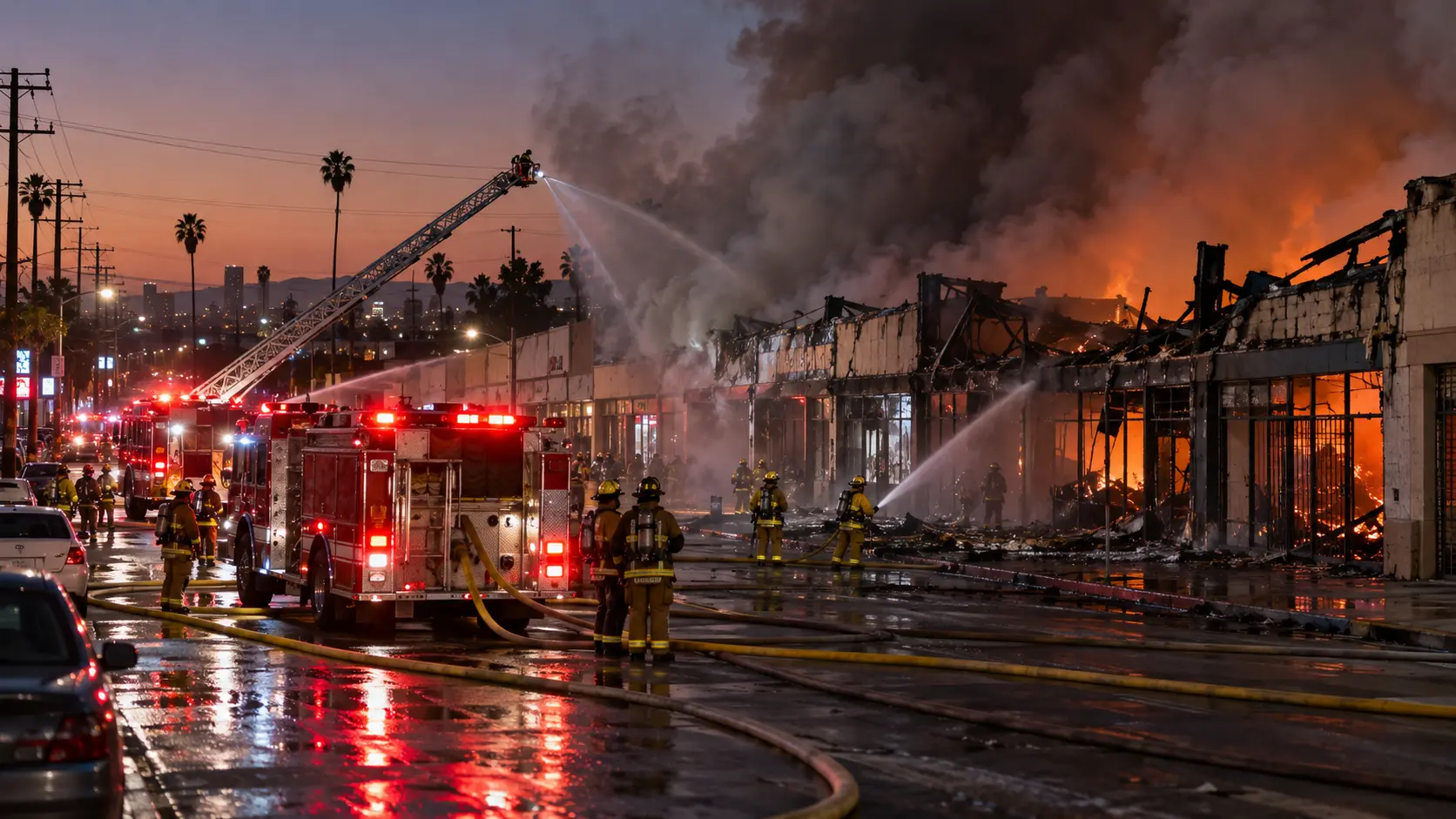

INGLEWOOD, California — Updated October 9, 2026 at 11:41 AM EDT. A five-alarm fire tore through a multi-tenant strip mall on East Hyde Park Boulevard on October 8. Two business roofs collapsed, firefighters shifted to defensive operations, and one person was taken to a hospital, according to local reporting.
At a glance:Location: 700 block of E. Hyde Park Boulevard, Inglewood. First response: shortly after noon PDT, October 8. Alarm level: five. Knockdown: 4:15 p.m. PDT. Injuries: one reported transported to hospital. Cause: under investigation.
What happened on East Hyde Park Boulevard?
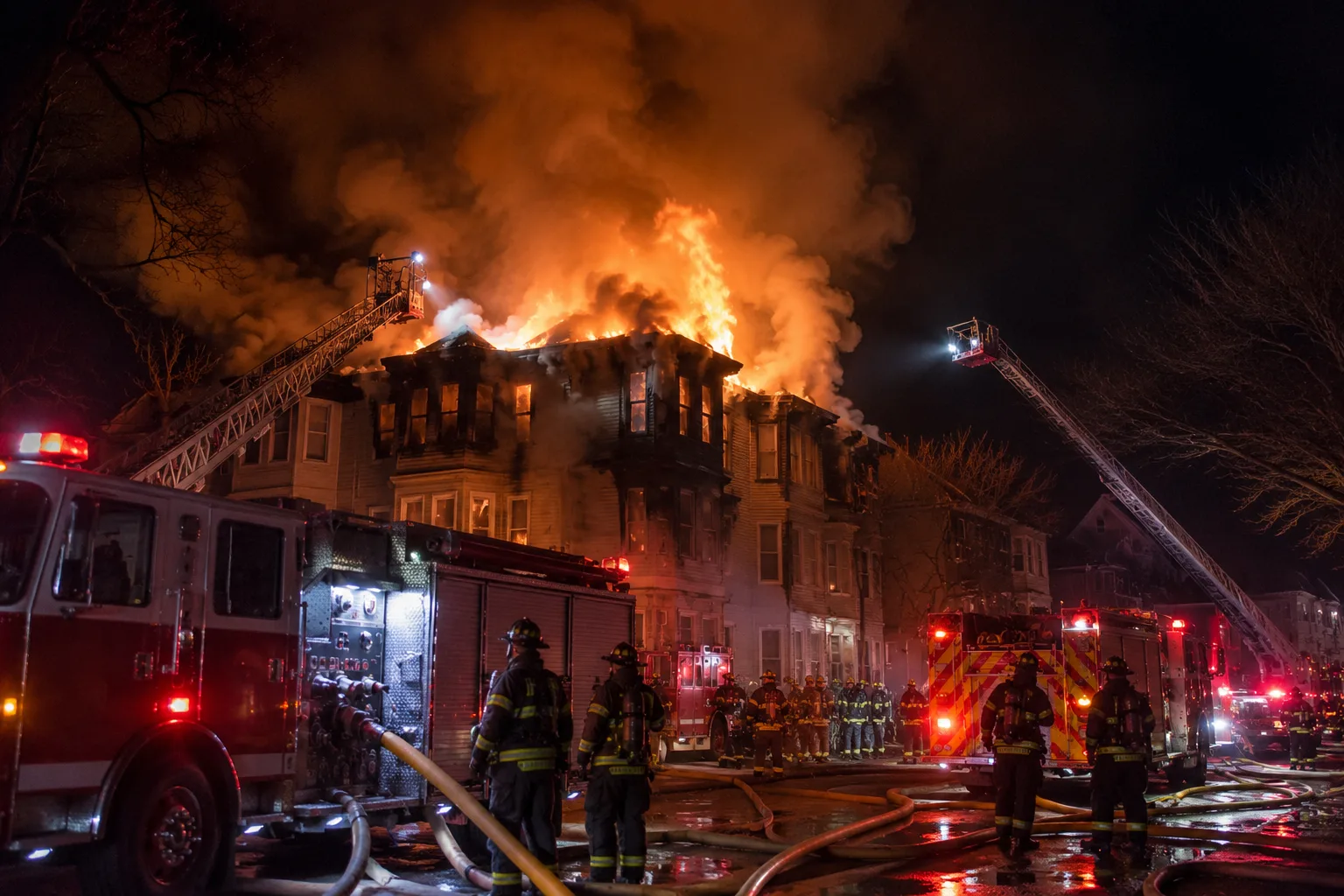
An intense fire tore through a row of businesses in Inglewood, California, on Thursday, October 8, 2026, sending smoke above the neighborhood and forcing firefighters to abandon roof-level operations as the structure deteriorated. The incident occurred in the 700 block of East Hyde Park Boulevard, just north of Edward Vincent Jr. Park. Video and local reporting showed flames emerging through the roof and large streams directed onto the building from outside.
The fire drew a county fire response that grew from multiple alarms to five alarms. By the end of the afternoon, officials had confirmed roof collapses involving two businesses. NBC Los Angeles reported that one person was transported to a hospital and that approximately 130 firefighters worked the fire before knockdown at 4:15 p.m. local time. The cause was not publicly established in the reports reviewed for this account.
Inglewood fire timeline: from the first call to knockdown
Just after noon, firefighters were called to the multi-unit commercial property. ABC7 placed the response at about 12:04 p.m.; CBS Los Angeles cited crews arriving at approximately 12:05 p.m. Other accounts described the fire as reported around 12:10 p.m. The small difference reflects how outlets characterized the initial call and response, rather than separate incidents.
At 12:23 p.m., a second alarm brought more resources. A third alarm followed at 12:37 p.m., according to local reports attributing the sequence to fire officials. Crews had initially worked at roof level, including efforts to make ventilation openings, but flames and structural compromise changed the operating conditions.
By about 1:15 p.m., news footage showed fewer visible flames, although smoke remained heavy and elevated streams continued. FOX 11 later reported that the incident reached five alarms by about 1:30 p.m. NBC Los Angeles reported a knockdown at 4:15 p.m., after which personnel were expected to continue searching for and extinguishing hot spots.
Knockdown means the main body of fire has been brought under control; it does not mean every hidden pocket has been extinguished or that a damaged structure is safe to enter. Extensive overhaul and investigation can follow the publicized knockdown time.
Why firefighters moved off the roof
Commercial-strip roofs can appear continuous from the street, but their load-bearing systems, concealed spaces and previous alterations may be difficult to judge while a fire is advancing. In Inglewood, crews were initially observed cutting roof openings for ventilation. As fire moved through the roof and portions collapsed, they withdrew and shifted to a defensive attack.
That change is not a failure of the first strategy. It is a response to a new risk picture. Roof work exposes personnel to weakening supports, falling through openings and a rapidly changing escape route. Firefighters must reassess the building as soon as its roof or structural members show signs of failure. ABC7 reported that the roof of two businesses ultimately collapsed.
An operational takeaway is the importance of timely roof-status reports between ventilation crews, interior companies and command. When the building can no longer support a reasonable interior or roof operation, large outside streams may help cool the fire and protect adjacent exposures while personnel remain clear of collapse hazards. Those are general firefighting principles, not a claim about every tactical order given at this incident.
What a five-alarm response means in this incident
An alarm level describes the resources an agency requests as an incident expands. It is not a universal measure of flame height, loss or the number of structures destroyed. Each department has its own assignment system. In this fire, escalating alarms supported additional engines, trucks, firefighters and incident-management capacity as flames spread across multiple business units.
The second alarm was reported at 12:23 p.m. and the third at 12:37 p.m. Later reporting from FOX 11 said the incident reached five alarms. That later update explains why early stories may describe the blaze as a two- or three-alarm fire. Those reports were snapshots of an evolving response, not necessarily contradictions.
For a prolonged commercial fire, additional companies may be assigned to exposure protection, hose-line supply, apparatus positioning, relief, firefighter accountability and extended overhaul. The exact deployment at the Inglewood property has not been published in the cited news reports, so those functions should be understood as the broader operational context.
Damage, injuries and businesses affected
The most clearly documented structural damage was to the roof. ABC7 reported that the Los Angeles County Fire Department confirmed roof collapses involving two businesses. Images published by local outlets also showed substantial smoke and fire spread along the connected commercial frontage. Officials had not supplied a definitive count of all businesses affected in the reporting reviewed here.
Early news updates stated that no injuries had been reported. Later, NBC Los Angeles reported that one person had been injured and transported to a hospital; the injury details and condition were not specified. Reporting cited here did not identify an injured firefighter. The later injury report should take precedence over preliminary stories that said no injuries were known.
The precise monetary loss and the condition of individual storefronts were not established in the cited coverage. Those figures should not be estimated from aerial photographs, which can obscure interior damage and the effects of water or smoke beyond the visibly burned area.
Where exactly was the fire in Inglewood?
The incident was in the 700 block of East Hyde Park Boulevard, north of Edward Vincent Jr. Park, in Inglewood in southern Los Angeles County. KTLA provided 730 E. Hyde Park Boulevard as the reported address. Other broadcasters used the block rather than a specific street number. Both descriptions refer to the same commercial fire.
The proximity to other occupied business units made limiting horizontal extension an important concern. A strip mall can contain multiple shops under connected roof areas; smoke moving behind ceilings or through common voids may complicate efforts to determine the true extent of a fire. Whether this particular building had shared concealed roof spaces has not been established in the available reporting.
What investigators still need to establish
As of the reports reviewed on October 9, officials had not announced a confirmed ignition source. Witness accounts, smoke patterns and social-media assertions cannot establish origin and cause by themselves. Investigators will need to evaluate the area of origin, electrical and mechanical systems, fire spread and any reliable witness or video evidence.
Also unconfirmed in the available sources were a full list of affected businesses, a final damage estimate and a detailed engineering account of the roof failures. Those facts should be added only when released by the responsible agencies or independently substantiated. This article will not infer a cause from the type of business present in the building.
Why this commercial fire matters to firefighters
The most important operational detail is the transition from crews working near or on the roof to an exterior defensive attack after the structure became unsafe. News footage can make a roof look like a flat working platform, yet smoke beneath the surface may conceal damage to the supporting members. Firefighters reading the incident should focus on how changing structural conditions alter both ventilation options and withdrawal decisions.
Another lesson is how quickly a seemingly localized storefront fire can require a much larger assignment. Connected occupancies, possible concealed routes of travel and the need to position elevated master streams can make access and accountability demanding. Large resource requests do not prove that an attack was ineffective; they can reflect the importance of getting sufficient personnel and water in place before additional exposures are lost.
For broader training context, AllFirefighter’s guides to building construction types, commercial fire tactics and fireground size-up address related concepts. These links are learning resources rather than evidence for the facts of this incident.
Sources and verification
This report separates confirmed event details from general fireground analysis. The figures and timelines above reflect reporting available at the New York publication time shown, and may change as agencies publish additional information.
- ABC7 Los Angeles — roof collapse and incident chronology
- FOX 11 Los Angeles — escalation to five alarms
- NBC Los Angeles — injury, staffing and knockdown
- CBS Los Angeles — arrival and third-alarm report
- KTLA / AOL — reported street address
Frequently asked questions
Where was the Inglewood strip mall fire on October 8, 2026?
The fire was in a multi-tenant commercial building in the 700 block of East Hyde Park Boulevard in Inglewood, California, north of Edward Vincent Jr. Park. KTLA identified the reported address as 730 E. Hyde Park Boulevard.
What time did the Inglewood commercial fire start?
Los Angeles County firefighters responded shortly after noon on Thursday, October 8, 2026. Reports put the response at about 12:04–12:10 p.m. Pacific time.
How many alarms was the Inglewood fire?
The incident reached five alarms, according to FOX 11. Earlier reports described the second alarm at 12:23 p.m. and the third at 12:37 p.m.
Did the roof collapse at the Inglewood strip mall?
Yes. ABC7 reported that fire officials confirmed roof collapses affecting two businesses. Firefighters withdrew from roof operations and fought the fire from defensive positions.
Were people injured in the Inglewood fire?
NBC Los Angeles reported one person was injured and transported to a hospital. The available reporting did not establish the person’s condition or the precise nature of the injury; no firefighter injuries were reported in the cited coverage.
How many firefighters responded to the Inglewood fire?
Approximately 130 firefighters fought the blaze, according to NBC Los Angeles, which reported knockdown at 4:15 p.m. Pacific time on October 8.
What caused the fire at the Inglewood shopping center?
The fire’s cause remained under investigation in the reports reviewed for this article. No ignition source was publicly confirmed in those accounts.
Comments 0
No comments yet. Be the first to share your thoughts!
Leave a Comment