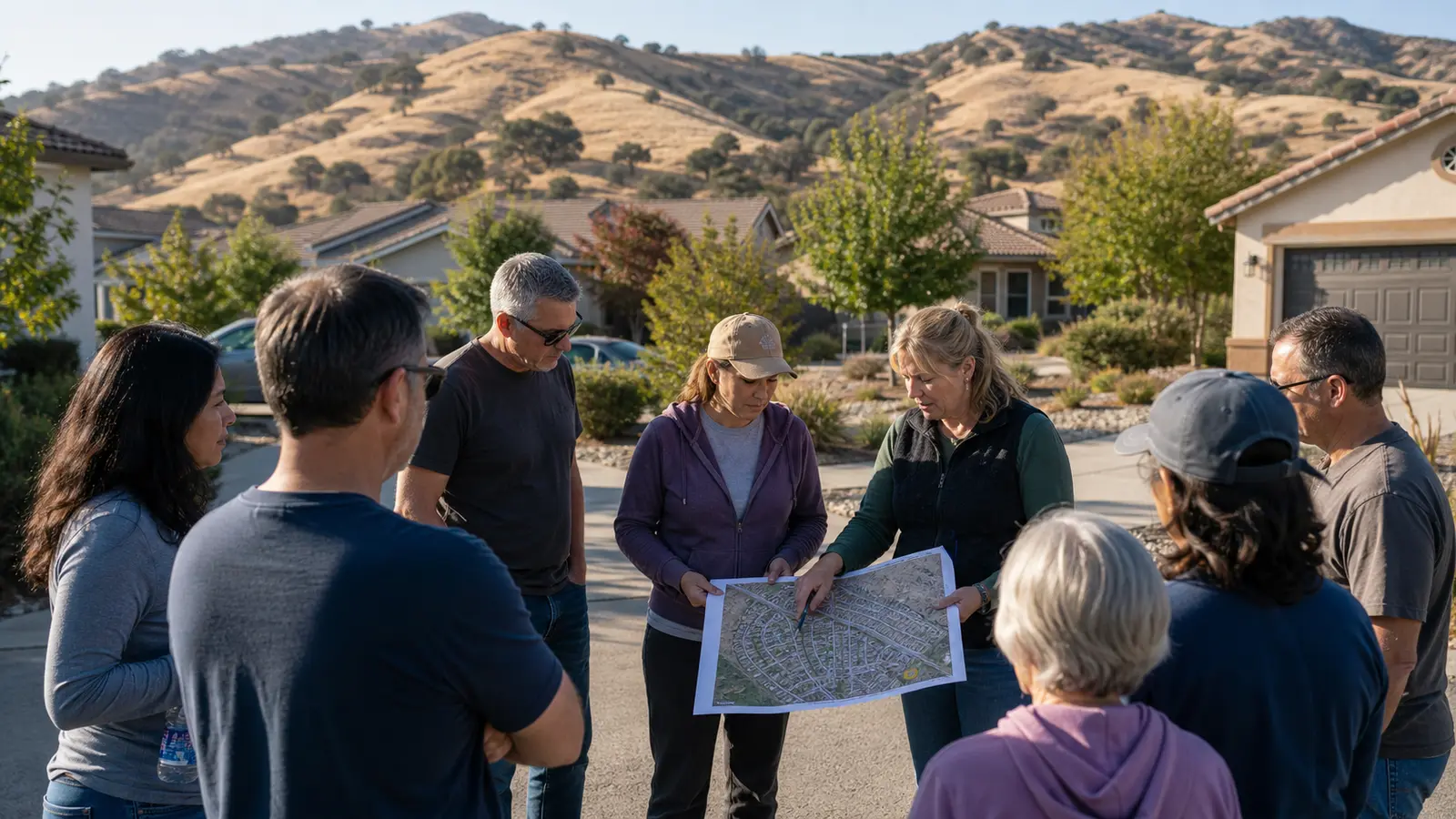
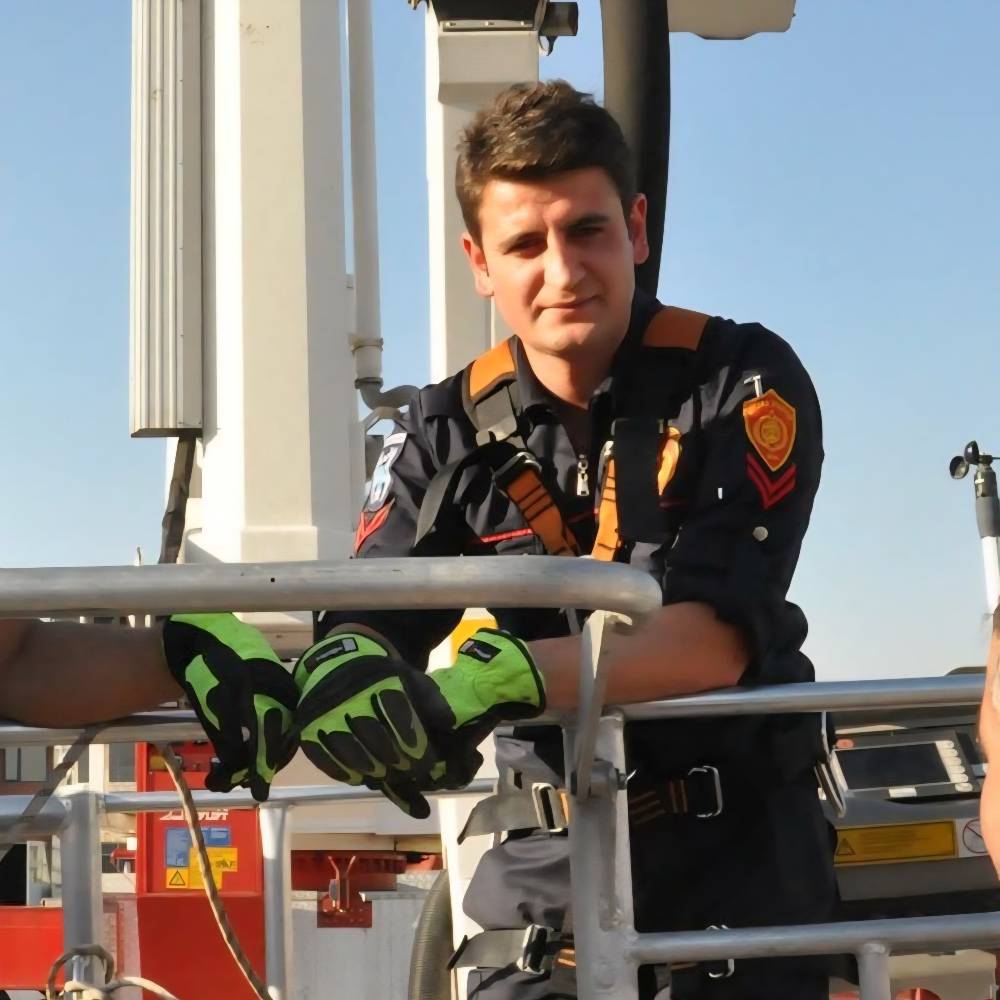
In the Palisades Fire in January 2026, some neighborhoods burned completely. Others — separated by only a few hundred feet of terrain, facing the same wind, the same ember cast, the same fire behavior — lost far fewer homes. The difference was not always the fire. Sometimes it was the neighbors.
Communities that had organized before the fire — that had mapped their vulnerable residents, coordinated their evacuation routes, established communication trees, identified which properties needed which specific preparation — survived those fires differently than communities that hadn't. Not because organized communities had better luck. Because collective preparation changes specific outcomes in specific ways: the elderly neighbor who didn't have transportation got a ride. The property with tall dry grass against the fence got a call from a neighbor before the fire reached it. The family that didn't receive the emergency alert found out through a text chain within minutes of the alert going out.
Wildfire community preparedness is one of the most consistently underutilized fire safety levers available. It costs almost nothing. It scales to any community size. And it produces outcomes that individual household preparation alone cannot, because some wildfire risks — isolated residents, blocked evacuation routes, horses and livestock that require specific handling, properties with access problems that need to be flagged for fire crews — require coordination across households to address.
In this article:
- Why organized communities survive differently
- NFPA Firewise USA — what it is and how to join
- The five core functions of a wildfire-ready neighborhood
- Mapping vulnerable residents — who needs help and what kind
- Community communication systems that work when power is out
- Evacuation route planning — what your community needs to know
- How to connect your neighborhood effort to the local fire department
- How to start a wildfire neighborhood watch in six steps
Why Organized Communities Survive Differently
Post-fire community assessments consistently identify a pattern: organized communities achieve faster evacuation, have fewer residents who are surprised by the fire's arrival, and report higher rates of prior preparation — defensible space, go-bags, early departure — than comparable unorganized communities facing the same fire event.
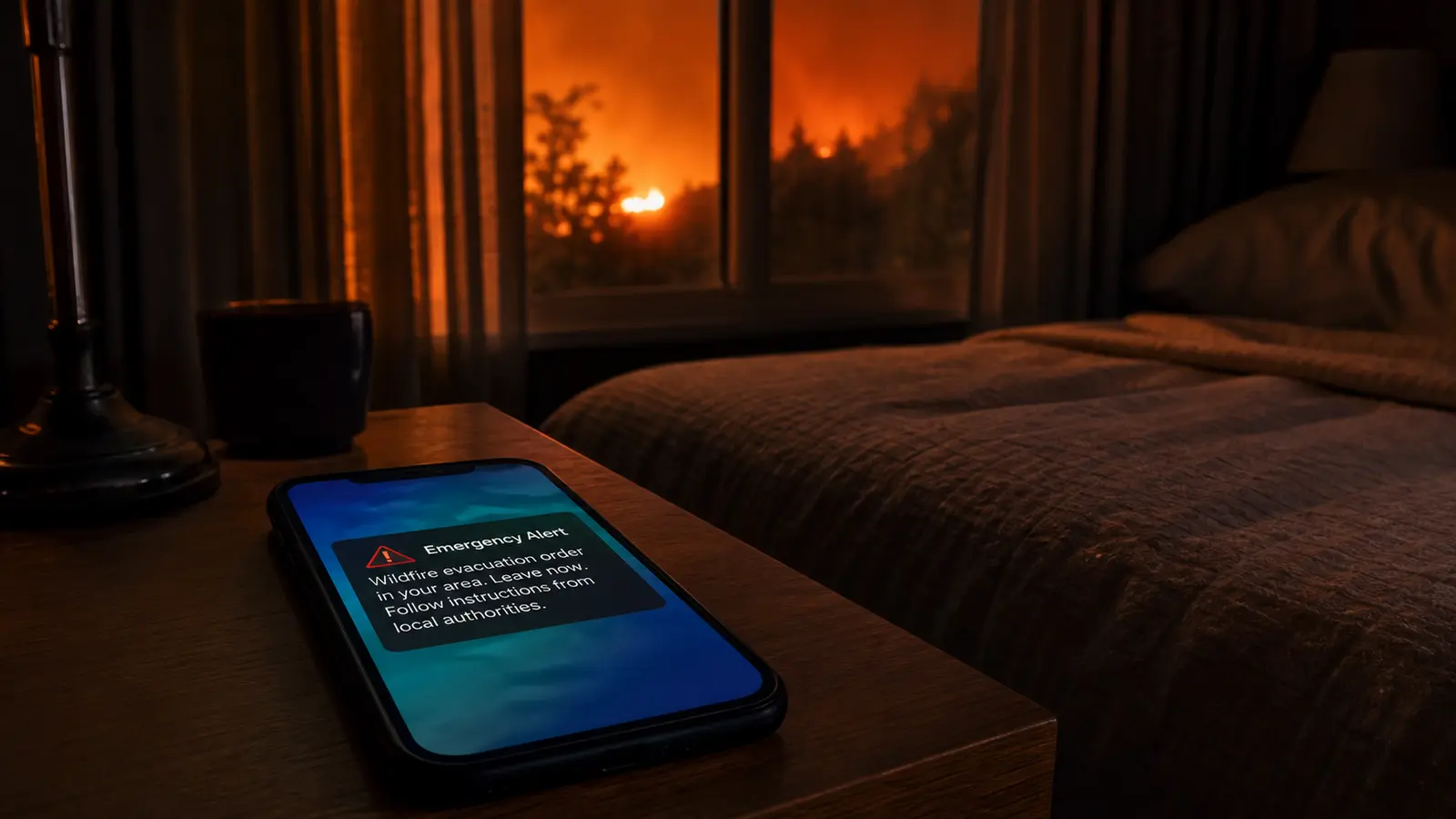
The mechanism is information velocity. In a wildfire event, the difference between 20 minutes of warning and 5 minutes of warning is often the difference between a successful evacuation and a near miss. Communities with active communication networks — text chains, Nextdoor groups, neighborhood emergency volunteers — receive and distribute information from the fire department, from residents who can see the smoke, and from neighbors closer to the fire, faster than the official notification system alone delivers it.
The second mechanism is collective capacity. Individual households can prepare their own properties and their own families. They cannot check on the elderly widow three houses down who doesn't have a car, or confirm that the family at the end of the cul-de-sac whose driveway is blocked by a dead oak actually has a way out, or ensure that the five households sharing a single-access road have coordinated their departure so they're not all trying to leave simultaneously in a traffic jam at the gate. Neighborhood organization converts individual preparation into collective capability for the problems that individual preparation alone doesn't solve.
NFPA Firewise USA — What It Is and How to Join
Firewise USA is the National Fire Protection Association's community recognition and support program for wildland-urban interface communities that organize around wildfire risk reduction. As of 2026, more than 1,800 communities across 44 states participate. It is free to join and provides a framework, resources, and national recognition that can support insurance discount applications and grant funding for community fuel reduction projects.
To become a Firewise USA site, a community needs four things: a local champion (a resident who takes the lead), a local fire department or fire agency that agrees to serve as a technical advisor, a community risk assessment, and a community action plan with a documented investment of at least $25 per household per year in wildfire risk reduction activities. That investment can be in the form of labor hours — residents doing defensible space work count toward the dollar threshold at a standard hourly rate. The $25 floor is intentionally low; most active Firewise communities invest substantially more.
The Firewise designation has become increasingly relevant to the insurance market. Some carriers explicitly offer premium discounts to homeowners in certified Firewise communities. Oregon's 2026 legislation requiring carriers to consider mitigation work in rate-setting is expected to make community-level certification more directly valuable in that market. The connection between Firewise certification and insurance access is still developing nationally, but the trajectory is toward greater formal recognition.
The Five Core Functions of a Wildfire-Ready Neighborhood
Effective wildfire neighborhood organizations consistently build capacity in five areas. Each addresses a specific gap that individual household preparation cannot fill:
| Function | What it does | Why individuals can't do it alone |
|---|---|---|
| Rapid warning | Distribute fire alerts faster than official channels alone | Official alert systems have enrollment gaps; a text chain reaches neighbors who didn't register |
| Vulnerable resident support | Identify and assist residents who cannot self-evacuate | You may not know who in your neighborhood can't drive or needs oxygen equipment |
| Evacuation coordination | Prevent traffic bottlenecks, ensure everyone departs safely | Uncoordinated departure from a single-access road creates gridlock that traps everyone |
| Fuel reduction | Community-wide defensible space and shared property clearing | A single un-cleared property can carry fire to a neighbor who has done everything right |
| Fire department liaison | Provide local knowledge to responding crews | Responding crews don't know which driveway has the locked gate or which road floods |
Mapping Vulnerable Residents — Who Needs Help and What Kind
Wildfire fatalities are disproportionately concentrated in older adults, people with mobility limitations, people who live alone, and people without personal vehicles. These are also the people least likely to proactively self-identify as needing evacuation assistance. A neighborhood watch that creates a confidential resident needs map — who has mobility limitations, who needs a ride, who has livestock or animals requiring specific equipment, who relies on electricity-dependent medical equipment — converts that invisible vulnerability into a plan.
This mapping is sensitive. Not every resident will want to disclose their limitations or needs. A successful neighborhood watch approach frames the needs map as a community resource — not a liability list — and ensures that the information is held by a small number of trusted neighbors, not circulated widely. Residents with privacy concerns can simply designate a single neighbor as their emergency contact who knows their situation without that information being entered into any document.
County emergency services offices often maintain functional needs registries — voluntary lists of residents who need evacuation assistance — and will share the general scope of that need with neighborhood organizations working in coordination with the county. Making sure your neighborhood organization knows about the county registry, and that residents who need assistance are enrolled, closes a gap that otherwise falls through in the minutes before evacuation orders are issued.
Community Communication Systems That Work When Power Is Out
Public Safety Power Shutoffs — utilities preemptively cutting power during high fire weather — are now a standard feature of fire season in California and are being adopted in other western states. A PSPS event removes cellular service in some areas, reduces internet connectivity as backup generators run down, and eliminates landline service. The community communication system that relies entirely on smartphone notifications and internet-connected platforms has a significant single point of failure.
Text chains are the baseline. A SMS group that includes all registered households in the neighborhood can distribute alerts faster than official systems and works as long as cellular service is functional. Text uses significantly less bandwidth than voice calls, making it more reliable when networks are congested during a major event.
GMRS and ham radio provide communication when cellular fails. General Mobile Radio Service (GMRS) radios require an FCC license (simple application, $35, no test, covers a household for 10 years) and provide reliable short-range communication independent of cellular infrastructure. Several wildfire-affected California communities have organized GMRS radio networks that function as their backup emergency communications during PSPS events.
Physical rally points and knock procedures remain the last-resort backup. Designate a neighbor who will knock on specific doors if electronic communication fails. This is not a technology solution — it is the pre-technology solution that remains effective when everything else fails. Communities that have established door-to-door notification chains as a backup have successfully evacuated residents who received no electronic alert.
Evacuation Route Planning — What Your Community Needs to Know
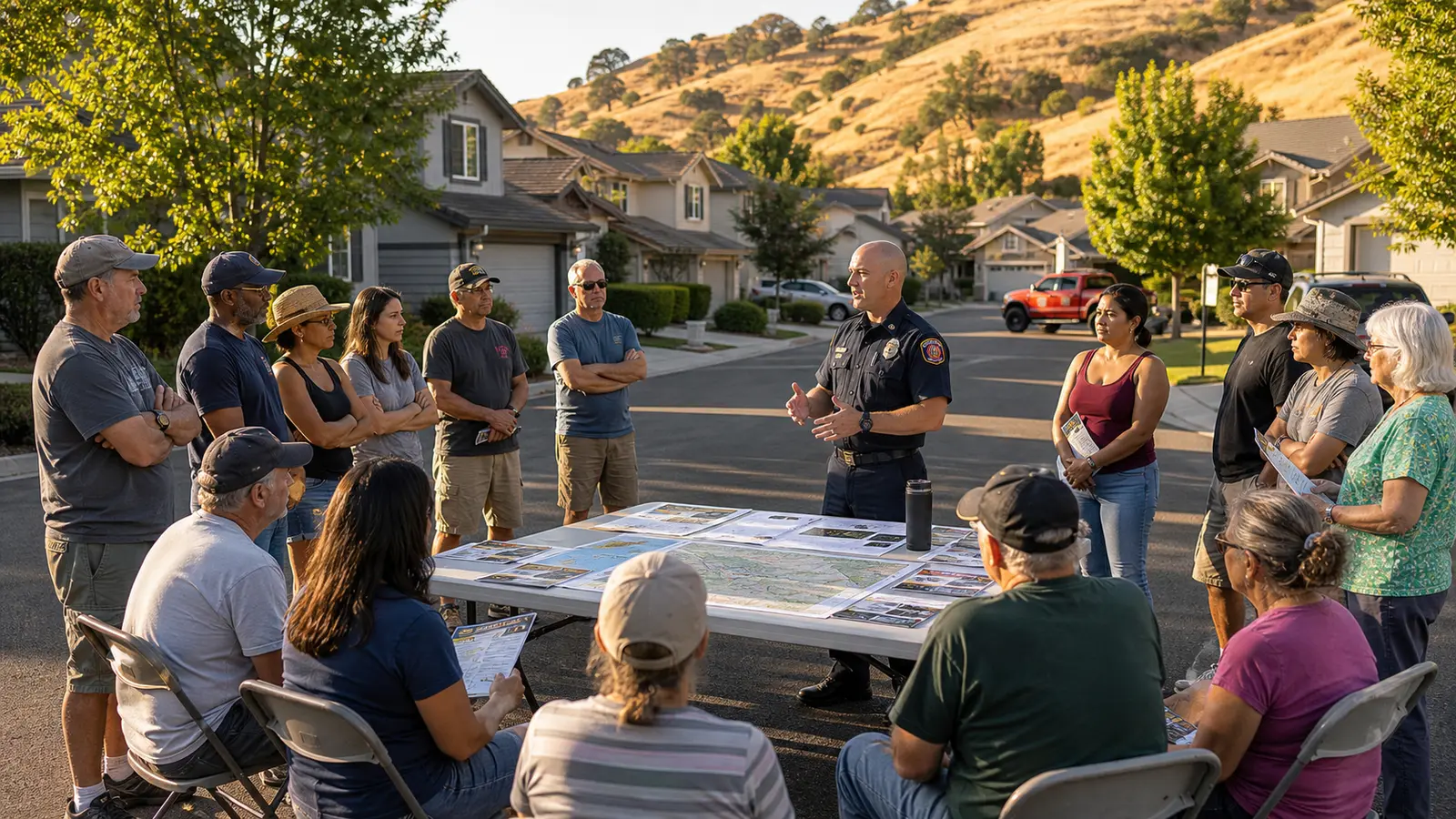
Single-access communities — neighborhoods with one road in and one road out — are the highest evacuation risk category in wildland-urban interface areas. When that single road is congested by simultaneous departure from all households, or when the road is threatened by the fire itself, options become limited very quickly. Community evacuation route planning addresses this before the emergency rather than improvising during it.
Key questions every WUI neighborhood should have answered before fire season:
- What are the primary and alternate evacuation routes? Are the alternate routes paved, passable in a passenger car, and accessible without crossing private property?
- Which route becomes unusable first depending on which direction the fire approaches? If the fire comes from the south, does the primary route remain clear?
- Are there gates, locked barriers, or road grade issues that would prevent emergency vehicles from accessing the neighborhood or residents from exiting?
- How long does it take to evacuate all households sequentially on the primary route? At what point does the road capacity saturate if all households depart simultaneously?
- Where is the nearest official evacuation shelter, and what route does it require?
Most county sheriff's offices and OES agencies will walk through these questions with a neighborhood organization that requests the conversation. Fire departments can provide input on road access issues that affect crew response. The road width and turnaround capacity that affects whether a fire engine can serve your neighborhood is the same capacity that affects whether all your neighbors can leave simultaneously.
How to Connect Your Neighborhood Effort to the Local Fire Department
The fire department relationship is the most operationally valuable connection a wildfire neighborhood organization can build. What fire departments want from organized communities:
Local knowledge. Which driveway has the locked gate. Which road floods in the first rain. Which property has horses that will need to be moved before the owner can leave. Which resident is unlikely to leave on their own. This information changes how a responding crew prioritizes addresses during a wildfire event, and it is information that fire crews cannot acquire on their own without prior community contact.
Fuel reduction investment. Fire departments in WUI areas want communities to do the fuel reduction work. Many departments offer free defensible space inspections and will work with neighborhood organizations to identify community-scale fuel reduction priorities — shared fence lines, common area vegetation, road corridor clearance — that individual household work doesn't address.
Pre-incident planning data. A neighborhood organization that can provide a map of properties, access road conditions, water supply locations, and vulnerable resident information to the local fire department before a season starts is providing pre-incident planning data that responding crews would otherwise have to develop from scratch during an incident. Some departments actively request this information from organized communities and incorporate it into their incident pre-plans.
How to Start a Wildfire Neighborhood Watch in Six Steps
- Contact your local fire department or CAL FIRE unit. Tell them you want to organize your neighborhood around wildfire preparedness. Ask for a community liaison or prevention officer. Most WUI-area departments have staff for exactly this. They can provide materials, structure, and will often attend your first neighborhood meeting.
- Call a first meeting. You need five to ten engaged neighbors to form a functional core. A flyer on mailboxes or a Nextdoor post is enough. Don't wait for perfect organization — a meeting of eight neighbors with a whiteboard is how this starts.
- Build the communication tree. At the first meeting, collect phone numbers and establish the text chain. Assign a backup contact for each household in case the primary is unreachable. Test it — send a non-emergency message within a week so everyone confirms they received it.
- Map the vulnerable residents. Through casual conversation at the meeting or follow-up, identify who in the neighborhood would need evacuation assistance. Assign a neighbor — who agrees to this — to be the emergency contact for each vulnerable household.
- Walk the evacuation routes. As a group. Drive the primary route and the alternate. Find the bottlenecks. Locate the locked gate. Document what you find and share it with the fire department.
- Apply for Firewise USA recognition. Once you have a core group, a fire department liaison, and a basic action plan, you can apply for Firewise recognition through the NFPA. The application process itself is a useful organizing exercise — it structures the community risk assessment and action planning in a way that produces the documentation you need for insurance applications and grant funding.
The fire service has a clear view of the difference between communities that have organized before a fire and those that haven't. The difference shows up in evacuation timing, in which residents are accounted for, in how quickly a crew gets the local knowledge they need to make structure triage decisions, and in how many people are waiting in their driveways for guidance that arrives too late.
Wildfire neighborhood organization is not complicated. It doesn't require a formal nonprofit or a large budget. It requires one neighbor willing to make the first call to the fire department and schedule the first meeting. The communities that are best prepared for the 2026 fire season started that conversation last winter. The communities preparing now are ahead of the ones that wait until the first evacuation order comes out for a neighbor three miles away.

Comments 0
No comments yet. Be the first to share your thoughts!
Leave a Comment