Why Lithium Battery Fires Are Fundamentally Different
A conventional structure fire burns as long as three things are present: fuel, oxygen, and heat. Remove any one of those elements and the fire stops. This is the foundation of every fire suppression strategy ever developed. Lithium battery fires break this rule.
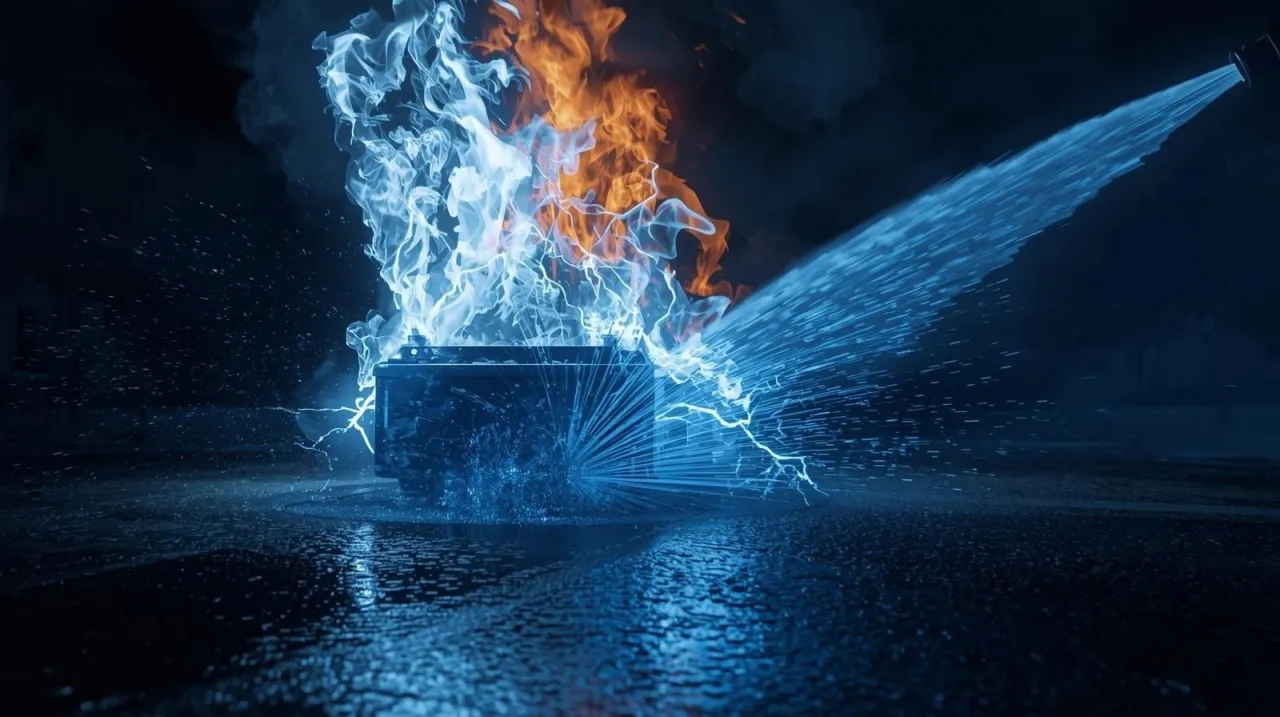
A lithium battery in thermal runaway is both the fuel and the ignition source simultaneously. The internal chemical reaction generates its own heat and does not require external oxygen to sustain itself. You can cool it with water, deprive it of oxygen, and the internal reaction may continue regardless — re-igniting minutes, hours, or even days later.
30,000+Gallons used in some EV fire suppression operations
1,500°FTemp inside battery pack during full thermal runaway
30 ppmIDLH for hydrogen fluoride — primary toxic gas product
DaysRe-ignition risk window after apparent suppression
What Is Thermal Runaway?
Thermal runaway is a cascade failure process within individual battery cells that, once initiated, is extremely difficult to stop:
PHASE 1 Onset
Cell temperature rises above safe range (>60–80°C)
Overcharging, external heat, mechanical damage, or internal short circuit. At this stage, cooling or disconnecting power can still prevent runaway.
PHASE 2 SEI
Electrolyte interphase breaks down (~90–120°C)
The SEI layer decomposes, releasing heat. Cell vents white or gray vapor — a critical warning sign that runaway is imminent.
PHASE 3 Runaway
Separator melts, cathode decomposes (~130–180°C)
Internal short circuit. Temperature escalates hundreds of degrees in seconds. Electrolyte vaporizes and ignites. Reaction is now self-sustaining.
PHASE 4 Cascade
Adjacent cells reach runaway temperatures
Heat propagates through the entire pack. EV packs contain thousands of cells — complete cascade can take minutes to hours.
PHASE 5 Re-ignition
Suppressed battery retains internal thermal energy
Water cools the surface but cannot remove energy from intact cells. Re-ignition risk persists until all cell temps are confirmed stable.
Toxic Gases Produced by Lithium Battery Fires
Hydrogen Fluoride (HF)
🔴 IDLH: 30 ppm — Extremely Toxic
Source: Decomposition of LiPF₆ electrolyte saltRisk: Severe respiratory damage; delayed pulmonary edema; potentially fatal. Symptoms may not appear for 8–24 hours after exposure.
Carbon Monoxide (CO)
🔴 IDLH: 1,200 ppm
Source: Incomplete combustion of carbon-based materialsRisk: Asphyxiation; impairs oxygen transport in blood
Hydrogen Cyanide (HCN)
🔴 IDLH: 50 ppm
Source: Combustion of nitrogen-containing cathode materialsRisk: Cellular hypoxia; rapid incapacitation at high concentrations
Source: Electrolyte decompositionRisk: Explosion risk in confined spaces; fuel for re-ignition
Critical PPE Note for Firefighters: Full SCBA is mandatory at any lithium battery fire scene — not just when in smoke, but whenever downwind. HF gas below detectable smell can cause fatal delayed pulmonary edema. Any firefighter who suspects HF exposure should seek immediate medical evaluation regardless of how they feel at the time.
Lithium Battery Fire Types: Where the Risk Appears
🚗
Electric Vehicles
Largest packs (40–100+ kWh); highest water demand; re-ignition risk highest; manufacturer ERGs essential
🚲
E-Bikes & Scooters
Most common residential source; charged inside homes; third-party batteries dramatically increase risk
📱
Consumer Electronics
Phones, laptops — smaller fires but stored near flammable materials; swell before ignition
🏭
Energy Storage (ESS)
Grid-scale and home solar batteries; cascade in enclosed space creates extreme explosion risk
✈️
Aviation & Cargo
Among the most dangerous aviation scenarios; limited suppression access; several aircraft losses attributed to undeclared shipments
🏠
Residential Storage
Home solar backup batteries; wall-mounted in garages; growing with residential solar adoption
How Firefighters Respond to EV Battery Fires
1
Size-Up & Approach
Identify vehicle type; locate manufacturer ERG via NFPA EV app or QR code; establish upwind approach.
⚠️ Do not assume EV is off — 400–800V DC present even in shutdown vehicles.
2
Suppression
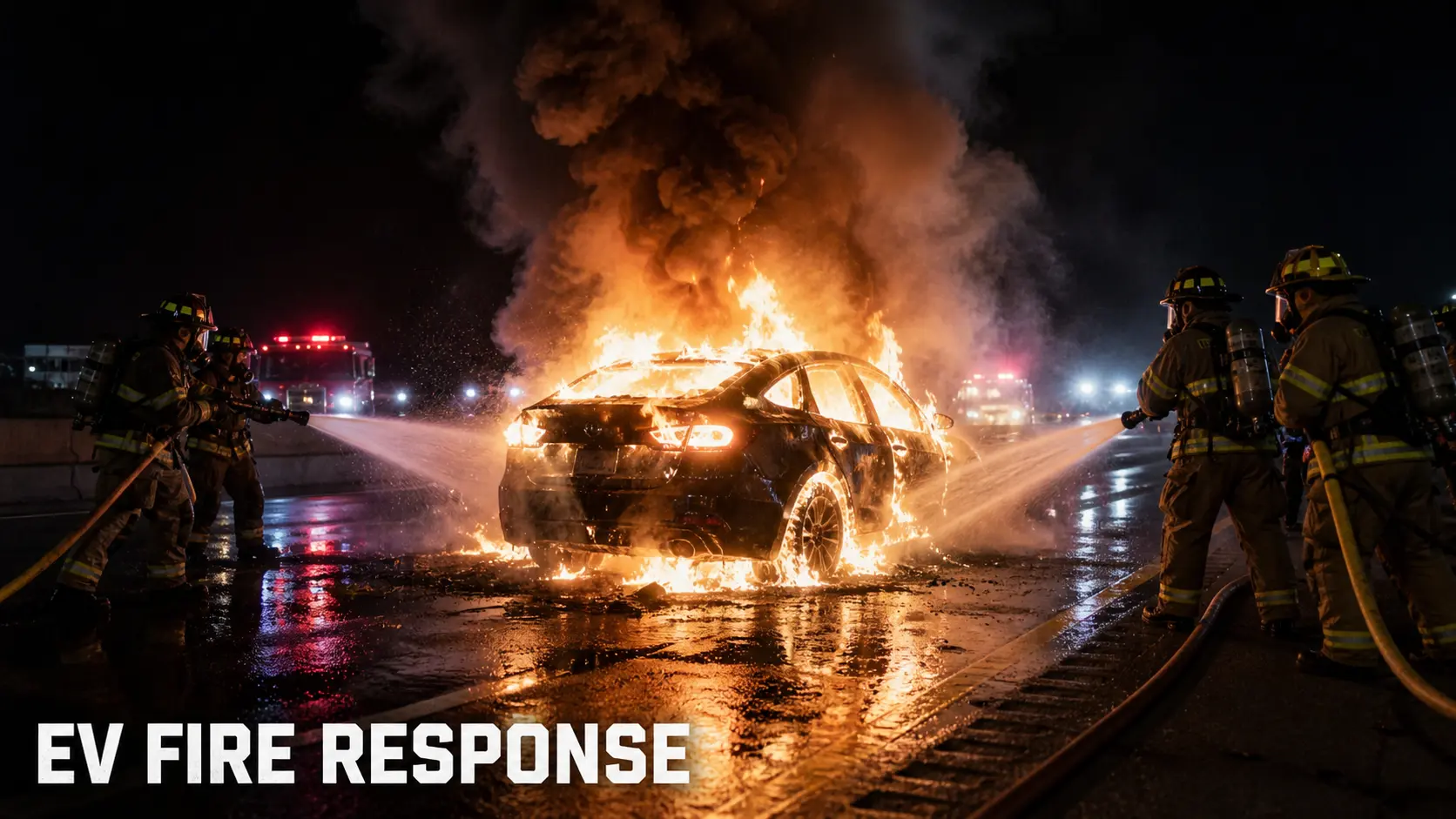
High-volume water directly to battery pack undercarriage; 2½" or master stream; goal is cooling, not extinguishment.
⚠️ Do not use CO₂, dry chemical, or foam — water is the only effective cooling agent.
3
Disconnection
12V auxiliary battery or manual service disconnect (MSD) per vehicle ERG if accessible and safe.
⚠️ Never cut high-voltage orange cables without specific EV training.
4
Monitoring
Maintain thermal imaging of battery pack after flames are suppressed. Vehicle not cleared until pack temperature is stable for extended period.
5
Transport & Disposal
Tow to open area away from structures. Consider EV fire blanket or submersion trailer.
⚠️ Never store fire-involved EV in enclosed structure — re-ignition risk.
Homeowner Battery Safety Guide
🚲 E-Bike / E-Scooter
Risk: Charging fires; exit-blocking storage
Use OEM charger only. Never charge overnight. Store away from exit routes. Install smoke alarm in charging area.
💻 Laptop / Phone
Risk: Swollen battery; charging on soft surfaces
Never charge on beds or sofas. Replace swollen batteries immediately. Use hard ventilated surface for charging.
🚗 Electric Vehicle
Risk: Garage fire; re-ignition in attached garage
Don't charge immediately after heavy use. Install smoke alarm in garage. Never park damaged EV in attached garage.
🔧 Power Tools
Risk: Third-party batteries; charging in tool bags
Use only manufacturer batteries. Remove from charger when complete. Never charge in enclosed bags or cases.
Lithium battery incidents increasingly intersect with hazardous materials response. For DOT hazmat classifications and first-action guides relevant to battery transport incidents, see the AllFirefighter Hazmat Hub. For broader fire science context see our fire behavior guide and our analysis of hidden home fire hazards.
Comments
0
No comments yet. Be the first to share your thoughts!
Lithium battery fires are uniquely difficult to extinguish because of a process called thermal runaway — a self-sustaining exothermic reaction that occurs within battery cells when they overheat. Once thermal runaway starts in one cell, the heat generated is sufficient to trigger the same reaction in adjacent cells, causing a cascade failure that progresses through the entire battery pack. Unlike conventional fires that require external heat to sustain combustion, a battery in thermal runaway is simultaneously its own fuel and its own ignition source. Water can cool the external temperature but cannot stop the internal chemical reaction; the battery can re-ignite hours or days after it appears to be extinguished. Complete submersion in water for extended periods is currently the most reliable suppression method for fully involved lithium battery packs.
Significantly more than a conventional vehicle fire. A standard vehicle fire typically requires 500–1,000 gallons of water. Electric vehicle battery fires have required anywhere from 3,000 to over 30,000 gallons of water in documented incidents, depending on the battery size, state of charge, and how far thermal runaway has progressed before suppression begins. Some departments have adopted specialized EV fire blankets or submersion trailers that allow the entire vehicle to be submerged in water, which is more water-efficient than continuous hoseline application.
Lithium battery fires produce a hazardous mixture including hydrogen fluoride (HF) — extremely toxic with IDLH at just 30 ppm — plus carbon monoxide, hydrogen cyanide, benzene, methane, and ethylene. HF is particularly dangerous because symptoms of exposure may not appear until 8–24 hours after contact. Firefighters should wear full SCBA at any battery fire scene, even when not in direct smoke.
Yes — re-ignition is one of the most significant hazards. After a battery fire appears to be extinguished, thermal energy trapped within the battery pack can continue to drive internal reactions that eventually re-ignite the pack. Re-ignition has been documented hours and in some cases days after the initial fire appeared to be out. Homeowners should never park a vehicle with a damaged or previously fire-involved battery pack in an attached garage.
Proportionally, they present a very high residential fire risk. While smaller than an EV pack, these devices are charged and stored inside homes — often near exits. Battery fires occur most frequently during charging, and numerous fatal residential fires have been attributed to e-bike and e-scooter batteries. Inexpensive third-party batteries that lack proper battery management systems dramatically increase the risk.
Only use the manufacturer-supplied charger; do not charge overnight or unattended; do not store batteries in locations that block exit routes; install smoke and CO alarms where batteries are charged; let batteries cool after heavy use before charging; never charge a swollen or damaged battery; store e-bikes and scooters away from living spaces if possible; if a device begins to overheat or smoke, disconnect immediately and move outdoors if safe.




Comments 0
No comments yet. Be the first to share your thoughts!
Leave a Comment