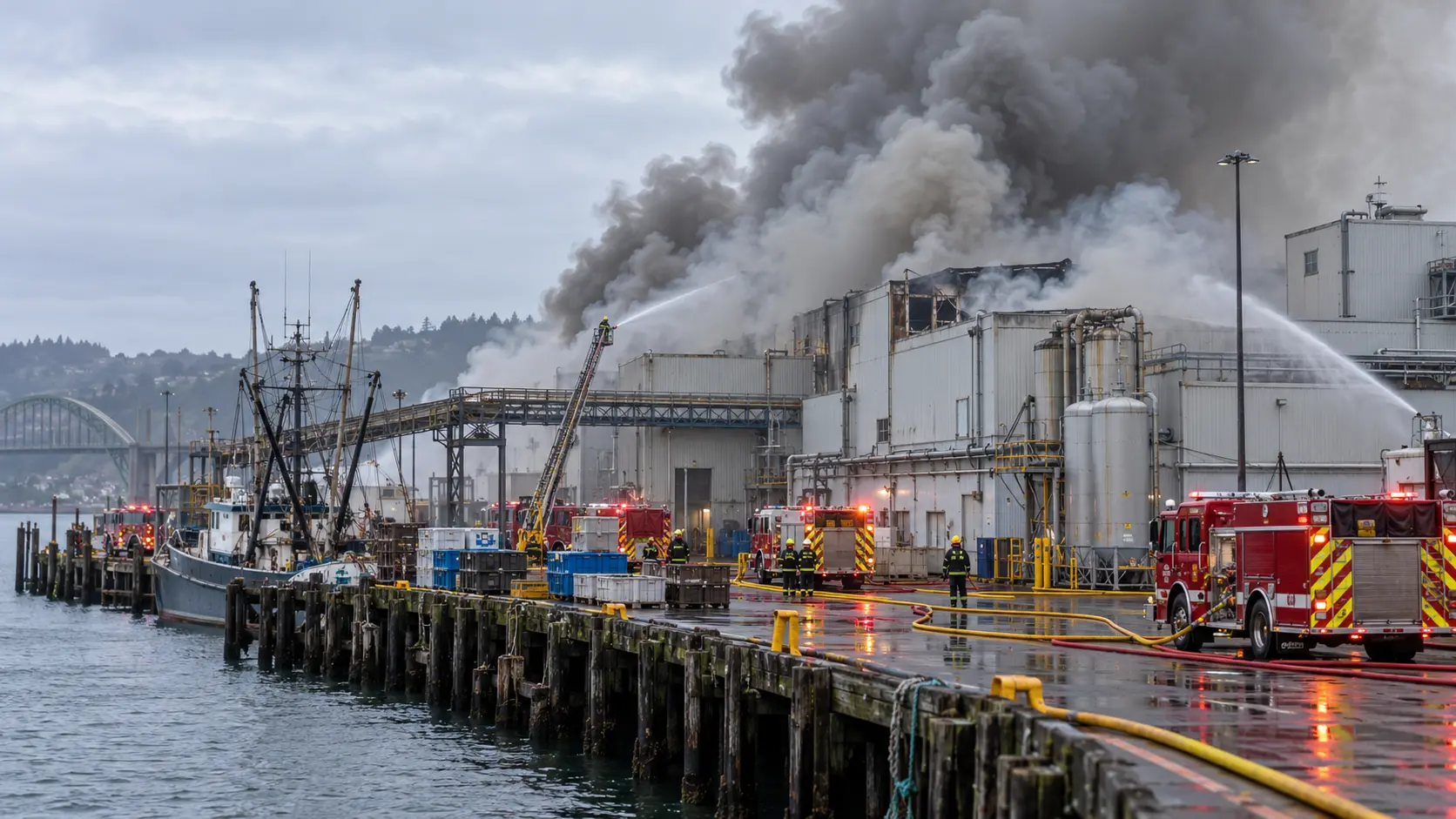
NEWPORT, Oregon — October 26, 2026. A fire at a Pacific Seafood processing and cold-storage facility on Newport's Historic Bayfront sent thick smoke over the waterfront Sunday morning, October 25. The incident triggered a broad initial evacuation, a regional firefighting response and a hazardous-materials deployment because the building contained anhydrous ammonia used for refrigeration. By Sunday evening, officials said the tanks appeared intact and the immediate evacuation area had been reduced. The cause of the fire had not been established.
What happened at the Pacific Seafood plant?
Emergency calls began at about 8:51 a.m. Sunday, according to reporting based on Newport officials. The fire involved a seafood processing facility on the Bayfront near Yaquina Bay, an area that combines working waterfront businesses with visitor destinations. Crews had to manage both the flames and the consequences of smoke moving through a populated coastal neighborhood.
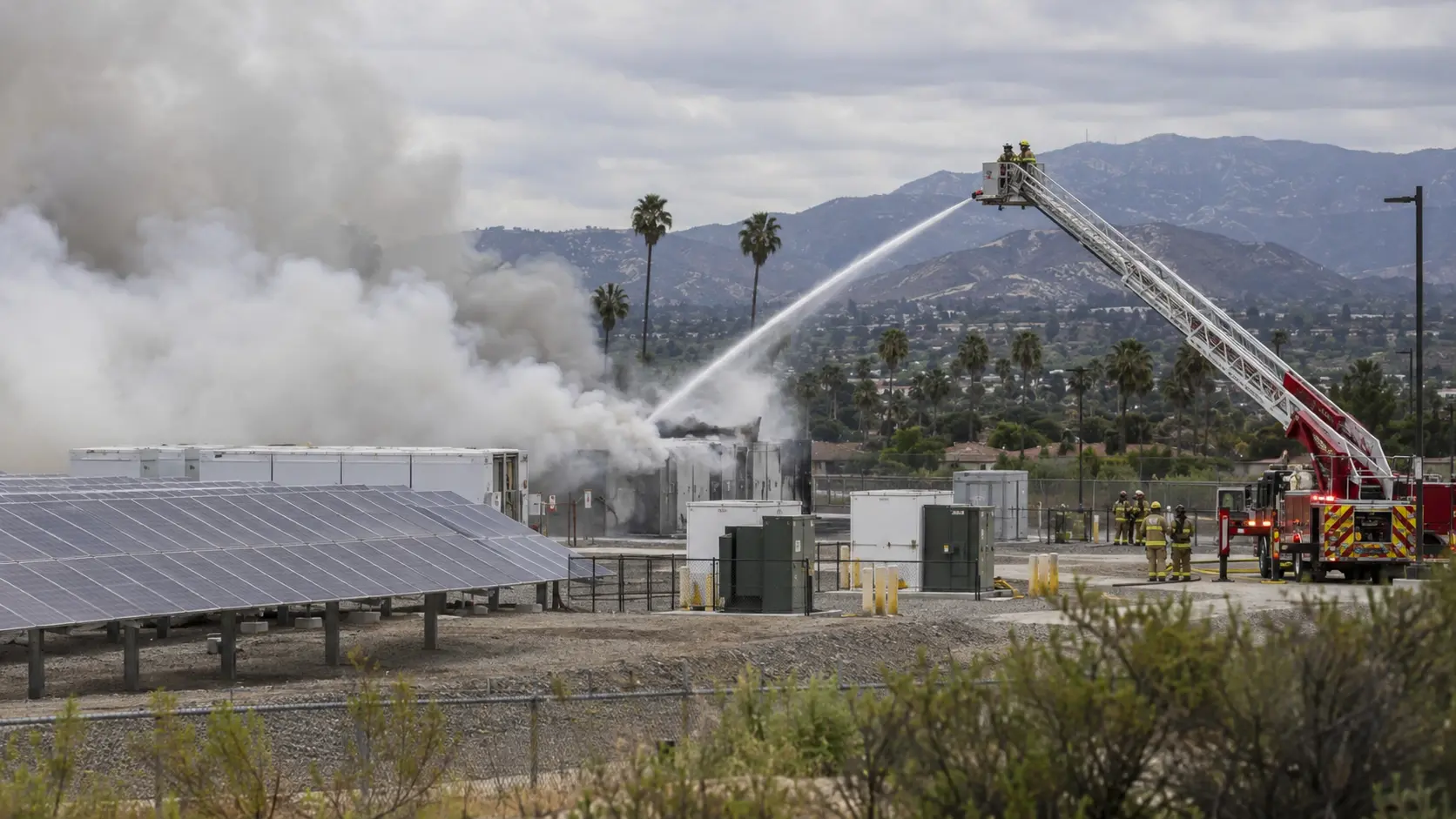
The building's internal conditions presented a separate problem. Newport Fire Chief Rob Murphy described an interior that was not safe for firefighters to enter, requiring crews to work around limited access while keeping the fire from reaching nearby structures. Local authorities later said the blaze had been contained to the affected facility rather than spreading to adjacent buildings.
Why was there concern about ammonia?
Refrigerated seafood facilities may use anhydrous ammonia in industrial cooling systems. An accidental release can create a serious inhalation hazard and complicate fireground operations. That is why incident commanders treated the contents of the facility as a hazardous-materials concern instead of assuming the emergency was limited to smoke and structural damage.
The Oregon State Fire Marshal said it deployed Linn-Benton State Hazmat Team 05, which used specialized instruments and plume modeling to evaluate potential off-site impacts. State Fire Marshal Mariana Ruiz-Temple said responders had located the ammonia tank and that it did not appear to be punctured or leaking. This official finding matters: a risk of ammonia release is not the same as a confirmed tank rupture or sustained leak.
Smoke itself remained an operational and public-health concern. Officials urged people near affected areas to follow the evacuation and shelter guidance rather than independently judging the situation by the visible amount of smoke.
Evacuations and shelter information
Authorities initially ordered evacuations over roughly a one-mile radius around the site because of concerns about possible chemical exposure. As the response progressed, the evacuation footprint was reduced to a smaller section around the Bayfront. The city arranged temporary shelter at Atonement Lutheran Church, 2315 N Coast Highway, after an earlier shelter location was changed.
Those boundaries and shelter arrangements describe the situation reported on October 25; they should not be interpreted as current directions after publication. Readers in Newport should consult the city and Lincoln County Sheriff’s Office before returning to a restricted area or traveling toward the waterfront.
Firefighters and hazmat teams at the scene
The Oregon State Fire Marshal mobilized additional teams to support local responders operating through a prolonged incident. Plans included a Marion County task force with a ladder truck and four engines, followed by a Lane County strike team with five engines. These resources were intended to rotate and reinforce personnel as the fire and its hazards continued to require attention.
The combination of a hazardous industrial refrigerant, unstable interior conditions and sustained smoke illustrates why commanders may maintain an exterior posture even when a building appears accessible from the street. A structural fire can change rapidly as roof systems, equipment and mechanical spaces are damaged. Decisions about entry depend on conditions observed by the incident commander, not solely on the fire's apparent size.
Were there any injuries?
Officials said an estimated 30 to 40 workers were inside when the fire began and were accounted for after evacuating. Early local reports said there were no injuries at the facility. A subsequent Associated Press report described one firefighter hospitalized for exhaustion. These statements refer to different stages of reporting and should not be reduced to a blanket claim that no responder required medical care.
What caused the Newport fire?
The origin and cause had not been publicly determined in the official information reviewed for this report. No explanation involving refrigeration equipment, electrical systems or deliberate ignition should be treated as established without investigators' findings. The visible damage and the presence of ammonia are not proof of how the fire started.
What the Newport incident shows about industrial fire response
For responders, this event highlights the overlap between ordinary fire suppression and site-specific industrial hazards. A cold-storage facility can contain pressurized piping and equipment that remain relevant even when the principal fire appears to be in another part of the structure. An early inventory of chemicals, exclusion zones, continuous air monitoring and coordination with plant representatives can shape the entire operation.
It also shows why evacuation decisions may be adjusted in stages. A large initial safety perimeter reflects uncertainty about potential consequences. Reducing the area later can be appropriate when crews gather reliable information about tank integrity and measured conditions. Neither action, by itself, establishes whether a hazardous release occurred.
Frequently asked questions
Where was the Pacific Seafood fire?
At a Pacific Seafood facility on Newport's Historic Bayfront beside Yaquina Bay in Oregon, on Sunday, October 25, 2026.
Did the ammonia tanks explode?
No explosion of the ammonia tanks was confirmed by the Oregon State Fire Marshal in its October 25 announcement. It reported that the located tank did not appear punctured or leaking.
Why did Newport order evacuations?
Officials were concerned that an industrial-refrigeration ammonia release could affect people beyond the building. Fire and smoke also made the waterfront area hazardous.
Is the evacuation still in effect?
This article records October 25 updates and does not verify real-time evacuation status. Check official local alerts before traveling.
Sources and continuing updates
- Oregon State Fire Marshal — October 25 response and ammonia-tank statement
- Oregon Public Broadcasting — local fire and evacuation updates
- Associated Press — evacuation, employees and responder condition
Editorial note: Details reflect available reporting on October 26, 2026. Cause, evacuation status and damage estimates may change after new official statements.

Comments 0
No comments yet. Be the first to share your thoughts!
Leave a Comment