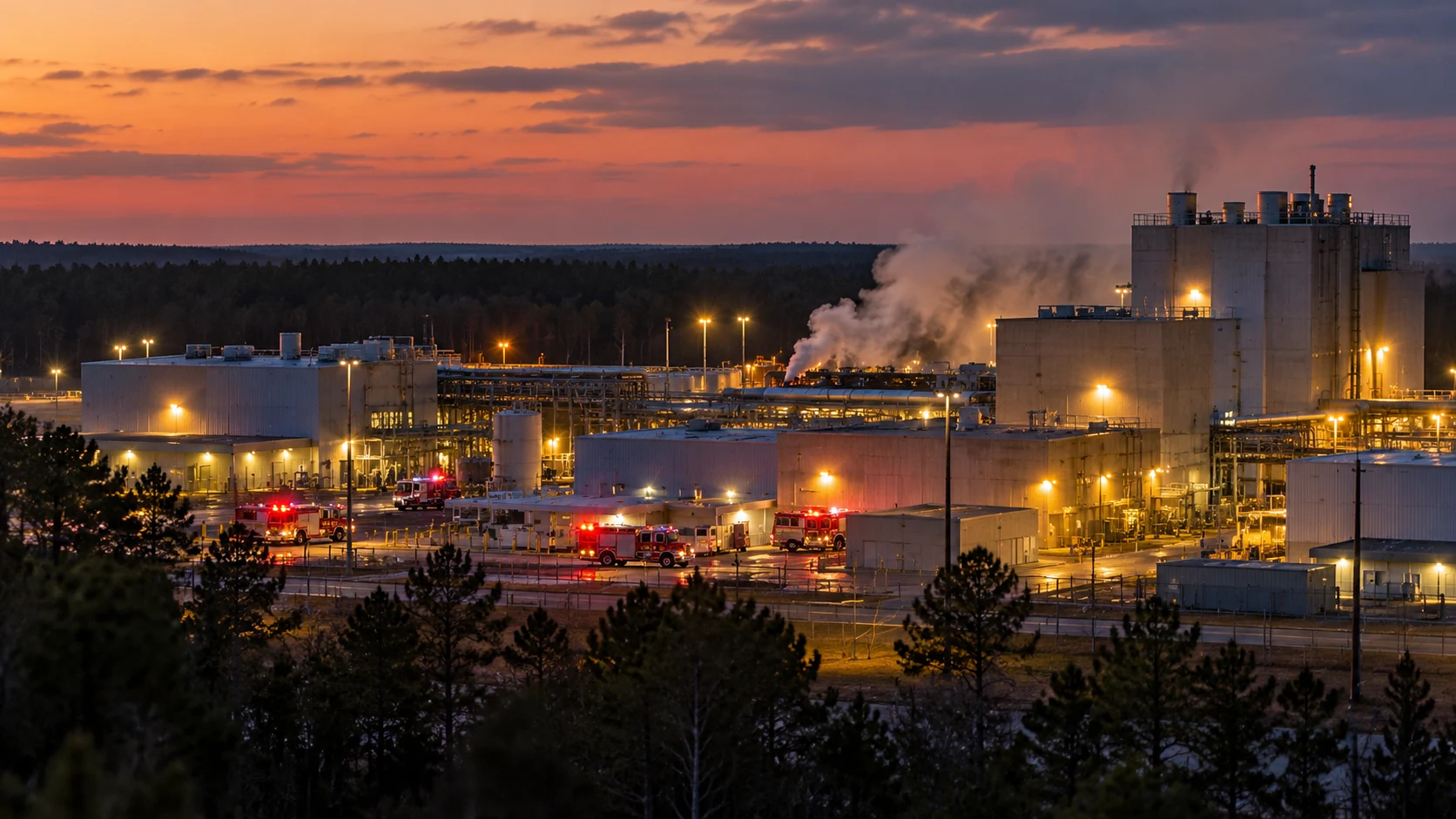
UNITED STATES — October 30, 2026. A fire in a room at the Savannah River National Laboratory led the Savannah River Site to declare a Site Area Emergency on the evening of October 28, 2026. The emergency was terminated at 9:45 p.m. the same night. A Department of Energy spokesperson said one employee went to a hospital with minor injuries, and site radiological surveys found no detectable contamination. The cause of the fire has not been made public.
What happened at Savannah River Site?
A fire was reported on Wednesday, October 28, at Savannah River National Laboratory, which sits in A-Area of the U.S. Department of Energy’s Savannah River Site near Aiken, South Carolina. Local station WRDW, citing site sources, reported that the fire was confined to a single room. Site officials declared a Site Area Emergency and ran the response themselves. The laboratory fire was put out the same evening.
Under DOE’s emergency system, a Site Area Emergency ranks above an Alert and below a General Emergency. Here, it set off access restrictions on and around the site, and shelter-in-place instructions for some employees.
One detail is still inconsistent in the official record. The site’s News Release #2 gave 5:39 p.m. as the time the emergency was declared. News Release #3, issued once the emergency ended, gave 5:07 p.m. Media reports have used both times, and the site has not explained the difference. This article does not pick one.
How did the emergency unfold?
- Around 5 p.m.: The fire was reported at the laboratory. WRDW’s sources said it began shortly after 5 p.m.
- 5:07 or 5:39 p.m.: Site officials declared the Site Area Emergency, depending on which news release you read.
- 5:45 p.m.: SRS notified the South Carolina Emergency Management Division by telephone, according to the division’s director, Kim Stenson.
- Evening: Barricades at site entrances were closed to incoming traffic but stayed open for outgoing traffic. Rail, river and air traffic near the site was restricted. Employees in the laboratory area were reported to have sheltered in place for roughly 30 minutes.
- 7:30 p.m.: The site’s second news release said no contamination had been reported outside the affected facility.
- 9:45 p.m.: The emergency was terminated, protective actions were lifted and the barricades reopened.
When was the emergency lifted?
The Savannah River Site announced that the Site Area Emergency ended at 9:45 p.m. local time on October 28. Protective actions were lifted and the barricades at site entrances reopened. Oncoming shift workers were told to report as usual, and everyone else was told to come in as scheduled on Thursday, October 29. Highway 125 stayed open during the response, according to site officials. The Federal Aviation Administration, which had issued temporary flight restrictions over the Aiken area, lifted them late Wednesday.
Was there a radiation release?
The accounts here do not line up perfectly, so it helps to separate them.
The site’s final news release said radiological surveys found no detectable levels of contamination, and the earlier release said none had been reported outside the affected facility. On October 29, Monte Volk, public affairs officer for the DOE Office of Environmental Management, said the fire was contained with no radiological release and no employee exposure to radiological contamination, and that there was no risk to the public or the environment.
Earlier on Wednesday night, WRDW reported that an emergency dispatch had described an “unfiltered ground-level radiological release.” Site officials told the station that no contamination had been reported outside the affected facility and that nothing pointed to consequences beyond the site boundary. Officials have not publicly explained the wording of that dispatch. Until they do, it is fair to say that the official position is “no release, no detectable contamination,” and that the early dispatch language was reported but not confirmed.
Were there injuries?
A Department of Energy spokesperson said one employee was taken to a hospital with minor injuries. The site’s own news releases did not mention an injury. The employee has not been named, and officials have not described the injuries or said whether the person has been released.
What precautions did responders take?
Access for incoming traffic was cut off at the site barricades. Employees not involved in the emergency response or in shutting down operations were sheltered in the affected areas. Rail, river and air traffic near the site was restricted, and the FAA temporary flight restriction described the event as a U.S. government nuclear incident at the Savannah River Site. That label comes from the FAA notice, and it is a standard airspace designation rather than a finding about what happened inside the laboratory.
These steps are what you would expect at a facility handling sensitive nuclear-related work while responders are still working out conditions.
Who was notified, and did outside crews respond?
SRS has its own fire department. State officials said they received no requests for assistance. The South Carolina Emergency Management Division was told by phone at 5:45 p.m., Gov. Henry McMaster was informed, and the State Warning Point in the State Emergency Operations Center was activated. Aiken County learned of the event through the SRS Emergency Notification Network, and Barnwell and Allendale counties were notified as well. Barnwell County’s emergency management director said he did not activate the county operations center but came in to monitor, and described the communication with SRS as good in both directions.
What caused the laboratory fire?
It has not been disclosed. DOE says an investigation is underway. Officials have not said which building caught fire, what work was happening there, how the fire started or how much damage it caused, and no public account reviewed for this article answers those questions. Those details should stay open until investigators or the site release findings.
What is Savannah River National Laboratory?
The laboratory is a DOE research facility located in A-Area of the Savannah River Site. Its work covers environmental cleanup, national security and energy, including the processing of radioactive waste and nuclear materials, cleanup of contaminated groundwater and soil, and hydrogen production and storage. DOE also lists nuclear material processing and disposition and weapons production technology among its research areas.
What are watchdog groups saying?
Dylan Spaulding, a senior scientist in the Global Security Program at the Union of Concerned Scientists, said the public is owed a clear account of what happened, including whether any radioactive material was released and what the National Nuclear Security Administration is doing to keep workers and the community safe.
Tom Clements, director of the watchdog group Savannah River Site Watch, said the fire raised concern about worker health and safety and about the reported release of radiation. He also said archived documents from the Defense Nuclear Facilities Safety Board show the board has raised fire-suppression issues at the laboratory for more than six years. That is his reading of the board’s records, and DOE has not responded to it in the coverage we reviewed.
Why does this incident matter to firefighters?
A laboratory or industrial fire asks for more than a standard structure fire response. The incident commander has to work with facility experts on what is in the building, keep track of every person on site, control who goes where, and decide on protective actions based on measured conditions rather than assumptions. Radiological surveys are what separate a frightening label from an actual finding, and in this case the surveys are the main reason the emergency could be closed out in under five hours.
The response also fits a pattern of preparation. SRS runs an annual site emergency exercise, and in June 2024 that drill simulated a radiological release and contamination emergency with nearly 250 personnel. We do not know how closely the October 28 response followed that training, and the investigation may eventually say.
What is still unknown?
- What started the fire, and in which building and room.
- What work or materials were involved.
- How much damage the room and the facility sustained.
- The identity and condition of the injured employee.
- Why an emergency dispatch reportedly used the words “radiological release” when the later official statements say there was none.
- Why the site’s two news releases give different declaration times.
Frequently asked questions
What happened at Savannah River Site?
A fire broke out on the evening of Wednesday, October 28, at Savannah River National Laboratory, part of the Savannah River Site near Aiken, South Carolina. Site officials declared a Site Area Emergency, restricted access and sheltered some employees. The fire was extinguished and the emergency ended at 9:45 p.m.
When was the emergency lifted?
The Site Area Emergency was terminated at 9:45 p.m. local time on October 28. Protective actions were lifted, barricades reopened and employees were told to report to work as scheduled on October 29.
Was there a radiation release?
Official statements say no. Surveys found no detectable contamination, and DOE said there was no radiological release and no risk to the public or environment. An early emergency dispatch reportedly used the phrase “unfiltered ground-level radiological release,” which officials have not explained.
Was anyone hurt?
A DOE spokesperson said one employee was taken to a hospital with minor injuries. No other injuries have been reported.
What caused the fire?
The cause has not been released. DOE says an investigation is underway.
Sources and updates
- Savannah River Site official emergency update (News Release #3)
- Savannah River Site official emergency update (News Release #2)
- Aiken Standard / Post and Courier report
- WRDW News 12 report
- Reuters report
- Associated Press report
Editorial note: This story separates confirmed reports from questions still under investigation. Cover illustration is AI-generated and does not depict the actual scene.
Comments 0
No comments yet. Be the first to share your thoughts!
Leave a Comment