Published: · Reviewed for fire service operations, hazmat and command context.
On June 24, 2026, two major earthquakes struck northern Venezuela within a short time window. USGS event data showed a magnitude 7.2 earthquake at 22:04 UTC followed 39 seconds later by a magnitude 7.5 earthquake at 22:05 UTC near Yumare, in the Moron and Yumare area west of Caracas. The larger event was shallow, with USGS listing a 10 km depth, and both USGS and GDACS placed the sequence in a red-alert category for potential humanitarian impact.
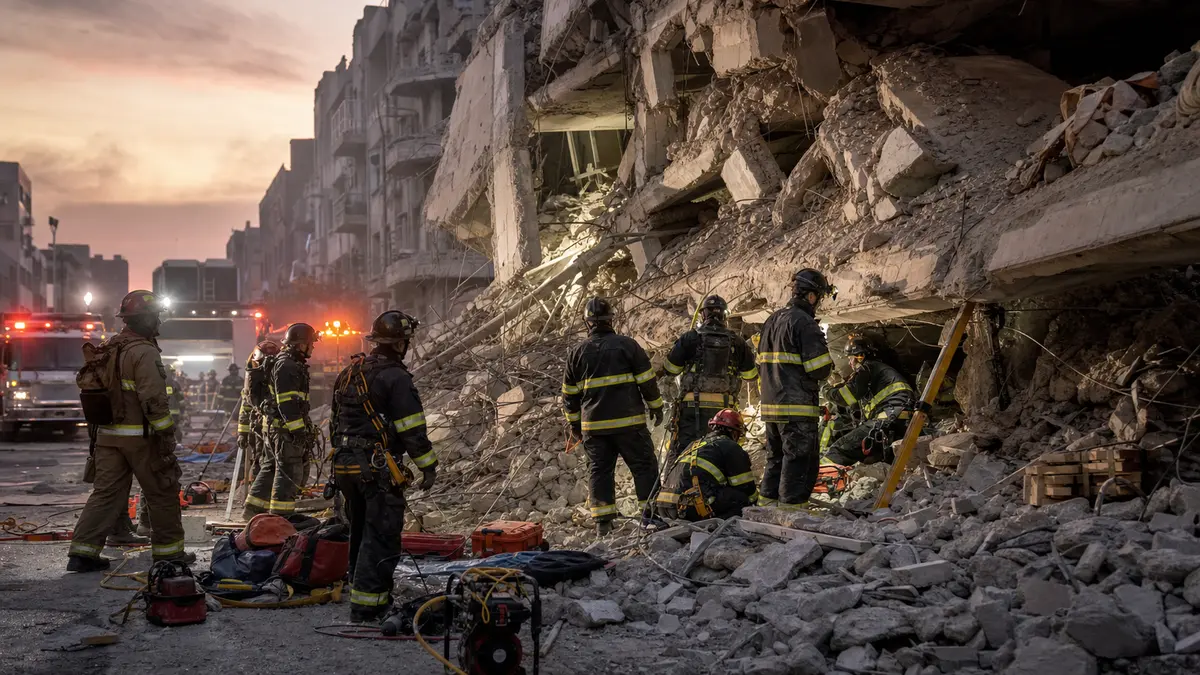
Early reporting described building collapses, trapped victims, aftershocks, damaged infrastructure, hospital and airport disruption, and emergency response challenges in and around northern Venezuela. AllFirefighter is not a breaking news desk, and this article does not try to track a live casualty count. Instead, it looks at the incident the way a fire officer, USAR team leader, EMS supervisor, hazmat officer or emergency manager would study it: as a multi-hazard earthquake response problem.
Editor note: This article focuses on firefighter and emergency response lessons from the Venezuela earthquakes. Casualty figures, damage assessments and official response details may change as authorities and relief agencies update their reports.
In this analysis:
- What happened in Venezuela?
- Why this earthquake matters for firefighters
- The first operational challenge: scene size-up
- Urban search and rescue priorities
- Rescuer safety and the aftershock problem
- EMS and mass casualty lessons
- Hazmat and fire risks after earthquakes
- Command, control and mutual aid
- Lessons for fire departments outside Venezuela
- Public safety guidance after a major earthquake
What Happened in Venezuela?
The June 24 sequence is best understood as a back-to-back earthquake event rather than a single isolated shock. USGS listed the first event as M7.2, centered 23 km southeast of Yumare at a depth of about 20.3 km. The second and stronger event, M7.5, followed 39 seconds later, centered 28 km southeast of Yumare at a depth of 10 km. Responders and the public did not get a clean pause between the first major shaking event and the next.
That timing matters for operations. A building that survived the first shock with heavy cracking, partial diaphragm failure or damaged columns may have been pushed past its remaining reserve by the second shock. A stairwell that was still passable after the first event may have become unsafe seconds later. Firefighters arriving after the sequence have to assume they are dealing with structures that were loaded dynamically more than once before any professional assessment could occur.
Shallow earthquakes raise the stakes for urban response. Depth is not the only factor in damage, but a shallow source lets more energy reach the surface with less attenuation. The USGS M7.5 event at 10 km depth and the GDACS red alert help explain why this incident became a collapse rescue and disaster logistics problem so quickly. GDACS also reported that the M7.5 event potentially exposed about 2.4 million people to shaking intensity of MMI VII or higher, which does not mean every exposed person was injured or every building failed, but it does point to a response environment that was wide, dangerous and likely larger than local resources could comfortably handle.
Initial reporting identified Caracas, La Guaira, Carabobo and other northern areas among the places where damage, disruption or emergency operations were reported. As with any fast-moving disaster, responders should treat early location reports as operational leads rather than final truth, since damage surveys, utility status, road access, hospital status and confirmed collapse sites usually evolve hour by hour.
Why This Earthquake Matters for Firefighters
Earthquakes rarely present as a single, clean problem for firefighters. They produce collapse rescue, EMS surge, hazardous materials, fire risk, utility failure, traffic disruption, communications overload, sheltering needs and public information demands all at once. A department that normally thinks in single alarms and discrete incidents suddenly has dozens or hundreds of simultaneous problem sites to manage.
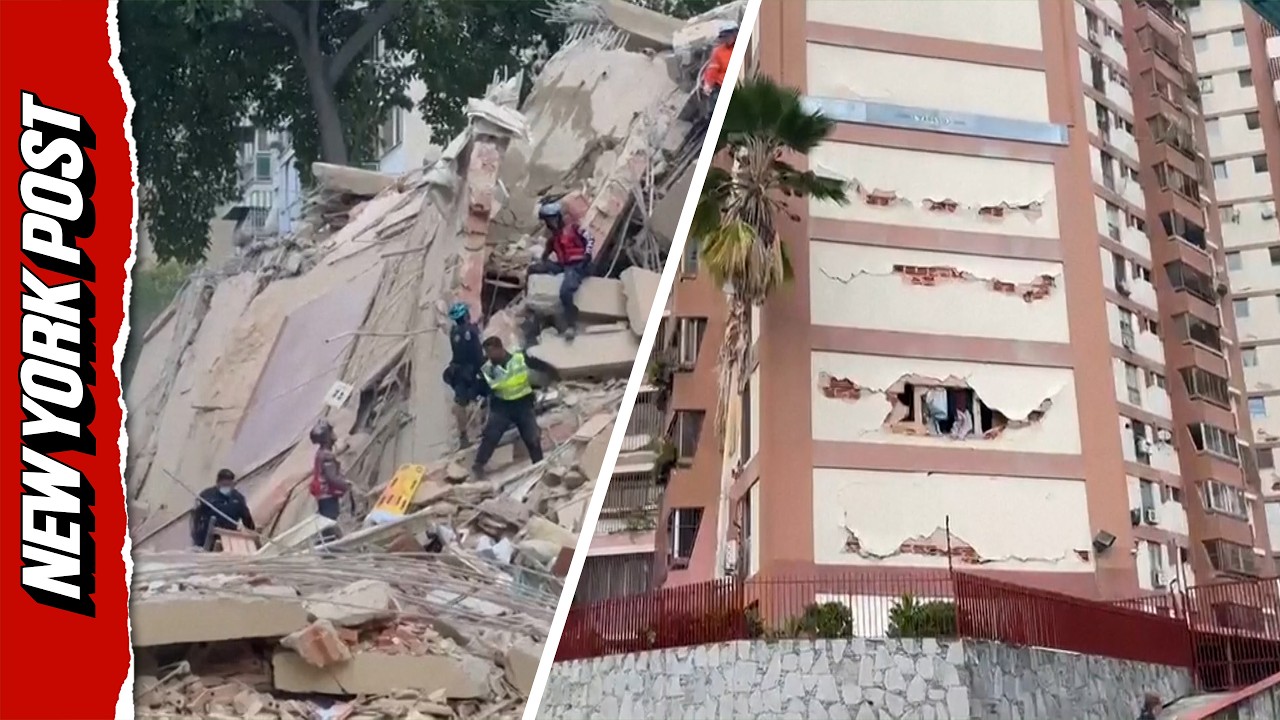
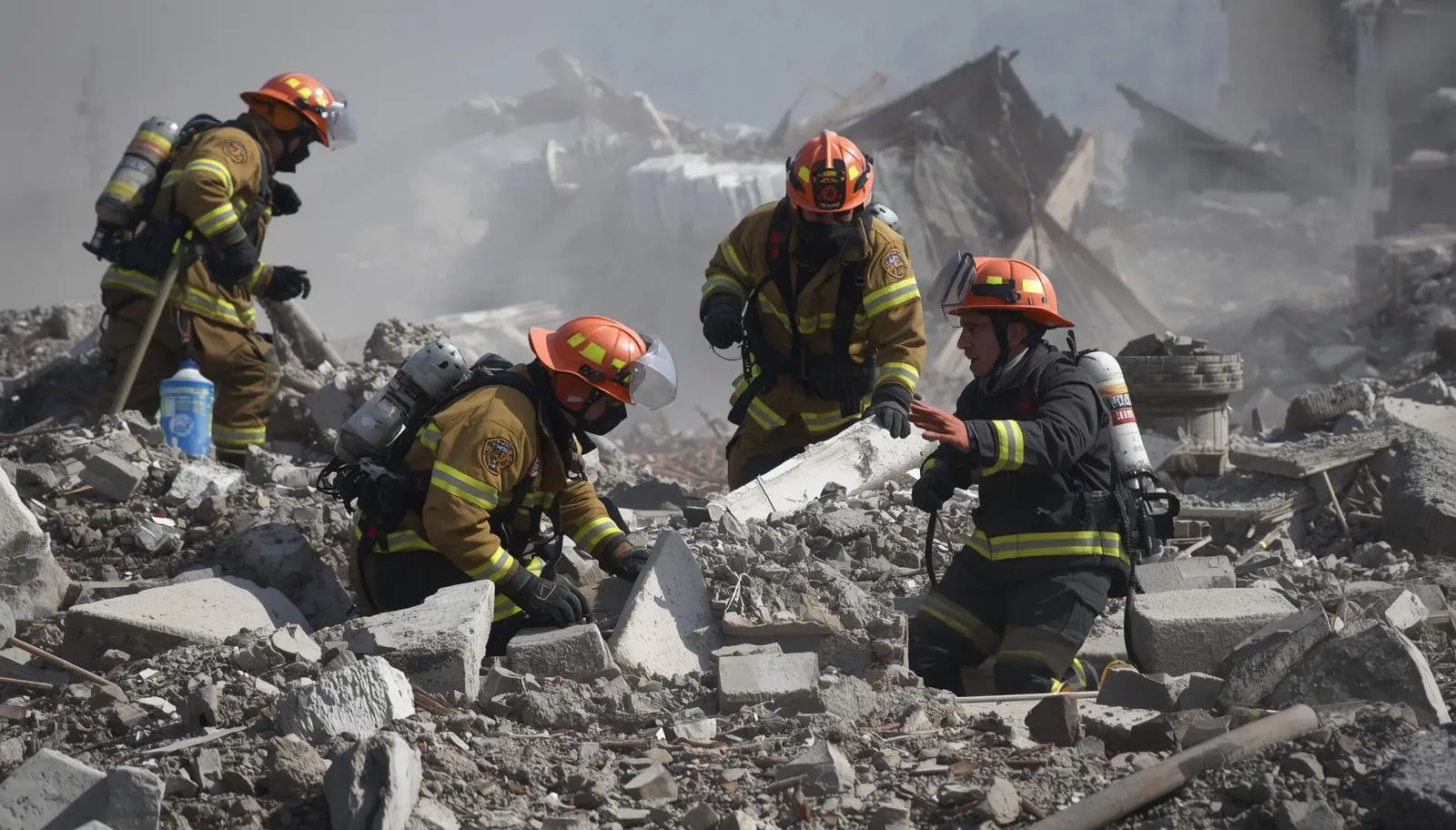
The most visible hazard is structural collapse. Pancake collapse, lean-to collapse, V-shaped collapse and partial facade failures each create different survivable voids and different risks for rescuers. Search priorities have to be based on structure type, occupancy, time of day, witness information and the probability of viable victims, not on which pile of debris looks most dramatic.
Aftershocks are the second major operational concern. They can turn a damaged but standing building into an active collapse hazard, injure crews already working inside a hazard zone, bury equipment, break hose lines, drop glass from high-rise elevations, and panic crowds gathered near the scene. Aftershock planning belongs in the incident action plan from the first operational period, not as an afterthought once shaking has already caused new damage.
Transportation and communications failures shape everything that follows. Damaged roads slow ambulances and heavy rescue apparatus. Bridges, tunnels and overpasses require structural checks before reuse. Cell networks become overloaded, radio systems may lose repeater sites or backup power, and hospitals end up receiving walking wounded, critical trauma patients and searching families at the same time, often faster than the incident commander can gather confirmed information.
Fire risk is present even when flames are not the headline. Broken gas lines, damaged electrical systems, ruptured fuel tanks, generator use, battery backup systems, industrial facilities and compromised water supply can all create fire or explosion problems once the shaking stops. Earthquake response is as much a fire prevention task under degraded infrastructure as it is a rescue mission.
The First Operational Challenge: Scene Size-Up
The first arriving officer at a collapse site has to resist the pressure to rush directly into the rubble. The priority is a disciplined size-up that separates where rescuers can work now, where they can work after stabilization, and where nobody should operate until specialists arrive.
Wide-area size-up: Command needs a fast picture of the affected district. Which buildings are collapsed, which are partially damaged, which roads are blocked, where are utilities compromised, and where are crowds forming? In a major earthquake, individual company officers may be reporting by radio, runners, mobile data or handwritten notes. The information must be mapped and updated continuously.
Damage categories are useful. Light damage may involve cracked plaster, broken glass and minor nonstructural failures. Moderate damage may include cracked masonry, displaced parapets, jammed doors and visible deformation. Heavy damage includes partial collapse, leaning walls, failed columns, floor separation and signs that load paths have been interrupted. Firefighters can help identify these categories, but structural specialists and engineers should be brought into the operation as early as possible.
Collapse zones must be established before crowds settle into dangerous locations. A simple rule used on many firegrounds is to keep personnel outside a collapse zone at least the height of the wall plus a safety margin. Earthquake-damaged structures complicate that rule because falling debris may come from parapets, glass, cladding, balconies, signage and adjacent buildings, so the zone has to account for what can fall, not only what has already fallen.
Spontaneous volunteers are another size-up issue. People will try to dig with bare hands because family members may be trapped, and their urgency is understandable, but the scene cannot become uncontrolled. Civilians and unassigned volunteers must be moved out of active hazard zones, organized into safe support roles where appropriate, or directed to official volunteer management points. A second collapse that injures unprotected civilians only adds more victims and slows the rescue.
Urban Search and Rescue Priorities After a Major Quake
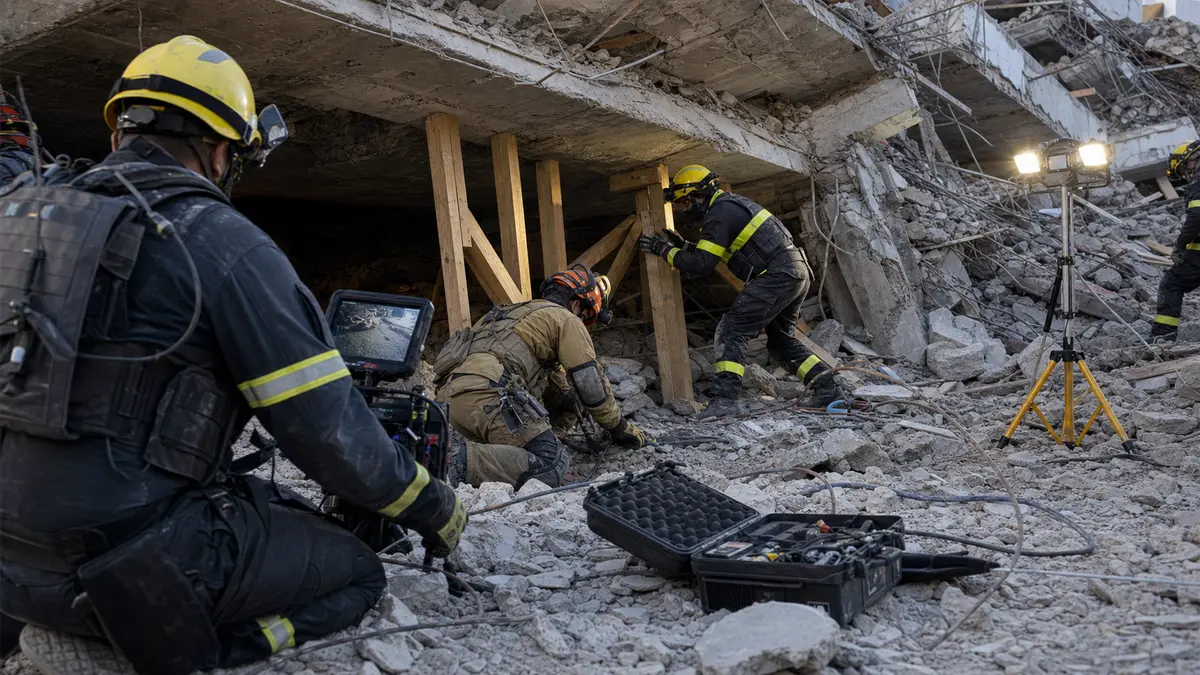
Urban search and rescue after an earthquake is slow, technical work. The public often imagines rescuers digging straight down until they find a victim. In real operations, teams work through a sequence: reconnaissance, surface rescue, search assessment, rescue triage, stabilization, access, medical contact, packaging and removal. The pile is treated as a structure, not a heap.
Search begins with information. Witnesses, residents, building managers, phone calls, noises from the void, last-known locations and occupancy patterns guide initial priorities. Crews should document where searches have been completed and where victims were located or ruled out, since several teams may rotate through the same site over many hours and marking keeps that history intact.
Canine search, acoustic listening devices, seismic listening devices and camera search all have value, but none of them replace good scene discipline. A search dog may indicate a possible live scent, a listening device may pick up tapping or a voice, a camera may confirm a void space — each result still has to be interpreted against building layout, debris stability and rescue feasibility.
Rescue triage can be uncomfortable but necessary. A site with multiple confirmed victims may require command to prioritize the victim with the highest probability of survival and the most feasible access route. No one is abandoned in that decision; scarce shoring, breaking, lifting, medical and crew resources are simply assigned where they can save the most lives first.
Void space operations are where structural collapse rescue becomes a technical discipline. Crews may need to breach concrete, cut rebar, tunnel through debris, shore unstable slabs, lift heavy elements with airbags or cribbing, and package patients in positions that are medically and mechanically difficult. Every breach can change the load path, and every lift can shift debris, which is why shoring and structural monitoring stay part of the job rather than optional extras.
Medical stabilization inside rubble is often the difference between rescue and recovery. Victims trapped for hours may develop crush syndrome, dehydration, hypothermia or heat illness, airway compromise, bleeding, fractures and psychological distress. EMS contact should begin as soon as access allows, sometimes before complete extrication, with fire and EMS crews ready for IV access, pain control under protocol, bleeding control, airway support and crush injury precautions before the final lift occurs.
Long-duration operations require crew rotation. Dust, noise, heat, night operations, emotional pressure and repetitive heavy work all degrade judgment over time. Technical rescue teams need rehab, accountability, rest cycles, food, hydration, respiratory protection and a safety officer with authority to stop work, because even a sound rescue plan fails if the rescuers become too exhausted to catch the next warning sign.
Rescuer Safety: The Aftershock Problem
Aftershocks are an operational hazard, not background noise to plan around later. A damaged building can tolerate one condition at 1800 hours and fail at 1830 hours after a smaller secondary shock. The hazard is not limited to full collapse, either — falling glass, facade pieces, parapets, ceiling systems and utility poles can injure crews working outside the structure as well.
Collapse zones should be marked, communicated and enforced. Lookouts should be assigned wherever crews are working near unstable walls or overhead hazards. Evacuation signals should be simple, loud and understood by every assigned crew — air horns, apparatus horns, radio emergency traffic and verbal withdrawal orders should all be part of the briefing, and the signal needs to mean stop work and move to the designated refuge area, not pause and look around.
Accountability gets harder in a wide-area disaster because units may self-dispatch, mutual-aid companies may arrive from outside the region, and freelancing pressure rises. Command has to know who is operating in each structure, what their assignment is, and how long they have been inside the hazard zone, so that a secondary collapse does not turn into a search for missing rescuers nobody can immediately account for.
PPE decisions need to match the hazard. Structural firefighting gear protects against cuts and impact, but it is hot and can fatigue crews quickly during rubble work, so technical rescue helmets, eye protection, gloves, steel-toe or composite-toe boots, hearing protection and respiratory protection may suit many collapse tasks better. Dust from concrete, masonry, insulation, plaster, burned materials and unknown building contents deserves more caution than ordinary nuisance dust would.
Crews working around concrete, rebar, glass and unstable slabs need slow hands and clear communication. Rebar can impale or snag, glass can fall from above long after the shaking stops, and slabs can bridge over voids before failing once weight shifts. A scene that looks still is not necessarily stable — quiet is not the same as safe.
EMS and Mass Casualty Lessons
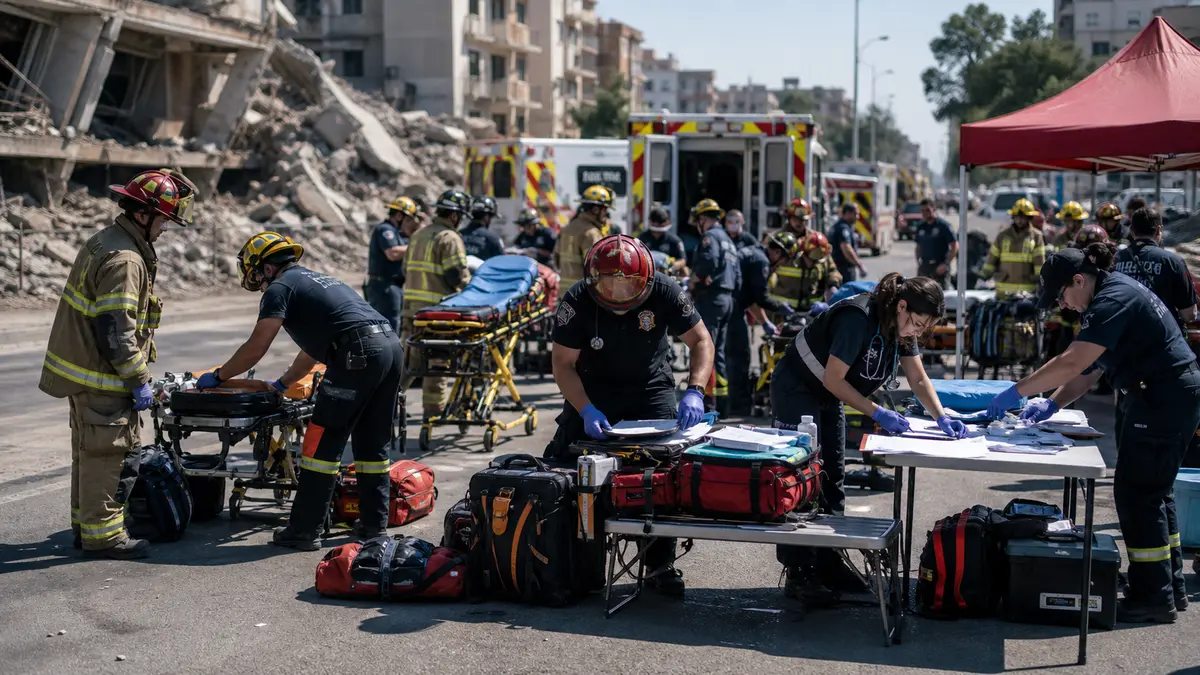
Earthquake EMS is a mass casualty problem layered on top of infrastructure damage. Triage may occur in streets, parking lots, schoolyards, public squares or near collapse sites. Standard ambulance routing may not work, and hospitals may be dealing with structural damage, power problems, water loss, staff shortages or an overwhelming volume of self-presenting patients. EMS command has to plan for more than transport alone.
Field treatment areas should be established early and moved if hazards change. They need enough distance from unstable buildings, downed wires, gas leaks, traffic and crowds, while staying close enough to receive patients from rescue sites. The treatment area needs basic tracking — who the patient is, where they came from, triage category, interventions, destination and who transported them — because in an earthquake, family reunification becomes part of patient care as families search multiple hospitals and shelters for the same missing person.
Crush injury deserves specific attention. A victim pinned under heavy debris may be conscious and talking but still physiologically dangerous to free without preparation. Prolonged compression of large muscle groups can produce rhabdomyolysis, acidosis, hyperkalemia, hypovolemia and renal failure after release. EMS protocols vary by system, but the underlying principle holds: identify likely crush patients early, begin treatment under local medical direction, and notify receiving hospitals before extrication when possible.
Delayed extrication changes ordinary trauma care. A patient who would normally be packaged in minutes may remain inside a void for hours, which makes pain management, airway positioning, hemorrhage control, temperature management, psychological support and communication with the patient all matter more than usual. Heat compounds dehydration and heat stress, while cool night temperatures can bring on hypothermia even in a tropical or coastal region when a patient is immobilized and exposed.
Ambulance officers also need alternate transport planning. Damaged roads, bridge closures, blocked intersections and crowding around hospitals can break normal transport patterns, so staging ambulances away from the collapse site, reserving ambulances for critical patients, and assigning buses or other vehicles for minor walking wounded may be necessary under local emergency plans. The goal is to preserve advanced transport capacity for the patients who truly need it.
Hazmat and Fire Risks After Earthquakes
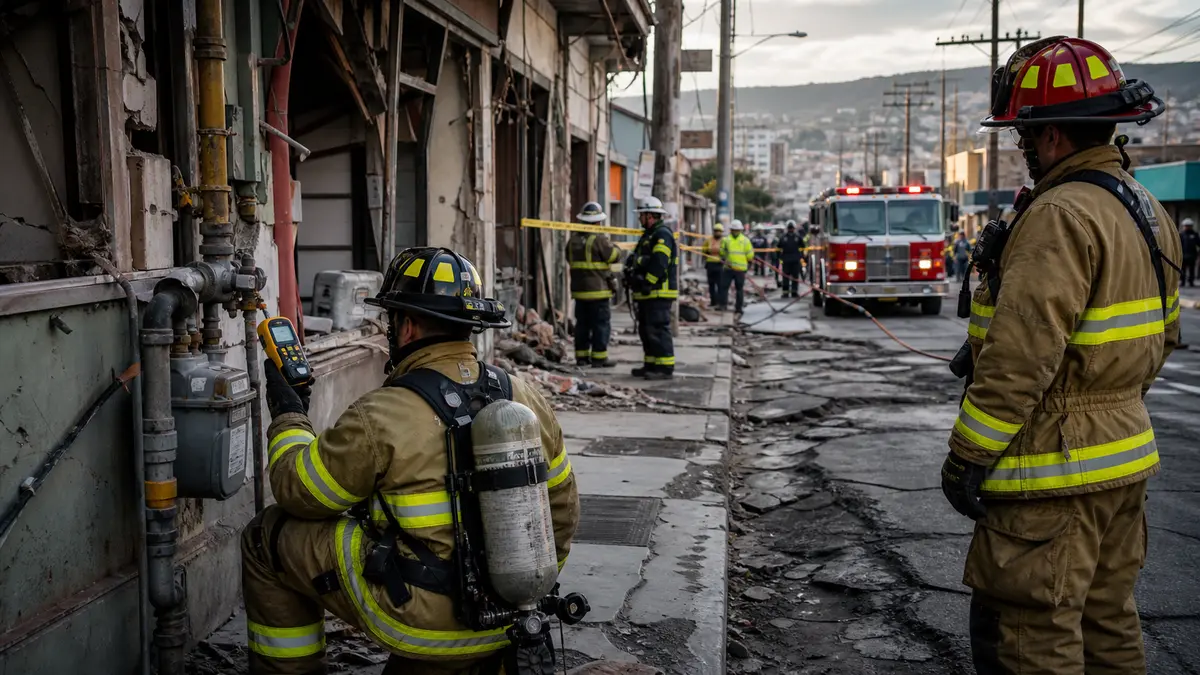
This is a major AllFirefighter issue because earthquakes hide hazmat inside ordinary damage. The obvious scene may be a collapsed apartment building, but secondary hazards can include broken natural gas lines, leaking fuel, damaged electrical panels, ruptured oxygen cylinders, pool chemicals, battery backup systems, industrial chemicals in a nearby commercial building, or contaminated runoff from firefighting and rescue operations.
Gas leaks are among the first concerns. Firefighters should treat the smell of gas, hissing sounds, damaged meters and broken service lines as ignition hazards until utilities confirm otherwise. Electrical systems may be wet, crushed, energized from backfeed or damaged in ways that are not visible. Downed wires should be assumed energized, and portable generators, solar systems and battery energy storage can introduce unexpected electrical pathways once the utility grid fails.
Industrial and port areas add another layer of risk. Venezuela has fuel storage, petrochemical and industrial infrastructure in several regions, and the early information available to responding crews may not be enough to know what has leaked, what is burning, or what is stored behind a damaged wall. A conservative hazmat approach works best here: isolate, identify, deny entry, monitor air if equipment is available, and use facility representatives, shipping papers, placards, safety data sheets and recognized references once materials are identified.
Commercial buildings can contain unknown chemicals even when they are not labeled as hazmat facilities. Auto shops, laboratories, medical clinics, janitorial supply rooms, paint storage, refrigeration systems and battery rooms can all create responder exposures, so a collapsed structure with a chemical odor should be treated as a hazmat clue rather than a nuisance.
Air monitoring is especially useful after an earthquake because senses become unreliable. Dust, sewage odors, smoke, fuel vapor and decomposing organic material can mix together. Monitors for oxygen, flammability, carbon monoxide and hydrogen sulfide can guide entry decisions where available, and specialized hazmat teams may add photoionization detectors, specific gas sensors and product identification tools.
Internal references can support this work once materials are identified. AllFirefighter crews and readers can use the Hazmat Hub for class-level response thinking and the UN Number Lookup when a placard or shipping number is known. Those tools do not replace the ERG, local SOPs or technical specialists, but they help keep product identification at the center of the response.
Water supply disruption affects both firefighting and hazmat control. Broken mains, low pressure, blocked hydrants and damaged pump stations can limit exposure protection, and contaminated runoff from firefighting, fuel leaks or chemical releases may enter drains, canals or coastal waters. Where possible, command should coordinate early with public works, utilities, environmental authorities and facility operators to control valves, protect drains and identify alternate water sources.
Command, Control and Mutual Aid
A major earthquake demands incident command at multiple levels: an area command or emergency operations center coordinating the overall disaster, branch or division supervisors managing geographic sectors, and individual incident commanders handling collapse sites, fires, medical staging, shelters and utility hazards. The system has to scale up without losing accountability anywhere along the way.
Unified command matters because fire departments cannot solve an earthquake alone. Police, EMS, public works, utilities, hospitals, transportation agencies, building officials, engineers, military units, public health, social services, volunteer organizations and international teams may all have essential roles, and the command structure needs to make room for those partners without turning the field operation into a meeting.
Staging is one of the first signs of whether a response is organized. Heavy rescue units, ambulances, water tenders, engineers, search dogs, cranes, loaders, dump trucks, fuel, lighting, lumber, food, water and relief crews all need controlled movement, since sending every resource directly to the most visible collapse site creates gridlock. Staging lets command assign the right resource to the next verified priority instead.
Heavy equipment coordination has to stay disciplined. Excavators, cranes and loaders can save time, but they can also crush survivable voids if used before search and stabilization, so equipment operators need clear assignments, spotters, rescue team coordination and stop-work authority whenever a possible victim location is identified.
International rescue team coordination works best when it is planned for in advance. Incoming teams need a reception point, an assignment process, a communications plan, maps, a local liaison, logistics support and clear safety expectations. They also need to understand local building types, language issues, utility systems and medical handoff procedures, since mutual aid only helps as much as the plan that receives it.
Public information is command work too. People need to know where shelters are, which roads to avoid, how to report missing persons, how to shut off utilities safely, and why they must not re-enter damaged buildings. Rumor control matters operationally, because bad information sends people into unsafe places and clogs emergency routes.
Lessons for Fire Departments Outside Venezuela
Departments far from Venezuela should still study this incident, because earthquake risk is not limited to places that experience frequent disasters. Moderate-risk regions often have older masonry, unreinforced buildings, limited collapse rescue depth and little recent earthquake experience. The first real test of a department's collapse plan should happen on paper, not during an actual doublet sequence.
Every department should know its local collapse risks: unreinforced masonry, soft-story buildings, high-occupancy apartments, schools, hospitals, nursing homes, assembly occupancies, bridges, parking structures and industrial facilities. Pre-planning should cover access points, utility shutoffs, likely victim locations, hydrants, alternate water sources and staging areas.
Structural collapse awareness training should reach more than the technical rescue team. Engine and ladder companies may arrive first, and they need to recognize collapse indicators, establish a zone, control civilians, request the right resources and avoid creating additional victims. Operations-level crews are there to support USAR, not to freelance technical rescue tasks beyond their training.
Radio fallback plans need testing well before they're needed. Companies should know the simplex channels if the repeater fails. Command staff should have satellite phones, amateur radio partners, runners or mobile command posts ready if cellular networks become overloaded. These plans hold up better when they are practiced during tabletop and field exercises rather than left in a binder.
Heavy equipment relationships should exist before the disaster. Public works, private contractors, crane operators, lumber suppliers, fuel vendors, structural engineers and utility supervisors are part of collapse rescue capability, and a call list built during quiet days is worth far more than a scramble after the shaking starts.
Departments should also prepare public messaging templates in advance. Earthquake messaging tends to repeat the same core points: do not re-enter damaged buildings, expect aftershocks, avoid gas leaks and downed wires, keep roads clear, check on neighbors without entering dangerous structures, and use text messages when networks are overloaded. Pre-written messages save time when the public information officer is already under pressure.
Tabletop exercises are worth running even in places that don't think of themselves as earthquake country, and they are most useful when they are genuinely difficult to manage. A realistic version might close a hospital, take out a bridge, overload the radio system, add a hazmat leak, and delay mutual aid — that kind of pressure is exactly where weaknesses in the plan tend to surface.
Public Safety Guidance After a Major Earthquake
Fire departments also have to speak clearly to the public. The safest civilian action after a damaging earthquake is often simple but lifesaving: stay out of damaged buildings. A structure that looks mostly intact from the street can have cracked columns, compromised stairwells, falling ceilings, broken gas lines or loose facade elements, so re-entry should wait for official inspection or instructions.
People should expect aftershocks and move away from damaged walls, glass, overhead signs, power lines and unstable slopes. If they smell gas, they should leave the area, avoid switches or flames, and call emergency services or the utility from a safe location, following local instructions as they come in. Downed wires should be treated as energized even when they aren't sparking.
When phone networks are overloaded, texting tends to work better than calling and leaves voice capacity for emergencies. Roads should stay clear for fire apparatus, ambulances, utility crews and heavy equipment. Families should rely on official shelter and reunification systems where available, rather than driving through damaged areas looking for relatives.
Basic household readiness still matters: water, medications, a flashlight, a battery radio, charged power banks, sturdy shoes, gloves, first aid supplies and copies of important documents. Neighbors can help each other, especially older adults, children and people with disabilities, but nobody should enter a visibly damaged structure without trained responders and a proper assessment first.
Key Takeaways for Firefighters
- Earthquakes are multi-hazard incidents, not only collapse calls.
- Back-to-back shaking can leave buildings with hidden structural damage before responders arrive.
- Collapse rescue is slow, technical and dependent on disciplined size-up, marking, shoring and crew rotation.
- Aftershocks are operational hazards that require collapse zones, lookouts, evacuation signals and accountability.
- EMS surge planning must include crush injury, delayed extrication, field treatment areas, hospital coordination and patient tracking.
- Hazmat risk can be hidden inside ordinary damage: gas, fuel, chemicals, batteries, electrical systems and contaminated runoff.
- Communications and logistics often fail early; staging and redundancy keep the response moving.
- Public messaging saves lives when it keeps civilians out of damaged buildings and emergency routes clear.
Sources
This article uses source material for verified event facts, situational reporting and responder safety context. It does not copy source language.
- USGS event page: M 7.5 - 28 km SE of Yumare, Venezuela
- USGS event page: M 7.2 - 23 km SE of Yumare, Venezuela
- GDACS report: Red earthquake, Magnitude 7.5M, Venezuela, June 24, 2026
- GDACS report: Red earthquake, Magnitude 7.2M, Venezuela, June 24, 2026
- The Guardian live updates, including Reuters, AP and AFP reporting, June 25, 2026
- OSHA: Earthquake Preparedness and Response
- FEMA: Urban Search and Rescue

Comments 0
No comments yet. Be the first to share your thoughts!
Leave a Comment