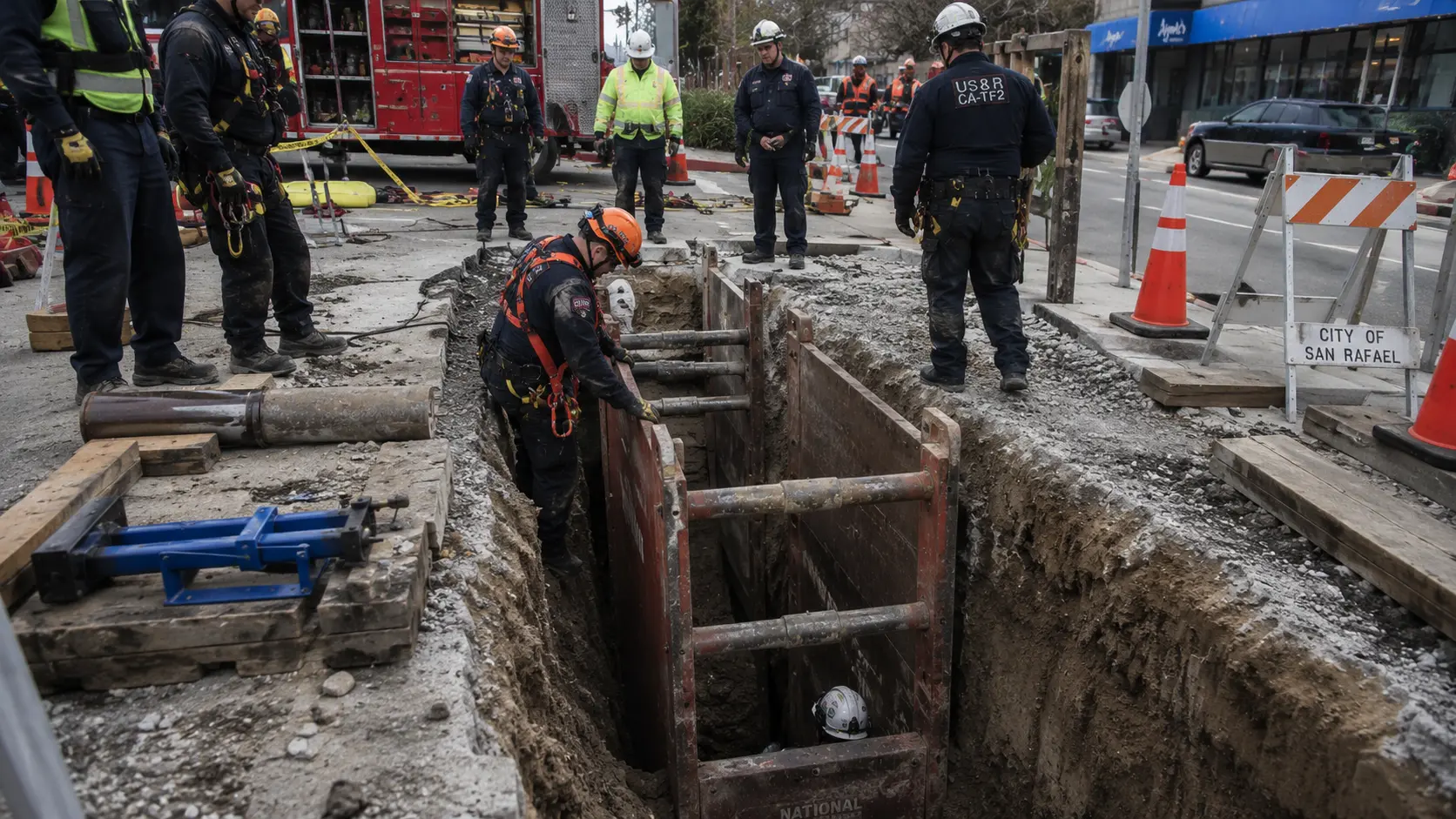

Trench work looks stable right up until it is not. Workers have been in the same trench all morning. The walls look solid. The soil is dry and firm. Nobody has heard any cracking or settling. Then in a fraction of a second, a wall fails — and a worker who was standing upright is buried to the chest in 1,500 pounds of soil that is pressing inward on their thorax with enough force to prevent them from drawing a breath.
The physiology of burial kills people in under two minutes from respiratory failure under the weight. By the time an ambulance arrives — by the time anyone on scene has processed what happened — the survivability window may already be closing. Trench rescue is one of the few emergency scenarios where speed of shoring matters as much as speed of response.
In this article:
- The weight problem: what burial actually does
- The five soil types and their collapse potential
- Cave-in patterns: simple, slough, and spoil pile failure
- Why collapses happen without warning
- OSHA requirements and why they keep being violated
- The rescue sequence: no entry without shoring
- Shoring systems: pneumatic, hydraulic, and panel
- Why you cannot dig fast enough with your hands
The Weight Problem: What Burial Actually Does
Soil is not light. Moist clay soil weighs approximately 100 pounds per cubic foot — roughly 2,700 pounds per cubic yard. Sandy soil runs slightly less, dry soil slightly less than moist. A partial collapse that deposits one cubic yard of soil against a worker buried to chest depth has placed approximately 2,700 pounds of material against them in a configuration where most of that weight is bearing inward on the thorax.
The respiratory muscles — the diaphragm and intercostal muscles — produce the force that expands the thorax for inhalation. That force, in a healthy adult, can overcome modest external pressure. It cannot overcome 700 to 1,000 pounds of lateral compression from soil pressing in from both sides of the torso simultaneously. The worker cannot inhale. The situation is equivalent to being held under water in terms of time to incapacitation and death: approximately 90 seconds to two minutes before consciousness is lost from hypoxia.
The burial does not need to be complete to kill. Chest-depth burial in solid soil is sufficient. The victim may be alert and speaking when rescuers arrive — they are dying while they talk.
The Five Soil Types and Their Collapse Potential
| Soil type | Characteristics | OSHA trench protection required at |
|---|---|---|
| Type A | Hard, cohesive soil — clay, silty clay, sandy clay. Highest stability. Holds a near-vertical cut face. Can be crumbled only with difficulty. | 5 feet depth |
| Type B | Medium cohesion — angular gravel, silt, sandy loam. Intermediate stability. Granular soils without cohesion. Previously disturbed Type A. | 5 feet depth |
| Type C | Least cohesive — gravel, sand, soft clay, wet soil of any type. Very low stability. Cannot hold a vertical wall without support. | 5 feet depth |
| Fissured soils | Any soil with visible crack patterns — immediately downgraded to Type C regardless of apparent cohesion. Fissures indicate internal stress lines along which failure can propagate instantly. | 5 feet depth — classified as Type C |
| Previously disturbed | Any soil that has been excavated and backfilled — classified as Type C regardless of original classification. Fill soil has no cohesive structure regardless of appearance. | 5 feet depth — classified as Type C |
The classification matters because it determines what the soil will do when a wall is undercut, when water infiltrates, or when a vibration source (nearby traffic, machinery, even footsteps) changes the stress conditions. Type A soil in good condition can hold a vertical cut face for hours without failure. Type C soil cannot — it requires immediate shoring or sloping to remain stable. The problem is that Type A and Type C soil can look identical to a visual inspection. Both can be brown, both can be firm on the surface. The difference is in the composition and cohesion that determines how they fail.
Cave-In Patterns: Simple, Slough, and Spoil Pile Failure
Trench collapses follow predictable physical patterns, and understanding them helps rescuers assess secondary collapse risk during a rescue operation.
Simple cave-in: One wall face fails suddenly and falls into the trench. The failed wall material lands against the worker. This is the most common pattern and can happen in a second with no visual warning — the soil holds, holds, holds, then releases. There is no cracking sound in many cases because the failure is along an internal stress plane, not visible surface cracks.
Slough-in: Gradual failure where material slides down the wall face continuously rather than in a single block fall. More common in sandy or gravelly soils. May give more warning than a simple cave-in, but the continuous material flow makes it difficult to work in the trench without ongoing burial risk.
Spoil pile collapse: The excavated material piled at the edge of the trench adds a surcharge load — weight at the top of the wall — that increases the stress on the wall and lowers the threshold for failure. OSHA requires that spoil piles be placed at least 2 feet from the trench edge. A spoil pile directly at the edge is both a collapse risk (the pile itself can slide in) and a structural risk (its weight causes the wall below it to fail faster).
Why Collapses Happen Without Warning
The absence of warning before a trench collapse is not a failure of observation — it is a physical property of soil cohesion. Cohesive soils (Type A) maintain their integrity right up to the point of failure because the forces holding them together — the electrostatic attraction between fine clay particles, the capillary tension of pore water — remain intact until they do not. The transition from stable to failed is not a gradual process with visible cracking and settling. It is a threshold event.
Contributing factors that lower the failure threshold without visible indication: water infiltration from rain or irrigation (pore water pressure reduces effective stress), vibration from traffic or machinery (disrupts cohesion structure), undercutting (removing material at the base of the wall reduces the support for everything above), and time (soil relaxes against the cut face over hours, progressively loading the cohesion that is holding it).
A worker who has been in a trench all morning without incident has been in a trench that has been relaxing against the cut face all morning. The collapse risk at 11am is not the same as it was at 7am, even if nothing visible has changed. This is the specific reason experienced workers have been killed in collapses in trenches they had worked in all day — familiarity does not equal safety when the soil is approaching its failure threshold.
OSHA Requirements and Why They Keep Being Violated
OSHA's Excavations standard (29 CFR 1926 Subpart P) has been in effect since 1989. It requires that any trench over 5 feet deep be either sloped at the appropriate angle for the soil type, shored with a protective system, or have workers in a trench box or shield. Compliance is not optional and OSHA inspects proactively and after incidents.
Violations continue killing workers approximately 40 times per year for consistent reasons. The time and cost of installing shoring or a trench box creates pressure to skip it on short excavations — "we're only going to be in there for 20 minutes." The soil looks stable. The crew has worked in similar trenches before without incident. The job is running behind schedule and the shoring equipment is on another site. These are the specific circumstances documented in OSHA fatality investigations, in roughly the same distribution every year.
The economic calculus that produces these violations fails on several levels. A 20-minute job in an unshored trench is the same risk per minute as an 8-hour job. Soil that looks stable is not assessed as stable — it is unassessed. Previous incident-free work in similar trenches is experience that does not transfer to a trench with different soil type, different depth, or different water conditions.
The Rescue Sequence: No Entry Without Shoring
Fire department and rescue team protocols for trench rescue require shoring before any rescuer enters the trench. This is not a bureaucratic delay — it is the rule that prevents a single-victim incident from becoming a multiple-victim incident.
The sequence:
- Establish a perimeter. Remove all non-essential personnel from the collapse zone — specifically from the ground adjacent to the trench edge, where their weight adds surcharge load to an already unstable wall.
- Stop all powered equipment within 50 feet — vibration is a secondary collapse trigger.
- Establish communication with the victim. Keep them calm, assess breathing and consciousness, maintain voice contact throughout the operation.
- Assess the trench — soil type, depth, collapse pattern, secondary collapse risk, spoil pile location, water presence. This assessment drives the shoring selection.
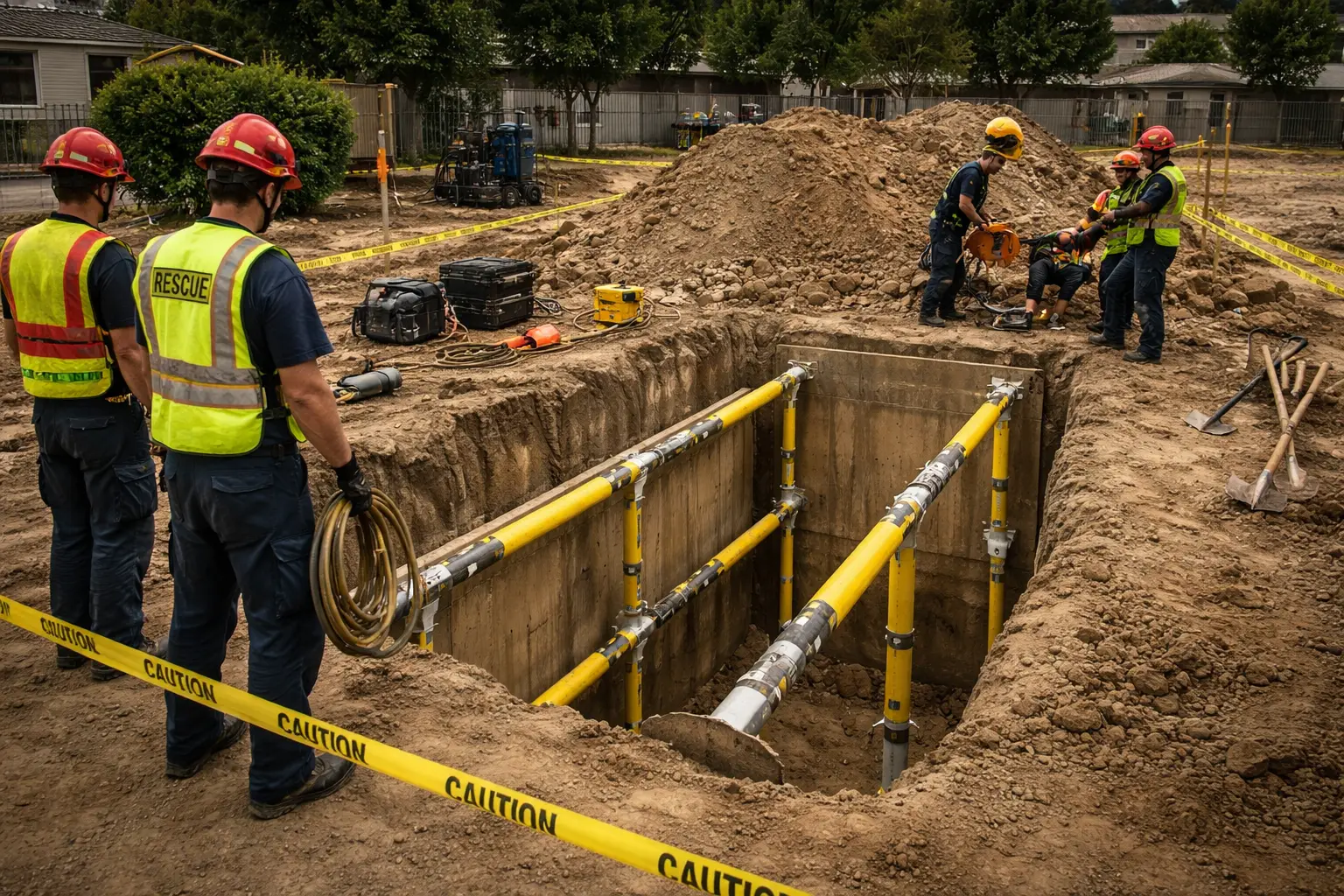
- Install shoring panels or pneumatic shores at the trench walls before any rescuer enters and before any significant manual digging begins.
- Once shores are in place and stable, rescuers enter and begin hand digging to free the victim — starting from above the burial level and working down.
- Extricate, package the victim (spinal precautions if indicated), and raise from the trench.
Shoring Systems: Pneumatic, Hydraulic, and Panel
Three primary shoring systems are used in trench rescue. Which is selected depends on trench geometry, soil type, and available equipment.
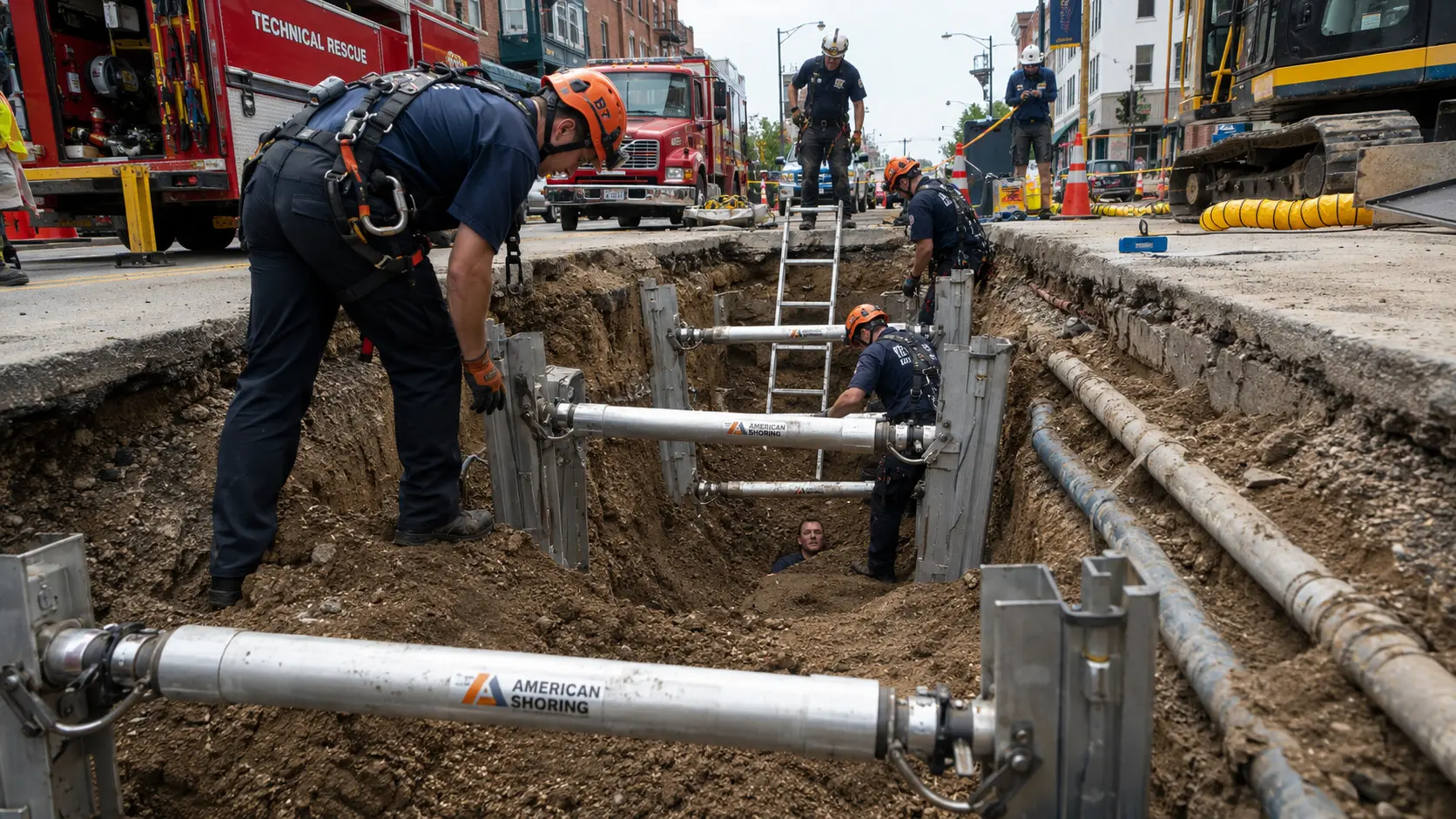
Pneumatic shores: Air-powered cylinders that extend to press against opposite trench walls, providing lateral support. They can be installed from the surface — without a rescuer in the trench — and are the fastest shoring method for the first level of protection. Pneumatic shores can be installed in pairs from above as the first protective measure while a victim is already buried.
Hydraulic shores: Similar to pneumatic but operated hydraulically. Slower to install but capable of higher extension forces and more precise pressure control. Used when soil conditions require more aggressive lateral support.
Panel shoring systems (trench boxes): Prefabricated steel or aluminum panels that are lowered into the trench adjacent to the walls and spread apart with cross braces to form a protective box. The victim and rescuers work inside the box. Trench boxes provide the most complete protection but are heavier, require equipment to lower them into position, and take longer to install than pneumatic shores. They are the standard for deep or wide trenches where pneumatic shores alone are insufficient.
Why You Cannot Dig Fast Enough With Your Hands
The instinct at a trench collapse is to dig. Bystanders, coworkers, and first responders without trench rescue training frequently begin hand-digging immediately after a collapse. The problem is the math.
A worker buried to chest depth in a simple cave-in has approximately 200 to 400 pounds of soil against their torso and lower body. Two people digging with their bare hands remove approximately 5 to 10 pounds of soil per minute from a position at the victim's side, without disturbing the walls enough to cause a secondary collapse. At that rate, freeing a chest-deep victim takes 20 to 40 minutes. The survival window is 2 minutes.
Uncontrolled digging with shovels at the wall face is faster in terms of soil removal but creates vibration and undercutting that produces secondary collapses — potentially burying the victim deeper, burying the rescuers, or collapsing the opposite wall onto everyone in the trench simultaneously. The secondary collapses documented in trench fatality investigations frequently convert a partially-buried surviving victim into a fully-buried fatality.
The correct approach — shoring first, careful hand digging within the shored zone — is slower than uncontrolled digging at the start and faster over the entire rescue timeline, because it does not produce secondary collapses that add burial depth and create additional victims. It also keeps the rescue team alive to complete the rescue.
Comments 0
No comments yet. Be the first to share your thoughts!
Leave a Comment