
How to Become a Firefighter in Ohio (2026) – State Certification & City-by-City Hiring Process
Last updated:
Ohio doesn't run firefighter hiring through one statewide process. Every city sets its own civil service exam, physical test, age cap, and academy — but they all lead to the same underlying credential: Firefighter I and Firefighter II certification under Ohio Revised Code Chapter 4765, with training delivered through the Ohio Fire Academy (a bureau of the State Fire Marshal's office) and certification exams administered by the Ohio Department of Public Safety, Division of EMS. This guide walks through both layers — what's true everywhere, and what changes city to city.
Compare pay first:Ohio Firefighter Salary — City Breakdown · National overview:How to Become a Firefighter (2026 Guide)
The Two Paths Into an Ohio Fire Department
Like Texas, Ohio's largest departments will train and certify you themselves — you don't need to walk in the door already certified. That splits every applicant into one of two tracks:
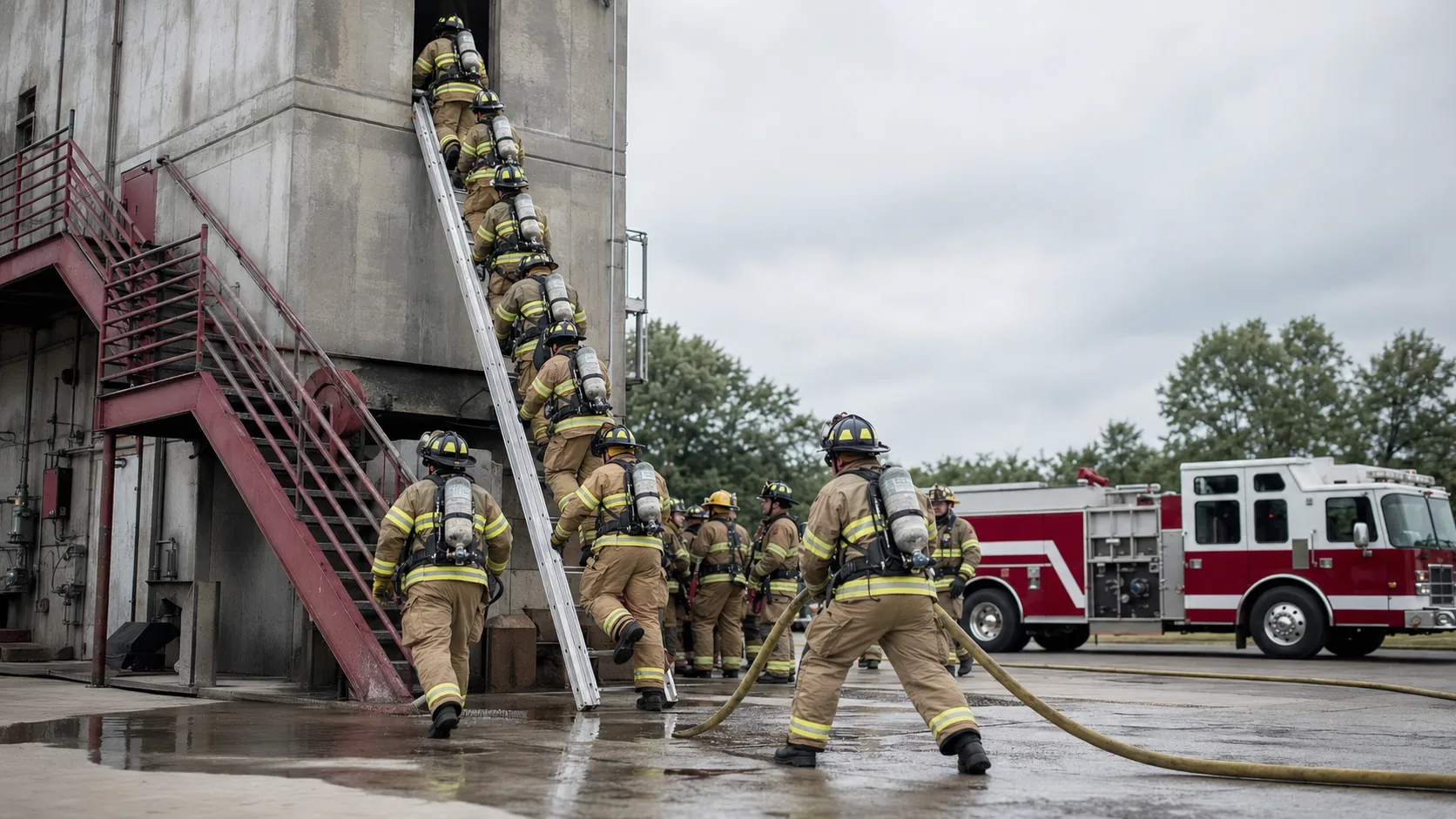
- Non-certified recruit — you apply with no Firefighter certification. If hired, the department pays you a recruit/cadet salary while you complete their in-house academy, which covers Firefighter I and II certification and, at virtually every career department in the state, EMT-Basic certification as well. This is the default path for Columbus, Cleveland, Cincinnati, Toledo, and Akron.
- Pre-certified applicant — you complete a chartered fire training program first (community colleges, joint vocational school districts, and regional training centers across Ohio run these, including programs at the University of Akron, Columbus State, and various county career centers), pass the state certification exam through the Division of EMS on your own, then apply already holding Firefighter I or Firefighter II. This costs tuition and time up front, but it widens your options — smaller and suburban departments, along with part-time and volunteer positions, often require certification before you can even apply.
Neither path is objectively better. Non-certified is the faster, cheaper way into a big department that trains its own people. Pre-certified gives you more departments to apply to — including part-time and volunteer roles that build experience — and a credential that travels if a hiring cycle falls through.
Statewide Minimum Requirements
Unlike Texas, Ohio does not set a single statewide age window for career firefighters — each city's civil service commission sets its own minimum and maximum age by ordinance, so the caps genuinely differ department to department (see the table below). The rest of these apply almost universally across Ohio's career departments:
- ✓At least 18 years old by the time of appointment (some departments, including Columbus and Cincinnati, accept applications at 17 or 17.5)
- ✓High school diploma or GED
- ✓Valid driver's license (an Ohio license is generally required by time of hire, even if you apply from out of state)
- ✓No felony convictions
- ✓U.S. citizen or otherwise legally authorized to work in the U.S.
- ✓Able to pass a department medical exam, drug screen, and psychological evaluation
- ✓Willing and able to become a certified EMT (and, at several major departments, Paramedic) as a condition of employment
Because Ohio doesn't require EMT certification at the state fire-certification level, this last point is easy to underestimate — but Columbus, Cleveland, Cincinnati, Toledo, and Akron all build EMT (and in several cases Paramedic) training directly into the recruit academy, and treat it as mandatory for the job.
City-by-City: Age, Exam, and Academy
| Department | Age Window | Written Exam | Academy | Extra Notes (non-certified track) |
|---|---|---|---|---|
| Columbus Division of Fire | 17½ at application, 18 at hire, not older than 40 when sworn in | Civil service written aptitude test through Columbus Civil Service; active CPAT card required and presented at the written test | Columbus Fire Academy — combined fire and EMT recruit training, paid from day one; exact length confirmed per class | Prior EMT not required — recruits earn it in the academy. College education, paramedic cert, or military service can improve standing on the eligibility list |
| Cleveland Division of Fire | Set by the current civil service exam bulletin — confirm on the active posting | Civil service written exam (reading, math, reasoning) + pass/fail physical agility test; no filing or testing fee | Fire Training Academy; starting academy pay is $15.00/hr | 10 points added for 1+ year Cleveland residency at time of filing; veterans get 5–10 additional points |
| Cincinnati Fire Department | 17 at application, 18 at appointment, not yet 41 at appointment | Civil Service written and physical assessments, followed by placement on the Civil Service Eligibility List | Recruit academy with background investigation (fingerprinting, polygraph — no credit check) before appointment | Must reside in Hamilton County or a contiguous county by appointment; no citywide residency requirement to apply |
| Toledo Fire & Rescue Department | 18 minimum, cannot be 40 or older at the final closing date of the civil service exam | FireTEAM exam (math, reading, mechanical, human relations) via National Testing Network, plus a Firefighter Mile run | 6 months at the Toledo Fire & Rescue Academy | Preference points stack: EMT-B (+3), EMT-A (+4), Paramedic (+5), plus veteran's preference (+5, or +10 if disabled) |
| Akron Fire Department | 18–35 at the written civil service exam | Civil Service Exam; corrected vision must reach 20/30 binocular (no worse than 20/100 uncorrected in each eye) | 16-week Fire/Medic training program; starting pay $29.43/hr (~$61,214/yr) | Hired as Firefighter/Medic — all new hires are trained and required to become certified EMTs and Paramedics; tuition-free college courses through Stark State partnership |
Sources: department and civil service commission job postings and recruiting pages (Columbus, Cleveland, Cincinnati, Toledo, Akron), current as of mid-2026. Hiring windows, exam vendors, age caps, and academy length change between recruitment cycles — always confirm dates and requirements on the department's own civil-service page before you apply.
What Ohio Firefighter Certification Actually Covers
Whichever path you take, you end up needing the same credential: Firefighter I certification, with most career departments requiring or building toward Firefighter II. Coursework follows the NFPA 1001 Standard for Fire Fighter Professional Qualifications and covers structural firefighting, hazardous materials awareness, vehicle extrication basics, ladders, ventilation, hose handling, personal protective equipment, and SCBA use. If you go the pre-certified route, this is delivered through a chartered training program at a community college or joint vocational school district; if you go the department route, it's built into your recruit academy curriculum, which at Ohio's major departments also folds in EMT-Basic (and at some, Paramedic) training.
Training itself is delivered through Ohio Fire Academy (OFA)-approved providers and IFSAC-accredited course offerings under the State Fire Marshal's office, but the certification exam is administered separately, by the Ohio Department of Public Safety, Division of EMS, under Ohio Revised Code Chapter 4765. A typical standalone academy runs roughly 14 to 20 weeks for Firefighter II certification; folding in EMT-Basic training, as most Ohio department academies do, stretches that to roughly 24 to 30 weeks.
Step-by-Step: The Ohio Civil-Service Hiring Process
- Apply during an open recruitment window. Ohio departments open applications for a set filing period, then close them once an eligibility list is established. Most run through the city's civil service commission site or governmentjobs.com; some, like Toledo, use National Testing Network to administer the written exam itself.
- Pass the written civil service exam. Content and vendor vary by city — see the table above. Scores build a ranked eligibility list, so a higher score matters even after you clear the passing threshold, and the list typically expires after one to two years.
- Pass the physical ability test. Several Ohio departments, including Columbus, require an active CPAT card presented at the written exam rather than testing physical ability later in the process — check the specific department's sequence before you apply.
- Background investigation. Criminal history, driving record, and employment history get reviewed; some departments (Cincinnati among them) add a polygraph. Disclose everything — an old, disclosed issue is usually survivable, an undisclosed one usually isn't.
- Oral board / panel interview. Standard behavioral-interview format — be ready to talk through teamwork, pressure, and ethical judgment calls with specific examples.
- Conditional offer, then medical exam, drug screen, and psychological evaluation. Vision and cardiovascular standards are checked here — Akron, for example, requires vision correctable to 20/30 binocular.
- Academy. Paid, live it like a job — length and pay vary by department (see table above), and most fold EMT training in alongside fire training.
- Probation period after graduation before you're a fully vested member of the department; all Ohio career firefighters then participate in the Ohio Police and Fire Pension Fund (OP&F), which provides retirement benefits after 25 years of service.
What Disqualifies You
- ✗Felony convictions. A near-universal disqualifier across Ohio civil-service departments, though the exact standard is set by each city's civil service commission rather than a single state statute.
- ✗Age. Because Ohio sets no single statewide cap, missing your target department's specific window disqualifies you for that cycle — Columbus caps at 40 when sworn in, Cincinnati at 41 by appointment, Toledo at 40 at the exam's final closing date, and Akron at 35 on exam day. Always check the current department, not a neighboring city's rule.
- ✗Misdemeanor and driving-record lookback windows vary by department. There is no single statewide list — each civil service commission publishes its own disqualifying-offense standard in the exam announcement for that hiring cycle.
- ✗Vision and medical standards. Departments set specific uncorrected/corrected vision thresholds (Akron's is 20/30 binocular corrected) and cardiovascular standards checked during the post-offer medical exam; failing these can end an otherwise strong application late in the process.
Frequently Asked Questions
What is the minimum age to become a firefighter in Ohio?
18 years old at appointment is the near-universal floor, and some departments — Columbus and Cincinnati among them — accept applications from 17 or 17.5-year-olds. Unlike Texas, Ohio has no single statewide upper age cap; each city sets its own maximum, ranging from 35 (Akron) to 41 (Cincinnati) as of this writing.
Do I need Firefighter certification before I apply to an Ohio fire department?
No. Columbus, Cleveland, Cincinnati, Toledo, and Akron all hire non-certified recruits and train them through a paid in-house academy that includes earning Firefighter I and II certification, and typically EMT-Basic as well. Getting certified first through a chartered training program is optional — it widens which departments and part-time or volunteer roles you can apply to, but it isn't required to get hired at a career department.
How long does an Ohio fire academy take?
It depends on the department and whether EMT training is folded in. Toledo's academy runs about 6 months. Akron's Fire/Medic training program runs about 16 weeks. A standalone Firefighter II academy statewide typically runs 14 to 20 weeks, stretching to roughly 24 to 30 weeks when EMT-Basic is included, as it is at most major Ohio departments.
What disqualifies someone from becoming a firefighter in Ohio?
Felony convictions are a near-universal disqualifier. Beyond that, each city's civil service commission sets its own age window, misdemeanor and driving-record lookback periods, and medical/vision standards — always check the specific department's current exam announcement rather than assuming one city's rules apply statewide.
Want to know what you'd actually earn once you're hired? See the Ohio Firefighter Salary breakdown by city, or start training now with our CPAT prep guide.





Comments 0
No comments yet. Be the first to share your thoughts!
Leave a Comment