How to Become a Firefighter in Florida (2026) – Certification, EMT & Department Hiring
Last updated:
Florida is a little different from states where you can simply wait for a big-city department to hire you and expect the academy to handle everything. Florida has a statewide firefighter certification system, while individual departments decide what you need before they will put your application into the hiring process.
That distinction is where a lot of candidates lose time. You can complete fire training and still discover that the department you want expects a Florida EMT license, CPAT, a particular driver's license, or another credential before it will consider you. On the other hand, a few departments offer recruit pipelines that can change the order completely.
The practical way to approach Florida is to choose the departments you would realistically work for first, then build your certifications around their requirements. Don't spend thousands of dollars just because one academy has an opening next month.
Already comparing departments? See the Florida Firefighter Salary — Miami-Dade, Tampa, Jacksonville & City Pay.
New to the entire hiring process? Start with the national step-by-step firefighter hiring guide, then come back here for Florida-specific rules.
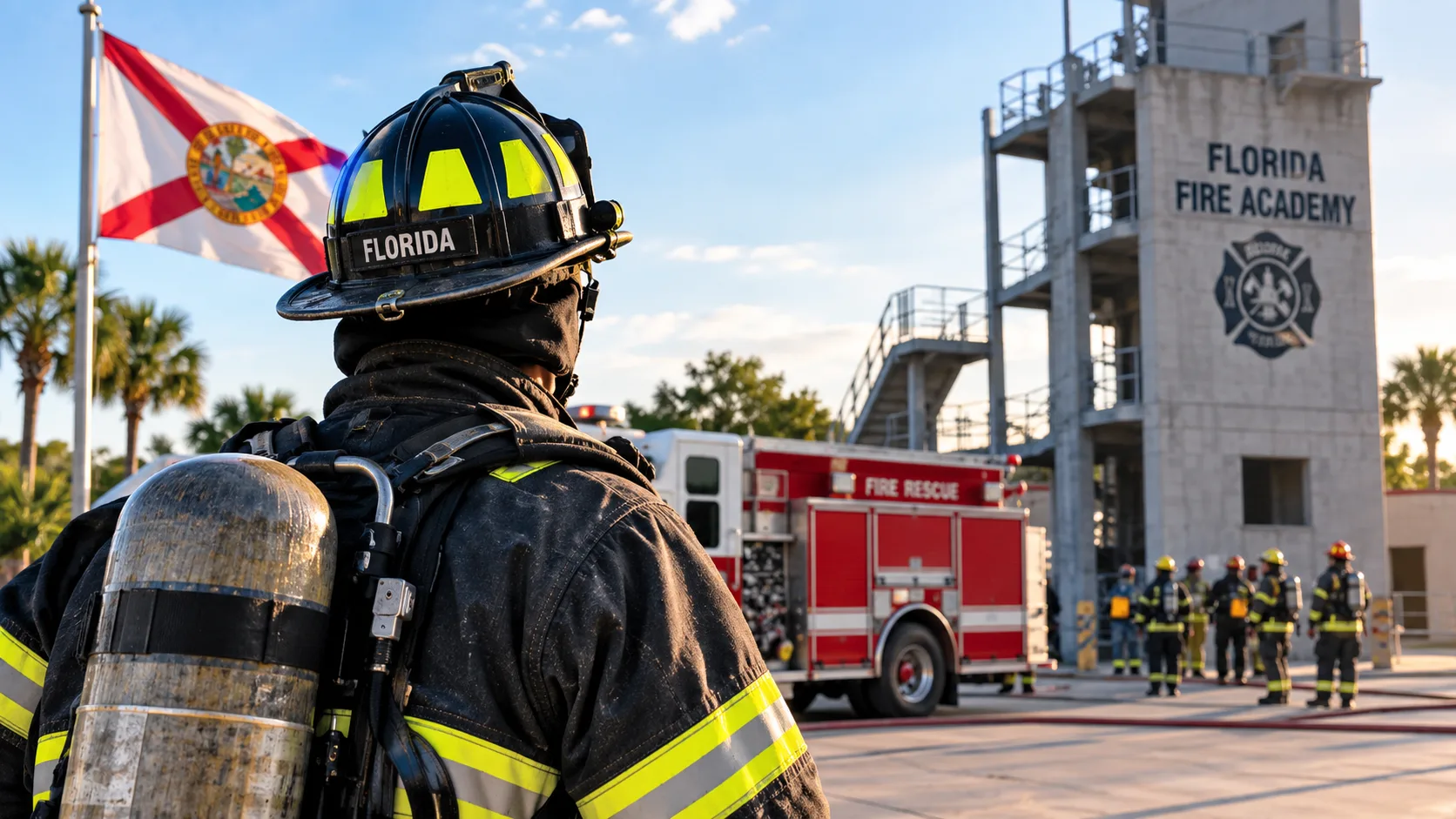
Florida controls firefighter certification at the state level, but individual departments still control who they hire and what additional qualifications they require.
Florida's System in Plain English
There are really two sets of rules you need to satisfy.
- Florida firefighter certification requirements. These come through the Florida Division of State Fire Marshal and the Bureau of Fire Standards and Training.
- Your department's hiring requirements. Jacksonville, Tampa, Orlando and Miami-Dade do not run identical hiring processes even though they operate under the same state certification framework.
Florida's Bureau of Fire Standards and Training says a career firefighter must complete the Firefighter Minimum Standards Course — Firefighter I and Firefighter II — at a certified training center, or qualify through an approved equivalency route, and then pass the required state written and practical examinations.
Official source:Florida Bureau of Fire Standards and Training — Florida Firefighter Certification
State Certification Requirements
Florida Statute 633.412 establishes the baseline qualifications for firefighter certification. The state requirement is not the same thing as a department job posting, but it is the foundation every career candidate has to understand.
- ✓At least 18 years old.
- ✓High school diploma or equivalent.
- ✓Required fingerprint and criminal-background review.
- ✓Good moral character under the state certification standard.
- ✓Physical condition sufficient to meet the state's medical requirements.
- ✓Compliance with Florida's tobacco-use restriction for firefighter certification.
- ✓Completion of approved firefighter training or an accepted equivalency pathway.
- ✓Passing the state written and practical firefighter examinations.
Official source:Florida Statute 633.412 — Firefighter Qualifications for Certification
If age is the part you're worried about, don't use a random national answer. Florida's certification floor and a city's hiring rules are two different things. Our firefighter age limits guide explains why department-specific age rules still need to be checked.
How Much Training Is Required?
The state's published Minimum Standards curriculum consists of at least 206 hours for Firefighter Part I and another 192 hours for Part II. That puts the published minimum firefighter curriculum at roughly 398 hours before you add EMT school, CPAT preparation or a department selection process.
Official source:Florida BFST — Certification and Testing
Those hours also explain why looking only at academy duration can be misleading. A full-time academy, a night program and a combined fire/EMS program may take very different amounts of calendar time while leading toward the same state credential.
If you haven't been through a structured recruit academy before, the fire academy preparation guide covers the physical workload, study habits and day-to-day expectations without repeating them here.
The EMT Question: Get This Right Before You Enroll
Florida firefighter certification and Florida EMS certification are separate systems. That does not mean EMT is optional if your goal is a career department.
Jacksonville requires firefighter applicants to already hold both a Florida Firefighter Certificate of Compliance and a Florida EMT or paramedic certificate. Tampa also requires firefighter certification plus EMT-Basic or paramedic certification. Orlando's regular firefighter route is aimed at State of Florida certified firefighters who are also EMTs or paramedics.
So when someone asks, “Do I need EMT to become a firefighter in Florida?” the useful answer is: look at where you intend to work, not just the minimum firefighter certification rule.
Florida EMT and paramedic certification is handled through the Florida Department of Health. Florida-trained EMT applicants use the NREMT cognitive examination, while out-of-state applicants have separate certification requirements.
Official source:Florida Department of Health — EMT and Paramedic Certification
For the bigger career decision — whether stopping at EMT makes sense or whether paramedic school is worth the extra time — see our Firefighter EMT vs. Paramedic guide.
Major Florida Departments Do Not Hire the Same Way
This is why a state guide is useful. “Florida certified” tells only half the story.
| Department | What stands out | What to check before applying |
|---|---|---|
| Jacksonville Fire and Rescue | Applicants must already be Florida-certified firefighters and EMTs or paramedics before applying. | Current CPAT, valid driver's license, certificates and JFRD's screening process. |
| Tampa Fire Rescue | Requires Florida firefighter certification plus EMT-Basic or paramedic certification. Tampa also requires firefighters to obtain Florida paramedic certification within its published post-hire period. | CPAT/FireTEAM documentation, current credentials and the active City hiring requirements. |
| Orlando Fire Department | The normal route is for Florida-certified firefighter/EMTs or paramedics, but Orlando also operates a paid recruit pathway for people who are not yet certified. | Whether the regular firefighter process or Fire Recruit Program is the better route for you. |
| Miami-Dade Fire Rescue | Uses a structured recruitment process that can include written screening, CPAT, medical/stress testing and background steps. | The current recruitment cycle and packet — don't rely on requirements from an old hiring class. |
Jacksonville Fire and Rescue
Jacksonville is one of the clearest examples of a department where you should finish your credentials before sending the application. JFRD says applicants must already be state-certified in Florida as a firefighter and EMT or paramedic.
Its listed minimum qualifications also include CPAT, a valid driver's license and the state's tobacco-use requirement. After eligibility review, candidates can move through a criminal background investigation, oral interview, medical evaluation and psychological evaluation.
Official source:Jacksonville Fire and Rescue Department — Join JFRD
If Jacksonville is your target, there is little value in finishing fire school and then waiting months to begin EMT. Build both credentials into the plan from the start.
Tampa Fire Rescue
Tampa currently lists a minimum age of 18, high school diploma or GED, Florida driver's license, State of Florida Firefighter Certificate of Compliance, and EMT-Basic or paramedic certification.
The department's required-document list also includes CPAT/FireTEAM certification. Tampa further states that firefighters must obtain Florida paramedic certification within the first three years of employment, with enrollment requirements before that deadline.
Official source:Tampa Fire Rescue — Employment Opportunities
That makes Tampa a good example of why merely asking “What is the minimum I need to apply?” can be the wrong career question. You should also ask what the department expects you to become after you are hired.
Orlando Fire Department
Orlando has one of the more interesting entry routes in Florida. Its regular firefighter hiring page says the city hires State of Florida certified firefighters and EMTs/paramedics and notes that firefighter hiring normally opens periodically rather than remaining continuously available.
Official source:City of Orlando — Become an Orlando Firefighter
But Orlando also runs a Fire Recruit Program for people with little or no firefighting experience. Selected recruits receive paid training while attending fire academy and EMT training.
Official source:City of Orlando — Fire Recruit Program
For a candidate starting from zero, that changes the math. Before paying for both certifications yourself, check whether a sponsored route you actually qualify for is available.
Miami-Dade Fire Rescue
Miami-Dade's recruitment system is another reason not to copy requirements from a forum post or an old academy class. MDFR publishes its own recruitment material and examination sequence, including written screening, CPAT and medical/stress testing.
Official source:Miami-Dade Fire Rescue — Firefighter Recruitment
Recruitment-cycle details can change, so use the current Miami-Dade posting when applications reopen. If a written exam is part of your target department's process, our firefighter written exam guide covers the math, reading, mechanical reasoning and FireTEAM-style preparation that candidates commonly face.
What About CPAT?
CPAT is common enough in Florida that it should be part of your planning, but don't assume every department handles it at the same stage. Jacksonville lists CPAT among its minimum qualifications, Tampa asks for CPAT/FireTEAM documentation, and Miami-Dade includes CPAT in its selection process.
Train for the actual events, not just “firefighter fitness.” Loaded stair work, hose movement, equipment carries, ladder work, forcible entry, search, rescue drag and ceiling breach/pull create a very different fatigue pattern from a normal gym session.
We already cover all eight events and the 10:20 test standard in the complete CPAT preparation guide.
A Practical Step-by-Step Florida Route
- Choose three to five target departments. Read their current employment pages before choosing a school.
- Compare what is required at application. Write down firefighter certification, EMT/paramedic, CPAT, driver's license and any department-specific testing.
- Choose your training sequence. If all realistic targets expect EMT before application, there is little reason to leave EMT until the end.
- Complete Florida Minimum Standards training through a certified training center unless you qualify for the state's equivalency process.
- Pass Florida's firefighter written and practical examinations and complete the Certificate of Compliance process.
- Finish EMS certification at the point required by the departments on your shortlist.
- Complete CPAT or other pre-hire testing. Make sure your card or test result will still be valid when applications open.
- Apply during the correct recruitment cycle. Don't assume a department continuously accepts entry-level applications just because another Florida city does.
- Prepare for background and oral-board stages. Driving history, employment history, criminal history and honesty in the personal-history process matter. Our firefighter background investigation guide explains what investigators normally review.
- Expect more training after selection. Being certified gets you eligible; it does not mean your department training and probation are finished.
The most useful planning rule: build toward the highest common requirement among the departments you would genuinely accept a job with.
If Jacksonville, Tampa and another target all want firefighter certification + EMT + CPAT, that combination is a much better training plan than working from the bare minimum state statute.
Can an Out-of-State Firefighter Transfer to Florida?
Florida does have an equivalency process, but holding another state's firefighter certificate does not automatically convert into a Florida certificate.
The Bureau of Fire Standards and Training reviews documented out-of-state or Department of Defense training. If the training is accepted as equivalent, the candidate may be able to avoid repeating the full Florida academy, but still has to complete Florida's required written and practical examinations.
If the training is not accepted as equivalent, the candidate must attend a Florida Firefighter Minimum Standards Course.
Official source:Florida BFST — Out-of-State Firefighter Equivalency
Remember that EMS is a separate credential. An experienced firefighter moving to Florida should check firefighter equivalency and Florida EMT/paramedic certification independently rather than assuming one transfers the other.
What Can Derail a Florida Application?
There isn't one universal municipal disqualification list for every Florida department. The state establishes certification requirements, then departments add their own employment standards.
- ✗Assuming certification equals employment eligibility. A department may still require EMT, paramedic, CPAT or other credentials.
- ✗Using an old recruitment packet. Hiring cycles change. Always compare this guide with the department's current posting.
- ✗Waiting too long to deal with EMS certification. This is especially costly if your preferred departments require EMT before application.
- ✗Hiding something during the background investigation. A disclosed past issue and an undisclosed one are not treated the same way.
- ✗Ignoring the tobacco requirement. Florida firefighter certification includes a non-user requirement, and departments such as Tampa explicitly address it in their hiring rules.
How Long Does It Take?
There is no useful single number for the whole state.
Florida's published firefighter curriculum alone totals roughly 398 minimum instructional hours. EMT training adds another block of education. Then you have state testing, certification processing, CPAT and whatever recruitment timetable your department uses.
Jacksonville accepts applications from qualified firefighter/EMTs on an ongoing basis. Orlando says its regular firefighter openings generally occur every one to two years. Those two candidates can have identical certifications and very different timelines simply because of when the department is hiring.
That is why the fastest route isn't necessarily the shortest academy. The fastest route is the one where your certifications line up with an actual hiring opportunity.
Frequently Asked Questions
What is the minimum age to become a firefighter in Florida?
Florida's firefighter certification statute sets the minimum at 18 years old and requires a high school diploma or equivalent. Individual departments may add their own employment requirements.
Do I need EMT certification to become a firefighter in Florida?
EMT is separate from the state's firefighter certification process, but many career departments require Florida EMT or paramedic certification for employment. Jacksonville, Tampa and Orlando are examples where EMS credentials play a direct role in eligibility.
Does Florida require Firefighter I and Firefighter II?
Florida's career Firefighter Minimum Standards Course consists of Firefighter Part I and Firefighter Part II. Candidates then complete the state's required written and practical examinations for the Firefighter Certificate of Compliance.
Is CPAT required to become a firefighter in Florida?
CPAT is used by several major Florida departments, but there is not one identical statewide municipal hiring sequence. Check the current requirements of the department where you intend to apply.
Can an out-of-state firefighter become certified in Florida without repeating an academy?
Potentially. Florida operates an equivalency process for qualifying out-of-state and military firefighter training. If the training is accepted, the candidate may avoid repeating the full Minimum Standards Course, but Florida written and practical examinations are still required.
Should I complete EMT or fire academy first?
There is no universal order that fits every candidate. Check several target departments first. If all of them require EMT before application, completing EMT early usually makes more sense than finishing fire school and discovering you still cannot apply.
Next steps: Compare current pay in our Florida firefighter salary guide, prepare for the physical test with the CPAT guide, and use the EMT vs. Paramedic guide before choosing your EMS path.

Comments 0
No comments yet. Be the first to share your thoughts!
Leave a Comment