
Firefighter Written Exam Study Guide: NTN FireTEAM, Math, Mechanical & 6-Week Plan
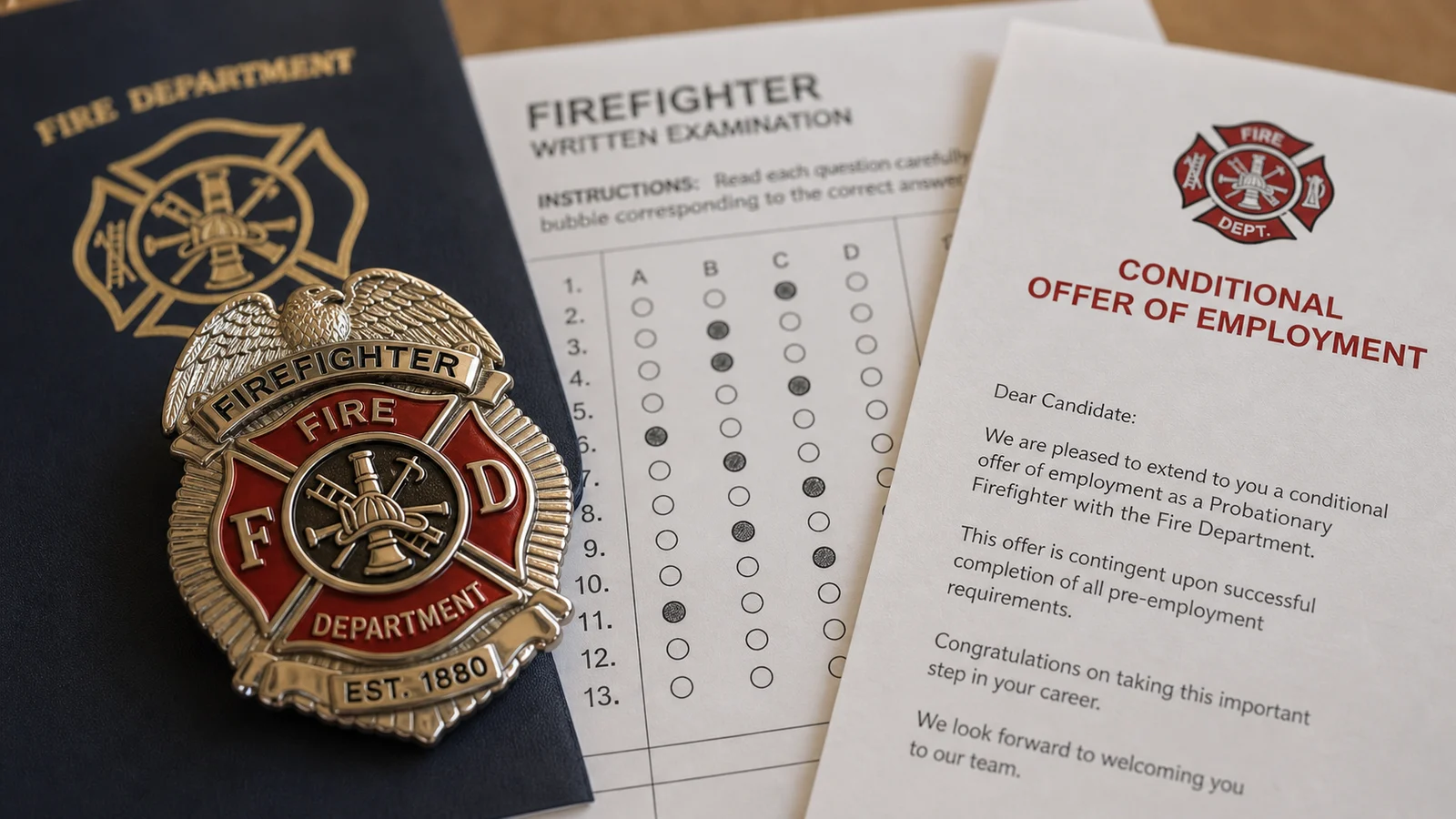
The written exam is the first elimination round in the firefighter hiring process. Departments use it to cut large applicant pools down to candidates who proceed to the oral board, background, and physical testing. A candidate who understands what is on the exam, how to prepare for each component, and how to perform under timed pressure has a significant advantage over candidates who treat the exam as an afterthought. This guide covers the major exam formats, every content area, and a 6-week preparation plan.
Jump to:Major exam formats · NTN FireTEAM · National Testing Network · Content areas: what is tested · Math and mechanical reasoning · Reading comprehension · Listening comprehension · Spatial orientation · 6-week study plan · FAQ
Major Firefighter Exam Formats
Firefighter written exams are not standardized nationally. Different departments use different exams, and the specific content and format vary. The most commonly used exams:
| Exam | Used by | Format | Primary skills tested |
|---|---|---|---|
| NTN FireTEAM | Hundreds of departments nationwide; most IAFF-affiliated departments | Computer-based; 5 distinct sections; approximately 2.5 hours | Video-based human relations, reading video, mechanical reasoning, math, spatial orientation |
| Firefighter Select (PSI/Cooperative Personnel Services) | California departments; multiple state civil service systems | Paper or computer; multiple choice | Reading comprehension, math, mechanical aptitude, map reading |
| Department-specific exams | Large departments (FDNY, LAFD, Chicago, Houston) with civil service | Varies; usually paper/computer multiple choice | Varies; often reading, math, judgment, memory |
| Criticall | Some dispatch-heavy departments; combined FF/dispatch roles | Computer-based; multitasking under time pressure | Data entry accuracy, multitasking, reading under pressure |
Before studying, identify which exam your target department uses. Check the department's recruitment announcement — it will specify the exam vendor. If it says "NTN FireTEAM," study for that format specifically.
NTN FireTEAM: The Most Common Format
The National Testing Network (NTN) FireTEAM is now the most widely used firefighter written exam in the United States. If you are applying to any IAFF-affiliated department or most mid-to-large municipal departments, there is a high probability you will take this test.
FireTEAM has 5 sections:
- Human Relations Video: Watch short video scenarios depicting workplace, emergency, or interpersonal situations. Answer questions about the best response. Tests judgment, values alignment, and situational awareness.
- Reading Video: Watch an emergency scene video, then answer questions about what you observed. Tests observation, memory, and situational awareness under realistic conditions.
- Mechanical Reasoning: Standard mechanical aptitude questions: pulleys, gears, levers, basic physics, fluid dynamics. No firefighting knowledge required — this is general mechanical reasoning.
- Math: Arithmetic, percentages, fractions, ratios, basic algebra, unit conversion. Fire service math problems (water flow, area calculation). Calculator not permitted.
- Spatial Orientation: Map reading and navigation questions. Determine direction of travel, shortest route, or relative position from a map or diagram.
FireTEAM scores are portable. NTN FireTEAM scores can be submitted to multiple departments without retaking the test. A good score is an asset that opens multiple doors simultaneously. Invest in preparation — one solid score can support dozens of applications.
Content Areas: What Is Actually Tested
Across all major firefighter exam formats, the content areas that appear most consistently:
| Content area | What to expect | How to prepare |
|---|---|---|
| Math | Arithmetic, fractions, percentages, ratios, basic algebra, word problems with fire/EMS context | Khan Academy free math courses; timed practice without calculator |
| Reading comprehension | Read a passage, answer questions about its content; sometimes fire-related policy passages | Read non-fiction articles daily; practice active reading with recall questions |
| Mechanical reasoning | Pulleys, gears, levers, inclined planes, simple machines, basic physics concepts | Mechanical Aptitude and Spatial Relations tests (free online); Barron's Mechanical Reasoning |
| Spatial orientation | Map reading, compass directions, route planning, understanding relative positions | Practice reading street maps; USPS carrier orientation tests (free online) |
| Situational judgment | Video or text scenarios requiring the best response from provided options | Study firefighter values (integrity, teamwork, accountability, courage); practice identifying what a good firefighter would do |
| Memory and observation | Read or watch something, then answer questions about specific details without referring back | Read passages, close the book, write what you remember; practice video observation exercises |
Math Section: What You Must Know
The math on firefighter exams covers basic arithmetic through simple algebra. Calculator is not permitted on most exams. Practice doing these by hand:
Core math skills
- Fractions and decimals: Convert between fractions, decimals, and percentages. Add, subtract, multiply, and divide fractions.
- Ratios and proportions: "If 3 firefighters can search 2 floors in 4 minutes, how long for 6 firefighters to search 5 floors?"
- Percentages: Calculate percentage of a number; find the original number given a percentage; percentage increase/decrease.
- Area and volume: Area of rectangles and circles; volume of rectangular spaces. Used in water flow and room size calculations.
- Unit conversion: Convert gallons to liters, feet to meters, PSI to various units. Know basic conversion factors.
- Basic algebra: Solve for X in simple one and two-step equations.
Fire service math problems
Some exams include fire-specific math. The most common:
- Fire flow calculations: NFF = (Length × Width) / 3 for basic needed fire flow
- Friction loss: FL = C × Q² × L (simplified form)
- GPM from smooth bore tip: GPM = 29.72 × D² × √NP
- Percentage problems: "This building is 20% involved. If the building is 10,000 sq ft, how many square feet are burning?"
Use the Friction Loss Calculator and Fire Flow Calculator to understand the math behind the tools you will use in your career.
Reading Comprehension: The Most Improvable Section
Reading comprehension is the most improvable section of the firefighter exam because it directly responds to reading volume. The candidate who reads 30 minutes of non-fiction every day for 6 weeks will score significantly better on reading comprehension than they did at the start. Practice techniques:
- Active reading: After each paragraph, stop and summarize the main point in one sentence without rereading. This is the same skill the exam tests.
- Main idea identification: Practice identifying the main argument of a passage vs. supporting details. Exam questions frequently distinguish between these.
- Inference questions: Practice answering questions about what a passage implies rather than what it explicitly states. "Based on the passage, what would the author most likely conclude about X?"
- Read fire service publications: Fire Engineering, Firehouse Magazine, and NFPA Journal contain exactly the kind of technical reading passages that appear on firefighter exams.
Listening Comprehension (NTN Specific)
NTN FireTEAM's Reading Video section is unique: you watch a video of an emergency scene and then answer questions about what you observed, without being able to rewatch. This is specifically designed to simulate the conditions of real fireground information gathering. How to prepare:
- Watch news reports, emergency video footage, or training videos. After watching once, write down every specific detail you can remember: numbers, locations, people, sequence of events.
- Practice noting specific details, not general impressions. Exams ask "how many people were in the room" not "was it crowded."
- Take notes on paper during the practice video if the exam allows note-taking. Know the rules of your specific exam.
Spatial Orientation
Spatial orientation questions require you to navigate a map or diagram and answer questions about relative positions, directions, or routes. Key skills:
- Cardinal directions: North is up on a standard map. When a question says "turn left from heading north," you are now facing west. Practice this automatically.
- Relative direction: "The station is north of the school and east of the hospital" — practice placing objects in space relative to one another from verbal descriptions.
- Route planning: "What is the fastest route from A to B following one-way street rules?" Practice on actual street maps.
- Map reading exercises: Download free USPS mail carrier orientation tests or DMV permit test map sections for specific spatial practice.
6-Week Study Plan
| Week | Focus | Daily sessions (30–45 min each) |
|---|---|---|
| 1 | Baseline and math fundamentals | Take practice test to identify weakest areas; Khan Academy math: fractions, percentages, ratios |
| 2 | Math + mechanical reasoning | Timed math practice without calculator; mechanical aptitude practice problems; review basic physics |
| 3 | Reading comprehension + spatial | 30 min non-fiction reading with active recall; 15 min map reading / spatial practice |
| 4 | Situational judgment + observation | Video observation exercises (watch, pause, recall); review firefighter values and IAFF Code of Ethics |
| 5 | Full practice tests under timed conditions | Complete full practice exams timed; review every wrong answer and understand why |
| 6 | Targeted review + confidence | Focus on remaining weak areas; 1 more full practice test; sleep and rest priority before exam |
Frequently Asked Questions
What is on the firefighter written exam?
Most firefighter written exams test math (arithmetic through basic algebra), reading comprehension, mechanical reasoning, spatial orientation/map reading, and situational judgment. The NTN FireTEAM, the most common format, also includes video-based observation and human relations scenarios. Specific content depends on the exam format used by your target department.
Is the NTN FireTEAM exam hard?
For candidates who prepare specifically for its format, FireTEAM is a fair test of the targeted skills. For unprepared candidates, the timed video sections and mechanical reasoning can be challenging. The total test duration is approximately 2.5 hours. Scores are competitive across departments — a 70th percentile score or higher is generally needed to be competitive in most markets.
Can you retake the NTN FireTEAM?
Yes, but there is a waiting period (typically 30 days) between attempts. Your most recent score is typically what departments see. Prepare thoroughly for your first attempt; retaking after an unsatisfactory score costs time in the hiring process.
How long should you study for the firefighter written exam?
Six to eight weeks of daily focused preparation (30–60 minutes per day) is sufficient for most candidates who are academically comfortable. Candidates who are significantly weak in math or reading comprehension benefit from 10–12 weeks to build those foundational skills. Do not start studying two weeks before the exam and expect competitive results.

Comments 0
No comments yet. Be the first to share your thoughts!
Leave a Comment