How to Become a Firefighter in California (2026) – EMT, FCTC & Department Hiring
Last updated:
California does not have one firefighter hiring system.
That sounds obvious, but it matters more here than in most states. A candidate aiming for Los Angeles can face a different physical test and application sequence than someone trying to get into San Francisco. San Diego will hire qualified entry-level recruits into a paid academy. Sacramento uses California's statewide candidate testing system. CAL FIRE is another track again.
The mistake is assuming you need to collect every California fire-service certificate before you are allowed to apply anywhere. In some departments, prior academy training is useful. In others, the department expects to train its own recruit class. What you actually need depends on where you intend to work.
Before spending money on an academy: pick several departments you would genuinely accept a job with and compare their current application requirements.
Also compare compensation in our California Firefighter Salary guide, which covers LAFD, SFFD, San Jose and other major departments.
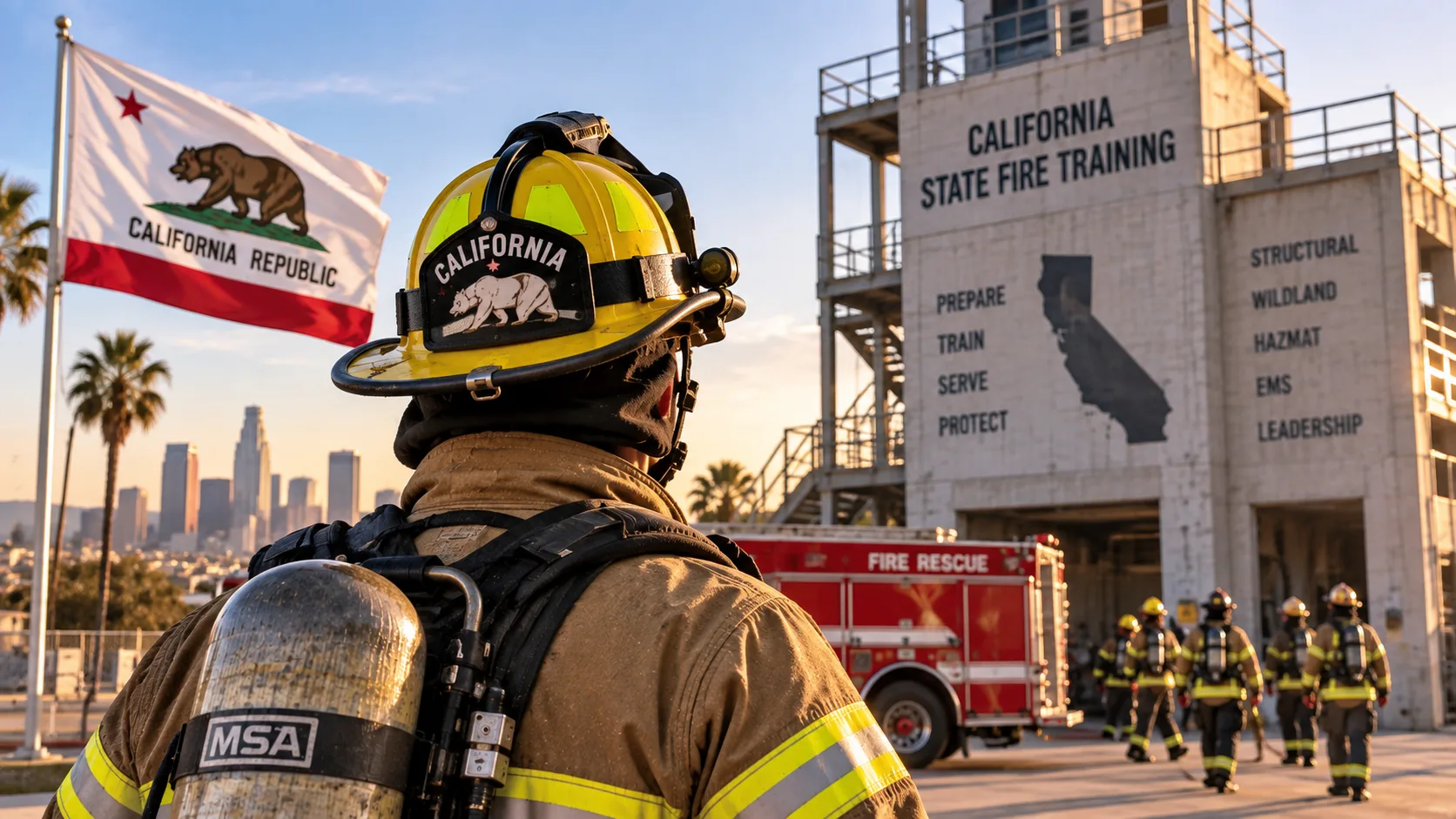
California State Fire Training establishes professional certification standards, while cities and fire agencies run their own hiring processes.
The First Thing to Understand: Certification and Hiring Are Not the Same Thing
California's Office of the State Fire Marshal runs State Fire Training, usually shortened to SFT. The state's Fire Fighter 1 certification is the first professional certification in that system.
Under the current standard, Fire Fighter 1 combines three qualification areas:
- ✓Structural Fire Fighter 1 under NFPA 1010.
- ✓Wildland Fire Fighter 1 under NFPA 1140.
- ✓Hazardous Materials Awareness and Operations under NFPA 470.
California implemented the 2024 edition of the Fire Fighter standard on July 1, 2025. Candidates training through an Accredited Regional Training Program or Accredited Local Academy are enrolled into the certification examination process through the academy. After required training and successful certification testing, Fire Fighter 1 certification is issued automatically.
Official source:California OSFM State Fire Training — Fire Fighter 1
That is useful certification. It is not, however, a universal prerequisite for every municipal entry-level firefighter application in California.
For somebody starting from zero, that distinction can save months and a substantial amount of tuition.
Do You Need Fire Fighter 1 Before Applying?
Sometimes. Not everywhere.
California has accredited community-college fire academies and local agency academies throughout the state. Completing one can make you eligible for departments that expect academy-trained applicants and can strengthen your file where prior training is valued.
But some of the state's largest departments recruit people without requiring a California Fire Fighter 1 certificate before application.
LAFD's current entry process, for example, starts with age, education and the Firefighter Candidate Assessment. San Diego's Firefighter Recruit classification sends selected candidates through the city's own academy. San Francisco's current process revolves around the FCTC eligibility system, CPAT and EMT.
So I would not treat academy enrollment as step one until I had checked the departments I actually wanted.
Official academy directory:California State Fire Training — Accredited Academies
EMT Is the Credential You Should Take Seriously
If there is one qualification that repeatedly shows up in California municipal firefighter hiring, it is EMT.
The exact timing differs. One department may require an EMT certificate before appointment, another during a later selection phase, and another may accept NREMT while you finish the California certification process.
California EMT certification is administered through local EMS agencies and authorized certifying entities rather than directly by the state EMS Authority. A typical California path is to complete an approved EMT course, pass the National Registry examinations, and apply to the local EMS agency for California certification.
Official source:California EMS Authority — EMT Certification
This is an important practical point: passing NREMT does not by itself mean you are already a California-certified EMT. EMSA explains that the local certification process still has to be completed before you can work as an EMT in California.
For a broader comparison of the EMS career paths, see our Firefighter EMT vs. Paramedic certification guide.
FCTC and Cal-JAC: Why You Keep Seeing Them in California Job Postings
California has something many states do not: a widely used statewide firefighter candidate testing system.
The Firefighter Candidate Testing Center, or FCTC, was created by the California Firefighter Joint Apprenticeship Committee. FCTC administers the Cal-JAC Candidate Physical Ability Test and its entry-level written examination.
Candidates who meet the requirements can be placed on the FCTC Statewide Eligibility List. Participating fire agencies can then use that list to identify applicants who already have verified testing and qualifications.
Cal-JAC says more than 150 departments use the Statewide Eligibility List in their hiring processes.
Official source:California Firefighter Joint Apprenticeship Committee — FCTC
For departments using the system, you should think of FCTC as part of your application preparation rather than an afterthought. A department may open recruitment and expect applicants to already be current on the list.
California's Major Departments Use Different Entry Routes
| Department | Entry-level pattern | Important 2026 detail |
|---|---|---|
| Los Angeles Fire Department | 18+, high school diploma/equivalent, FCA, interview and later EMT/physical testing requirements. | LAFD says CPAT is not accepted for the 2026 application period; it is using the Biddle Physical Agility Test (BPAT). |
| San Francisco Fire Department | FCTC Statewide Eligibility List, written test, CPAT and EMT pathway. | 19 at application, 20 at appointment; CPAT and FCTC testing must remain current through required stages. |
| San Diego Fire-Rescue | Entry Firefighter Recruit route with EMT/paramedic qualification. | Selected recruits attend a 16-week paid Fire Academy. |
| Sacramento Fire Department | EMT/paramedic preparation followed by FCTC Statewide Eligibility List. | Recruit applications normally open in summer; Sacramento tells candidates to complete EMT or paramedic school well before that cycle. |
Los Angeles Fire Department: Do Not Prepare From an Old Checklist
LAFD is probably the best example of why a California guide needs to be kept current.
For the 2026 Firefighter I process, LAFD lists 18 as the minimum application age and says there is no maximum application age. Candidates need a high school diploma, GED or qualifying equivalent and must pass the Firefighter Candidate Assessment, commonly called the FCA.
The FCA is a computer-based general aptitude assessment covering learning, reasoning, written and audio comprehension and basic arithmetic.
After the initial application stages and interview, candidates reaching the Pre-Employment Assessment phase must provide proof of their physical ability test and EMT or paramedic credential.
Important 2026 change: LAFD states that CPAT is no longer accepted for the 2026 application period. The department is using the Biddle Physical Agility Test (BPAT).
That is exactly the kind of detail that makes generic advice dangerous. Training for CPAT because an old Reddit thread or a three-year-old article told you to do so does not satisfy a current BPAT requirement.
Official source:Join LAFD — 2026 Application and Selection Process
The later LAFD sequence includes a field background investigation, review of qualifications, medical and psychological evaluation, and driver's-license requirements.
If you're preparing for that investigation, our firefighter background check guide explains what departments commonly examine and why incomplete disclosure causes more trouble than many old mistakes themselves.
San Francisco: FCTC First, Department Process Second
San Francisco's H002 Firefighter path looks very different from LAFD's.
SFFD's current classification requires applicants to be at least 19 when applying and at least 20 at appointment, with a high school diploma or equivalent. A California driver's license is required by appointment.
The department also uses the FCTC Statewide Eligibility List.
For its 2026 recruitment material, San Francisco lists these FCTC-related requirements:
- ✓A current Cal-JAC CPAT card.
- ✓A passing FCTC Written Test score.
- ✓Current NREMT, California EMT-1 or California paramedic credential as required by the process.
San Francisco's posted process requires a 70% passing score on the FCTC Written Test and specifies timing rules for CPAT validity. EMT-1 becomes part of the department's eligibility and interview process, with local EMS accreditation requirements following.
Official source:City and County of San Francisco — H002 Firefighter Recruitment
That means a California candidate who wants both LAFD and SFFD should not assume one physical-test card covers both. In 2026, those departments are explicitly using different testing paths.
San Diego: EMT First, Paid Fire Academy After Selection
San Diego provides a cleaner example of the recruit-academy model.
The city's Firefighter Recruit classification requires candidates to be at least 18 and to have a high school diploma or qualifying equivalent. Applicants must have an EMT certificate or paramedic license from an accepted California or National Registry pathway, along with the required CPR credential.
San Diego also requires a valid CPAT certification by the required hiring stage and a California Class C driver's license at hire.
Once selected, recruits attend a 16-week paid Fire Academy. Successful graduates move into the Firefighter I classification.
Official source:City of San Diego — Firefighter Recruit
California Fire Fighter I or II certification is listed by San Diego as highly desirable, not as the basic entry requirement for this route.
That distinction is worth noticing. Someone focused only on collecting fire certificates could spend months in an academy while another candidate gets the EMT, CPAT and application timing right and enters through the department's recruit academy.
Sacramento: Build Around the Hiring Calendar
Sacramento is a good example of why timing matters almost as much as qualifications.
The department's current hiring calendar tells Firefighter Recruit candidates to complete EMT or paramedic school, pass the National Registry process, register with FCTC and get onto the Statewide Eligibility List.
Sacramento says Firefighter Recruit applications normally open during the summer and advises candidates to have EMT or paramedic school completed by the previous December.
Official source:Sacramento Fire Department — Hiring Calendar
This is the kind of department where “I'll start preparing when the firefighter job opens” is already too late.
By the time the application appears, a serious candidate should ideally already have the EMS and testing pieces lined up.
What About CAL FIRE?
CAL FIRE should not be mixed casually into a municipal firefighter checklist.
CAL FIRE is a state agency and its Fire Fighter I positions include wildland, rural and structural fire duties. Its application package and acceptable training documents are different from a city department's entry-level civil-service process.
For the 2026 season, CAL FIRE lists multiple acceptable training and certification documents that can qualify candidates, including California State Fire Training academy and Fire Fighter 1 credentials as well as specific structural, hazmat, wildland, ICS and medical training documentation.
Official sources:CalCareers — CAL FIRE Fire Fighter I 2026 posting · CAL FIRE — Fire Fighter I career overview
If your goal is CAL FIRE rather than LAFD, SFFD or another municipal department, build your training plan around the current CAL FIRE recruitment package. They are related fire-service careers, but they are not interchangeable application processes.
A Practical California Route for Someone Starting From Zero
There is no honest California checklist that works for every department. But there is a sensible order of operations.
- Pick five realistic target departments. Include agencies you would actually accept a job with, not just famous names.
- Read their current entry-level recruitment pages. Write down EMT, academy, FCTC, CPAT/BPAT, driver's-license and age requirements.
- Get EMT moving early. It appears often enough in California hiring that delaying it usually narrows your options.
- Create an FCTC profile if your target departments use the system. Do not wait for a job posting to discover that the department expects you to already be on the Statewide Eligibility List.
- Take the correct physical test. CPAT is widely used, but LAFD's 2026 process is a good reminder that it is not universal.
- Decide whether a pre-service fire academy actually helps your shortlist. If three target departments want academy-trained applicants, it may be worth it. If your main targets run paid recruit academies, the calculation changes.
- Prepare for written and interview testing. California departments use FCTC, FCA and other department-specific systems. Our firefighter written exam guide covers the underlying math, reading and mechanical reasoning skills.
- Keep every credential current. A CPAT card, written test score or EMT certificate expiring halfway through a long hiring process can stop an otherwise competitive application.
- Treat the background packet like part of the exam. Start collecting employment history, addresses, driving records and references before an investigator asks for them.
Should You Pay for a California Fire Academy Before Applying?
Sometimes it is the right move. Sometimes it isn't.
A California State Fire Training accredited academy can give you structured training and Fire Fighter certification that opens doors at agencies looking for academy-trained candidates. It can also give a new candidate a much better understanding of turnout gear, SCBA, ladders, hose work, wildland operations and fireground discipline.
But a certificate is not automatically worth more than EMT, a strong FCTC position and correct timing for a department that runs its own recruit academy.
From a career-planning standpoint, the academy is a tool — not the goal.
If you're considering a pre-service program, use the official State Fire Training accredited academy list rather than assuming every program advertising “fire academy” leads to the same California credential.
Our fire academy prep guide covers how to prepare once you know an academy is actually part of your route.
CPAT Is Important — But California Is a Good Example of Why You Must Check the Posting
FCTC and many California departments use the Candidate Physical Ability Test. If CPAT is part of your target process, prepare specifically for its eight events rather than relying on general strength and cardio training.
Our CPAT preparation guide covers stair climb, hose drag, equipment carry, ladder work, forcible entry, search, rescue drag and ceiling breach/pull.
But again: LAFD's 2026 application is the exception worth remembering. LAFD says CPAT is not being accepted for that cycle and requires BPAT instead.
Always train for the physical examination your actual department is administering.
California Driver's License and Firefighter Endorsement
Driver requirements are another area where applicants mix up entry requirements with later employment requirements.
A normal California Class C license may be enough at the application or appointment stage for certain departments. Operating fire apparatus later involves separate California rules and department training.
We cover that issue separately in What Is a Firefighter Endorsement? California DMV Requirements Explained.
Do not delay an entry-level application because you think you need every apparatus-driving credential before you are even hired unless the current job posting specifically requires it.
Out-of-State Firefighters: California Reciprocity Is Not Automatic
California State Fire Training offers certification reciprocity for candidates holding qualifying IFSAC and/or Pro Board credentials.
The key word is qualifying.
SFT says reciprocity applicants must possess all required components of the California certification level. If a required portion is missing, additional training or testing may be necessary.
Official source:California OSFM — Course Equivalency, Reciprocity and Challenge
EMT transfer is a separate process. California EMSA directs out-of-state EMTs to a local EMS agency or authorized certifying entity for California certification and background processing.
So someone relocating to California should check fire certification reciprocity and EMS certification separately.
What Makes a California Candidate More Competitive?
Meeting the minimum requirements gets you into a process. It does not make you the candidate a department chooses.
Across California's larger agencies, the useful advantages tend to be practical:
- ✓EMT completed and current before the hiring window opens.
- ✓Paramedic qualification where departments heavily value ALS staffing.
- ✓Current FCTC/CPAT results where applicable.
- ✓Fire academy or Fire Fighter 1 certification when it genuinely expands your department list.
- ✓A clean and honestly documented driving/background history.
- ✓Strong interview examples that show teamwork, service, accountability and calm judgment.
A candidate with twenty certificates but expired EMT paperwork or the wrong physical test is not better prepared than the person who studied the department's actual process.
Common California Applicant Mistakes
- ✗Assuming Fire Fighter 1 is mandatory before every application. It is not the entry route used by every large department.
- ✗Assuming CPAT works everywhere. LAFD's 2026 switch to BPAT is the clearest counterexample.
- ✗Treating NREMT and California EMT certification as identical. California still uses local EMS agencies for state EMT certification.
- ✗Waiting for the job posting before preparing. Sacramento and FCTC-based departments reward candidates who already have testing and EMS credentials in place.
- ✗Using one city's requirements for another. LAFD, SFFD and San Diego are three good examples of genuinely different selection systems.
Frequently Asked Questions
What is the minimum age to become a firefighter in California?
There is no single municipal hiring age used by every California fire department. LAFD currently accepts applications from age 18, San Diego requires 18, while San Francisco requires applicants to be at least 19 at application and 20 at appointment. Check the specific department's current recruitment notice.
Do I need EMT certification to become a firefighter in California?
EMT is one of the most common requirements in California career-department hiring, but the stage at which it must be completed varies. Departments such as San Diego require EMT or paramedic qualification for the recruit path, while LAFD requires proof of EMT or paramedic credential later in its 2026 selection process.
Do I need California Fire Fighter 1 before applying?
Not for every department. California Fire Fighter 1 certification is valuable and required by some agencies or career paths, but several large departments operate entry-level recruit processes that do not require applicants to arrive with Fire Fighter 1 certification already completed.
What is FCTC?
The Firefighter Candidate Testing Center is a California testing and eligibility system operated by Cal-JAC. It administers the FCTC Written Test and Cal-JAC CPAT and maintains a Statewide Eligibility List used by many California fire departments.
Does LAFD require CPAT in 2026?
No. LAFD's published 2026 selection process states that CPAT will not be accepted for that application period and requires proof of the Biddle Physical Agility Test (BPAT) during the Pre-Employment Assessment phase.
Can an out-of-state firefighter transfer certification to California?
California offers reciprocity for qualifying IFSAC and/or Pro Board certifications, but applicants must meet the required components of the corresponding California certification. EMT certification is handled separately through California's EMS certification system.
Next steps: Compare department pay in the California firefighter salary guide, prepare for departments that use it with our CPAT guide, and review the EMT vs. Paramedic guide before deciding how far to take your EMS training.
Comments 0
No comments yet. Be the first to share your thoughts!
Leave a Comment