
Basement Fire Tactics: Why Below-Grade Fires Kill Firefighters
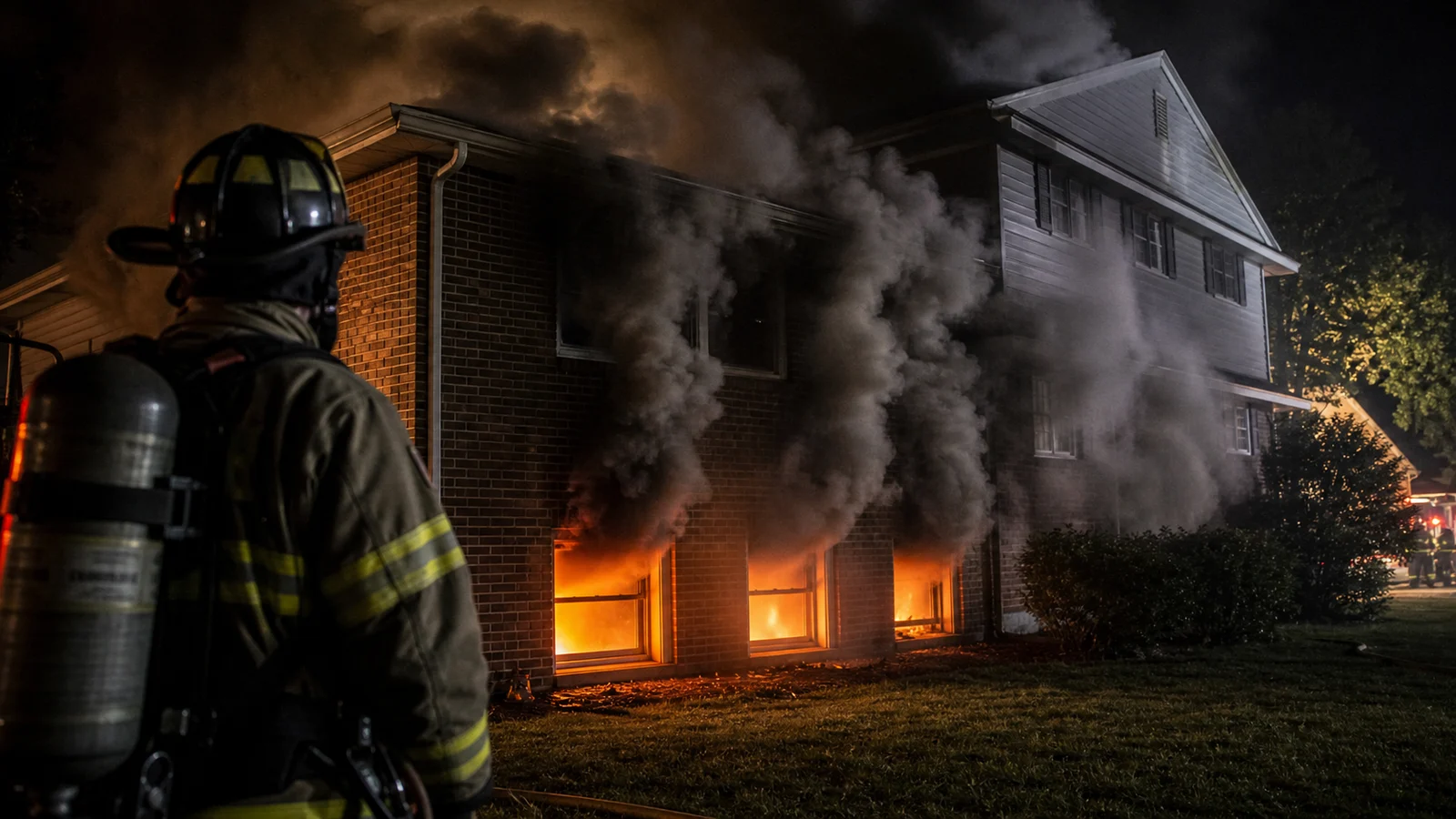
Basement fires represent one of the highest-risk scenarios in structural firefighting. The geometry works against you: fire burns upward through the floor above, hot gases and superheated smoke fill the only egress route, and collapse of the floor — with crews on it — is a constant threat. Understanding what makes these fires different, and building a deliberate tactical framework for them, is essential for every company officer and firefighter.
Jump to:Why basement fires are uniquely dangerous · Size-up priorities · Attack options · Ventilation · Floor collapse risk · Tactical benchmarks · FAQ
Why Basement Fires Are Uniquely Dangerous
Four physical factors combine to make basement fires disproportionately fatal compared to above-grade fires:
- Fire travels upward — toward crews. Unlike above-grade fires where fire moves away from the ground floor entry, a basement fire pushes heat, smoke, and flame up through the floor directly into the path of advancing crews.
- Single point of egress. In most residential basements, the interior staircase is the only way in and out. That staircase is directly in the fire's travel path, meaning the attack route is also the escape route — and the fire knows which way it wants to go.
- Limited ventilation options. Basement windows are small, often below grade, and rarely provide meaningful tactical ventilation. This traps heat and products of combustion far more effectively than above-grade fires.
- Floor collapse hazard. The floor assembly above the basement is directly exposed to the fire from below. Wood-frame floor systems — particularly lightweight engineered lumber (I-joists, LVL) — can fail in as little as 3–5 minutes of direct flame impingement, with little warning before catastrophic collapse.
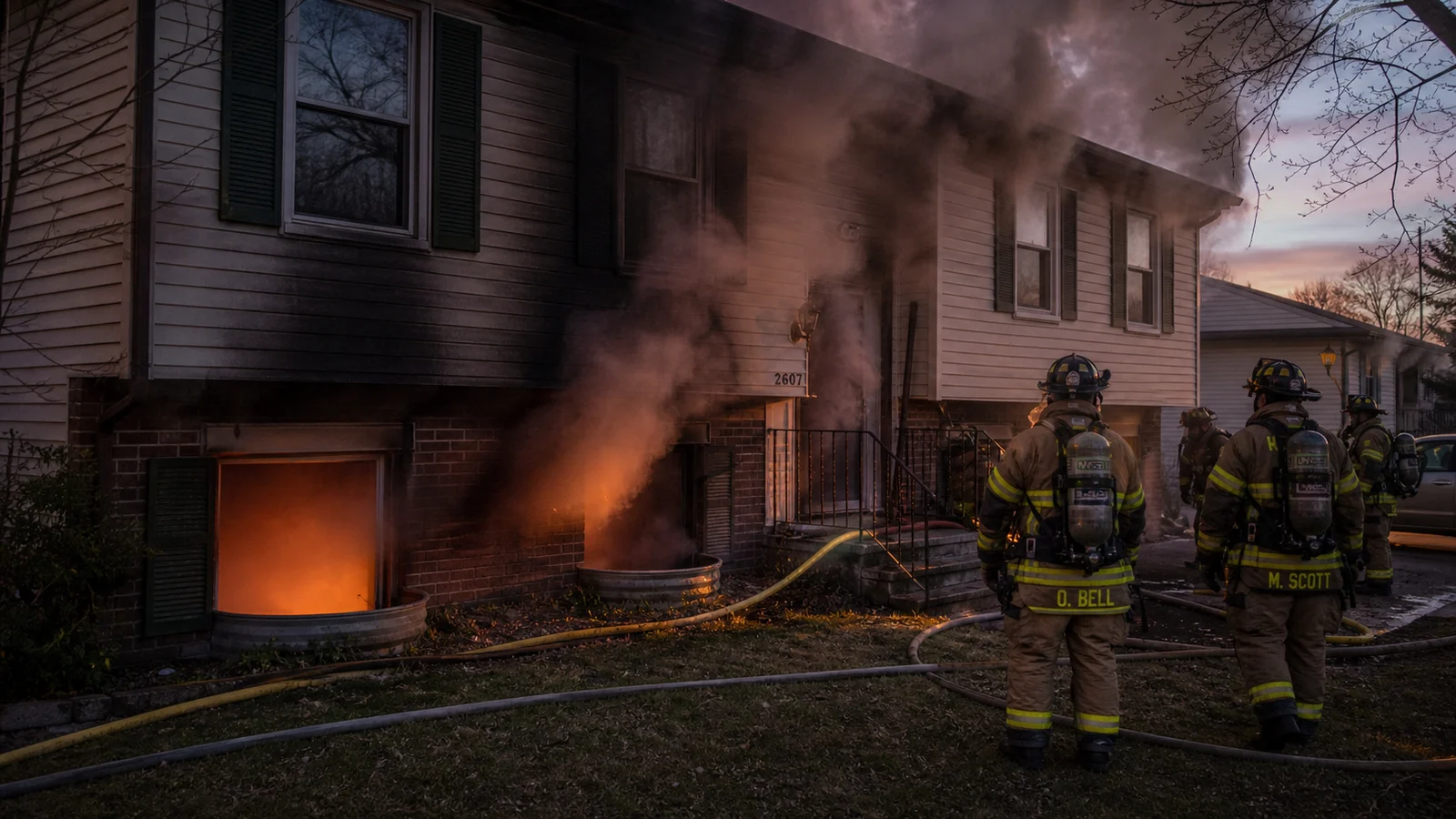
NIOSH data: Basement fires account for a disproportionate number of firefighter fatalities involving floor collapse. The combination of lightweight construction and below-grade fire produces rapid, unpredictable structural failure that gives crews almost no warning.
Size-Up Priorities for Basement Fires
The first minutes of a basement fire size-up must answer six questions before any crew goes interior:
- Is the basement confirmed on fire, or is the origin uncertain? Smoke showing from all levels of a structure with no visible flame may indicate a basement origin — but confirm it before committing crews to the first floor above.
- What is the construction type? Legacy balloon frame or platform frame with dimensional lumber gives more time than modern lightweight construction. I-joists over a basement fire are a rapid collapse hazard. See our building construction types guide.
- What is the floor assembly condition? Walk the perimeter. Look for spongy, soft, or visibly deflected flooring around basement access points. Check for smoke pushing through floor seams inside.
- Are there occupants in the basement or on the floor above? If life safety is confirmed, it changes your risk calculus — but it does not change the physics. You cannot save a victim from a collapsed floor.
- What access points exist? Interior stairs, bilco/exterior hatch, basement windows, or bulkhead doors. Identify all of them before entry.
- What is the fire load? A finish basement with stored materials burns far hotter and longer than an unfinished utility space.
Never send crews to the floor above an active basement fire without a charged line protecting the staircase and a rapid intervention team (RIT) staged outside. The floor above is your crew's ceiling — and it is on fire from below.
Attack Options
Option 1: Offensive interior attack via interior staircase
The highest-risk option and the one most likely to rescue a confirmed trapped victim. Prerequisites before committing:
- Floor integrity confirmed as sound by officer walking the perimeter
- Construction type assessed — lightweight construction narrows the time window severely
- Charged 1¾" or 2½" line positioned at the top of the stairs before any crew descends
- RIT activated and staged
- Accountability confirmed — PAR established before entry
The nozzle team positions at the top of the stairs first and applies water from the doorway, cooling the staircase and the space below before any crew descends. The officer goes last and maintains a position at the top to manage egress.
Option 2: Transitional/exterior attack through basement windows or bulkhead
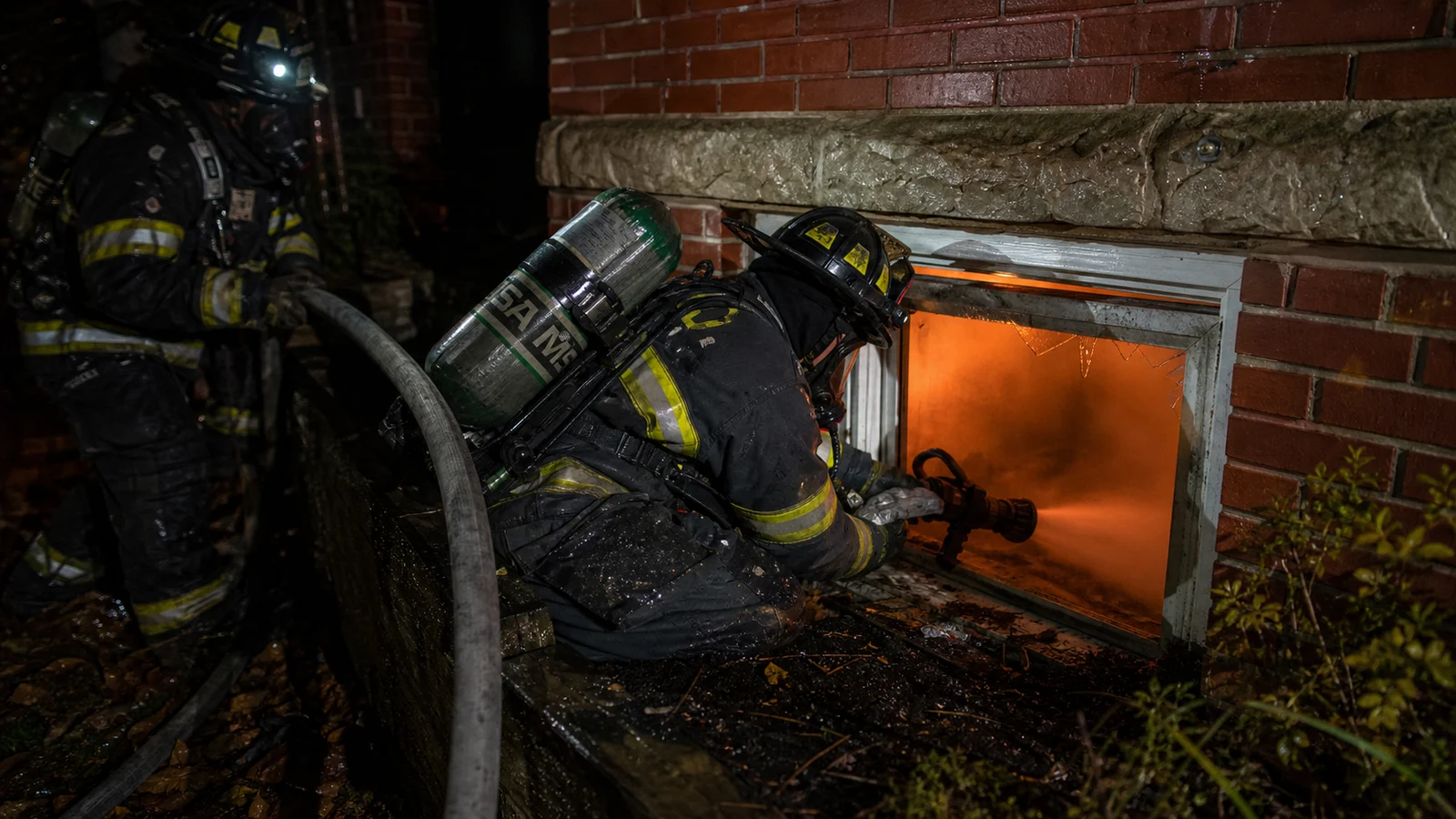
Insert a fog nozzle or smooth bore through a basement window and apply water before committing crews. This knocks down the main body of fire, reduces the thermal hazard on the staircase, and buys time to assess floor integrity before interior entry. This is an increasingly standard first action before any basement interior attack.
Option 3: Defensive operations
When lightweight construction is confirmed, fire has significant extension into the floor assembly, or floor integrity is questionable, defensive exterior operations protect exposure buildings, control fire spread, and protect crews. The word "defensive" is not a failure — it is the right call when the tactical calculus does not support interior operations.
Ventilation Challenges
Basement fires present severe ventilation limitations that must be factored into every tactical plan:
- Positive pressure ventilation (PPV) fans are generally ineffective in basements — fans pressurize the upper floor, not the below-grade space, and can actually push heat and gases further up through the structure.
- Horizontal ventilation through basement windows is the primary option but is limited by small window size and below-grade positioning.
- Opening the bulkhead or bilco door (if present) before interior attack provides a ventilation outlet and a secondary egress — but also increases the air supply to the fire. Coordinate this carefully with the attack.
- Do not open the interior door to the basement until the attack line is charged and the crew is ready to advance immediately. Opening the door without a ready hoseline provides oxygen to a ventilation-limited fire and can trigger rapid fire progression up the staircase.
Floor Collapse: Recognition and Prevention
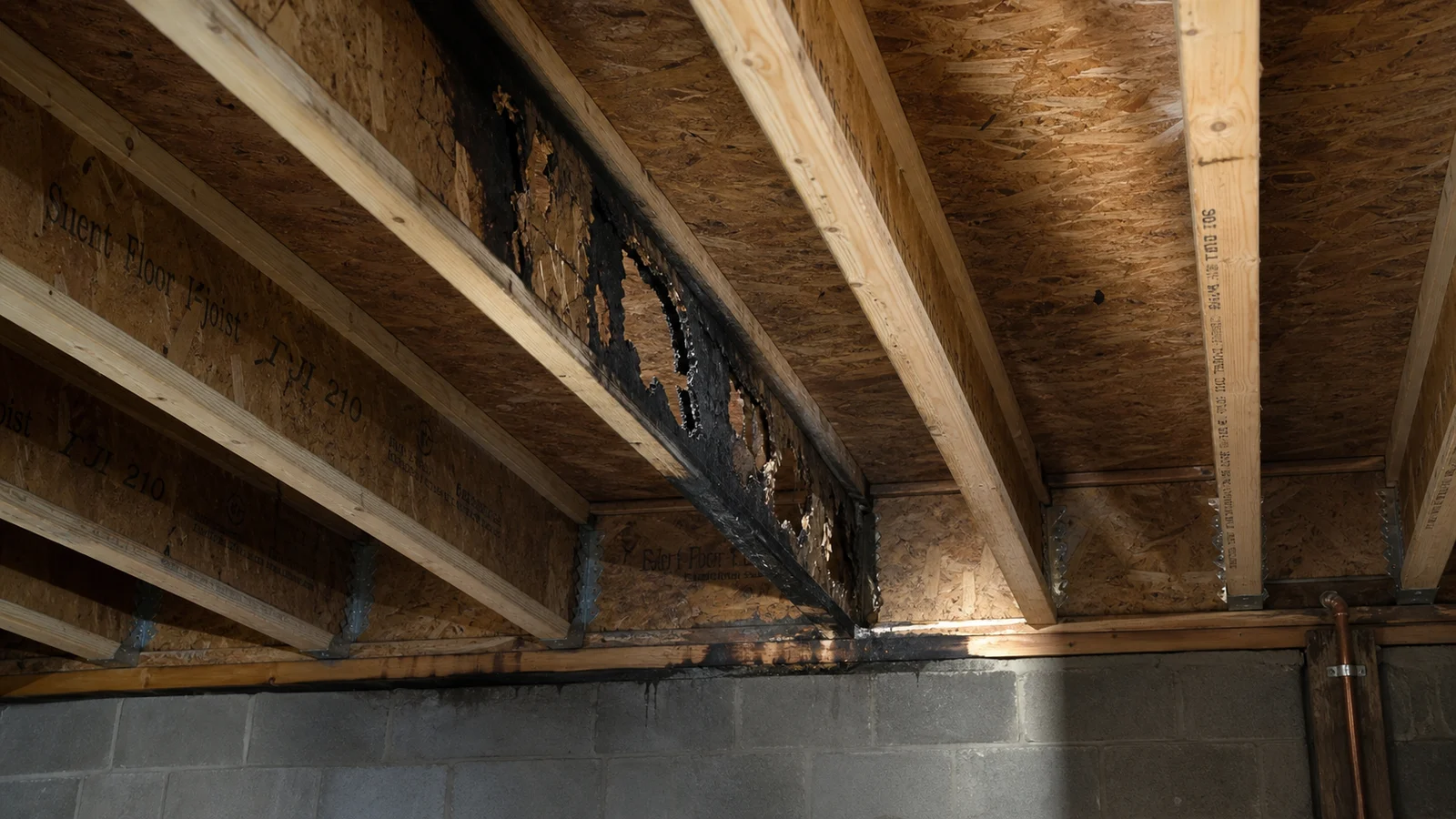
The single most important factor in basement fire collapse is construction type. Know the difference:
| Construction type | Floor assembly | Collapse timeline |
|---|---|---|
| Pre-1970 dimensional lumber | 2×10 or 2×12 solid wood joists | 15–20+ minutes of direct flame impingement |
| Post-1970 platform frame | 2×10 dimensional with OSB subfloor | 8–15 minutes |
| Lightweight engineered (I-joists) | I-joist with OSB web, OSB subfloor | 3–5 minutes of direct flame |
| Lightweight truss | Metal plate connected wood trusses | 5–8 minutes; sudden failure with no warning |
Warning signs of imminent floor failure: Spongy or soft feeling underfoot, visible deflection of the floor, cracking sounds from below, smoke pushing through floor seams or around baseboards, or a floor that feels warm to the touch through boots.
Tactical Benchmarks
- Never advance below grade without a charged line at the top of the staircase
- Apply water from the doorway before any crew descends the stairs
- Limit time on the floor above an active basement fire — it is a collapse hazard from the moment fire touches the floor assembly
- RIT must be activated before interior basement operations begin
- Consider exterior/transitional attack as a first action before interior commitment
- Reassess continuously — basement fires can rapidly transition from survivable to untenable
Frequently Asked Questions
Why are basement fires more dangerous than other structural fires?
Fire in a basement burns upward through the floor assembly directly under operating crews. Combined with limited egress, limited ventilation, and rapid floor collapse — especially in lightweight construction — basement fires create conditions where everything works against the firefighter simultaneously.
Should firefighters enter a basement for a rescue?
Only after a rapid but thorough assessment of floor integrity, construction type, and confirmation that the staircase is tenable with a charged line. If the floor above shows signs of compromise or lightweight construction is involved and fire has been burning for several minutes, the risk of floor collapse during an interior basement rescue may exceed the risk to the potential victim.
What is the best attack method for a basement fire?
An exterior/transitional attack through a basement window before interior entry is increasingly the recommended first action. This knocks down the main body of fire, reduces thermal conditions in the staircase, and improves survivability if interior operations follow.

Comments 0
No comments yet. Be the first to share your thoughts!
Leave a Comment