Correction — October 15, 2026: Corrected the universal 25% alarm and distinguished equipment standards from respiratory-program fit-testing requirements.
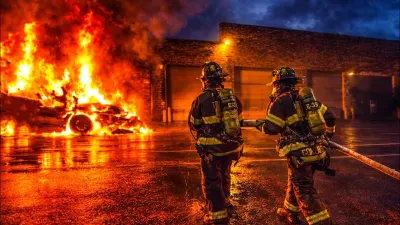
Every firefighter who enters a burning building is breathing from a tank on their back. That tank does not contain oxygen — it contains compressed air, the same mix of 21 percent oxygen and 78 percent nitrogen that you breathe right now, compressed to 4,500 psi and stored in a cylinder about the size of a fire extinguisher. The SCBA — self-contained breathing apparatus — is what makes interior structural firefighting survivable. Without it, a firefighter inside a working structural fire has, at best, seconds before the toxic gas concentration and heat produce incapacitation.
Most people who see an SCBA know roughly what it is. Fewer understand how it actually works, what its real failure modes are, or why something as seemingly simple as how you put it on determines whether it functions correctly when you need it most.
In this article:
- The four main components and what each does
- Pressure, duration, and the gap between rated and actual
- The facepiece: the most critical and most commonly failed component
- Don and doff: why putting it on correctly matters more than putting it on fast
- The low-air alarm and what to do when it sounds
- The bypass valve and emergency breathing support
- What happens when the SCBA fails inside a structure
The Four Main Components and What Each Does
The cylinder
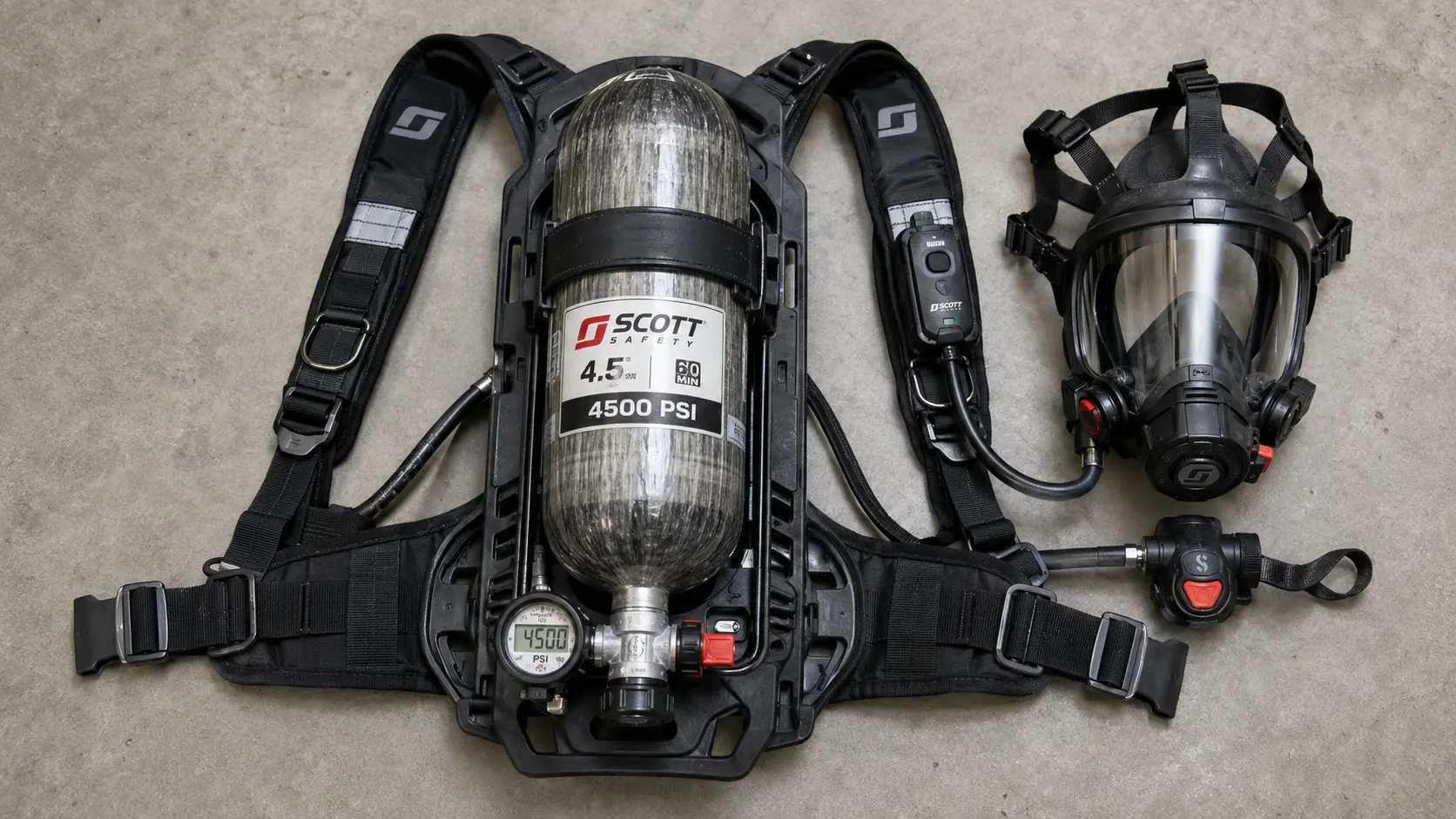
Modern SCBA cylinders are composite construction — an aluminum or steel liner wrapped in carbon fiber or fiberglass — rated to 4,500 psi (high-pressure) or in older systems, 2,216 psi (low-pressure). The higher pressure rating allows more air in a smaller, lighter package. A 45-minute rated cylinder at 4,500 psi holds approximately 66 cubic feet of air. The cylinder has a valve at the top that is opened by turning the handwheel counterclockwise before donning. A cylinder that is not fully open will provide reduced flow to the regulator, causing resistance to breathing that worsens as the cylinder pressure drops.
The backframe and harness
The backframe is the structural frame that positions the cylinder on the firefighter's back and carries the harness. Shoulder straps and a waist belt distribute the 25 to 35 pound weight of the fully loaded SCBA across the body. The waist belt is not decorative — an SCBA worn without a cinched waist belt rides high on the back, interferes with donning the facepiece, and shifts during movement in ways that affect the center of gravity. The shoulder straps should be adjusted so the cylinder sits at mid-back, not at the neck or lower.
The regulator
The regulator performs two functions: it reduces the cylinder's high pressure to a breathable delivery pressure (roughly 4 to 5 inches of water column positive pressure), and it delivers air on demand — only when the wearer inhales. On exhalation, air is exhausted through the facepiece exhalation valve to the outside atmosphere. The regulator connects to the facepiece via a low-pressure hose. Modern integrated regulators also house the PASS device, which activates automatically when the SCBA is donned and cannot be accidentally forgotten or disabled.
The facepiece
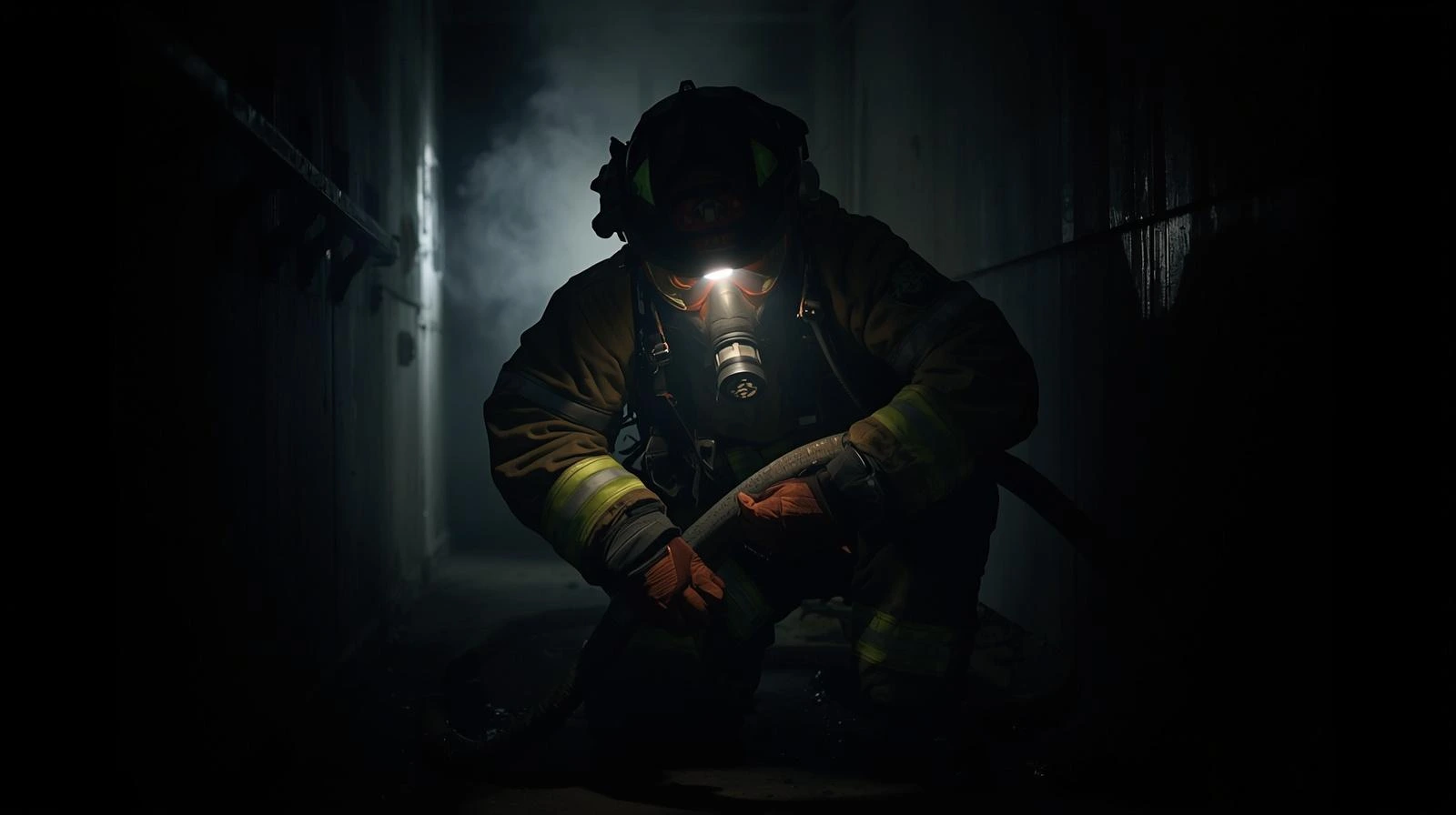
The facepiece is the sealed interface between the SCBA and the wearer's breathing zone. It covers the full face — eyes, nose, and mouth — and is held against the face by a head harness with multiple straps. The seal between the facepiece and facial skin is the single most critical performance point in the entire system, covered in detail below.
Pressure, Duration, and the Gap Between Rated and Actual
A 45-minute rated SCBA will not give you 45 minutes of working air in a structural fire. The rated duration is calculated at a moderate breathing rate — roughly 40 liters per minute, which is a calm, lightly active breathing rate. A firefighter advancing a charged hoseline through a smoke-filled hallway on hands and knees, in full gear, in high ambient heat, is breathing at 80 to 100 liters per minute or more. At that consumption rate, the 45-minute cylinder lasts 20 to 25 minutes.
This is not a product deficiency — it is physics. The rated duration provides a standardized comparison between products. It does not predict operational duration. Every department trains to the one-third rule: use one-third of the air supply advancing to your work position, one-third working, and maintain one-third for exit. At 4,500 psi, one-third remaining is 1,500 psi — the approximate activation point of the low-air alarm on most units. The rule exists because exit conditions are rarely identical to entry conditions, and the one-third reserve is the buffer for complications on the way out.
The Facepiece: The Most Critical and Most Commonly Failed Component
The SCBA can only protect the wearer if the facepiece seals completely against the face. Any leak — even a small one — allows ambient atmosphere into the breathing zone. In a structural fire, that ambient atmosphere contains carbon monoxide, hydrogen cyanide, and particulates at concentrations that produce rapid incapacitation. A facepiece that leaks is not a facepiece that provides reduced protection. It is, functionally, no facepiece at all.
Facial hair in the sealing surface can interfere with a tight-fitting respirator. OSHA 1910.134 addresses fit testing, seal checks and facial-hair restrictions. SCBA product certification and the employer's respiratory protection program are separate: current NFPA 1970 consolidates material formerly in NFPA 1981. Follow the exact facepiece instructions and employer program.
The second most common cause: incorrect don. Straps overtightened on one side, straps left too loose, hair caught under the seal, or the facepiece canted to one side — all produce seal failures that are not always obvious until the wearer is inside a contaminated atmosphere. A proper seal check before entry is the control: cup your hands over the exhalation valve and exhale sharply. The facepiece should pressurize and maintain briefly. If air escapes around the seal, the facepiece is not properly seated.
Don and Doff: Why Doing It Correctly Matters More Than Doing It Fast
NFPA 1001 requires firefighter candidates to don SCBA in under one minute. This is tested during certification. The focus on speed is understandable — on a working fire, there is no time to slowly work through each step. But the drill that only measures speed without measuring quality produces firefighters who can don quickly and incorrectly, which is worse than donning slowly and correctly.
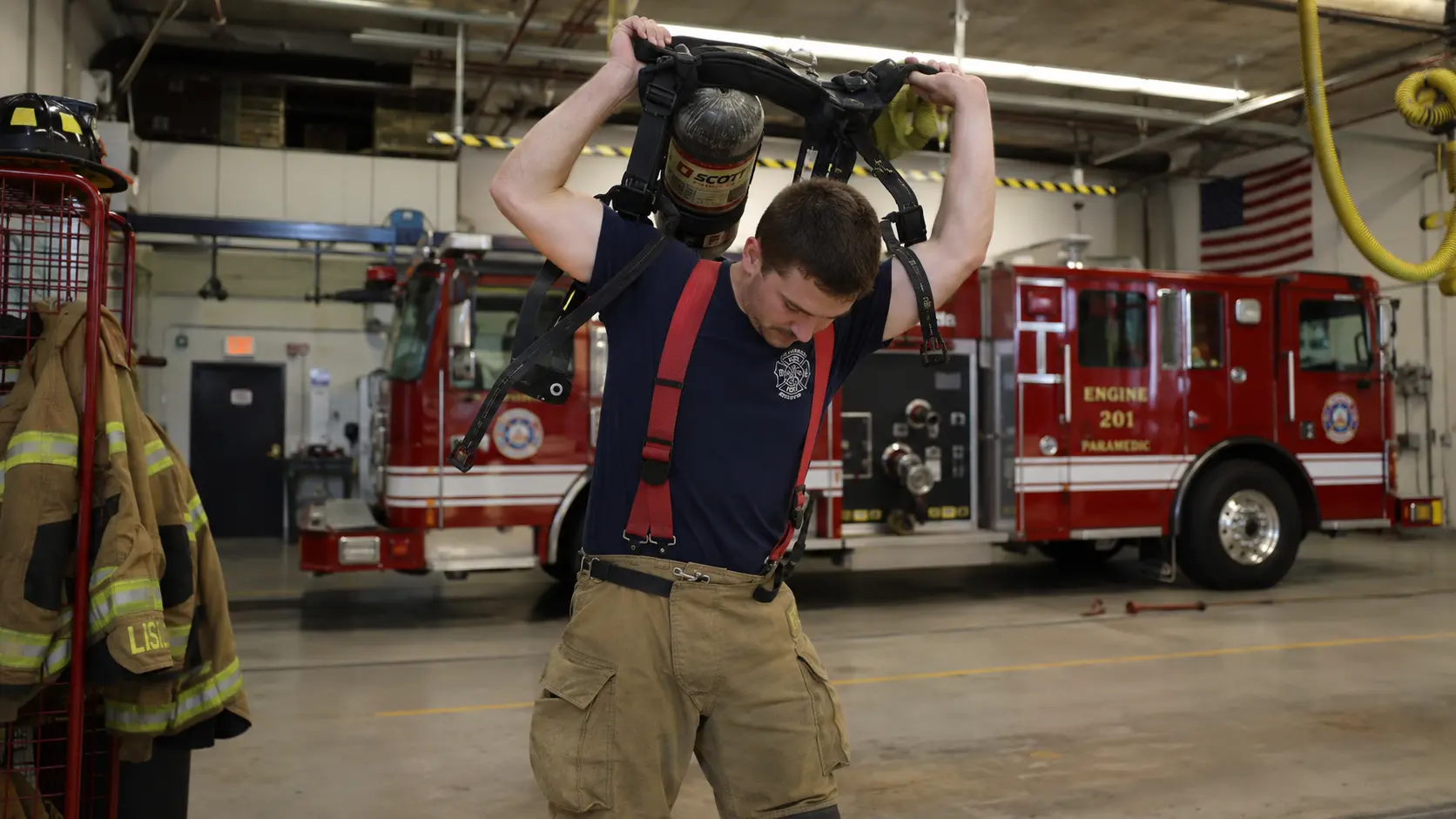
The over-the-head method — swinging the backframe overhead and into position — is the fastest don technique and the standard for most North American departments. The steps in sequence: open the cylinder valve fully, confirm pressure on the gauge, don the backframe, cinch waist belt, don and seat the facepiece, connect the regulator, perform seal check. The order matters. A firefighter who connects the regulator before seating the facepiece is breathing from the SCBA before confirming the seal — entering a potentially contaminated environment without verifying the system is functioning correctly.
The Low-Air Alarm and What to Do When It Sounds
Low-air warning settings depend on the exact approved SCBA and edition. The MSA G1 2025 manual describes a 35% warning and the cited Scott X3 Pro approval label identifies EOSTI-33 configurations; neither supports a universal 25% threshold. Use the actual manual and functional tests. Plan crew withdrawal before emergency reserve is needed, allowing for the route, workload and delays; do not treat any fixed fraction or alarm as a universal safe work limit.
When the alarm sounds, the action is immediate and non-negotiable: move toward the exit. Not "finish this search sweep first." Not "just check this last room." Move toward the exit. The alarm gives you an estimated 10 to 15 minutes of air at a working consumption rate. That is not a comfortable margin in a structurally compromised, zero-visibility, smoke-filled environment. It is enough to exit if you start immediately and conditions cooperate.
The Bypass Valve and Emergency Breathing Support
The bypass valve is a manual override on the regulator that bypasses the demand-valve mechanism and provides a continuous positive-pressure flow of air directly to the facepiece. It is used when the demand valve fails — producing no flow or insufficient flow — and as an emergency airflow boost. The bypass provides air continuously, so it depletes the cylinder faster than normal demand breathing. It is an emergency measure, not an operating mode.
Emergency breathing support devices — EBSS — are connections on SCBA harnesses that allow two firefighters to share one cylinder in an emergency. If one firefighter's cylinder is empty or their SCBA has failed and they cannot exit immediately, a second firefighter can connect the distressed firefighter's facepiece to their own cylinder and share the remaining supply while both exit. The shared supply will not last as long as a single user's supply — two people consume air at twice the rate. It is a bridge to exit, not a sustained solution.
What Happens When the SCBA Fails Inside a Structure
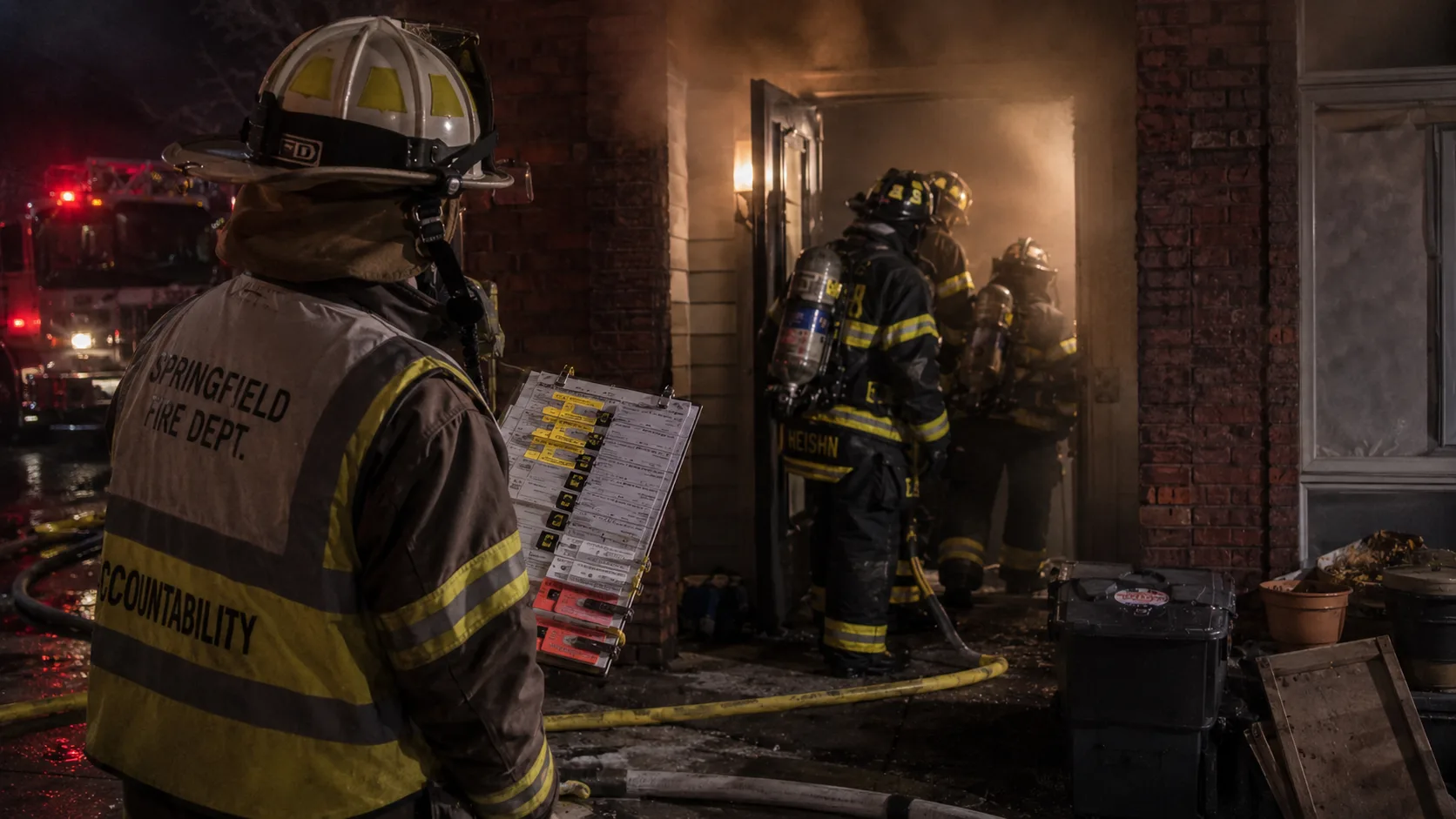
SCBA failures during interior operations are rare but documented. The response protocol is practiced and specific: a firefighter whose SCBA fails — no flow, facepiece failure, cylinder damage — calls a MAYDAY immediately, activates their PASS manually, transmits their location, and moves toward the exit if capable of doing so while holding their breath in short intervals. They do not stay and try to diagnose the failure.
The specific challenge is that an SCBA failure inside a burning building with zero visibility and an already partially depleted air supply is among the highest-consequence scenarios in the fire service. It is why buddy breathing protocols, emergency SCBA spare cylinders staged at entry points, and RIT carrying EBSS devices are not optional equipment — they are the contingency for the scenario where the primary protective system stops working.
Comments 0
No comments yet. Be the first to share your thoughts!
Leave a Comment