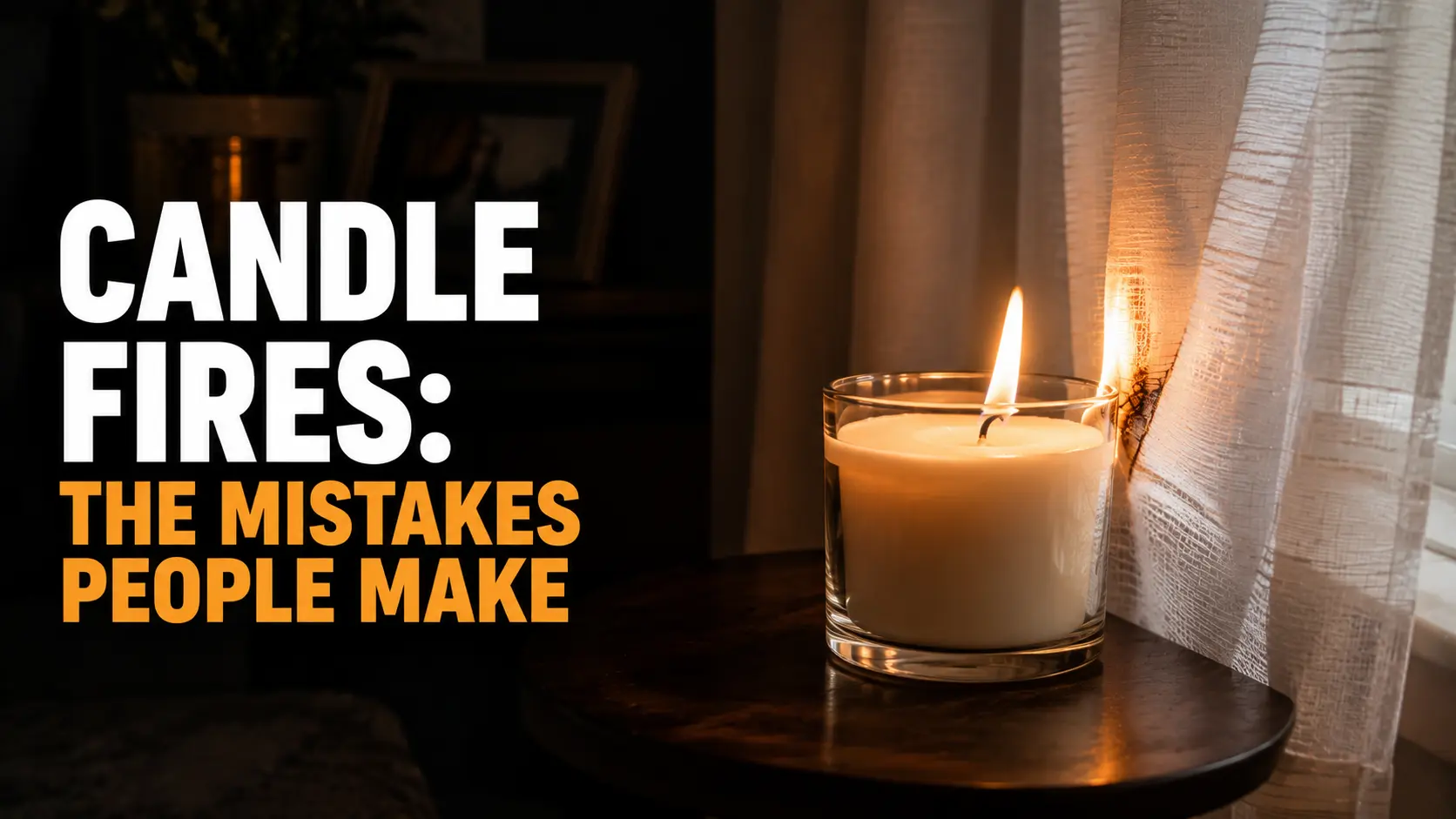

Candles are one of the oldest fire hazards in the home and still one of the most active ones. In 2022, U.S. fire departments responded to an estimated 7,400 home candle fires that caused 90 deaths, 670 injuries, and $291 million in property damage. The peak candle fire period is December — Christmas, Hanukkah, holiday entertaining — but candle fires happen year-round, and the circumstances are nearly always the same.
What makes candle fires worth a careful look is that they are almost entirely behavioral. The candle itself is not a manufacturing defect or an equipment failure waiting to happen. It is an open flame sitting in your home, and what happens next depends entirely on where you put it, what you put near it, and whether you stay awake.
In this article:
- How candle fires actually start
- Placement: what “away from flammables” actually means
- Bedroom candles — the highest-risk scenario
- Jar candles: safer but not safe
- Wick length and why it matters more than most people know
- Children and pets
- How to properly extinguish a candle
- Flameless alternatives that actually look good
- The habits that prevent candle fires
How Candle Fires Actually Start
Four scenarios account for the overwhelming majority of candle fires:
Direct contact with a combustible
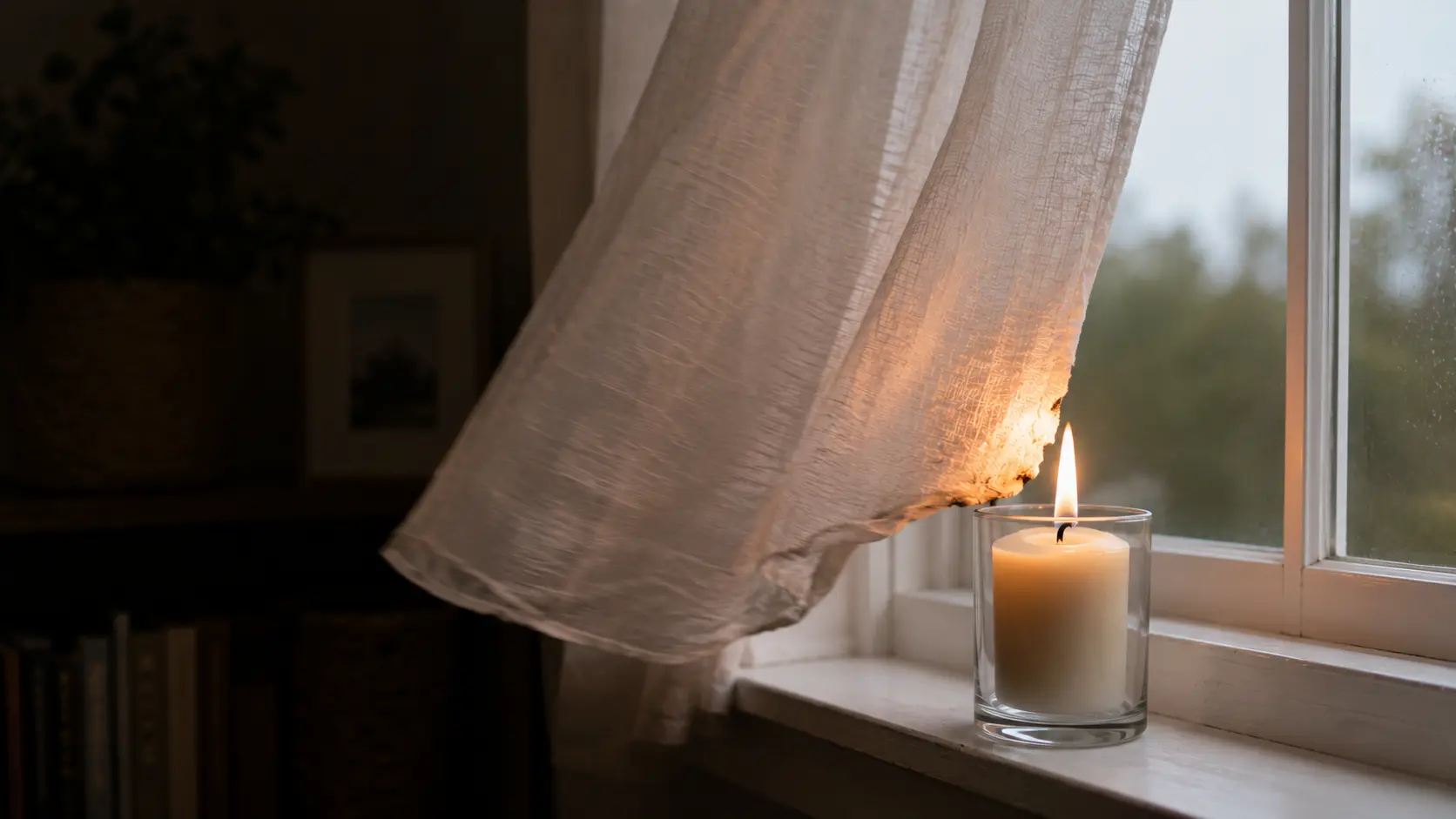
The candle flame contacts something flammable — a curtain that swings in a draft, a decoration placed too close, a book or a piece of paper, fabric from a tablecloth. This is the fastest ignition path. The contact is instantaneous and the fire starts immediately at the point of contact. Curtains are the most common culprit because they move toward the candle in air currents — an open window or an air conditioning vent creates a reliable mechanism for a curtain to swing toward a nearby flame even if it was not touching when the candle was lit.
Radiant ignition over time
Similar to a space heater, a candle flame radiates heat outward. Materials within a few inches of the flame are being continuously heated even if they are not in direct contact. A wooden surface, a stack of papers, a decorative element placed close to the candle gets progressively warmer during the burn. Given enough time, nearby combustibles can reach ignition temperature without the flame ever touching them.
Tip-over
A candle knocked over by a pet, a child, a person bumping the surface in the dark, or an unstable surface can contact whatever is below or beside it — carpet, bedding, fabric — and transfer burning wax. Molten wax is flammable and will sustain a flame on a combustible surface.
Burning down into the holder or container
When a pillar candle burns down low enough that the flame is at or below the rim of the holder, heat transfers directly into the holder material. A holder that is not rated for full candle burn can crack or break, releasing molten wax. Jar candles burned to the bottom can shatter from thermal stress, releasing burning wax onto surrounding surfaces.
Placement: What "Away From Flammables" Actually Means
Every candle safety recommendation includes “keep away from flammables.” The problem is that most people interpret this as “keep away from obviously flammable things like paper directly under the candle.” It means more than that.
Everything within 12 inches of a burning candle needs to be evaluated:
- Curtains and window treatments — even if they are 12 inches away when you light the candle. Air movement can bring curtains to the flame. If a candle is within reach of any window treatment in any air current, move the candle.
- Decorative items — dried flowers, artificial plants, paper decorations, seasonal decorations, anything with synthetic fabric or resin. These are all flammable and are frequently grouped with candles for aesthetic reasons.
- Shelves and the items on them — a candle on a bookshelf is surrounded by books. A candle in a bathroom cabinet niche is surrounded by the cabinet. Heat rises, and items directly above a burning candle receive the most intense radiant and convective heat.
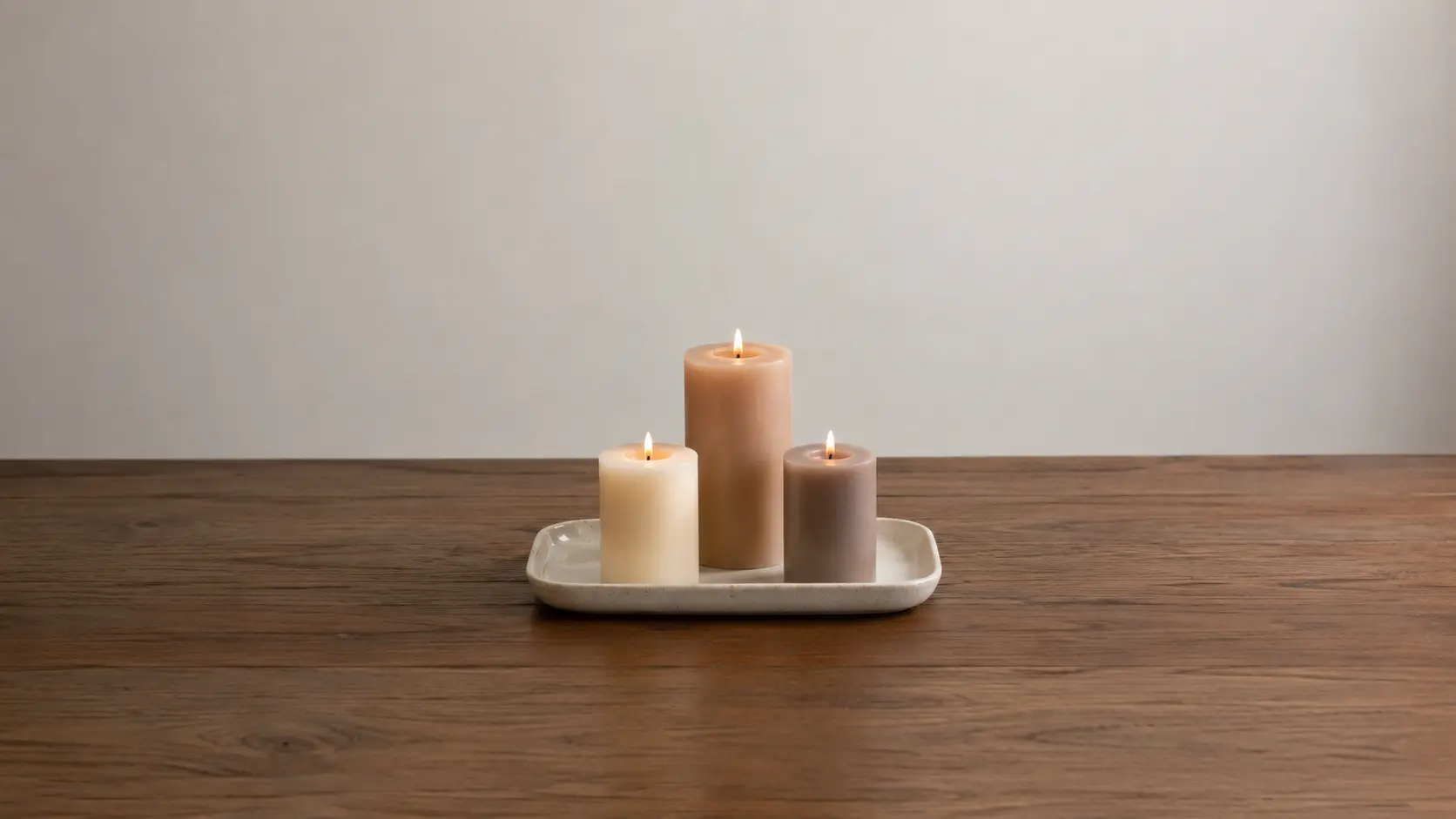
- The surface the candle sits on — a candle directly on wood can char the surface over time. Use a non-combustible holder that sits on a non-combustible plate or tray.
The honest version of “safe placement” is a candle on a stable, non-combustible surface, with nothing combustible within 12 inches in any direction including above it, and away from any source of air movement. In most decorating contexts, this is harder to achieve than it sounds — which is worth acknowledging honestly rather than pretending the rule is easy to follow if you just pay attention.
Bedroom Candles — The Highest-Risk Scenario
Thirty-six percent of candle fires start in the bedroom. The bedroom is the highest-risk room in the home for candle fires for reasons that are directly connected to what people do in bedrooms: they relax, they get drowsy, and they fall asleep. A candle lit in the living room and forgotten is a problem. A candle lit in the bedroom by someone who falls asleep reading is a fire with no one awake to notice it start.
The bedroom also concentrates risk factors: bedding and pillows immediately adjacent to nightstand candles, curtains on nearby windows, carpeted floors, and a person who is going to be unconscious and unable to respond. It is the worst combination of fuel, proximity, and delayed detection.
Do not burn candles in a bedroom unless you are fully awake and present, and plan to extinguish the candle before sleep. If you light a candle to relax before bed, set a phone reminder to extinguish it. Not a vague intention — a scheduled reminder that will sound before you are likely to be asleep. The combination of a burning candle and someone who is drowsy is one of the most consistent predictors of a candle fire.
The 11% of candle fires that occur while occupants are asleep are among the most fatal, because the fire has undetected time to grow and the occupants have the least ability to respond quickly. These are fires that should never happen because the candle should have been extinguished before sleep.
Jar Candles: Safer — But Not as Safe as People Think
Jar candles feel safer than pillar or taper candles because the glass contains the wax and provides a stable base. They are somewhat safer in terms of tip-over risk and wax spill. They are not free from risk, and they have specific failure modes that pillar candles do not.
Burning to the bottom
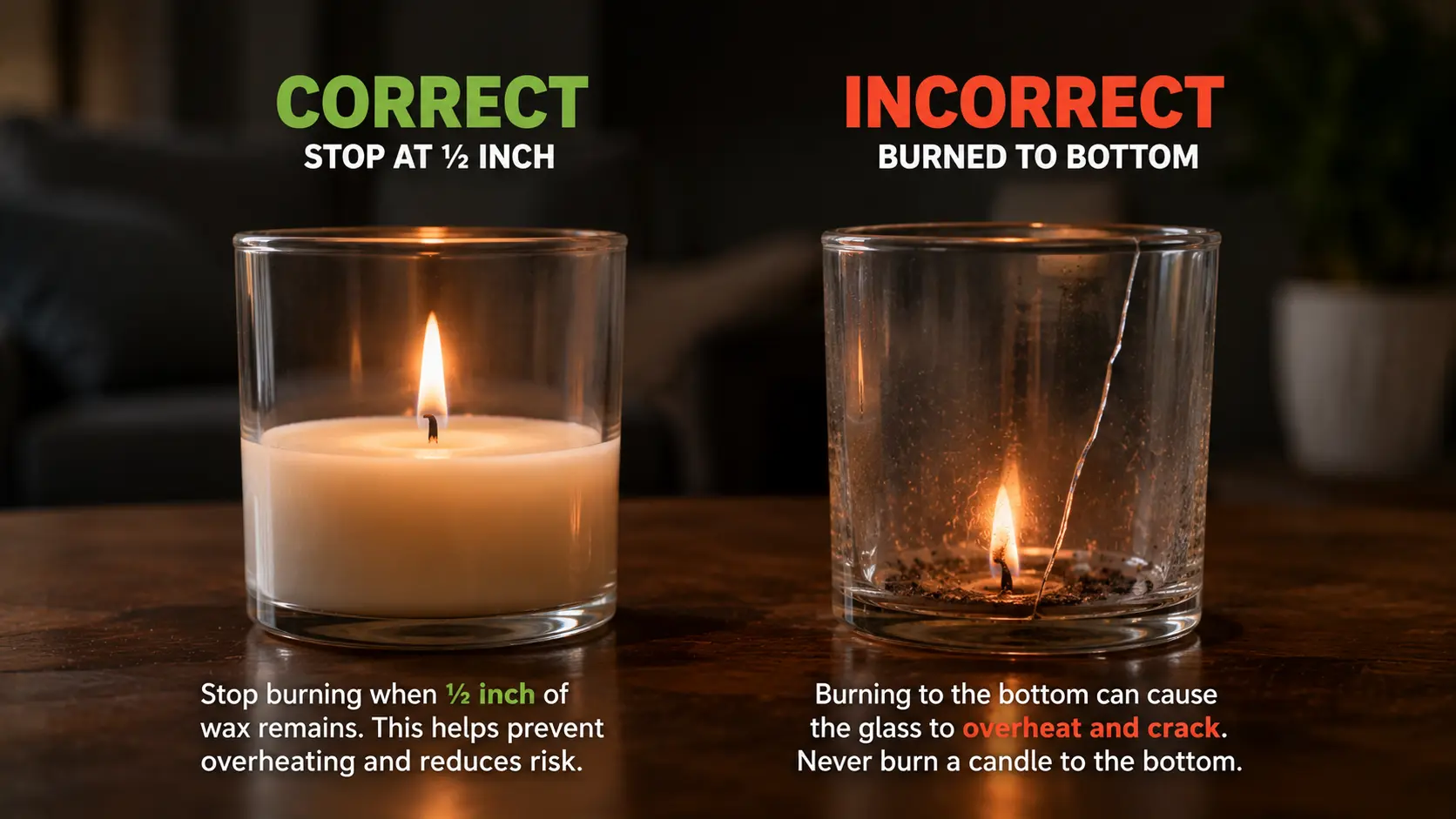
When a jar candle burns down to the last half-inch of wax, the flame is very close to the glass base. The thermal gradient through the glass increases, and if the glass has any manufacturing defect, stress crack, or external scratch, it can shatter from thermal stress. The shattering releases a puddle of burning liquid wax. Most jar candle instructions specify stopping at ½ inch of remaining wax for this reason. Follow this guideline.
Wick mushrooming and tall flames
A wick that is too long — more than ¼ inch — produces a larger flame with a carbon mushroom at the tip that drops burning carbon particles into the wax and can cause the candle to burn unevenly, tunnel into the wax on one side, and create hot spots. Trim the wick to ¼ inch before each burn. A wick trimmer costs $5 and is worth it.
Multiple wick burn time
Large jar candles with multiple wicks are popular and produce an impressive flame display. The combined heat from multiple wicks can exceed what the glass container is designed for, particularly if the wicks are not trimmed and the candle is burned for extended periods. Follow the manufacturer's recommended maximum burn time — typically 4 hours — and let the jar cool completely between burns before relighting.
Wick Length and Why It Matters
Most people have never thought about wick length. It matters more than almost any other variable in how safely a candle burns.
The correct wick height for most candles is ¼ inch — about the width of a pencil eraser. At this height, the flame is the correct size for the candle diameter, the heat output is as designed, and the candle burns cleanly with minimal soot. When a wick is longer than ¼ inch:
- The flame is taller and more energetic — it reaches higher and produces more heat
- The flame flickers more dramatically in air currents, increasing the chance of sparks or contact with nearby materials
- The wick develops a carbon mushroom at the tip — a buildup of carbonized material — that can fall off into the wax pool as a glowing ember
- Soot production increases significantly, blackening nearby walls, surfaces, and the inside of jar candles
- The candle burns through its wax faster than intended, shortening the candle's life and increasing heat output per unit time
Trim the wick to ¼ inch before every burn — not just when you first buy the candle. After a candle burns and the wax solidifies, the wick can be trimmed with nail scissors, dedicated wick trimmers, or by pinching off the carbonized tip with your fingers once the wax is completely cool.
Children and Pets
Children under 15 are involved in the cause of roughly 11% of candle fires — typically through play or curiosity with matches and lighters used to light candles, or by knocking candles over. Pets knock candles over at a frequency that is documented in fire incident reports frequently enough to be a recognized hazard category.
The simplest guidance: candles burning in a room should not be accessible to children or pets without adult supervision. This means keeping candles high enough that a child or pet cannot reach the candle or the surface it is on. It also means not leaving a room with a burning candle if children or pets are present without taking the candle with you or extinguishing it first.
Cats in particular are notorious for knocking over candles — they investigate unfamiliar objects with their paws, and a candle in a holder is exactly the kind of object a cat will investigate by pushing on it. If you have cats and burn candles, enclosed candle holders or lanterns with glass panels that prevent the cat from reaching the flame are a meaningful risk reduction. Not elimination, but reduction.
How to Properly Extinguish a Candle
Blowing out a candle is the standard method, and it is mostly fine — but it produces a significant smoke plume and can spatter hot wax on nearby surfaces if the flame is large. Better methods:
- Candle snuffer: A small bell-shaped cap on a handle that covers the flame and cuts off oxygen without the smoke plume or wax spatter. Costs $3–10 at any candle or home goods store. Worth having if you burn candles regularly.
- Candle dipper: Dips the burning wick into the wax pool to extinguish it, then repositions the wick upright. This also primes the wick for the next lighting and produces no smoke. Specific tool — not everyone has one.
- Lid on jar candles: Most jar candles come with a lid. Placing the lid on the jar extinguishes the flame by oxygen deprivation. Clean, no smoke, no wax spatter. The most underused tool that most candle users already own.
After extinguishing, verify the wick is fully out — not smoldering. A smoldering wick in a pool of warm wax can re-ignite the candle after you have left the room. Wait 30 seconds after extinguishing and confirm no glow remains at the wick tip before leaving the candle unattended.
Flameless Alternatives That Actually Look Good
Modern battery-operated LED candles have improved dramatically. The best ones use warm amber LED that flickers realistically, have timer functions, and come in realistic wax-appearance housings. They produce zero fire risk, work in bedrooms and on bookshelves and next to curtains without modification, and run for 100+ hours on a set of batteries.
They are not identical to real candles — the warmth, the scent, and the subtle quality of actual candlelight are distinct experiences. But for decorative use, especially in higher-risk contexts like bedrooms, bookshelves, holiday decorating with children, or anywhere with pets, they are a reasonable trade.
For people who want the real candle experience specifically — the scent, the actual flame — the answer is not flameless candles as a full substitute. It is using real candles with all the habits described here, in the lower-risk contexts, with full attention while they burn.
The Habits That Prevent Candle Fires
- ✓Before lighting: Trim wick to ¼ inch. Check 12 inches of clearance in all directions. Verify stable, non-combustible surface and holder.
- ✓Every time you light a candle: Ask whether you will be in the room until it is extinguished. If the answer is uncertain — do not light it.
- ✓Maximum burn time: No more than 4 hours per burn. Let cool completely before relighting.
- ✓Jar candles: Stop at ½ inch of remaining wax. Do not burn to the bottom.
- ✓Before leaving any room with a burning candle: Extinguish it. Not “I'll be right back.” Extinguish it.
- ✓Before sleep: Walk through the home and confirm every candle is out. Make this a closing routine, the same as locking the door.
- ✗Never burn a candle in a bedroom while drowsy or planning to sleep.
- ✗Never place a candle where a pet or child can reach it or the surface it sits on.
- ✗Never burn a candle near a window or vent where curtains or air movement is present.
- ✗Never use a candle during a power outage without keeping a constant eye on it — flashlights and battery lanterns exist precisely for this situation.
Candles are not going to disappear from homes, and there is no reason they should. Used with the habits above, the risk is genuinely manageable. The fires happen when those habits slip — when the candle is lit with the intention of being watched and then is not, when the placement seems fine but the curtain moves, when falling asleep feels unlikely and then is not. The gap between intention and attention is where candle fires live.
Close that gap, and you can burn candles without burning your house.

Comments 0
No comments yet. Be the first to share your thoughts!
Leave a Comment