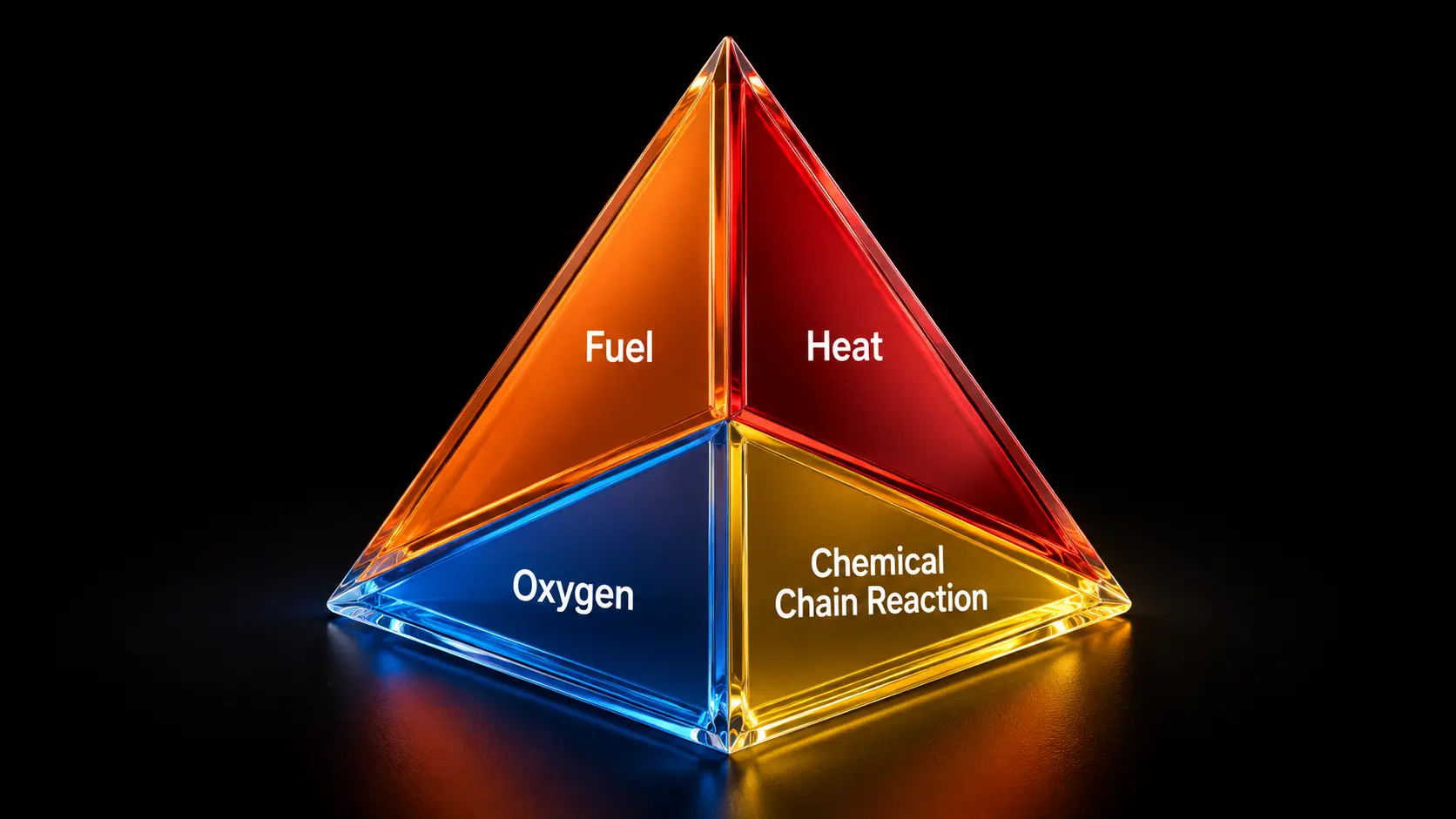
The fire triangle appears in fire safety training, school curricula, and firefighter certification courses worldwide. Fuel, heat, and oxygen — remove any one and the fire goes out. It is a useful simplification. It is also an incomplete model that fails to explain why certain fire suppressants work and why some fires persist in low-oxygen environments where the triangle predicts they should extinguish.
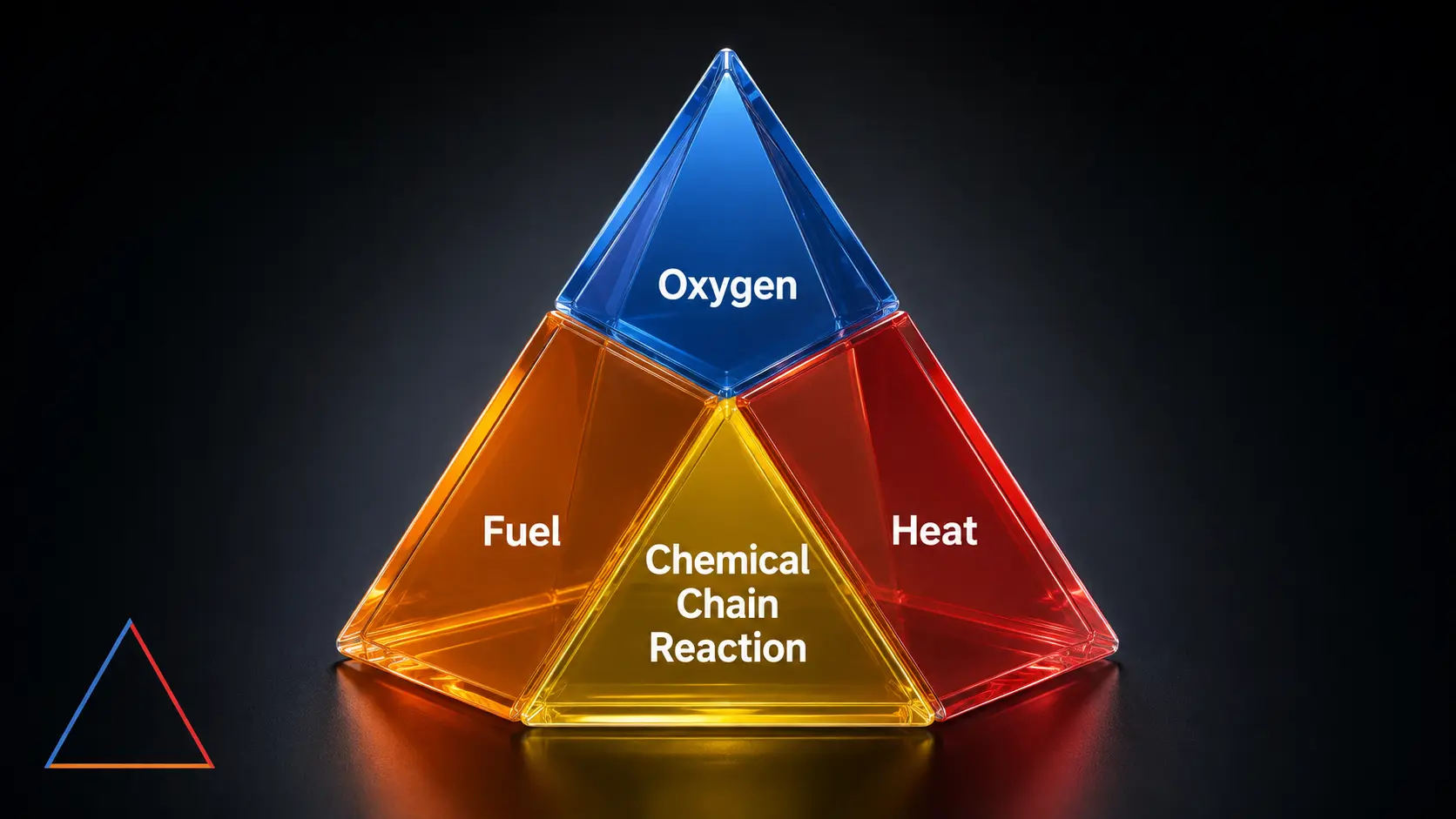
Fire scientists moved to the fire tetrahedron in the mid-20th century, adding a fourth element — the uninhibited chemical chain reaction — to address what the triangle leaves out. That fourth element is the reason halogenated suppressants like Halon could extinguish fires in small concentrations without removing oxygen or cooling the fuel. It is also the reason understanding suppression requires knowing what you are interrupting, not just what you are adding or removing.
In this article:
- What the triangle gets right — and where it stops
- What actually happens during combustion
- Free radicals: the chain reaction that sustains fire
- The tetrahedron: four sides, four interruption points
- How each suppressant type targets a different side
- Water: more than just cooling
- Why this matters for choosing the right agent
What the Triangle Gets Right — and Where It Stops
The fire triangle correctly identifies the three physical prerequisites for combustion: fuel (something to burn), heat (enough energy to initiate and sustain ignition), and oxygen (an oxidizer to support the chemical reaction). Removing any of these does extinguish a fire. Smothering a fire with a blanket removes oxygen. Cooling a fire with water removes heat. Removing fuel — clearing a firebreak — removes the fuel component. The triangle is not wrong. It is incomplete.
The place where the triangle fails: it implies that reducing any component below a threshold stops combustion. In practice, fires can continue burning in atmospheres where oxygen concentration has been reduced significantly below normal levels. Some fires sustain themselves in conditions where the triangle would predict extinction. The missing element is the self-sustaining chemical chain reaction that is established once combustion begins — a process that can persist even when the physical conditions that initiated it have been partially removed.
What Actually Happens During Combustion
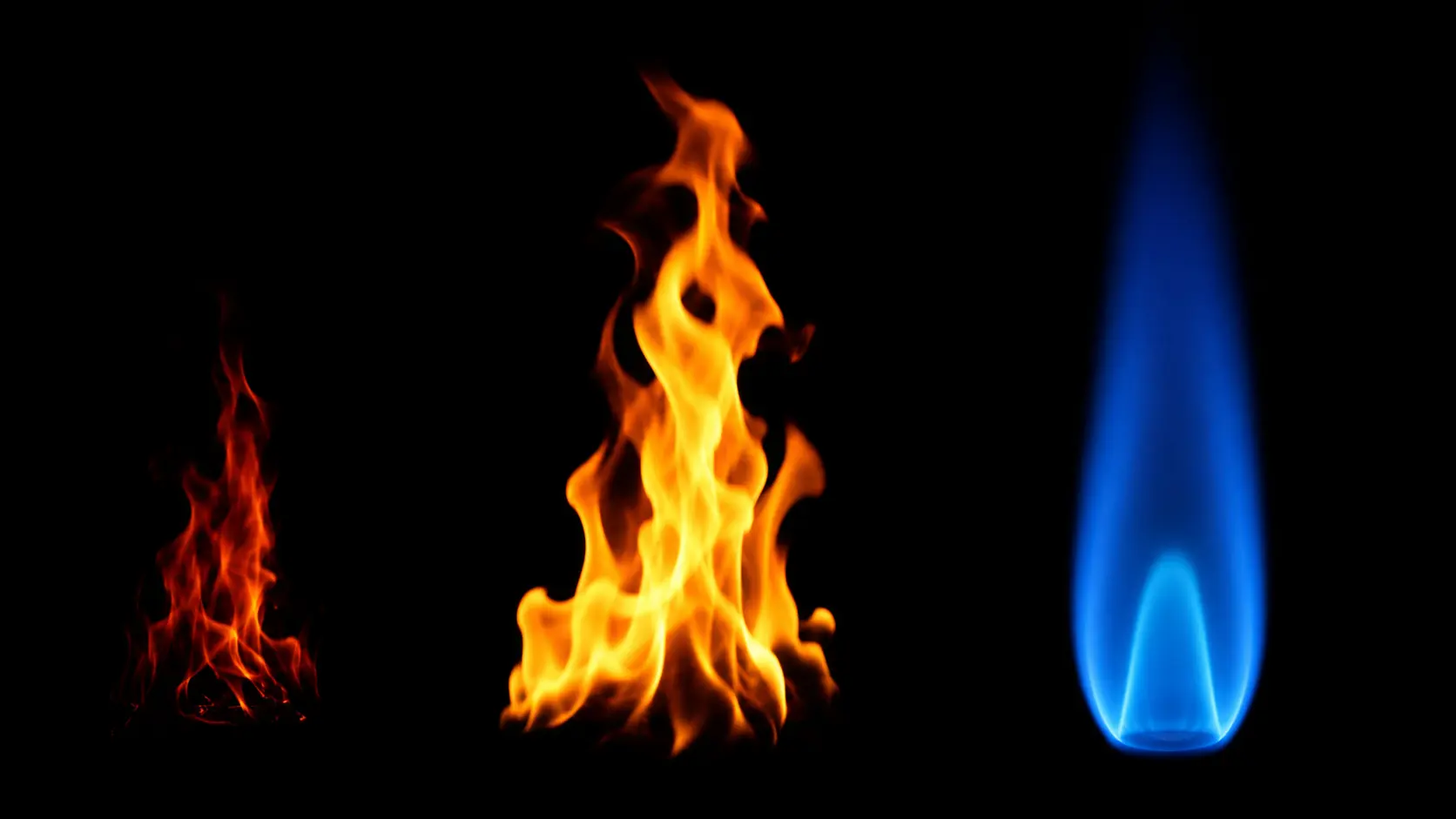
When a solid fuel — wood, for example — is heated, it does not directly catch fire. The heat causes the fuel to pyrolyze: decompose into volatile gases that are released from the fuel surface. These gases mix with atmospheric oxygen near the fuel surface. When the gas-oxygen mixture reaches its ignition temperature and an ignition source is present, combustion begins in the gas phase — in the air above the fuel surface, not in the solid fuel itself.
This is why most fires burn in the space just above the fuel and why extinguishing the gas-phase reaction stops the fire even when the fuel itself is still present. It also explains why a piece of wood does not burn when simply exposed to oxygen without heat — there are no combustible gases being produced from the cold wood. And it explains why a fire looks like it is "coming from" the wood when it is actually burning in the vapor layer a fraction of an inch above the surface.
Free Radicals: The Chain Reaction That Sustains Fire
At the molecular level, combustion is a chain reaction driven by highly reactive molecular fragments called free radicals. A free radical is a molecule or atom with an unpaired electron — chemically unstable and highly reactive. Combustion continuously produces free radicals, which then react with fuel molecules and oxygen molecules to produce more free radicals in a branching chain reaction.
The most important free radicals in hydrocarbon combustion are the hydroxyl radical (OH·) and the hydrogen radical (H·). These react with fuel and oxygen molecules at rates that sustain the combustion reaction as long as fuel and oxygen are available. The reaction is self-propagating: each step generates the radicals needed for the next step.
This chain reaction is the fourth element of the tetrahedron. It is established at ignition, maintained during combustion, and represents an independent pathway to sustaining fire beyond the simple presence of fuel, oxygen, and heat. A fire that has established a robust chain reaction can sustain itself briefly even when one of the other three elements is partially reduced — because the chain reaction itself is generating heat and maintaining local conditions.
The Tetrahedron: Four Sides, Four Interruption Points
The fire tetrahedron represents the four elements as four faces of a geometric solid — a triangular pyramid. All four faces must be present for the structure to stand. Remove any face and the structure collapses. The four elements are:
- Fuel — any combustible material that provides the carbon and hydrogen atoms consumed in the reaction
- Heat — thermal energy sufficient to initiate pyrolysis of the fuel and raise gas-phase temperatures to ignition
- Oxygen — the oxidizer that accepts electrons in the combustion reaction; normal atmospheric air at 21% oxygen is sufficient for most fuels
- Uninhibited chemical chain reaction — the self-sustaining radical chain process that propagates combustion independently of the initiation conditions
The three-dimensional representation is significant: all four elements are necessary and they are interdependent. Reducing heat reduces pyrolysis and radical production. Reducing oxygen reduces the oxidizer available for the radical reactions. Interrupting the chain reaction stops radical production regardless of available fuel, heat, and oxygen. This interdependence is what makes fire suppression effective through multiple independent mechanisms.
How Each Suppressant Type Targets a Different Side
| Suppressant | Primary mechanism | Tetrahedron side targeted |
|---|---|---|
| Water | Cooling — absorbs heat through evaporation; steam displaces oxygen locally | Heat (primary); Oxygen (secondary) |
| CO₂ | Oxygen displacement — heavy gas blankets the fire zone, reducing O₂ concentration below sustaining level | Oxygen |
| Dry chemical (ABC) | Multi-mechanism — coating fuel, some chain reaction interruption, oxygen exclusion | Fuel surface + Chain reaction (partially) |
| Halon (discontinued) | Chemical chain inhibition — bromine radicals scavenge hydroxyl and hydrogen radicals, breaking the chain | Chemical chain reaction |
| Clean agents (HFCs, FKs) | Chain reaction interruption and mild cooling | Chemical chain reaction + Heat |
| Class K wet chemical | Saponification — reacts with cooking oils to form a foam barrier; also cooling | Fuel surface + Heat |
| Foam (AFFF) | Fuel surface exclusion — foam blanket separates fuel vapors from oxygen | Fuel + Oxygen interface |
Water: More Than Just Cooling
Water is the most effective general-purpose fire suppressant available — not because it removes fuel or interrupts the chain reaction, but because it absorbs an extraordinary amount of heat during evaporation. One pound of water requires approximately 970 BTU to evaporate — far more than any comparable weight of other suppressants. When water contacts burning material, it absorbs heat faster than the combustion reaction can replenish it, dropping temperatures below pyrolysis threshold and stopping the vapor production that sustains the gas-phase fire.
The secondary mechanism — steam generation — is also meaningful. As water evaporates in the fire zone, steam expands to approximately 1,700 times the volume of liquid water, displacing oxygen in the immediate fire zone. This oxygen dilution effect is more pronounced in enclosed spaces than in open-air fires, which is part of why hoseline operations in a room fire are more effective than the same flow rate applied in the open air.
Water has one specific limitation the tetrahedron makes clear: it does not interrupt the chemical chain reaction. A fire that is suppressed with water but where the fuel remains hot enough to continue pyrolyzing will reignite when the water stops — because the chain reaction restarts as soon as conditions allow. This is why overhaul — thorough wetting of residual hot material — is required after knockdown, not just surface suppression.
Why This Matters for Choosing the Right Agent
The practical implication of the tetrahedron over the triangle: matching the suppressant to the fire type is not about tradition or preference. It is about targeting the correct side of the tetrahedron for the specific combustion scenario.
A computer room fire is best addressed by an agent that interrupts the chain reaction or displaces oxygen without leaving corrosive residue — which is why clean agents replaced Halon in most data center suppression systems. A cooking oil fire produces a fuel surface with an extremely high ignition temperature and sustained vapor production — which is why water makes it dramatically worse (explosive steam and scattered burning oil) and why Class K wet chemical agents that react with the oil surface are the correct choice. A flammable gas fire should not be extinguished at all unless the gas supply can be simultaneously shut off, because extinguishing the flame while gas continues to flow creates an unburned gas hazard that is more dangerous than the burning gas — which means the correct intervention targets the fuel (shut the supply), not the flame.
None of this logic flows from the fire triangle. All of it flows from the tetrahedron.

Comments 0
No comments yet. Be the first to share your thoughts!
Leave a Comment