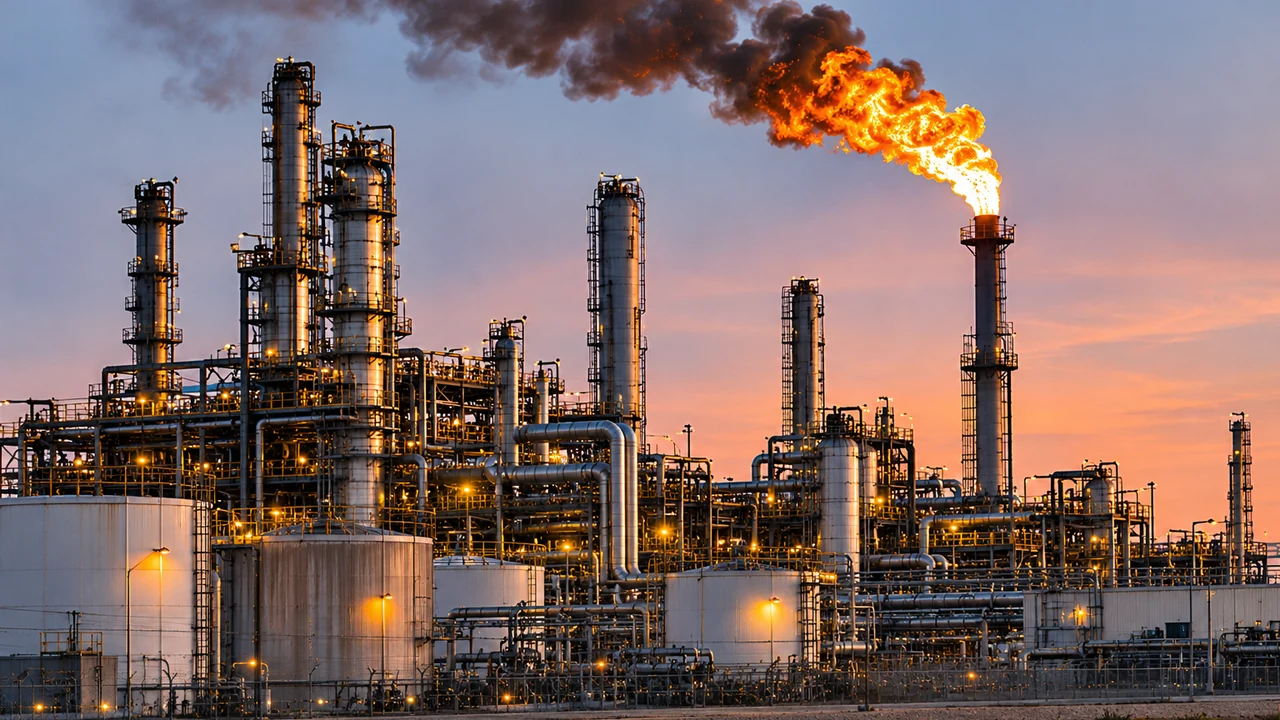
EL SEGUNDO, California — Flames and dark smoke rose over Chevron’s El Segundo refinery, close to LAX, after the November 28, 2026 earthquake off Manhattan Beach. Local authorities described contingency flaring, not a confirmed fire in process equipment. Officials also reported a separate episode of unplanned flaring at the Torrance refinery. A flare is an engineered safeguard, but its operation does not tell you whether every other part of the plant is safe.
Short answer: based on public statements so far, this was reported as earthquake-associated safety flaring, not a confirmed uncontrolled refinery fire. No explosion, burning storage tank or damage to a specific piece of equipment has been confirmed in the sources reviewed.
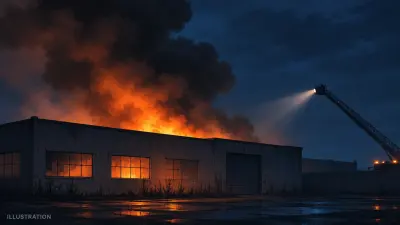
Reporting cutoff: November 29, 2026. This piece is built from public incident statements, facility-specific AQMD records and general refinery safety guidance. It is not an on-site investigation. The cover image is an AI-generated illustration of an industrial flare, not a photograph of this event.
What happened at the Chevron El Segundo refinery?
The USGS earthquake event page identifies a magnitude 5.0 earthquake off Manhattan Beach on Saturday morning, November 28. The USGS origin details also list a national-network moment-magnitude solution of 5.1. These are alternative estimates for the same event, not evidence of a separate earthquake. This article uses the 5.0 value displayed on the main event page when checked.
Chevron attributed intermittent flaring to its automatic safeguards activating after the quake, according to ABC7’s report of the company statement. The company said it had contacted the regional air district and local municipalities. Torrance officials separately reported flaring at their city’s refinery, with no off-site impact reported at the time.
In a November 28 municipal update, Manhattan Beach said intermittent flaring could remain visible for the next 48 hours and did not call for public protective action at the time. That advisory is a snapshot, not a guarantee about later conditions.
| Question | What the available evidence supports |
|---|---|
| Earthquake | M5.0 on the main USGS event page; an alternate national solution gives M5.1. |
| Chevron facility | Contingency flaring after the earthquake, per municipal and operator reporting. |
| Torrance facility | Separate unplanned flaring reported by local officials. |
| Uncontrolled process fire | Not confirmed in the statements reviewed. |
| Equipment damage or fault | Not confirmed in the sources reviewed. |
| Emissions and exposure | Preliminary event threshold flags exist; exact emissions and ground-level exposure were not verified. |
For actual footage of the plume, see the November 28 video listing at Reuters Connect. It is linked rather than reproduced. Footage alone cannot establish which process unit was involved.
What the AQMD event records reveal
AllFirefighter examined the facility-specific Flare Event Notification System (FENS) listing for Chevron Products Co., facility 800030 in El Segundo. The November 29 snapshot lists four unplanned notifications with November 28 start times, summarized below in chronological order. The first is classified as emergency flaring; the other three have an undetermined cause under investigation.
| Event ID | Reported start | Public notice | Reason | Threshold flags |
|---|---|---|---|---|
| 914488 | 9:30 a.m. | 10:03:23 a.m. | Emergency flaring | A, C |
| 914491 | 9:46 a.m. | 12:21:14 p.m. | Under investigation | B, C |
| 914489 | 10:10 a.m. | 11:23:18 a.m. | Under investigation | A, C |
| 914490 | 11:51 a.m. | 12:17:13 p.m. | Under investigation | B, C |
Threshold key: A — event-wide vent gas flow above 500,000 standard cubic feet (SCF); B — event-wide volatile organic compound (VOC) emissions above 100 pounds; C — daily cumulative vent gas flow above 100,000 SCF.
None of the four records displayed an actual stop time when checked. That does not establish that each flare was still burning, or that four separate physical stacks operated. The first reported start closely matches the earthquake’s local origin time, but the three other records do not establish their individual initiating causes. The flags describe threshold categories, not exact quantities. The daily threshold may recur across records, and the entries may overlap. Adding these flags together would not produce a defensible total for the release.
The distinction matters: vent gas volume measures gas handled by the system, while VOC mass describes a class of pollutants emitted. Neither directly measures what people breathed at ground level. Final emissions reporting, confirmed stop times and exposure measurements would be needed for a more complete assessment.
Why does a refinery have a flare at all?
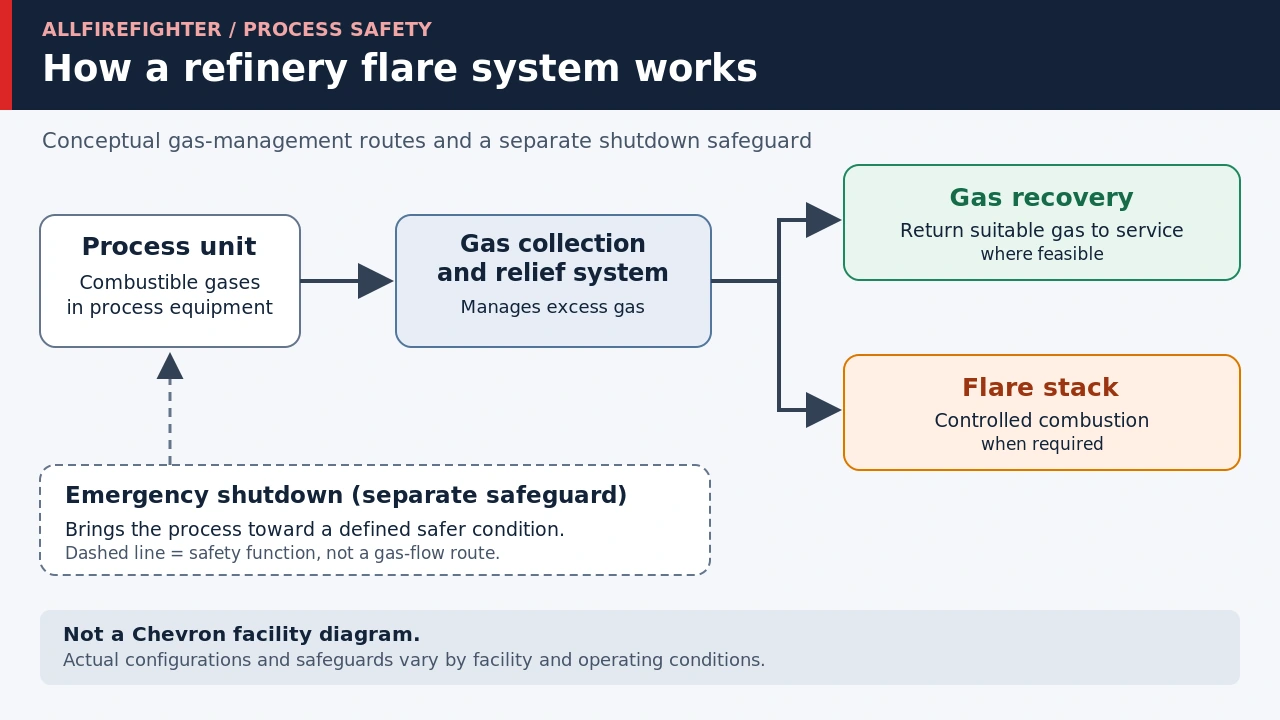
A refinery holds large volumes of combustible gas and liquid under tightly controlled conditions. When normal processing is interrupted, that material and its energy are still there. Shutting down production does not make the inventory disappear. The plant needs a designed way to manage gas that cannot remain in the process or be recovered.
South Coast Air Quality Management District (AQMD) describes the use of gas recovery and flaring to handle excess gas, including gas discharged through pressure relief systems. A flare is a designated location for combustion. That is very different from gas igniting after escaping a damaged pipe or vessel.
Four terms people mix up
| Function | Safety purpose |
|---|---|
| Emergency shutdown | Bring a process to a defined safer condition when limits or safeguards require it. |
| Pressure relief | Protect equipment from unacceptable pressure. |
| Flare gas recovery | Return suitable gas to useful service where the design and conditions allow. |
| Flaring | Burn combustible gas in equipment built for that purpose. |
These systems work together but they are not the same thing. A shutdown can happen without every relief device opening. A visible flare does not tell you which instrument, valve or unit started the response, and no plant-specific trip sequence has been published in the sources reviewed for this event.
Can an earthquake cause refinery flaring?
Yes, in principle. Shaking is an external hazard that process safety systems must account for. It can disturb utilities, upset normal operations or trigger abnormal readings, and the safeguards may respond even when nothing visibly broke. The reverse is also true: a safeguard that operated does not prove the equipment is undamaged.
For El Segundo, the supported statement is narrow. The company tied the flaring to earthquake-related safety system activation. Blaming it on a power loss, a broken line, a failed pump or a pressure spike would be guessing without a facility report.
Under the federal OSHA process safety management standard, 29 CFR 1910.119, covered processes need operating procedures for emergency shutdown, with responsibility assigned to qualified operators. Shutting down a refinery unit is an engineered procedure, not something an outside fire crew improvises. California requirements and facility procedures apply as well. This article makes no finding on Chevron’s regulatory compliance.
Is the refinery on fire, or is it flaring?
From a distance, both can look similar: orange flame, a large plume, worried phone calls. That is not enough to classify the incident or decide how to respond.
| Assessment issue | Engineered flaring | Uncontrolled process fire |
|---|---|---|
| Where combustion happens | In equipment built for it | Unintended ignition of released material or equipment |
| Main concern | Safe system operation and emissions | Loss of containment, escalation, exposures |
| Evidence needed | Facility confirmation, operating and environmental data | Incident assessment, facility information, emergency response findings |
| What a distant photo proves | Visible flame or smoke only | Visible flame or smoke only; not the source or extent of damage |
For a firefighter, the first question is not how big the flame looks. It is whether combustion is happening where intended and whether the facility can account for what it is seeing. The plant, public safety agencies and environmental regulators each hold part of the picture. A good assessment covers personnel accountability, other hazards, changing conditions and whether the public needs protective actions. That is general practice, not a description of what crews did at El Segundo.
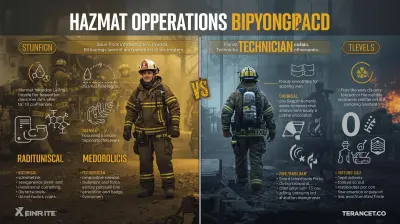
For the separate problem of loss of containment and industrial fire response, read our chemical plant fire and HazMat operations guide.
Is the black smoke from the refinery flare dangerous?
Dark smoke can indicate soot from incomplete combustion of hydrocarbon gas. Gas composition and mixing with air affect whether soot forms. A photo cannot tell you what was released or how much, and a cleaner-looking flame does not prove emissions are absent.
AQMD’s public flare guidance identifies potential emissions including particulate matter, carbon monoxide, sulfur and nitrogen oxides, and organic gases. The facility-specific records above supply threshold flags, but not a complete inventory of pollutants or measured concentrations at nearby homes.
A real exposure assessment needs release data, measured or estimated emissions, weather, plume movement and readings where people actually are. A tall dark plume can drift overhead, while a thin, hard-to-see emission can still matter. Height and color are poor guides to what a nearby resident actually breathes.
How is refinery flaring monitored in Southern California?
Two rule sets explain why safety and environmental accountability are handled separately. Federal 40 CFR 63.670 sets performance and monitoring requirements for covered flares, including combustion conditions and further analysis of certain release events. Locally, South Coast AQMD Rule 1118 covers refinery flare emissions and reporting.
Anyone can check the public Flare Event Notification System for notices and facility history. AQMD notes that facility-submitted information there is preliminary and can change. A notice is not a final compliance finding or a full exposure assessment.
To report smoke or odors, use AQMD’s public complaint service or call 1-800-CUT-SMOG (1-800-288-7664). Note the location, time and conditions from a safe distance. Do not approach an industrial site to investigate.
What should El Segundo and Manhattan Beach residents do?
The November 28 city advisory did not ask for protective action over the flaring, but conditions can change. Follow current instructions from local officials and emergency alerts, not an older statement. In an emergency, call 911. If you suspect a gas leak inside a building after the earthquake, get out first and call from outside. Do not flip switches or use devices indoors that could spark.
The city also urged earthquake preparedness and staying away from damaged structures. For real-time decisions, Manhattan Beach emergency notifications and AQMD’s public information are more useful than any archived news article.
What could change this assessment?
Watch three separate questions: did the refinery report damaged equipment, does environmental reporting establish how much was emitted, and did public safety agencies change their guidance? They concern different responsibilities (plant integrity, environmental regulation and emergency management), and an answer to one does not settle the others.
A facility incident report or regulator update could change how this event is classified. For now, the public statements and preliminary FENS records support calling it earthquake-associated contingency flaring. They do not support claims of an explosion, a burning storage tank, a specific equipment failure or a quantified hazardous exposure.
Frequently asked questions
Was the Chevron El Segundo refinery on fire after the earthquake?
Authorities described contingency flaring. An uncontrolled fire in refinery equipment was not confirmed in the sources reviewed.
How long will the flaring last?
The November 28 city advisory estimated that intermittent flaring could remain visible for 48 hours. The four FENS notices reviewed on November 29 did not list actual stop times. Neither establishes a confirmed end time.
Does black flare smoke mean the neighborhood is unsafe?
Smoke color alone cannot establish exposure. The city’s November 28 advisory called for no protective action at that time. Follow current official alerts and air-quality guidance rather than relying on that earlier statement.
Where can I check Chevron refinery flare updates?
Use the AQMD facility 800030 event list and your city’s emergency notices. Check the timestamp and remember that the records may change.
Sources and editorial methodology
- USGS — Manhattan Beach earthquake event record and alternative origin solutions (November 28, 2026).
- City of Manhattan Beach — Earthquake Update (November 28; municipal release syndicated by Public Technologies).
- ABC7 — Chevron and Torrance refinery statements (November 28).
- Chevron El Segundo — media updates (operator update indexed November 28; direct access was restricted during verification).
- South Coast AQMD — Chevron facility-specific event records (accessed November 29, 2026; four preliminary records transcribed and sorted by reported start).
- South Coast AQMD — FENS technical background and Rule 1118 program.
- OSHA — Process Safety Management and 40 CFR 63.670 — flare control requirements.
Incident-specific claims come from the public record above. The tables and conceptual diagram are editorial synthesis, not an engineering inspection. The preliminary notification flags are not final emissions totals; no event-specific ground-level exposure assessment or internal plant records were verified. This article should be updated if new official information changes the account.
Comments 0
No comments yet. Be the first to share your thoughts!
Leave a Comment