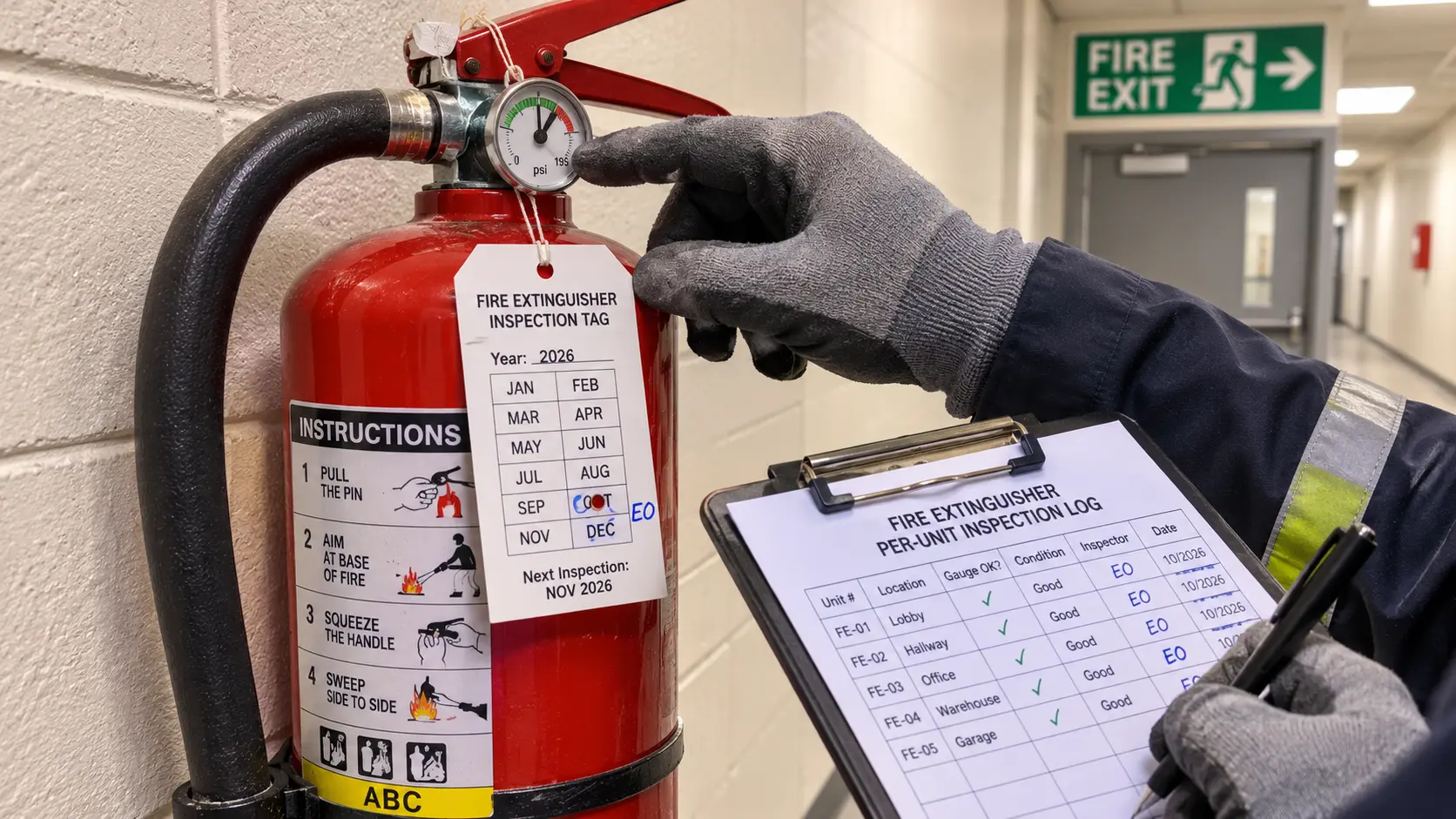

The short version: A portable fire extinguisher in a commercial building is not inspected once a year. It is checked visually once a month, serviced annually by a certified technician, given a six-year maintenance label, and hydrostatically tested on a longer interval that depends on the cylinder type. Each step produces a different record, and each record proves a different thing if an inspector or an insurance adjuster asks.
Most of the confusion around extinguisher inspection comes from treating it as a single event. It is not. It is a schedule with four separate clocks, and missing any one of them is the kind of gap that shows up on an OSHA citation or a fire marshal's report.
Monthly inspection: the part you do yourself
NFPA 10 and OSHA 1910.157(e)(2) both require a visual inspection at least monthly. OSHA's language is direct: portable extinguishers "shall be visually inspected monthly". NFPA 10 clarifies who can do it — the owner, the operator, the person in charge, or a designated crew member, not necessarily a certified technician.
What the monthly check actually covers is narrower than people assume. It is not a teardown. It is a visual confirmation that the extinguisher is where it is supposed to be, that nothing is blocking access to it, that the gauge needle sits in the operable range, that the pin and tamper seal are intact, that the hose and nozzle are not cracked or clogged, and that the inspection tag has been initialed and dated for the current month[reference:9][reference:10].
The practical failure mode here is not a technician missing something. It is a business that never assigns the task to anyone, or assigns it to someone who initials the tag without actually looking at the extinguisher. OSHA citations in this area tend to be pattern-of-practice findings, not one-off lapses[reference:11].
Annual maintenance: the part that requires certification
The annual service is a different job with a different standard. It is performed by a certified fire extinguisher technician, and it involves a hands-on examination that goes beyond the visual check: mechanical components, the expelling means, the agent itself, and the condition of the cylinder[reference:12]. If the unit fails, it must be repaired or replaced before it goes back into service.
This is the step where the tag changes from a monthly punch card to a service record. The annual maintenance tag carries the date of service and the technician's identifying information, and a qualified servicing organization's tag is the accepted evidence that the work was done. In some jurisdictions, the annual service tag is the document an inspector asks for first — not the monthly log.
Six-year and hydrostatic: the clocks most people forget
Beyond the annual cycle, stored-pressure dry chemical extinguishers require a six-year maintenance service and a 12-year hydrostatic test. Carbon dioxide extinguishers run on a five-year hydrostatic interval. These are not optional and they are not interchangeable with the annual service[reference:14][reference:15].
The six-year service involves a more thorough internal examination and is recorded with a separate label affixed to the extinguisher. The hydrostatic test is a pressure test of the cylinder itself, and it is recorded with a stamp or label that is distinct from both the annual tag and the six-year label. A fully compliant extinguisher can carry three separate pieces of evidence, and all three have to be current[reference:16].
Who is allowed to do what
The split is cleaner than most compliance guides make it sound. Monthly visual inspection: any responsible employee after brief training, no certification required. Annual maintenance, six-year service, and hydrostatic testing: a certified technician, typically employed by a licensed servicing company[reference:17].
That distinction matters for two reasons. First, it means a business cannot outsource the monthly check entirely and still claim compliance — the monthly log is supposed to reflect an actual in-house visual inspection. Second, it means the annual tag is not something a maintenance worker can sign off on. If the name on the annual tag does not belong to a certified technician, the tag is not evidence of service[reference:18].
How to read the tag (and why the colors are not the system)
Extinguisher tags are often described by color, but the color is not a universal code — it varies by manufacturer and jurisdiction, and the FDNY has changed extinguisher tag colors over the years[reference:19]. What is standardized is the content: the month and year of service, the initials or identifier of the person who performed it, and punch marks or a written record showing each month in the annual cycle is accounted for[reference:20].
A compliant tag tells you three things at a glance: whether the monthly checks are being kept up, whether the annual service is current, and who signed off on it. A tag with a current annual punch but an empty monthly row is a red flag — it suggests the annual service happened but the monthly routine did not.
What the inspection record must contain
NFPA 10 allows records to be kept on a tag attached to the extinguisher, on a checklist kept on file, or electronically. The minimum content is the same across formats: the month and year of the inspection, the identity of the inspector, and a note of any unit that needed corrective action[reference:21].
The record-keeping mistake that causes trouble is not a missing signature. It is a record that cannot be tied to a specific extinguisher. A log sheet that says "all units checked" without unit identifiers is weak evidence when an inspector asks which extinguisher was serviced and when. The stronger practice is a per-unit record — even a simple numbered list with initials and dates — so the paper trail matches the physical tags[reference:22].
What it costs in 2026
Monthly visual inspection costs nothing beyond staff time if it is done in-house. Annual professional maintenance runs roughly $15–$40 per unit on a commercial account, with single-unit visits often landing in the $40–$100 range because of trip minimums[reference:23]. Six-year maintenance and hydrostatic testing are priced separately, and hydrostatic testing commonly runs $35–$150 per cylinder depending on size and type[reference:24].
For budgeting, the number that matters is not the per-unit annual fee — it is the trip minimum and the bundle. A facility with a handful of extinguishers will pay closer to the single-visit rate. A facility with dozens spread across buildings should be negotiating a per-unit rate and scheduling the annual, six-year, and hydrostatic work together where the calendars allow it[reference:25].
Common gaps that show up in inspections
- Monthly tags initialed but not actually checked. The tag is a record of an inspection, not a substitute for one. A gauge in the red with a signed tag is worse than an unsigned tag.
- Annual service current, six-year label expired. The annual tag and the six-year label are different documents. A current annual tag does not cure an expired six-year service[reference:26].
- Extinguishers blocked or relocated. Access and placement are part of the monthly check. A unit behind stacked inventory is a finding even if the gauge is green[reference:27].
- No per-unit record. A building-wide checklist without unit identifiers is weak evidence. Number the units and log them individually.
- Assuming the fire department will catch it. The fire marshal inspects the building; the daily and monthly compliance obligation belongs to the occupant.
Frequently asked questions
How often does a fire extinguisher need to be inspected?
Monthly visual inspection, annual certified maintenance, six-year service for stored-pressure dry chemical units, and hydrostatic testing every 5, 10, or 12 years depending on cylinder type[reference:29].
Can I do the monthly inspection myself?
Yes, in most cases. NFPA 10 allows the owner, operator, person in charge, or a designated crew member to perform the monthly visual inspection. No certification is required for that step.
Who can perform the annual inspection?
A certified fire extinguisher technician, typically employed by a licensed servicing company. The annual service is not a task for in-house maintenance staff without certification[reference:31].
What is the six-year label on a fire extinguisher?
It records the six-year maintenance service required for certain extinguisher types, separate from the annual service tag and the hydrostatic test stamp. All three must be current for full compliance[reference:32].
How much does a commercial fire extinguisher inspection cost?
Annual professional maintenance is roughly $15–$40 per unit on a commercial account; single-unit visits often run $40–$100 due to trip minimums. Hydrostatic testing is typically $35–$150 per cylinder[reference:33][reference:34].
What has to be on the inspection record?
The month and year of inspection, the identity of the inspector, and any unit that required corrective action. Records can be on a tag, a filed checklist, or electronic[reference:35].
Sources
- 46 CFR 142.240 — Monthly inspection by owner/operator; annual testing requirement
- OSHA 29 CFR 1910.157(e)(2) — Portable extinguishers visually inspected monthly
- NFPA 10 & OSHA 1910.157 inspection checklist — monthly visual and annual certified maintenance
- Amerex — Annual maintenance scope, tagging, and technician requirements
- EMEDCO — Four inspection categories: monthly, annual, six-year, hydrostatic; tag size and record requirements
- Fire Inspected — Reading extinguisher tags: monthly vs annual vs six-year vs hydrostatic; 2026 cost ranges
Editorial note: Inspection intervals and record requirements summarized here reflect NFPA 10 and OSHA 1910.157 as published; local fire codes and the authority having jurisdiction may add requirements. Cost figures are 2026 market ranges, not quotes.





Comments 0
No comments yet. Be the first to share your thoughts!
Leave a Comment