
Most households have a fire extinguisher somewhere — in the kitchen, in the garage, in a utility closet. Fewer households know whether that extinguisher is actually functional. A fire extinguisher is not a purchase-and-forget item. It requires periodic inspection, has a defined service life, and may require professional recharging after use or after certain conditions. The extinguisher that has been on your kitchen wall for eight years and has never been used may or may not be ready to work when you need it.
The recharge-versus-replace question is the practical decision most homeowners face at some point, and the answer depends on the type of extinguisher, its condition, its age, and what it cost in the first place. Getting this wrong in one direction means paying to recharge an extinguisher that should have been replaced. Getting it wrong in the other direction means throwing away money on a new unit when the old one could have been serviced for a fraction of the price.
In this article:
Extinguisher Types and What They Protect Against
| Type | Rated for | Common locations | Not for |
|---|---|---|---|
| ABC Dry Chemical | Class A (ordinary combustibles), B (flammable liquids), C (electrical) | Kitchen, living areas, garage, vehicles | Cooking grease fires (Class K); leaves corrosive residue |
| BC Dry Chemical | Class B (flammable liquids), C (electrical) | Garages, workshop areas | Class A fires (wood, paper, cloth) |
| Class K (Wet Chemical) | Cooking oils and fats | Commercial kitchens; home kitchens with deep fryers | Not rated for other fire classes |
| CO₂ | Class B and C; leaves no residue | Server rooms, labs, sensitive equipment | Class A fires; outdoor use (wind dissipates agent) |
| Water Mist | Class A; safe around energized equipment | Healthcare settings, home use where chemical residue is a concern | Flammable liquid fires |
For most residential applications, an ABC dry chemical extinguisher in the 2.5 to 5 pound size is the standard. It handles the widest range of fire types and is widely available. The limitation — corrosive dry chemical residue — is a cleanup inconvenience that is far preferable to the alternative. If you have a deep fryer or do significant fry cooking, a Class K extinguisher in the kitchen is worth considering alongside or instead of a standard ABC unit.
The Monthly Inspection: What to Look For
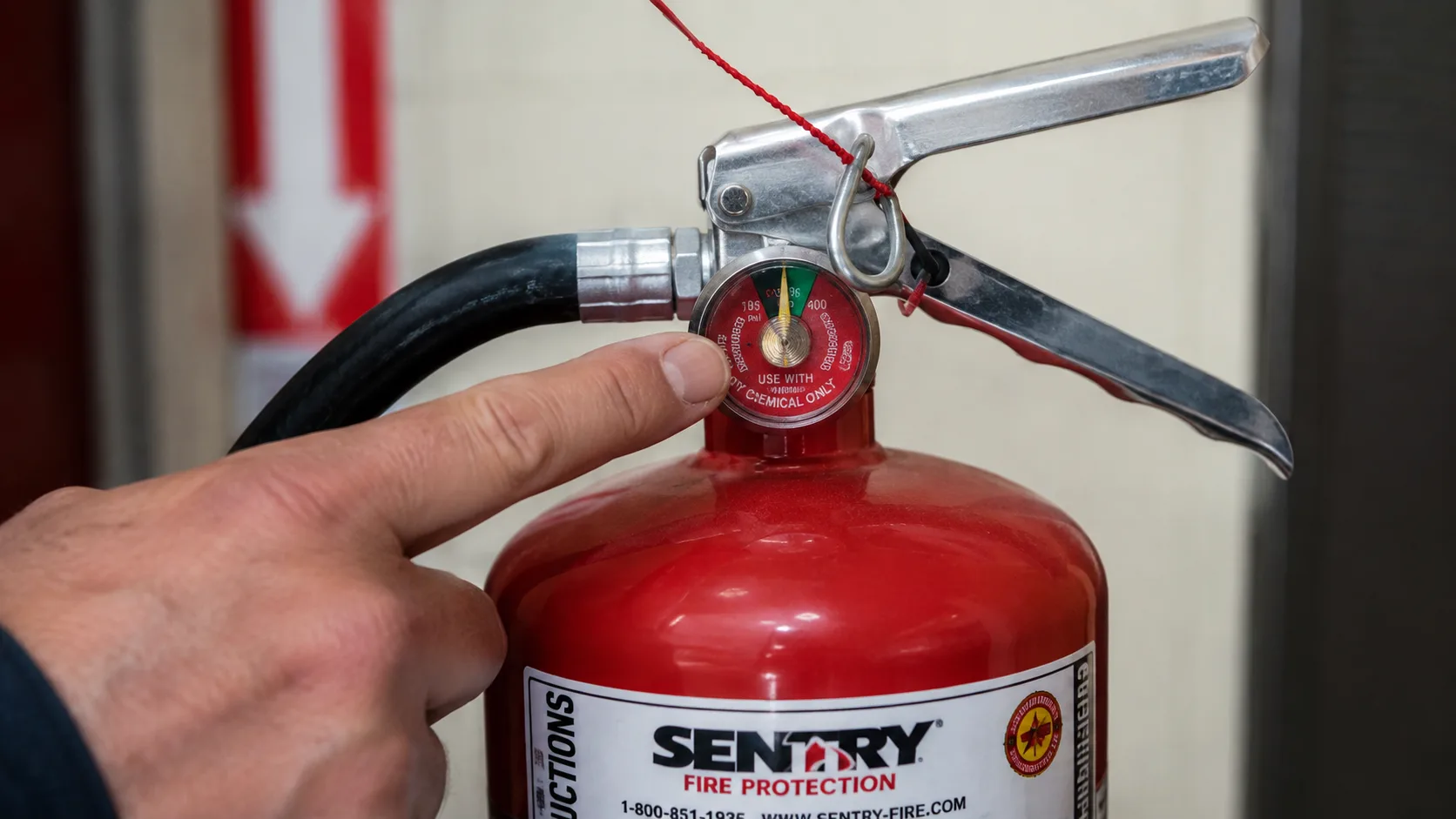
NFPA 10 — the standard for portable fire extinguishers — requires a monthly visual inspection. For a residential extinguisher this takes 30 seconds and covers five points:
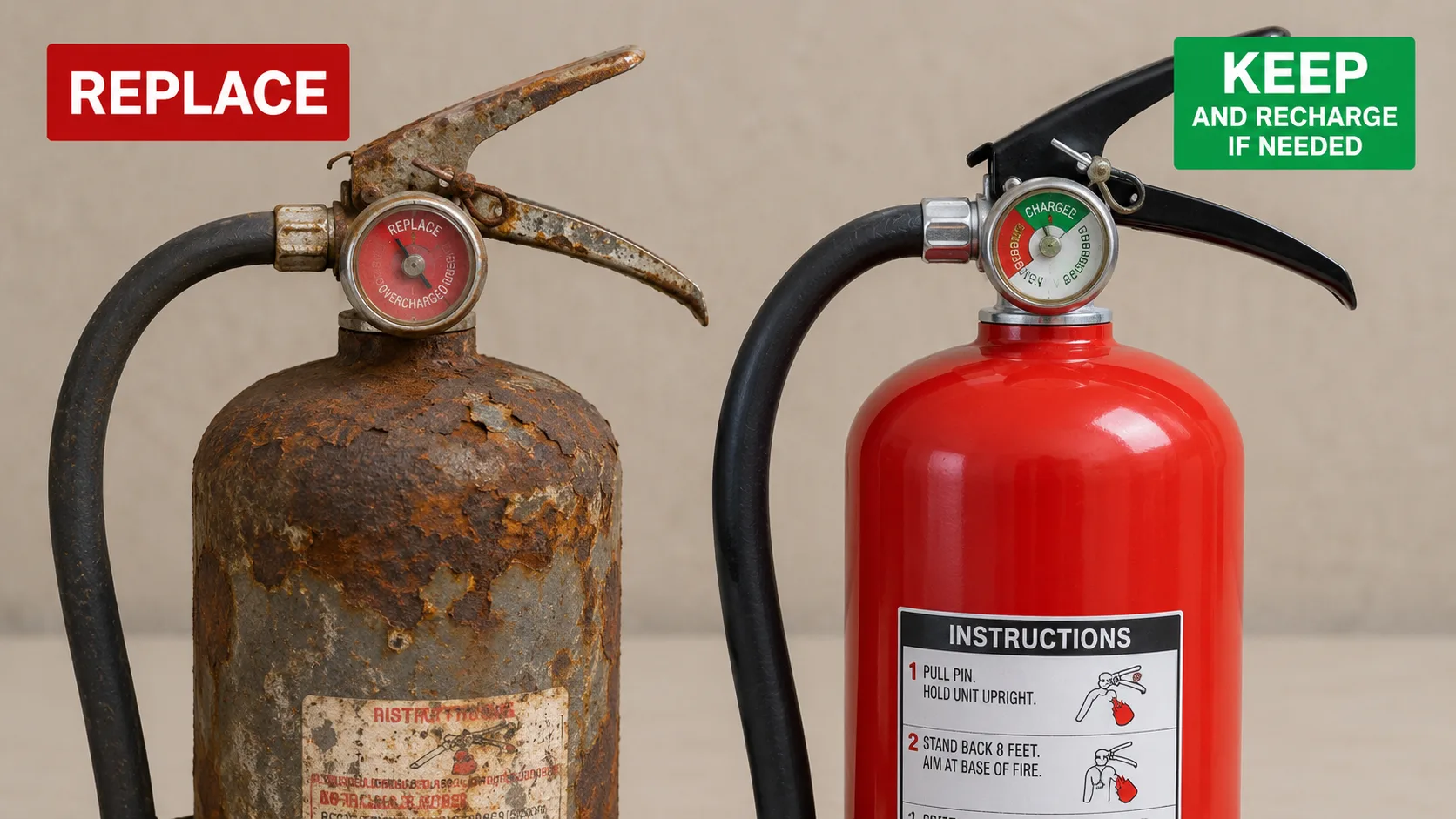
- Pressure gauge: The needle should be in the green zone. A needle below the green zone indicates low pressure — the extinguisher needs recharging. A needle above the green zone indicates overpressure and the extinguisher should be taken out of service and inspected by a professional.
- Pull pin: The safety pin through the handle should be intact and the tamper seal wire or plastic tie should be unbroken. If the pin is missing or the seal is broken, the extinguisher may have been partially discharged or tampered with — have it inspected.
- Nozzle and hose: No cracks, blockages, or damage. The nozzle should be clear.
- Cylinder: No visible dents, corrosion, rust, or damage. Rust on the exterior of a dry chemical extinguisher is a sign of internal moisture — this is a replace-immediately condition because moisture causes the dry chemical agent to clump and renders the extinguisher unable to discharge properly.
- Location and accessibility: The extinguisher is in its designated location, mounted at the correct height (handle at 3.5 to 5 feet for units under 40 lbs), and not obstructed.
When to Recharge
An extinguisher needs recharging under two circumstances: after any use, and when the pressure gauge drops below the green zone. After any use — even a brief, partial discharge — the extinguisher must be recharged before it is returned to service. A partially discharged extinguisher may appear to have most of its agent remaining, but the propellant pressure has been affected and the unit cannot be relied upon for its full rated discharge. Tag it as used and get it recharged or replaced before putting it back on the wall.
A low-pressure reading without visible damage or use typically indicates propellant loss over time — a slow leak that eventually drops the gauge below the operational range. This is a normal aging characteristic. The unit is rechargeable if it is otherwise in good condition and within its service life.
When to Replace Instead
Replace rather than recharge in the following situations:
- The extinguisher is disposable — many residential units are single-use, non-rechargeable. They are labeled accordingly (see below). Attempting to recharge a disposable unit is unsafe.
- The cylinder has visible corrosion, dents, or structural damage — a compromised cylinder should not be repressurized. The cost of recharging a damaged cylinder exceeds the risk of the cylinder failing under pressure.
- The unit is past its hydrostatic test interval and the cylinder is not worth the test cost — a small, inexpensive dry chemical extinguisher that requires a 12-year hydrostatic test may cost more to test and recharge than to replace with a new unit.
- The label or date information is missing or illegible — without knowing the manufacture date and service history, the extinguisher's condition cannot be adequately assessed.
- The unit is more than 12 years old without documented hydrostatic testing — regardless of gauge reading.
Hydrostatic Testing: What It Is and When It Is Required
Hydrostatic testing fills the extinguisher cylinder with water at pressure exceeding its rated operating pressure, and checks whether the cylinder expands beyond acceptable limits or shows any sign of failure. It verifies that the cylinder is structurally safe for continued pressurized service. NFPA 10 requires hydrostatic testing at intervals based on extinguisher type:
| Extinguisher type | Hydrostatic test interval |
|---|---|
| Stored pressure dry chemical (most residential ABC units) | Every 12 years |
| Cartridge-operated dry chemical | Every 12 years |
| CO₂ extinguishers | Every 5 years |
| Water and foam (stored pressure) | Every 5 years |
| Halogenated agent | Every 12 years |
For most homeowners with a standard residential ABC dry chemical extinguisher, the 12-year hydrostatic test interval means they will encounter this requirement once per extinguisher lifetime — at which point the replacement-vs-recharge-and-test calculation should account for the age of the unit and whether the test cost plus recharge cost is competitive with the cost of a new unit. For a basic 2.5 lb ABC extinguisher that costs $25 to $40 new, the economics typically favor replacement at the hydrostatic test interval. For a higher-end unit or a larger commercial unit, servicing and testing is often the better value.
Rechargeable vs. Disposable: What That Label Means
Fire extinguishers sold at retail stores fall into two categories that are not always clearly distinguished in their packaging: rechargeable and disposable (also called non-rechargeable or single-use).
Rechargeable extinguishers have metal valves and are designed for professional recharging. After discharge, they are taken to a service provider, the agent is refilled, and the cylinder is repressurized. The valve and cylinder are designed for repeated service cycles within their hydrostatic test limits.
Disposable extinguishers have plastic valves and are designed for one-time use. Once discharged — or once the pressure drops — they are not serviceable and must be disposed of at a hazardous materials collection facility (dry chemical is an irritant and should not go in the regular trash). Attempting to recharge a disposable unit by drilling and repressurizing it — a method that occasionally appears online — is dangerous. The valve and cylinder are not rated for repressurization.
The label or the extinguisher body will indicate which type you have. If it says "non-rechargeable," "disposable," or has a plastic valve assembly, it is a single-use unit. If it says "rechargeable" and has a metal valve, it can be serviced professionally.
Where to Get an Extinguisher Recharged
Professional extinguisher service is provided by fire equipment service companies — typically listed under "fire protection equipment" or "fire extinguisher service" in local business directories. Many fire departments maintain a list of licensed extinguisher service providers in their area. The service typically costs $15 to $30 for a standard residential dry chemical unit — less than a replacement, assuming the unit is otherwise serviceable.
A recharge service should include: refilling the agent to the correct weight, repressurizing with the correct propellant, inspecting the valve and discharge mechanism, replacing the pull pin and tamper seal, and applying a new inspection tag with the service date. A service provider who does not do all of these things is not performing a complete recharge.
Placement and Mounting
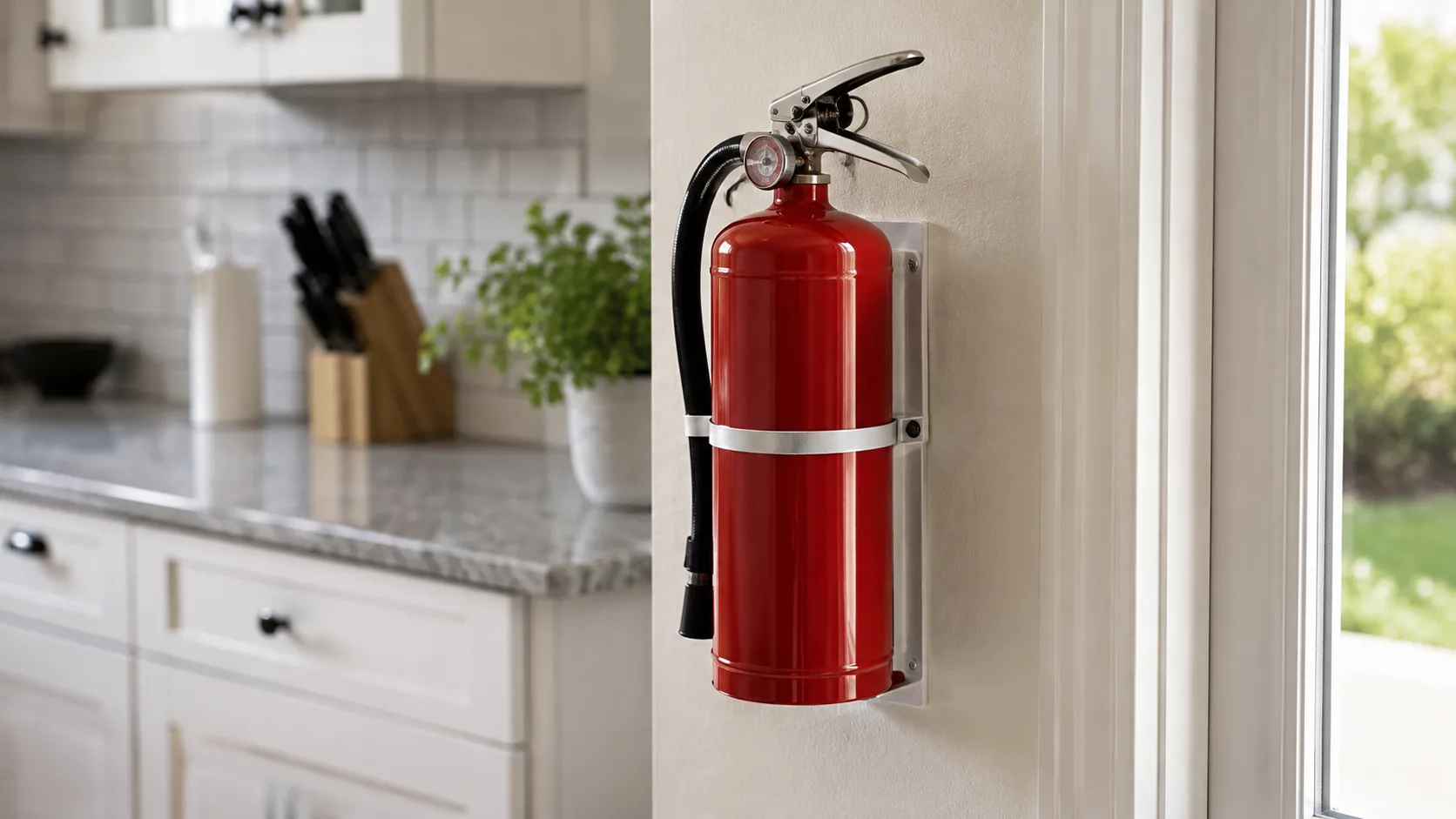
- ✓Kitchen: near the exit from the kitchen, not next to the stove — if the stove is on fire, the extinguisher mounted above the stove is inaccessible. Mount it by the doorway so you can access it without passing the fire.
- ✓Garage: near the pedestrian door, accessible before you need to pass a potential vehicle or fuel fire.
- ✓Mounted height: handle at 3.5 to 5 feet above the floor for units under 40 lbs; not higher than 3.5 feet for units over 40 lbs.
- ✓Visible and not obstructed: not behind a door, not in a cabinet, not under a sink where accessing it requires bending and searching.
- ✓One per floor minimum in a multi-story home; kitchen and garage at minimum in a single-story home.
- ✗Do not mount near a heat source — high ambient temperatures degrade the propellant over time and can cause pressure buildup in the cylinder.
Home fire prevention: Fire Prevention Week 2026 focuses on safe charging and lithium-ion batteries. See the full 2026 Fire Prevention Week guide.


Comments 0
No comments yet. Be the first to share your thoughts!
Leave a Comment