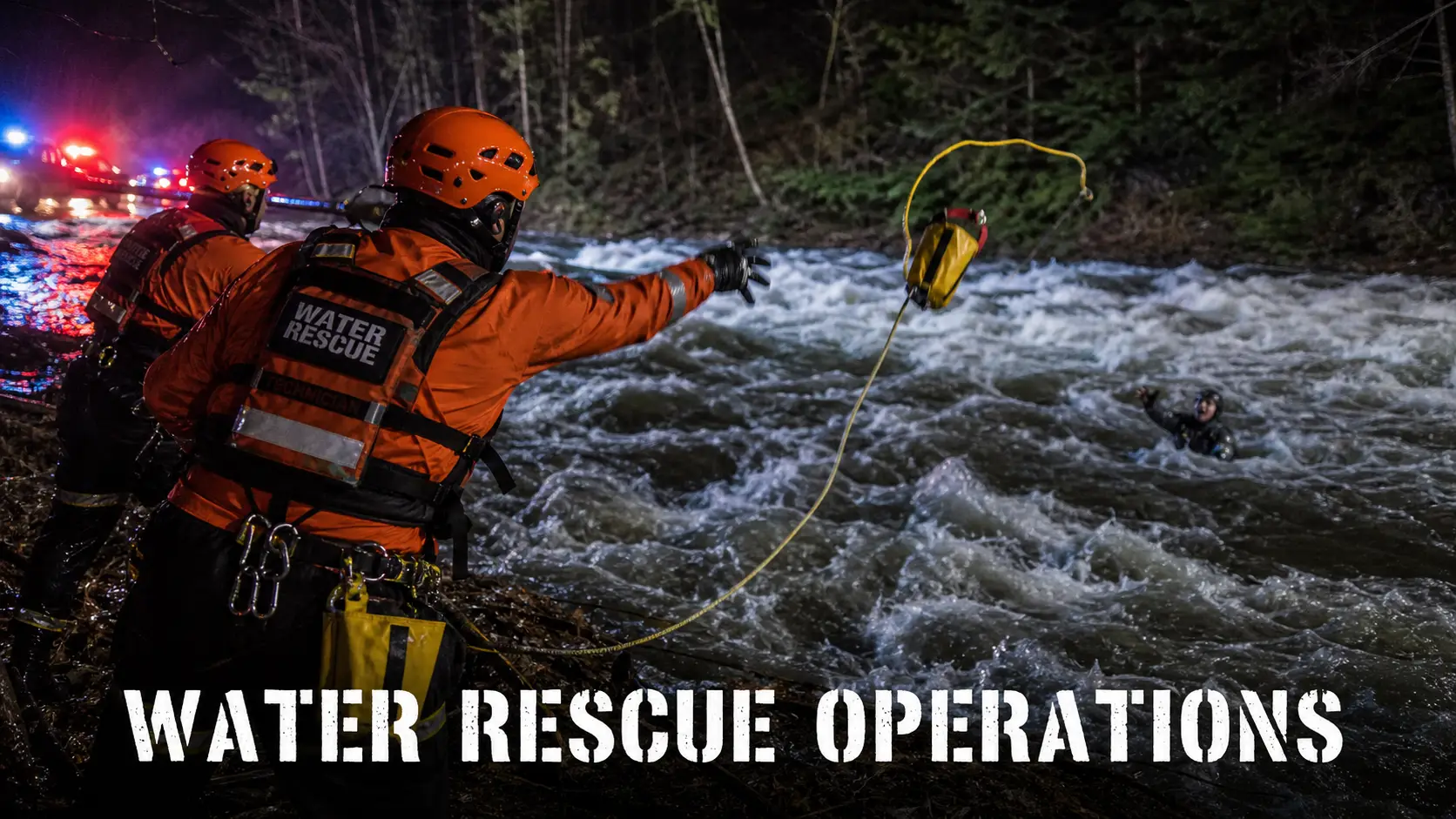
Water rescue is the third leading cause of firefighter line-of-duty deaths in the United States. Flooding events are increasing in frequency and geographic reach. Departments that trained exclusively for structural firefighting now find themselves dispatched to swift water rescues, flood evacuations, and submerged vehicle incidents with minimal preparation. This guide covers the complete operational picture: hazard recognition, the reach-throw-row-go decision hierarchy, swiftwater certification levels, low-head dam and strainer hazards, PPE requirements, incident command at water emergencies, and what every firefighter — even those without water rescue certification — must know before arriving at a water incident scene.
Jump to section:
- 1. Water Hazards Every Firefighter Must Recognize
- 2. Reach-Throw-Row-Go: The Rescue Priority Hierarchy
- 3. Strainers and Low-Head Dams
- 4. Swiftwater Certification Levels
- 5. PPE and Gear Requirements
- 6. Flood and Submerged Vehicle Rescue
- 7. Incident Command at Water Emergencies
- 8. Water Rescue Size-Up Checklist
- FAQ
1. Water Hazards Every Firefighter Must Recognize
Moving water is deceptively powerful. The force exerted on a body by moving water increases with the square of the velocity — water moving twice as fast exerts four times the force. A current of 6 inches deep moving at 7 mph can knock a full-grown adult off their feet. A current 2 feet deep at that speed can carry a vehicle. The first operational requirement at any water incident is understanding the specific hazards present before any rescue attempt is initiated.
Hydraulic features
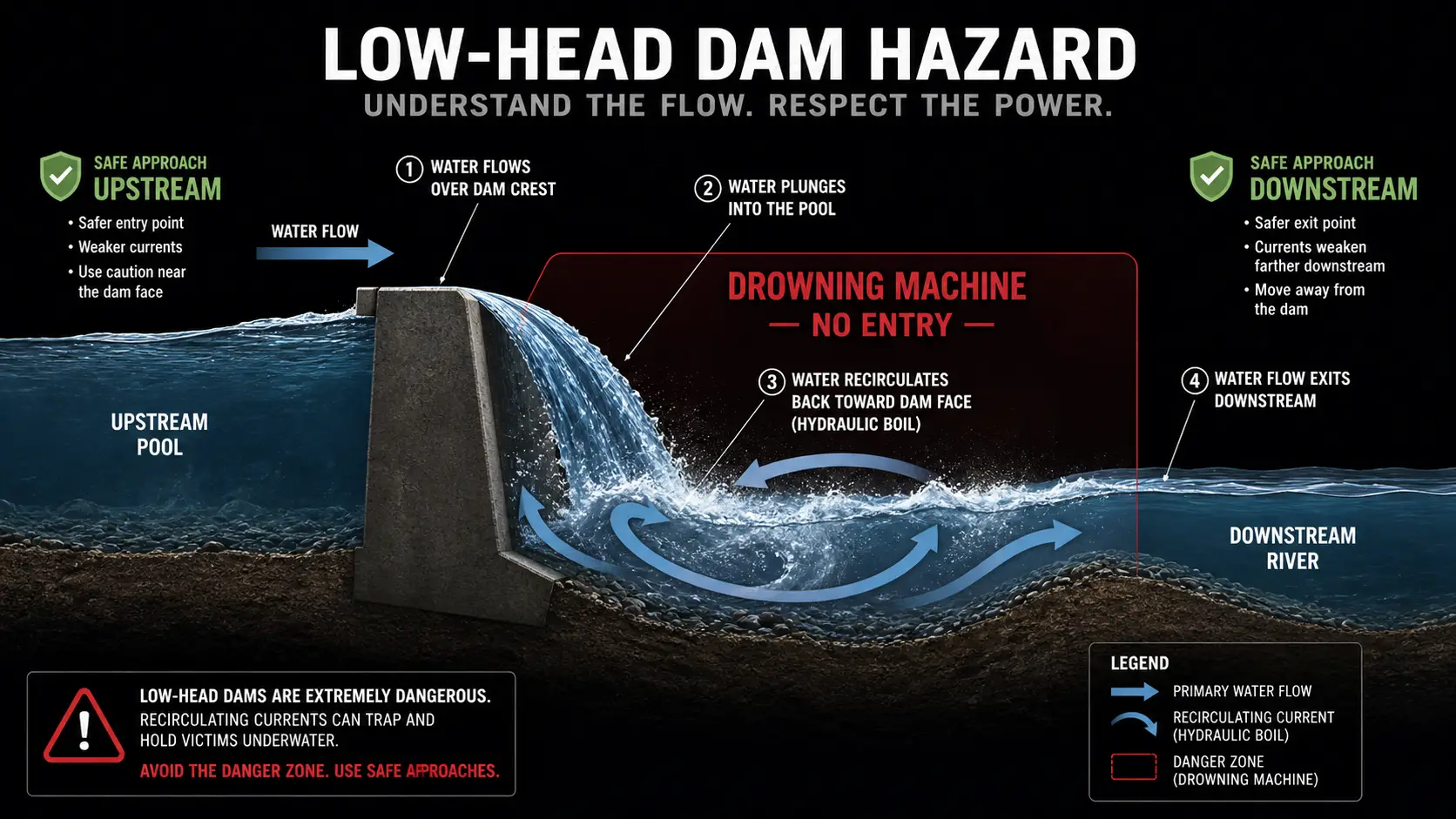
- Hydraulic (hole or keeper): Formed downstream of a drop in the riverbed or an obstruction. Water recirculates in a vertical cycle — surface water flows toward the feature, subsurface water flows away. A swimmer or rescuer caught in a hydraulic can be recirculated repeatedly and held underwater. Low-head dams are the most common artificial hydraulic in the U.S. fire service response area.
- Eddy: A calm pocket of water behind an obstruction where current reverses direction. Eddies are a rescuer's friend — they provide a stable working position in moving water and a staging point for victim contact. Know how to enter and exit eddies intentionally.
- Pillow: Water piling up against the upstream face of a large obstruction. Current flows around and under the obstruction. A rescuer or victim pressed against the upstream face of a boulder or bridge pier can be pinned with no mechanism for self-rescue.
- Undercut: A rock or ledge where the current flows under the feature. Victims and rescuers can be swept under and trapped with no possibility of exit. Treat any undercut rock as immediately fatal.
Current force and depth
| Water Depth | Current Speed | Effect on Adult | Effect on Vehicle |
|---|---|---|---|
| 6 inches | 7 mph | Knocked off feet | No movement |
| 12 inches | 7 mph | Swept off feet, unable to stand | Small cars begin to float |
| 24 inches | 7 mph | Immediate life threat | Most vehicles floating/moving |
| 12 inches | 15 mph (flash flood) | Fatal force, no survivable self-rescue | All vehicles displaced |
Flood-specific hazards
- Debris fields: Floodwater carries trees, lumber, propane tanks, vehicles, and structural debris at speed. Debris can pin a rescuer or victim against a fixed object without warning.
- Contamination: Floodwater is sewage water. It contains fecal coliform, industrial runoff, pesticides, fuel, and biological hazards. Full PPE, eye protection, and post-incident decontamination are mandatory.
- Electrical hazards: Submerged power lines are invisible. Flooded areas with downed power lines must be confirmed de-energized by the utility before any personnel enter the water. This is a non-negotiable life-safety requirement, not a guideline.
- Hidden topography: Floodwater covers curbs, storm drains, ditches, and sudden grade changes. Walking or wading through floodwater without probing ahead with a pole is how rescuers are lost.
- Cold water: Water below 60°F (15°C) causes rapid incapacitation. Cold shock response triggers involuntary gasping and hyperventilation on immersion. A swimmer can lose purposeful movement in minutes. Cold incapacitation time for the victim and rescuer must be factored into every water rescue IAP.
The #1 rule in water rescue: do not become a victim. More rescuers die at water incidents from attempting unprotected entry than from any other single cause. Every unprotected entry is a potential second victim. The reach-throw-row-go hierarchy exists specifically to protect rescuers while still prioritizing rapid victim extraction.
2. Reach-Throw-Row-Go: The Rescue Priority Hierarchy
Reach-Throw-Row-Go is not a suggestion or a training slogan — it is the operational decision hierarchy that determines which rescue method to attempt first based on rescuer safety and available resources. Work through the hierarchy from top to bottom. Do not skip to Go (in-water entry) because it feels faster. The hierarchy exists because the methods at the top of the list have higher rescuer survival rates and comparable or better victim outcomes when executed correctly.
Reach
Any extension from a fixed position on shore that allows the rescuer to contact the victim without entering the water. Tools for reach rescue: pike poles, ladders extended to the water's edge, extension cords, hose lines, tree branches, webbing, and dedicated reach poles. The rescuer must be anchored or held by another firefighter to prevent being pulled in. Lie flat on the bank to lower the center of gravity when reaching. A reach rescue can be completed in under 60 seconds with proper training and available equipment.
Throw
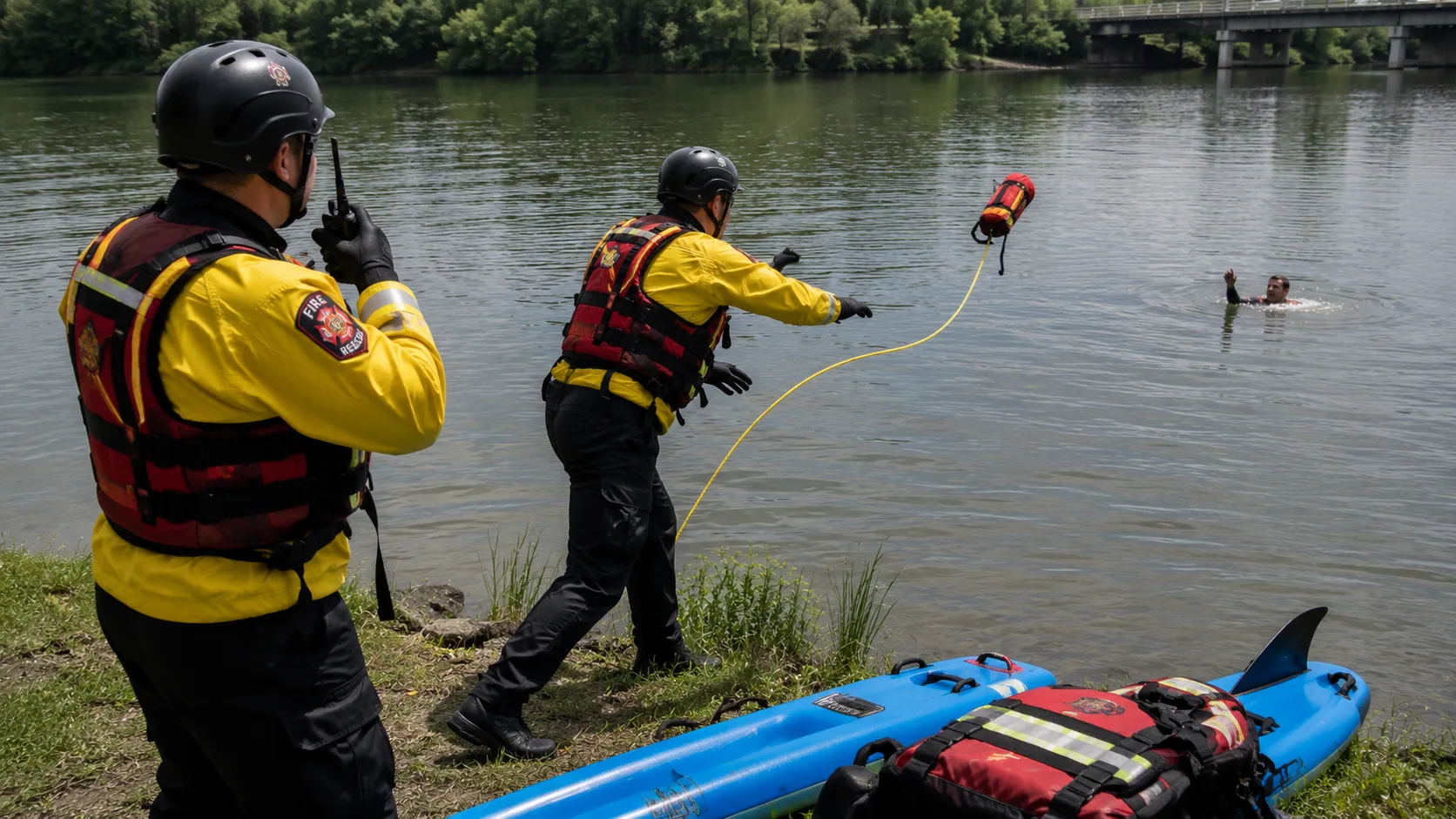
A throw bag is a water rescue bag containing 50–75 feet of floating polypropylene rope coiled inside a nylon bag. The bag is thrown past the victim; the victim grabs the rope; the rescuer swings the victim to shore using a pendulum action. Throw bag accuracy degrades rapidly with stress and distance. Train your crew to throw bags in realistic conditions — at moving targets, across distances of 30–60 feet, in wind, with gloves on. A ring buoy on a line works similarly. A throw PFD (a buoyant ring) thrown to an exhausted or non-swimmer victim can keep them afloat while you prepare a second rescue method.
Row
Any watercraft that keeps the rescuer out of the water: inflatable rescue boat (IRB), flat-bottom johnboat, canoe, kayak, personal watercraft, or flood rescue boat. Boat rescues allow rescuers to reach victims in mid-channel positions that are unreachable by throw bag, and allow victims who cannot swim to be extracted without entering the water. Boat operators must be trained in swiftwater boat handling — a motorized boat in fast current behaves completely differently from flatwater operation.
Go
In-water entry by a trained rescuer is the last resort, not the instinctive first response. Go rescue requires: swiftwater rescue certification (minimum Operations level), appropriate PPE (swiftwater PFD, wetsuit or drysuit, helmet, knife), tether rope when current allows, and a backup rescuer positioned downstream. An untrained rescuer entering moving water to reach a victim is the most common cause of double-fatality water incidents in the U.S. fire service. The emotional pull to immediately help a victim in distress is powerful and understandable — and it kills rescuers. Train the hierarchy until Reach-Throw-Row is the instinctive response.
3. Strainers and Low-Head Dams: The Most Dangerous Water Rescue Features
Strainers
A strainer is any obstruction that allows water to pass through but catches solid objects — including people. Common strainers in the U.S. fire service response area: downed trees in rivers and streams (the most common), debris piles against bridge piers, rebar exposed from eroded riverbanks, and culvert grates. The hydraulic force pressing a body against a strainer is proportional to the current velocity and the surface area of the obstruction. At 5 mph current, the force on a victim pressed against a strainer can exceed 700 pounds. There is no self-rescue from a strainer under these force levels.
Strainer rescue requires approaching from upstream (the victim cannot assist from a strainer) and using a physical lift-and-pull extraction technique, not a rope and pendulum. Throwing a line to a strainer victim and instructing them to hold on while you pull can make the strainer pinning worse by adding horizontal force. Train strainer extraction technique specifically — it is a distinct skill from throw bag rescue.
Low-head dams: the drowning machine
Low-head dams are small dams, typically 1–15 feet in height, built across rivers and streams for water supply, irrigation, or historical mill operations. There are more than 80,000 low-head dams in the United States. They are the most consistently lethal artificial water feature encountered in domestic water rescue operations, earning the operational nickname “drowning machine” because of their specific hydraulic characteristics.
As water flows over the crest of a low-head dam, it plunges into the pool below, entraining air and creating a recirculating hydraulic immediately downstream. The surface current in this hydraulic flows back toward the dam face; the subsurface current flows downstream. A victim or rescuer entering this hydraulic is recirculated toward the dam face and held by the subsurface return current. Victims have been held in low-head dam hydraulics for 20–30 minutes before being released. Rescuers entering the water to assist have been caught in the same hydraulic and drowned alongside the victim.
Low-head dam rescue approaches
- Upstream shore-based rescue: If the victim is above the dam crest or within reach upstream, reach/throw rescue from the upstream bank. This is the only safe shore-based position for low-head dam incidents.
- Downstream boat rescue: A boat positioned well downstream of the hydraulic can be used to contact victims who are released from the hydraulic by the natural downstream current. Do not attempt to motor into the hydraulic. Approach from downstream only after victims are clear of the recirculation zone.
- Rescue swimmer tethered approach: A certified swiftwater rescue technician on a tether can approach from above the dam and enter the hydraulic with a tether line secured from above — allowing pull-out by shore crew. This is a high-risk technique requiring extensive specific training. Never attempt without certification and specific low-head dam rescue training.
- Helicopter: For low-head dam incidents where shore-based and boat rescue is not feasible, helicopter hoist is the safest rescue option when available.
Do not enter the water at a low-head dam without specific swiftwater technician certification and low-head dam rescue training. The hydraulic is non-discriminating — it will hold a rescuer as readily as a victim. More rescuers have died at low-head dam incidents attempting unprotected entry than at any other single water rescue feature type.
4. Swiftwater Rescue Certification Levels
Water rescue in the U.S. fire service is structured around NFPA 1006 (Technical Rescuer Professional Qualifications) and NFPA 1670 (Operations and Training for Technical Search and Rescue Incidents). Understanding which level applies to your crew determines both your operational capabilities and your legal exposure at water incidents.
| Level | NFPA 1670 Definition | Authorized Actions | Minimum Training |
|---|---|---|---|
| Awareness | Recognize hazard, protect scene, call for resources | Scene control, victim contact from shore, summon help. No water entry, no boat operations. | Basic awareness curriculum, typically 4–8 hours |
| Operations | Perform non-entry rescue from shore; limited boat ops in calm water | Reach/throw rescue, wade rescue in <18" calm water with PFD, flat-water boat ops, surface swimming in non-technical water with PFD | NFPA 1006 Operations coursework, typically 24–40 hours |
| Technician | Full swiftwater rescue including in-water operations in technical water | All operations-level actions plus: in-water entry in swiftwater, tethered rescue swimmer, boat ops in moving water, low-head dam approaches, strainer extraction | NFPA 1006 Technician, typically 40–80 hours plus annual recertification |
Most line firefighters in the U.S. are trained to Awareness level for water rescue. Operations-level training is increasingly common in departments with significant water hazards in their first-due area. Technician-level personnel are typically on specialized water rescue teams — regional assets that may require mutual aid activation.
Know your department's certified level and the mutual aid resources available for water rescue incidents that exceed your capability. This determination should be made during pre-incident planning, not during dispatch.
5. PPE and Gear Requirements for Water Rescue
Personal flotation device (PFD)
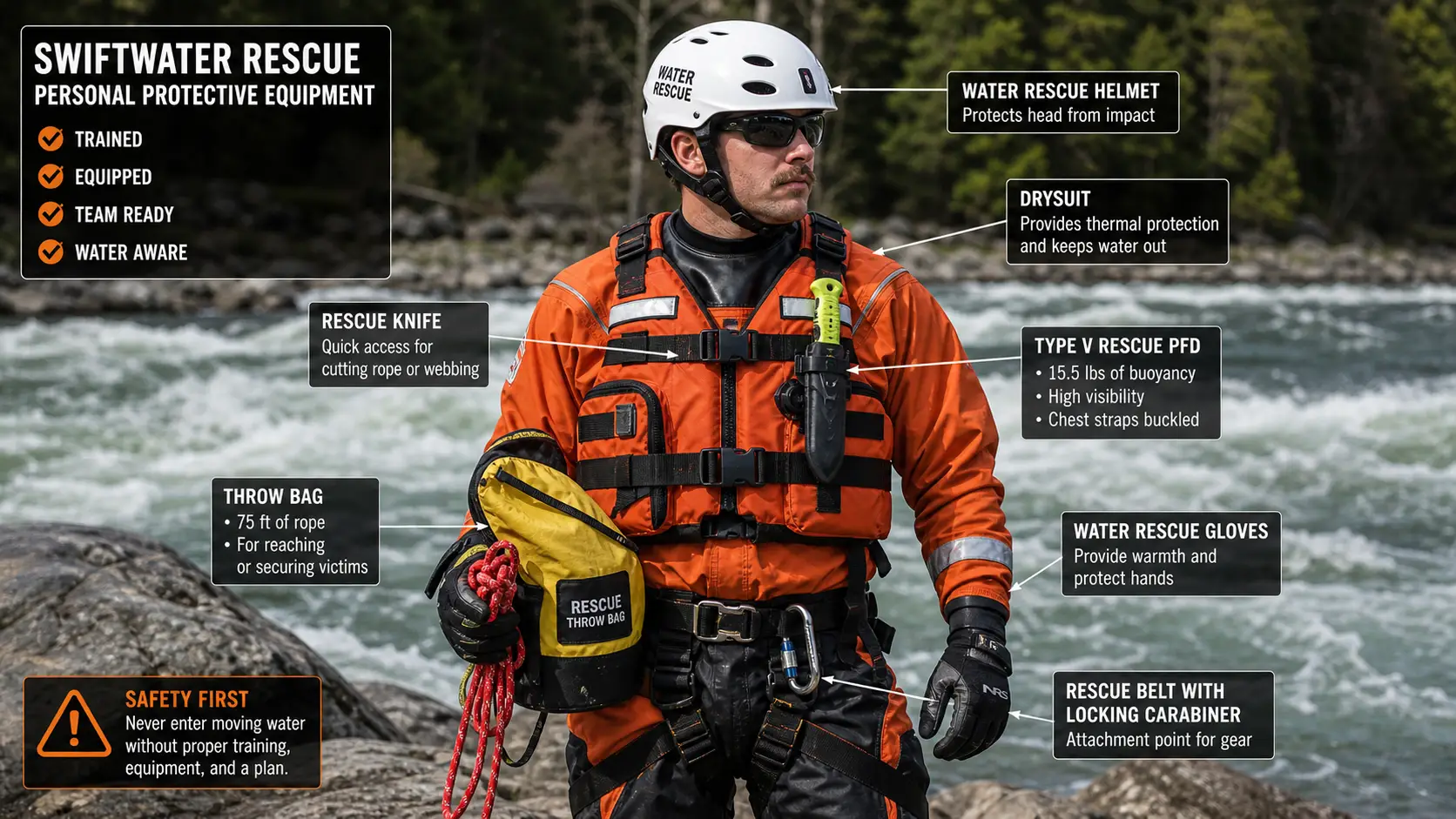
The NFPA 1670 and NFPA 1006 standard for water rescue personnel is a Type V rescue PFD — not a Type III recreational vest. Type V rescue PFDs are designed for fast-donning, high-visibility (typically orange), have integrated attachment points for tether lines, and provide a minimum of 22 pounds of buoyancy. They are also designed to be swum in — a Type III vest creates significant drag when a rescuer is actively swimming in moving water.
- ✓Type V rescue PFD (USCG-approved) for all water rescue personnel
- ✓PFD worn and properly fastened before approaching the water's edge — not carried
- ✗Structural turnout coat in water — waterlogged turnout gear adds 40+ lbs of dead weight; it will drown you
- ✗Type III recreational PFD for in-water operations
Thermal protection
Water temperature is the single most underestimated hazard at water rescue incidents. Cold shock response begins at water temperatures below 60°F. A rescuer or victim entering water at 50°F experiences immediate involuntary gasping, hyperventilation, and loss of swimming ability in 3–5 minutes. Loss of consciousness can occur within 15–30 minutes. Every water rescue PPE system must include thermal protection appropriate to the water temperature:
- Above 70°F: Wetsuit or dry suit optional but recommended for extended operations. Minimum: PFD, helmet.
- 60–70°F: 3mm wetsuit or drysuit strongly recommended. Cold shock risk is present.
- Below 60°F: Drysuit mandatory for any in-water or wading operations. 60°F water will incapacitate an unprotected rescuer in minutes.
- Below 50°F: Drysuit plus thermal underlayers. Limit in-water time. Warm-up capability on scene.
Helmet
A water rescue helmet is mandatory for any position within the swift-water hazard zone. Structural firefighting helmets are not appropriate for water rescue — they create drag, can trap the head underwater in certain positions, and do not provide the impact protection needed for collision with submerged rocks and debris. Use a purpose-built water rescue helmet with a helmet retention system appropriate for moving water.
Cutting tool
Every rescuer working in or adjacent to water must carry a knife accessible with one hand on the chest or shoulder. A rescuer entangled in rope, webbing, or debris in moving water cannot use a knife stored on a belt or in a pocket. The knife must be: accessible one-handed from the water surface, capable of cutting webbing and rope under tension, and stainless steel for corrosion resistance. A blunt-tipped rescue knife reduces accidental victim injury during entanglement cutting.
Throw bags
Every apparatus responding to water incidents should carry a minimum of two throw bags: one 50-foot bag and one 75-foot bag. Throw bag rope should be polypropylene (it floats) in high-visibility yellow, orange, or red. Inspect throw bags after every use — rope must be dried and recoiled correctly to prevent kinking and jam during the next throw. A throw bag with kinked rope will not deploy reliably under stress.
6. Flood and Submerged Vehicle Rescue
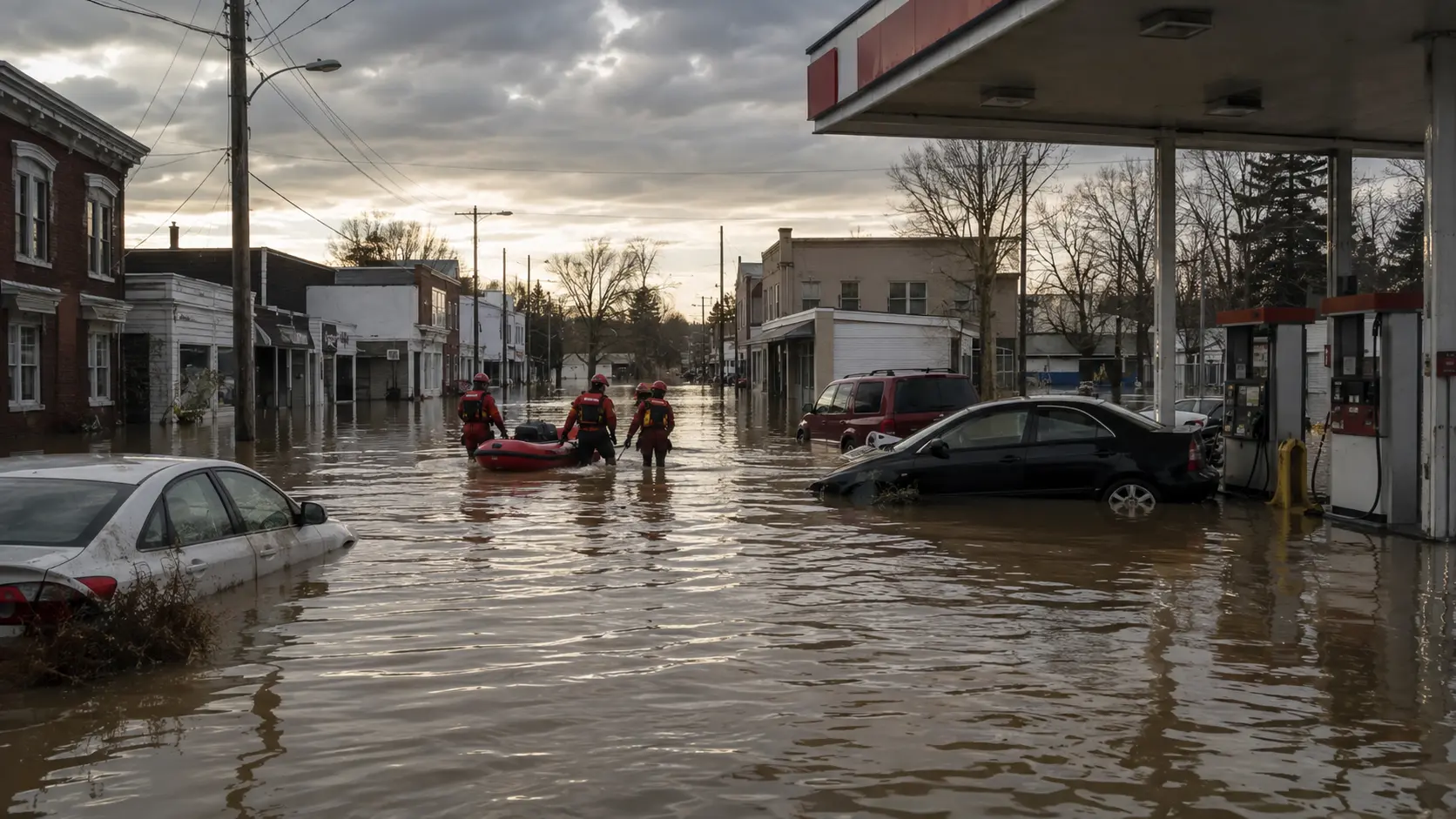
Flooded roadway and submerged vehicle incidents are the most common water rescue dispatches for structural fire departments. They occur during every significant rain event in most U.S. jurisdictions. They are also consistently fatal for both victims and responding personnel who underestimate the force of moving floodwater.
Submerged vehicle rescue
The sequence of events in a submerged vehicle rescue determines survivable time for the victim. Most vehicles will float for 30–120 seconds before beginning to sink. Once fully submerged, the vehicle equalizes pressure with the surrounding water in 1–3 minutes, after which door opening becomes possible. Victims are most at risk in the 30–90 second range as the vehicle is sinking but not yet equalized — water pressure prevents door opening, the vehicle is unstable, and panic is highest.
If the vehicle is still floating or just submerged:
Wading in flood conditions
Never wade in moving floodwater without a PFD, a probe pole, and a second rescuer holding a tether rope on shore. The probe pole (a pike pole, pike stick, or wooden pole at least 6 feet long) is used to probe ahead for hidden drains, curbs, and sudden depth changes. Move at an angle across the current — never directly into it. If swept off your feet, roll onto your back, feet downstream, toes up, and float in the defensive swimming position until you can reach an eddy or shore.
7. Incident Command at Water Rescue Emergencies
Water rescue incidents expand quickly and require ICS discipline from the first-arriving unit. A single victim in a river can rapidly become a multi-victim flood event requiring boat teams, medical, law enforcement, and mutual aid water rescue resources.
- Establish upstream and downstream lookouts immediately. A second victim, additional debris, or a dam release upstream can change the incident completely and without warning. Assign specific personnel to upstream and downstream watch and give them a radio and clear reporting criteria.
- Zone the water's edge. Establish a hot zone (water's edge and within the hydraulic hazard area — certified water rescue personnel only), warm zone (immediate shore, throw/reach rescue capable), and cold zone (staging, command, medical). This is standard technical rescue ICS adapted to water.
- Track all personnel in the water. Every rescuer who enters the water or the hot zone must be logged in and out. Personnel accountability at water incidents is harder than at structure fires because there are no walls to anchor accountability to.
- Pre-position downstream rescue. Always stage a backup rescue capability downstream before committing primary resources to a water rescue attempt. If the primary rescue fails, the victim (and possibly a rescuer) will travel downstream. Without pre-positioned downstream resources, you have no second chance.
- Request boat early. Water rescue boats take time to deploy. If there is any possibility of a boat being needed, request it on the first alarm. A boat that arrives and is not needed costs nothing. A boat that is needed and arrives 20 minutes late is a different outcome.
- Medical staging. Cold water victims require immediate medical assessment for hypothermia, near-drowning, and secondary drowning. Stage EMS inside the cold zone and brief them on cold water patient presentation before extraction is complete.
8. Water Rescue Size-Up Checklist
Use this checklist on every water rescue dispatch before and immediately after arrival:
- ✓Water type — still water, moving water, flood, coastal? Current speed estimate?
- ✓Victim location and status — conscious? Moving? Strainer/hydraulic involved?
- ✓Electrical hazards — downed power lines in or near water? Utility notified?
- ✓Low-head dam or strainer present? — upstream and downstream survey before approach
- ✓Water temperature — thermal protection required?
- ✓Crew certification level — awareness, operations, or technician? Mutual aid needed?
- ✓PFD on all personnel — before approaching water's edge
- ✓Reach/throw options staged — pole, throw bag, ring buoy
- ✓Boat requested — if current, depth, or victim position indicates
- ✓Downstream rescue positioned — before committing primary rescue
- ✓Upstream lookout assigned — radio equipped, clear reporting criteria
- ✓Medical staged — hypothermia and near-drowning protocol briefed
- ✓ICS zones established — hot/warm/cold delineated, personnel accountability active
Recommended tools for water rescue pre-planning
Use the SCBA Air Time Calculator to plan extended rescue operation air supply, and the Tanker Shuttle Calculator if water supply is needed at vehicle rescue or flood control operations in your response area. For training scheduling around water rescue drills, use the Shift Calendar Builder to coordinate multi-company training dates.
Frequently Asked Questions
How deep does water have to be to be dangerous for rescue operations?
As little as 6 inches of fast-moving water can knock an adult off their feet. Two feet of moving floodwater can carry a vehicle. Depth alone is not the hazard — it is depth combined with current velocity. Still water 10 feet deep is less immediately dangerous for a trained rescuer with a PFD than 18 inches of fast-moving floodwater. Assess depth and current velocity together, not depth alone.
What is the difference between swiftwater Operations and Technician certification?
Operations-level firefighters can perform shore-based rescue (reach and throw), wade in calm water up to 18 inches with a PFD and tether, and operate boats in non-technical water. Technician-level firefighters are certified for in-water operations in moving water, tethered rescue swimmer entry, boat operations in swiftwater, low-head dam rescue approaches, and strainer extraction. Technician certification requires 40–80+ hours of training and annual recertification in most programs.
Why is structural turnout gear dangerous in water rescue?
Structural turnout gear is designed to resist water penetration — which means it traps air initially and then absorbs water. A waterlogged turnout coat and pants can add 40–60 pounds of dead weight on a rescuer in the water, making swimming impossible and dramatically increasing drowning risk. Turnout gear also severely limits swimming mobility. Water rescue requires a Type V PFD and a wetsuit or drysuit. Never enter water in structural PPE.
What is the defensive swimming position?
The defensive swimming position is used when a rescuer or victim is swept into moving water unintentionally: roll onto your back, feet pointed downstream, toes up and out of the water, arms out to the sides for steering. This position protects your head from upstream impacts (feet hit rocks first), allows you to steer toward shore, and keeps your airway above water. Hold this position until you reach an eddy or stable shore position. Do not attempt to stand in moving water above knee depth — a foot can trap between rocks and the current will push you under.
What is secondary drowning and why does it matter post-rescue?
Secondary drowning (also called delayed drowning or dry drowning) occurs when aspirated water causes delayed pulmonary edema — fluid accumulation in the lungs — hours after the initial near-drowning event. Symptoms: persistent cough, shortness of breath, chest pain, unusual fatigue, or behavior changes in children. Any victim who aspirated water during a rescue, even if they appear fine on scene, should be transported to a hospital for evaluation. This is a non-optional medical recommendation. Deaths have occurred 24 hours after near-drowning events that appeared to be uneventful rescues.

Comments 0
No comments yet. Be the first to share your thoughts!
Leave a Comment