Firefighter Helmet Guide: Structural vs. Wildland, Styles, and How to Choose the Right One
The helmet is the most visible piece of a firefighter's personal protective equipment and one of the most personal. It protects against impact, heat, penetration, and electrical hazards — but not all helmets are equal, and the right choice depends on your type of work, your department's requirements, and your own ergonomic needs. This guide covers NFPA helmet standards, the two dominant structural helmet styles, wildland helmet options, key features to evaluate, and a side-by-side comparison of the most widely used models in the U.S. fire service.
Jump to:NFPA 1971 helmet requirements · Traditional vs. European style · Traditional (American) helmets · European (low-profile) helmets · Wildland helmets · Key features to evaluate · Model comparison · Helmet maintenance and retirement · FAQ
NFPA 1971: What the Standard Requires
NFPA 1971 (Standard on Protective Ensembles for Structural Fire Fighting and Proximity Fire Fighting) governs helmet performance for structural firefighting in the United States. Key requirements for a compliant structural helmet:
- Thermal performance: The outer shell and suspension system must resist conductive and radiant heat. The helmet must perform after radiant heat exposure at 250°C (482°F).
- Impact resistance: Must withstand impacts from above and penetration from sharp objects while protecting the head.
- Electrical resistance: The outer shell must resist electrical current (dielectric test at 30,000V for 3 minutes).
- Retention: The chin strap system must retain the helmet on the head under impact and during inversion.
- Eye protection integration: Must accommodate a face shield or goggles compliant with ANSI Z87.1.
Look for the NFPA 1971 certification mark on any helmet purchased for structural firefighting. Helmets not bearing this certification should not be used for interior structural fire operations regardless of their appearance.
NFPA 1971 is updated periodically. The 2018 and 2023 editions added specific requirements for earflap attachment, face shield performance, and retroreflective trim. When purchasing a new helmet, confirm it meets the current edition your department has adopted.
The Two Structural Helmet Styles: An Overview
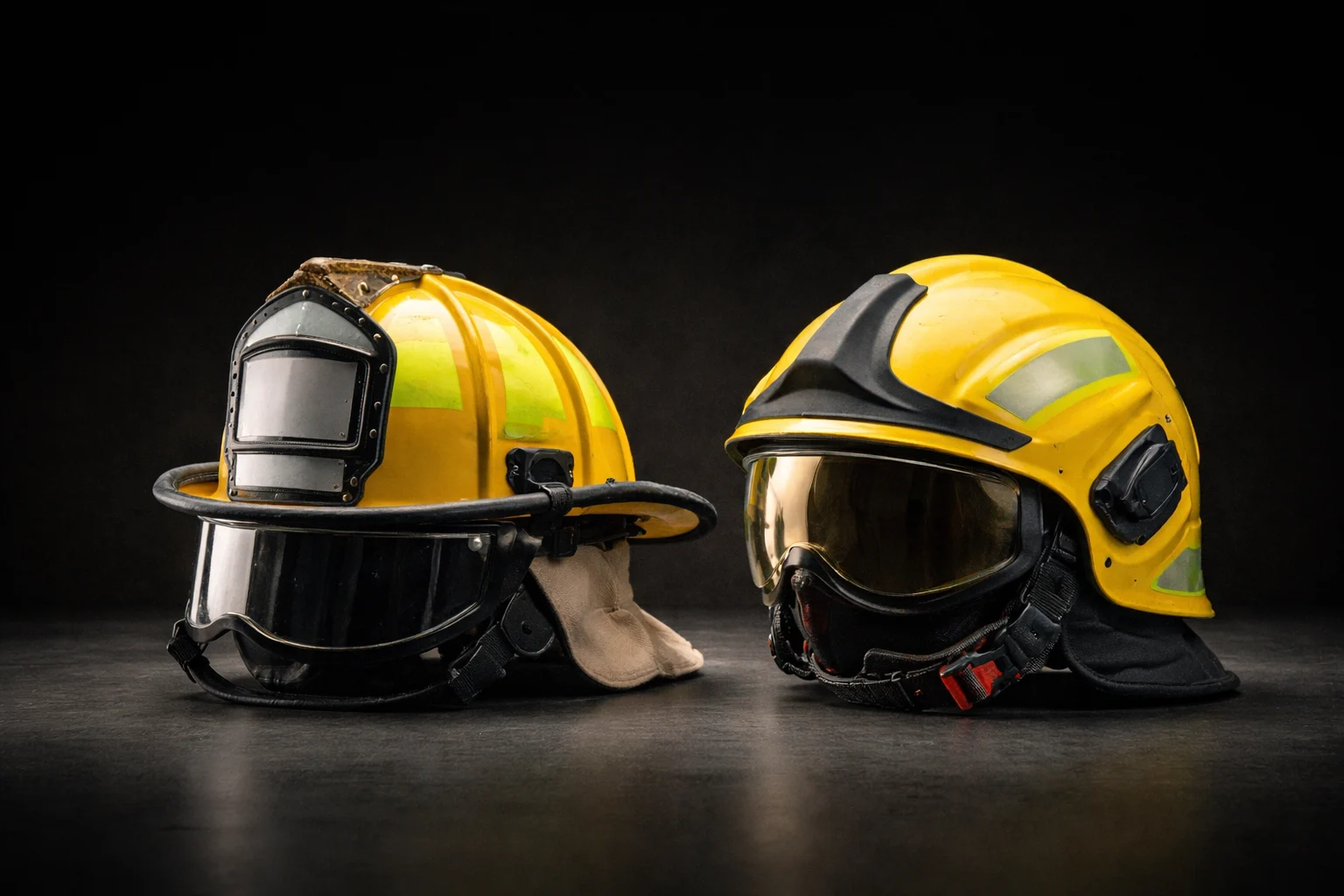
Two fundamentally different helmet designs dominate the U.S. structural fire service. Both meet NFPA 1971 when certified, but they differ substantially in profile, balance, visibility, and tradition:
| Traditional (American) | European (Low-profile) | |
|---|---|---|
| Profile | High crown; wide brim; prominent front and rear brim | Low-profile; compact; close to the head |
| Brim function | Rear brim directs water and debris away from collar; front brim provides sun/debris protection | Shorter or no rear brim; relies on hood and SCBA collar for water management |
| Weight | Typically heavier (1,200–1,800g) | Typically lighter (900–1,400g) |
| Balance | Brim weight can cause forward or backward tilt under certain conditions | More centered center of gravity; less neck fatigue |
| Fitting with SCBA | Wider brim can interfere with SCBA harness straps in some configurations | Generally easier fit with SCBA and PAPR systems |
| Hearing protection | Earflaps standard; wide brim provides some ambient noise blocking | Integrated ear cups or earflap accessories |
| Cultural tradition | Deeply embedded in U.S. fire service identity; significant generational preference | Growing adoption; common in urban departments and career fire |
Traditional (American) Style Helmets
The traditional American firefighter helmet traces its design lineage to the Cairns leather helmet of the mid-1800s. The distinctive high crown, wide brim, and earflap design is immediately recognizable and culturally significant in the U.S. fire service. Modern traditional helmets are made from thermoplastic or fiberglass composites rather than leather, but the silhouette is preserved.
Cairns 1010 Traditional Composite
Manufacturer: MSA Safety (Cairns)
Shell material: Thermoplastic composite
Weight: Approximately 1,560g with face shield and earflaps
Standout feature: The most widely issued traditional helmet in the U.S. fire service. High-impact thermoplastic shell; 4-point suspension; integrated earflaps; accepts Cairns or aftermarket face shields. Available in multiple colors for rank designation. Cost: $200–$280.
Best for: Departments that want proven traditional design at a moderate price point.
Cairns 1010 Leatherhead
Manufacturer: MSA Safety (Cairns)
Shell material: Genuine leather
Weight: Approximately 1,700–1,900g depending on leather thickness
Standout feature: Traditional aesthetic with real leather shell. Some departments still issue leather helmets for chiefs or honor guard; most operational use has transitioned to composite. Leather helmets require more maintenance (conditioning, drying) and are heavier than composite. Cost: $400–$700+.
Best for: Honor guard, ceremonial use, tradition-focused departments.
Bullard FH2100
Manufacturer: Bullard
Shell material: Fiberglass reinforced composite
Weight: Approximately 1,500g
Standout feature: Fiberglass shell construction for superior heat and impact resistance. Six-point suspension system for improved fit stability. Integrated face shield storage. NFPA 1971 certified. Slightly lighter than comparable thermoplastic models. Cost: $300–$400.
Best for: Firefighters who want traditional style with premium materials.
Pacific Helmets R6
Manufacturer: Pacific Helmets (New Zealand)
Shell material: Fiberglass composite
Weight: Approximately 1,400g
Standout feature: Hybrid profile between traditional and European — has a rear brim but lower crown than Cairns-style helmets. Popular in West Coast departments. Excellent face shield integration. NFPA 1971 certified. Cost: $350–$500.
Best for: Firefighters who want traditional brim protection but lighter weight and lower profile.
European (Low-Profile) Helmets
European-style structural firefighting helmets have steadily gained adoption in the U.S. fire service over the past two decades. Their lower center of gravity, lighter weight, and compatibility with modern SCBA and communication systems have made them the preferred choice for many career and urban departments.
MSA Gallet F1 XF
Manufacturer: MSA Safety (Gallet)
Shell material: Fiberglass composite
Weight: Approximately 1,350g
Standout feature: Modular design with integrated face shield that flips up and locks in the open or closed position. Excellent SCBA compatibility; used extensively with MSA SCBA systems. Integrated hearing protection earflaps. High visibility retroreflective trim. NFPA 1971 certified. Cost: $400–$600.
Best for: Departments with MSA SCBA systems; urban career departments prioritizing ergonomics and weight.
Dräger HPS 7000
Manufacturer: Dräger
Shell material: Thermoplastic/composite hybrid
Weight: Approximately 1,200g
Standout feature: Among the lightest certified structural helmets available. Integrated face shield system with quick flip mechanism. Designed for Dräger SCBA compatibility. Chin strap integrates with SCBA head harness adjustment. NFPA 1971 certified. Cost: $500–$700.
Best for: Departments with Dräger SCBA; weight-conscious firefighters; high-workload environments where neck fatigue matters.
Globe GR-36S
Manufacturer: Globe Manufacturing
Shell material: Fiberglass composite
Weight: Approximately 1,300g
Standout feature: American-made European-style helmet. Six-point suspension with adjustable fit. Integrated face shield; accepts aftermarket accessories. Increasingly common in departments that purchase Globe turnout gear as a matched PPE system. NFPA 1971 certified. Cost: $350–$500.
Best for: Departments purchasing Globe PPE systems; firefighters who want domestic manufacturing.
Wildland Firefighting Helmets
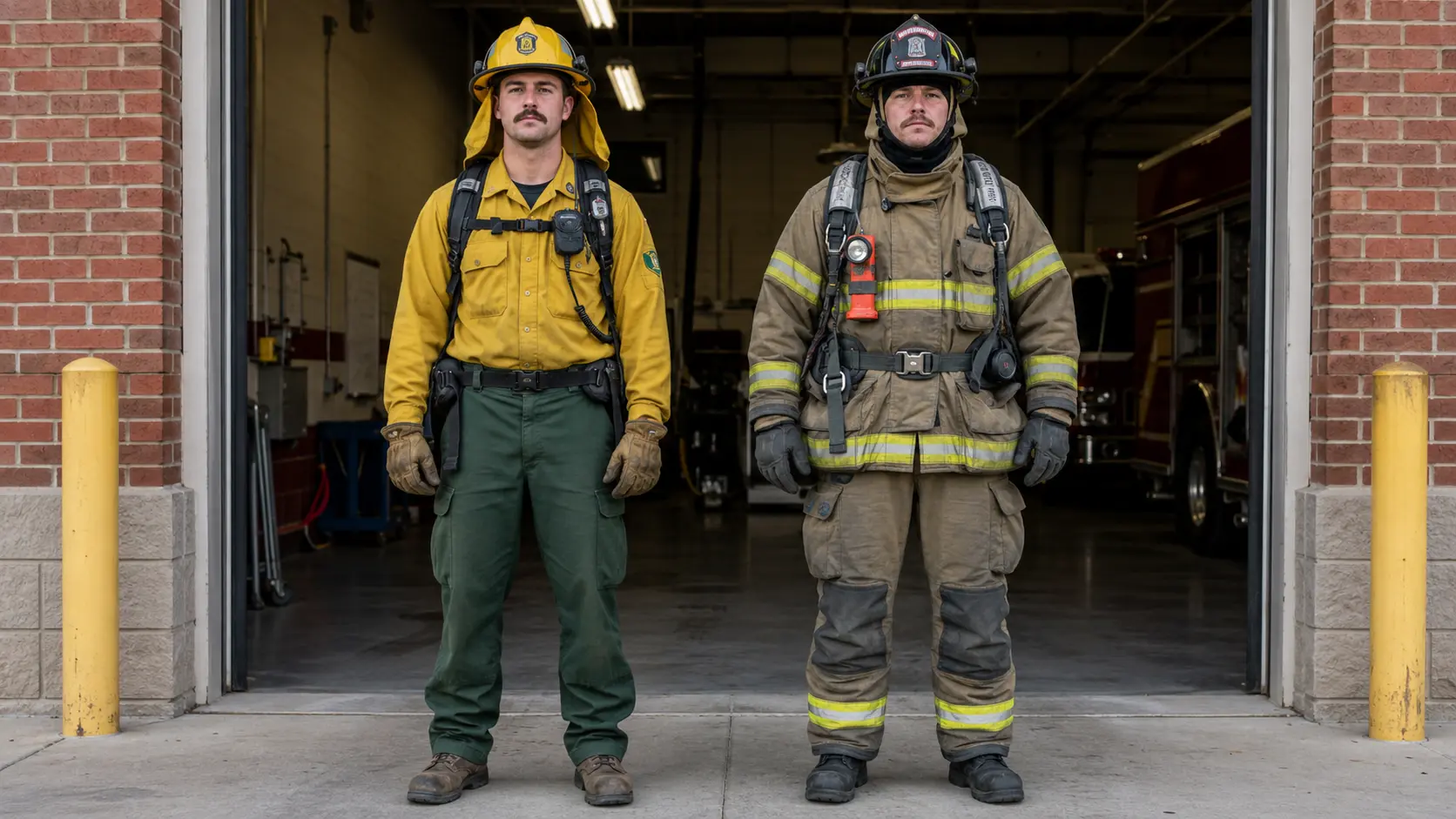
Wildland firefighting helmets are governed by a different standard: NFPA 1977 (Standard on Protective Clothing and Equipment for Wildland Fire Fighting). They are designed for different hazards than structural helmets — primarily ember contact, falling debris, and sun/heat exposure during extended outdoor operations. Wildland helmets should NOT be used for structural interior operations.
Bullard LT47 (Wildland)
Standard: NFPA 1977 certified
Shell material: High-density polyethylene
Weight: Approximately 400g (extremely light)
Standout feature: The most widely issued wildland helmet in the U.S. federal fire service. Available in orange (entry-level) and white (supervisory). Brim design protects from sun and falling embers. Simple suspension system. Accepts face shield. Cost: $50–$80.
Best for: All wildland fire operations; seasonal wildland positions; crew members on federal contracts.
Honeywell (Fibre-Metal) E2 Wildland
Standard: NFPA 1977 certified
Shell material: Fiberglass
Weight: Approximately 500g
Standout feature: Fiberglass shell offers better heat resistance than HDPE wildland helmets. More durable over extended deployments. More expensive than the standard LT47. Cost: $120–$180.
Best for: Experienced wildland firefighters who want premium materials for extended season use.
Key Features to Evaluate When Choosing a Helmet
Suspension system and fit
The suspension system determines how the helmet sits on your head, how it distributes weight, and how securely it stays in place during movement and impact. A 4-point suspension contacts the head at four points; a 6-point system at six. More contact points generally mean better load distribution and less rocking. Try the helmet on with your SCBA harness in place — a helmet that fits well without the harness may sit too high or tilt when the SCBA head straps are tightened.
Face shield integration
Face shields are required by NFPA 1971 but vary in quality, clarity, and ease of operation. Key questions: Does the shield flip up and lock securely? Can it be operated with gloves on? Does it fog in high-humidity or high-temperature environments? Some helmets accept only the manufacturer's face shield; others accept standard ANSI Z87.1 shields from multiple suppliers.
Earflap design
Earflaps protect the ears, neck, and jaw from heat and debris. The connection method matters: velcro-attached earflaps can separate under traction; snap or integral connections are more reliable under stress. Earflap thickness and material affect hearing (thicker earflaps attenuate ambient sound more, which can be a safety issue) and thermal protection.
Weight and balance
Helmet weight is cumulative over a shift. A helmet that weighs 300g more than an alternative adds meaningful neck and shoulder fatigue over a 24-hour shift and across a career. More important than absolute weight is balance — a helmet with a low center of gravity over the head stays in place better and tires the neck less than a heavy-browed helmet of equal total weight.
SCBA compatibility
If your department uses a specific SCBA brand, test the helmet with that SCBA before purchasing. The SCBA head straps, frame, and cylinder position interact with the helmet brim, earflaps, and suspension. Some helmet-SCBA combinations require adaptation; others fit naturally.
Retroreflective trim
NFPA 1971 requires retroreflective trim on structural helmets for visibility in low-light conditions. Check that the trim coverage on any candidate helmet meets your department's requirements and that the trim is securely attached (not peeling or cracked on display models).
Model Comparison Table
| Model | Style | Shell | Weight | Price | Best for |
|---|---|---|---|---|---|
| Cairns 1010 Composite | Traditional | Thermoplastic | ~1,560g | $200–$280 | Budget-conscious; traditional preference |
| Bullard FH2100 | Traditional | Fiberglass | ~1,500g | $300–$400 | Traditional style + premium materials |
| Pacific R6 | Hybrid | Fiberglass | ~1,400g | $350–$500 | West Coast; lighter traditional feel |
| MSA Gallet F1 XF | European | Fiberglass | ~1,350g | $400–$600 | MSA SCBA users; urban career |
| Globe GR-36S | European | Fiberglass | ~1,300g | $350–$500 | Globe PPE system match; domestic mfg |
| Dräger HPS 7000 | European | Composite | ~1,200g | $500–$700 | Dräger SCBA users; lightest option |
| Bullard LT47 | Wildland | HDPE | ~400g | $50–$80 | All wildland operations |
Helmet Maintenance and Retirement
A helmet is only as protective as its condition allows. Key maintenance practices:
- Clean after every fire. Soot and contaminants (including carcinogens from combustion products) accumulate on the shell, suspension, and earflaps. Wipe down with warm water and mild soap. Do not use harsh solvents that can degrade thermoplastic shells.
- Inspect the shell for cracks, deformation, and surface damage after every impact. A visible crack compromises structural integrity and indicates the helmet should be retired. Shell deformation from heat exposure (warping, discoloration) also warrants replacement.
- Inspect the suspension for wear and elasticity. A worn or stretched suspension may no longer provide the designed fit and energy absorption. Replace suspension components per manufacturer schedule (typically every 5 years).
- Replace the shell per manufacturer recommendations. Most manufacturers recommend retiring structural helmet shells every 10 years from date of manufacture (not purchase). The manufacture date is typically stamped inside the shell. Older shells may have degraded thermal performance even without visible damage.
- Never paint a structural helmet. Paint can mask shell damage, conduct electricity, and degrade the shell material with chemical solvents in the paint. Stickers are acceptable if they do not cover damage; solvent-based adhesives can degrade thermoplastic shells.
Frequently Asked Questions
What standard do firefighter helmets have to meet?
Structural firefighting helmets in the United States must meet NFPA 1971, Standard on Protective Ensembles for Structural Fire Fighting and Proximity Fire Fighting. Wildland firefighting helmets must meet NFPA 1977. The certifying organization tests the helmet against the standard and applies a certification mark. Do not use a non-certified helmet for interior structural operations.
What is the difference between a traditional and European firefighter helmet?
Traditional (American) helmets have a high crown, wide front and rear brim, and earflaps — a design tracing back to 19th century leather helmets. European (low-profile) helmets have a compact, close-fitting shell with an integrated face shield and no or minimal brim. European helmets are lighter and generally better-integrated with modern SCBA systems; traditional helmets have strong cultural tradition and the rear brim provides water and debris deflection at the collar.
How long does a firefighter helmet last?
Most manufacturers recommend retiring the helmet shell after 10 years from the date of manufacture. Suspension components typically should be replaced every 5 years. Any helmet that has been in a significant impact, exposed to extreme heat that caused deformation or discoloration, or shows any shell cracking should be retired immediately regardless of age.
Can a wildland helmet be used for structural firefighting?
No. Wildland helmets (NFPA 1977) are not rated for the thermal exposures of structural interior firefighting. They have significantly less heat resistance than NFPA 1971 structural helmets. Using a wildland helmet for interior structural operations is a serious safety violation.

Comments 0
No comments yet. Be the first to share your thoughts!
Leave a Comment