
MAYDAY and Firefighter Survival: When to Call, What to Say, and How to Survive
MAYDAY is the most important radio transmission a firefighter will ever make — and the one most firefighters hesitate to make when they need it. The hesitation kills people. Studies of firefighter LODD incidents consistently show that firefighters wait too long to declare MAYDAY: they try to self-rescue first, they worry about embarrassment, they do not want to disrupt the operation. By the time the MAYDAY is transmitted, the window for survival has narrowed dangerously. This guide covers the complete firefighter survival system: when to call MAYDAY, how to transmit it, what happens after, and the self-rescue techniques that buy time while RIT responds.
Jump to:When to call MAYDAY · LUNAR transmission · How to transmit · What happens after · RIT operations · Survival techniques · Wire entanglement · Low air / air management · Disorientation · FAQ
The single most important rule: Declare MAYDAY early. The moment you recognize you are in a situation you cannot resolve by yourself in the next 30–60 seconds, transmit the MAYDAY. Waiting costs you the time RIT needs to reach you.
When to Call MAYDAY: The Conditions
Any of the following conditions requires an immediate MAYDAY transmission. These are not situations to attempt to resolve before calling — call first, then work the problem:
- Lost or disoriented — you do not know where you are relative to egress and cannot determine it within seconds
- Trapped — structural collapse, debris, entanglement, or any physical barrier you cannot clear without assistance
- Low-air alarm activated — your SCBA low-air alarm is sounding and you cannot confirm you can reach egress before the cylinder empties
- Air supply failure — regulator malfunction, cylinder damage, or any condition where you are not receiving adequate air
- Injured — any injury that impairs your ability to self-rescue (fall, burn, cardiac event, any incapacitation)
- Fell through floor or roof — any structural failure that has changed your location
- PASS device activating on a crew member — another firefighter's PASS is alarming and they are unresponsive
There is no penalty for an unnecessary MAYDAY. If you call MAYDAY and self-rescue before RIT reaches you, that is a good outcome. If you do not call MAYDAY and you cannot self-rescue, that is a LODD. The cost of a false MAYDAY is temporary disruption; the cost of a delayed MAYDAY can be a life.
LUNAR: The MAYDAY Transmission Framework
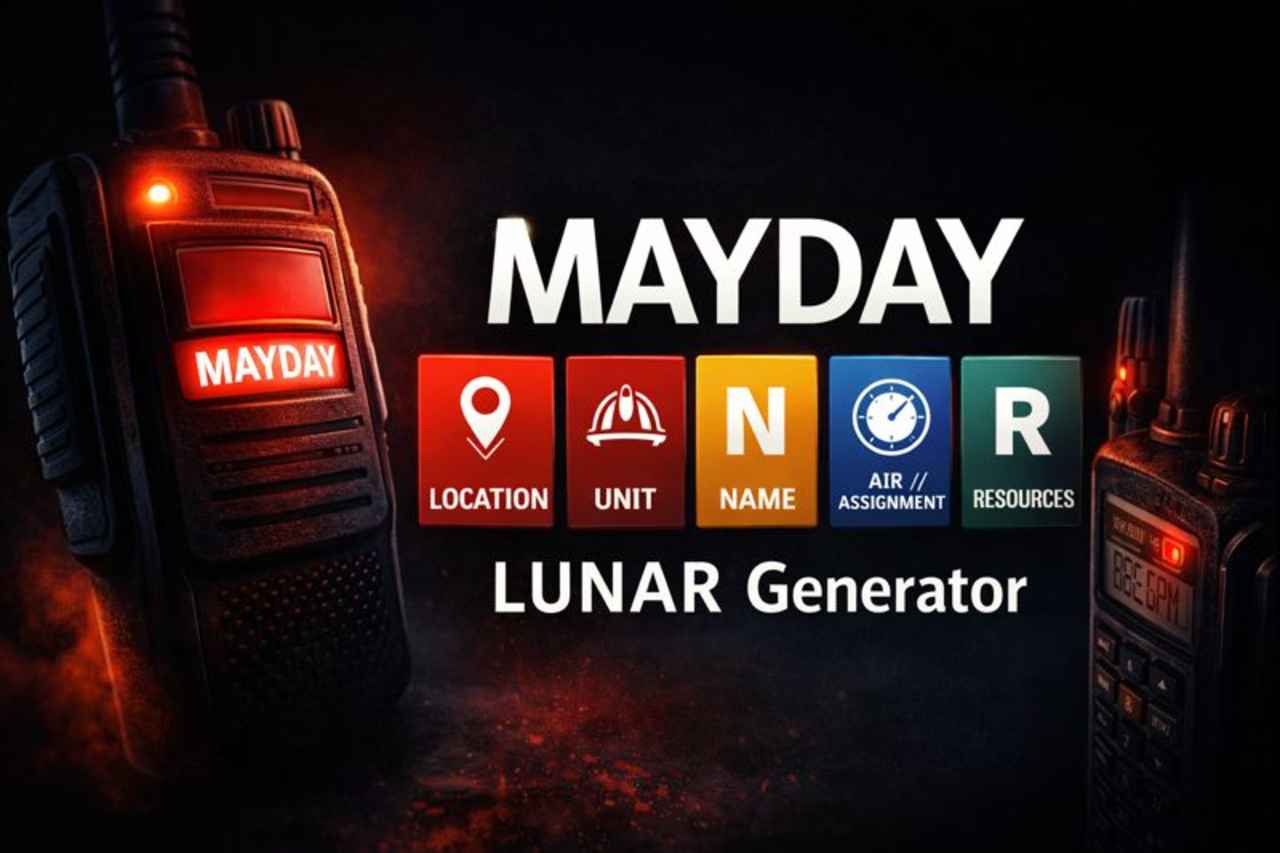
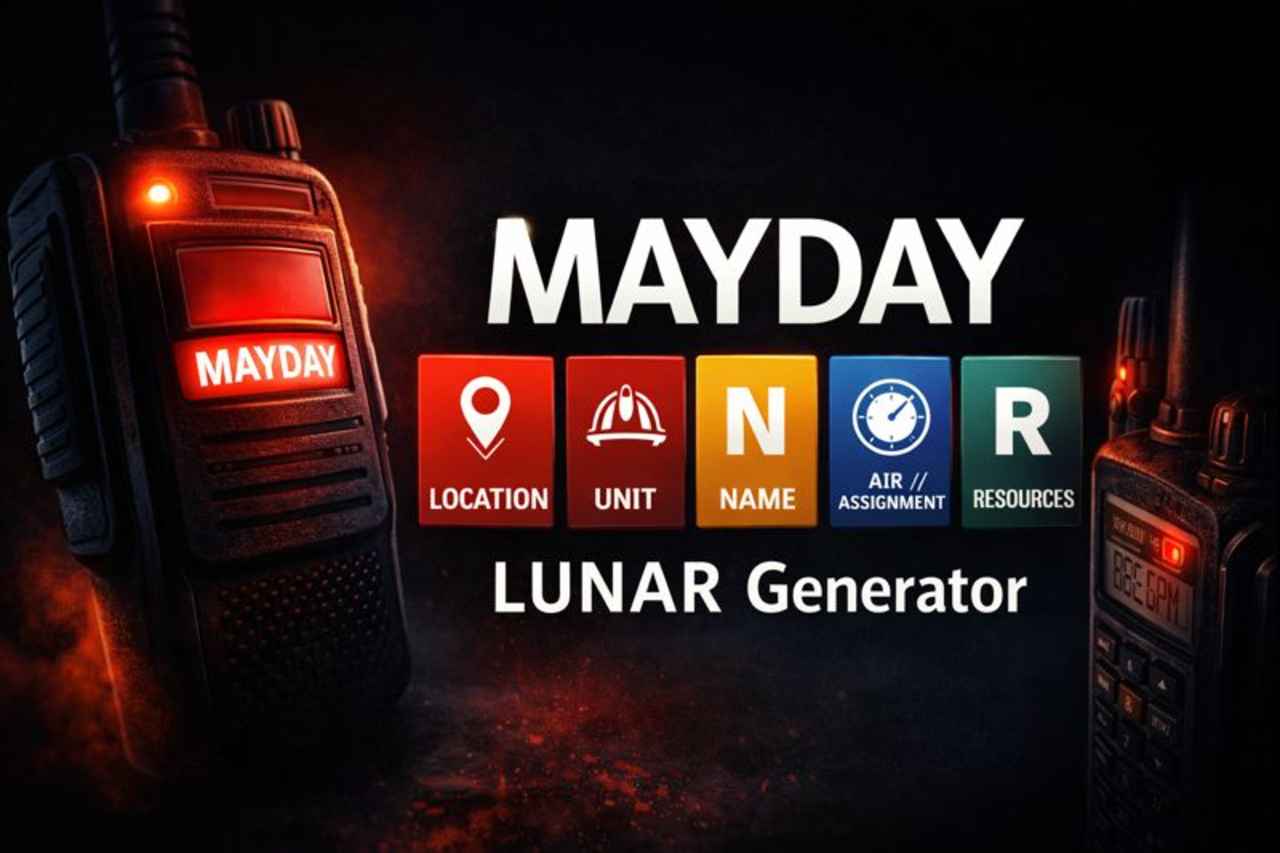
LUNAR gives your MAYDAY message the information command and RIT need to find you and help you. Every MAYDAY transmission should include all five elements. Practice building a complete LUNAR message in under 15 seconds.
| Letter | Stands for | What to say | Example |
|---|---|---|---|
| L | Location | As specific as possible: floor, room, window, landmark, sector | "Second floor, northwest bedroom, window facing Oak Street" |
| U | Unit | Your company name and number | "Engine 3" |
| N | Name | Your name | "Firefighter Johnson" |
| A | Air | Remaining air in PSI or alarm status | "Low-air alarm activated, approximately 800 PSI" |
| R | Resources needed | What help do you need: RIT, medical, air resupply, tool | "RIT response, trapped under debris, unable to self-rescue" |
Example complete MAYDAY transmission
"MAYDAY MAYDAY MAYDAY — Engine 3, Firefighter Johnson, second floor northwest bedroom window facing Oak Street, low-air alarm activated 800 PSI, trapped under collapsed ceiling, need RIT immediately."
Use the MAYDAY LUNAR Generator to build and practice complete MAYDAY transmissions for your specific scenarios before you need them at a working fire.
How to Transmit: Radio Procedures
A MAYDAY transmission is done in a specific way to ensure it cuts through all other radio traffic:
If your radio fails: Activate PASS manually. Bang on the floor, walls, and pipes with your tool — sound travels through structure. Move toward windows and make visual signals. Do not stop making noise.
What Happens After MAYDAY Is Declared
When a MAYDAY is transmitted, command immediately:
- Clears the radio channel. "All units hold radio traffic, MAYDAY in progress." All non-emergency transmissions stop.
- Acknowledges the MAYDAY crew. "Engine 3, command acknowledges your MAYDAY. RIT is activating."
- Activates the RIT. The Rapid Intervention Team deploys toward the last known location of the MAYDAY firefighter.
- Requests additional resources. MAYDAY automatically triggers at minimum one additional alarm. Additional engines, medical, air resupply, and command support are requested.
- Reassigns companies as needed. Attack companies may be redirected to protect the MAYDAY firefighter's location. Non-essential operations may be suspended.
- Maintains communication with the MAYDAY firefighter. Command continues to communicate with the firefighter to track location changes, air status, and condition.
Rapid Intervention Team (RIT): What They Do
The RIT (also called RIC — Rapid Intervention Crew) is a dedicated team staged and ready to rescue a trapped or injured firefighter. NFPA 1710 and 1720 require an RIT to be in place before interior operations begin at any structure fire.
RIT requirements
- Minimum of two personnel assigned exclusively to RIT — not performing other tasks
- Fully equipped with SCBA, tools, and spare SCBA cylinder or air resupply equipment
- Staged at or near the primary entry point, ready for immediate deployment
- Briefed on the building layout, crews operating inside, and their entry points
RIT tools and equipment
| Tool | Purpose |
|---|---|
| RIT pack / air resupply bottle | Connect to a trapped firefighter's SCBA for emergency air resupply |
| Halligan bar and flat axe | Forcible entry to reach the firefighter; debris removal |
| Charged hoseline (pre-connected) | Protection from fire during RIT operations |
| TIC (thermal imaging camera) | Locate the downed firefighter in zero visibility |
| Search rope | Orientation during RIT search; track path back to egress |
| Stokes basket or drag device | Victim packaging for stairwell removal |
| Webbing | Drag harness for victim removal |
| Bolt cutters / wire cutters | Entanglement removal |
Survival Techniques While Awaiting RIT
From the moment you declare MAYDAY until RIT reaches you, your job is to survive and communicate. The actions that maximize your survival probability:
Conserve air immediately
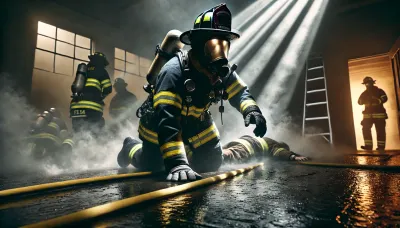
The moment you recognize a survival emergency, reduce physical activity to the absolute minimum. Stop all unnecessary movement. Get to the floor. Control your breathing. Every breath you conserve extends the time RIT has to reach you. Heavy exertion at 80+ L/min RMV empties an SCBA cylinder in minutes; controlled rest at 20–30 L/min can triple your remaining time.
Stay in communication
Maintain radio contact with command. Update your location if it changes. Report your air status every time you are asked. If your radio fails, create noise: bang on pipes, floors, and walls with your tool at regular intervals. The PASS alarm is also your beacon — do not muffle it.
Create a survivable space
In a collapse, push debris away from your face and chest to create a small breathing space. Even a few inches of clearance prevents crush asphyxia. In a room with fire, close the door between you and the fire. Reduce your exposure to heat by staying low and moving to an exterior wall where possible.
Signal your location
Activate your PASS manually. Use your radio. Use your tool to make sound. If you can reach a window, break it — both to signal your location and to access fresh air. Light from your SCBA or radio can be visible in smoke.
Wire Entanglement Survival
Wire entanglement is one of the most common firefighter survival situations. Panic and thrashing tighten the entanglement and drain air. The correct response:
- Stop immediately. No movement until you assess what is entangled and where.
- Reduce air consumption. Slow breathing. You need time to solve the problem methodically.
- Identify the entanglement point. Where is the wire? Your SCBA cylinder, facepiece straps, coat, boots?
- Back out the way you came. Most wire entanglement reverses by retreating. Your hose line tells you which direction is out.
- If backing out fails, call MAYDAY. Do not exhaust yourself. Transmit MAYDAY, activate PASS, stay still, and wait for RIT.
Low Air and Air Management Survival
Air management begins before you enter the building, not when the alarm sounds. The standard air management rule: use no more than one-third of your air supply to advance, maintain one-third to work, and retain one-third to exit. When the low-air alarm activates:
- Reduce activity immediately — stop all exertion
- Transmit MAYDAY immediately if you cannot confirm egress within the remaining air
- Follow the ROAM protocol: Reduce consumption, Orient to egress, Activate PASS, Move while communicating
- If you reach a window before air runs out: break it, take a breath of outside air, and signal for a ladder
- If you run out of air completely: remove the regulator and breathe from the facepiece seal gap (filter breathing) — toxic but may provide seconds to reach egress
Emergency filter breathing buys seconds, not minutes. Breathing around a facepiece seal in a smoke-filled environment is a last resort that delivers carbon monoxide and combustion products directly to your lungs. Use it only to cover the final seconds to a window or door, not as a work-around for running out of air.
Disorientation and Getting Found
Disorientation inside a burning structure is immediately life-threatening. When you lose your orientation:
- Stop moving. Random movement in a disoriented state carries you deeper into the structure or toward the fire.
- Find a wall. Any wall. Follow it. Walls lead to corners; corners lead to doors and windows.
- Find the hose line. Feel the couplings to determine direction: smooth (female) = toward the pump and egress; ribbed (male) = toward the nozzle.
- Move toward light or cooler air. Exterior windows admit cooler air and ambient light even in heavy smoke. TIC can show windows as cool rectangles.
- Listen for sounds. Traffic, crew voices, generator noise from outside all indicate the direction of the exterior.
- Declare MAYDAY. If you cannot determine egress direction within 30 seconds, transmit MAYDAY. Give command your last known location and activate PASS.
Frequently Asked Questions
When should a firefighter call MAYDAY?
Immediately upon recognizing any of these conditions: lost or disoriented, trapped, low-air alarm with uncertain egress, air supply failure, injury that impairs self-rescue, structural failure that changed your location, or another firefighter's PASS alarming without response. Call early — waiting until the situation is desperate reduces the time RIT has to respond.
What does LUNAR stand for in a MAYDAY?
Location, Unit, Name, Air, Resources needed. LUNAR is the framework for a complete MAYDAY transmission that gives command and RIT the information they need to find you and help you. Practice building a complete LUNAR message in under 15 seconds before you need it at a fire.
What is the RIT in firefighting?
The Rapid Intervention Team (RIT) or Rapid Intervention Crew (RIC) is a dedicated, fully equipped team staged at a structure fire exclusively to rescue a trapped or downed firefighter. NFPA 1710 and 1720 require an RIT to be in place before interior operations begin. The RIT does not perform any other fireground function — they exist solely to rescue their crew members if a MAYDAY is declared.
What does a firefighter do when lost inside a burning building?
Stop moving immediately. Find a wall and follow it to a door or window. Feel hose line couplings to determine direction to egress. Move toward cooler air or light. Transmit MAYDAY if egress cannot be determined within 30 seconds. Activate PASS, maintain radio communication, and continue making audible signals while awaiting RIT.

Comments 0
No comments yet. Be the first to share your thoughts!
Leave a Comment