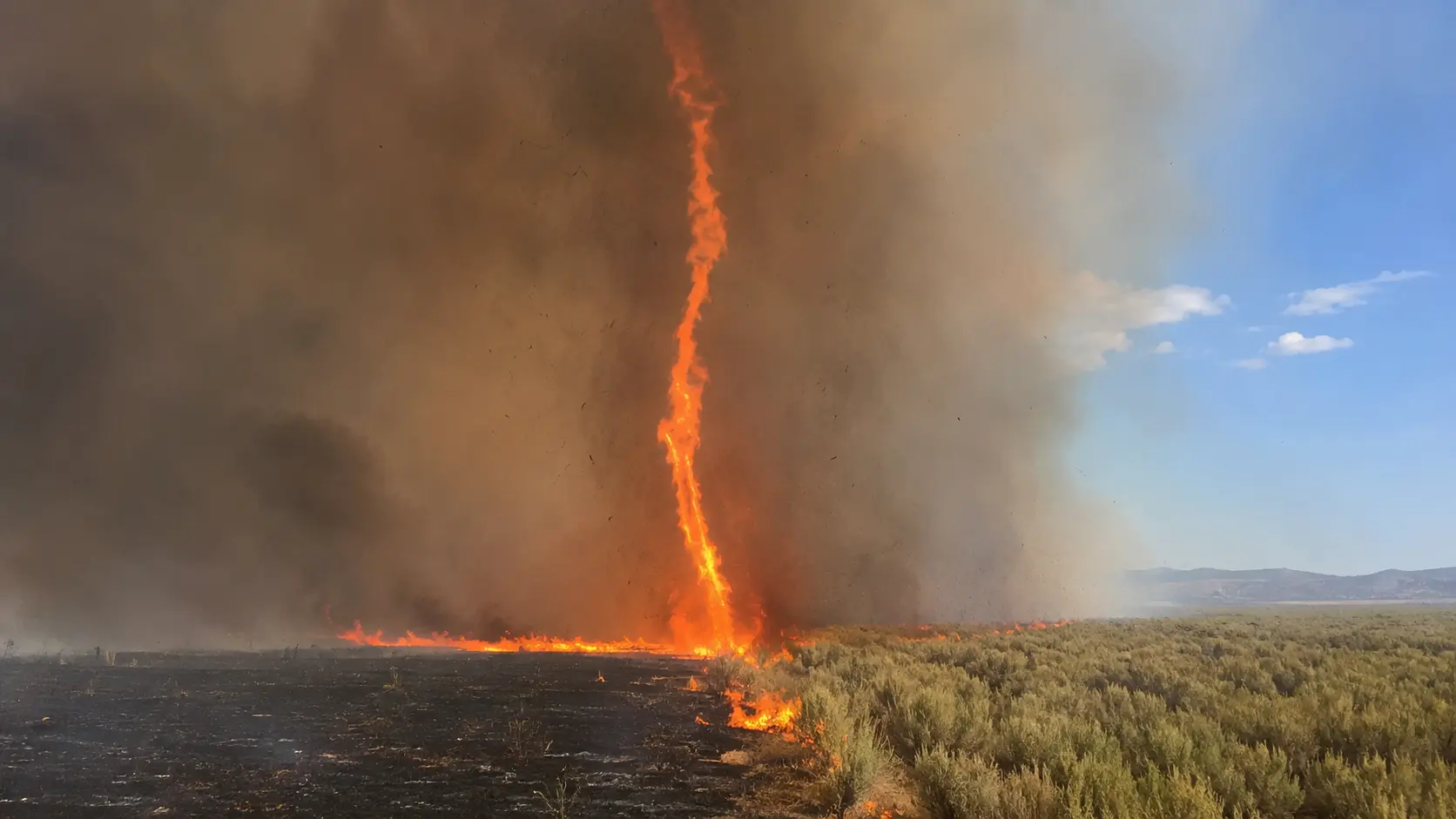
Most fire whirls are small — a spinning column of hot gas and flame at the edge of a fire that persists for seconds to minutes and has a diameter measured in feet. They are common enough in significant wildland fires that experienced crews treat them as a routine observation, something to note and stay away from but not a tactical emergency in most cases.
Then there is the 2018 Carr Fire near Redding, California, which produced a convective vortex that the National Weather Service subsequently classified as a fire tornado — the first confirmed example in American fire history. It reached winds of 143 mph, produced an EF3 tornado-level debris field, lofted burning material for miles, and killed a firefighter and a bulldozer operator who were working in its path before anyone fully understood what was happening. It was not a normal fire whirl.
The spectrum between these two events covers the full range of fire vortex phenomena — from the tiny whirls at a brush fire edge to the thermodynamically extreme events that behave more like atmospheric tornadoes than like fire features.
In this article:
How Fire Whirls Form
A fire whirl forms through the interaction of two atmospheric mechanics: a strong convective updraft from intense fire burning, and horizontal wind shear — a change in wind speed or direction with horizontal distance across the fire area. The same basic physics produces dust devils in hot, calm conditions: a spinning column develops when horizontal vorticity in the atmospheric boundary layer is tilted into the vertical plane by a convective updraft.
In a wildfire setting, the convective updraft is provided by the fire's intense heat release — a large, intensely burning fire produces a powerful column of rising hot air that can draw surface air from all directions. The horizontal wind shear is provided by the boundary between the fire-affected air (which is being drawn inward and upward) and the surrounding air (which is moving in ambient wind conditions). Where these two flow patterns interact — typically at the edges of the fire, at terrain features that create flow separation, or along the boundary between burned and unburned areas — the conditions for vortex formation exist.
When a rotating horizontal air mass is caught by the convective updraft and tilted to vertical, the conservation of angular momentum causes it to spin faster as it is stretched vertically by the ascending air — the same principle that makes a figure skater spin faster when they pull their arms in. The result is a rotating column of hot gas that, depending on its proximity to the fire, draws burning material into itself and becomes a column of rotating flame.
The Fire Whirl Spectrum: Small to Extreme
Fire whirls exist on a broad scale. Small fire whirls — columns of a few feet in diameter, lasting seconds to minutes, visible as spinning smoke columns at the fire edge — are common at any significant fire and pose limited direct hazard beyond their local spotting contribution. They are observed routinely, noted in fire behavior reports, and avoided by crews who see them, but they do not require tactical redirection in most circumstances.
Moderate fire whirls — 10 to 100 feet in diameter, sustained for minutes, with flame heights significantly greater than the surrounding fire — can carry burning debris for hundreds of feet and create spotting conditions that complicate line construction. Experienced fire managers include observed whirl activity in their fire behavior assessment and use it as an indicator of unstable convective conditions that may be developing toward more extreme behavior.
Large, sustained fire whirls — diameters of hundreds of feet, sustained for many minutes, associated with extreme fire behavior during large-fire events — are a significant tactical hazard. They generate their own wind field, carry burning material long distances, and can overwhelm crew positions that seemed safe given the main fire's behavior. Several firefighter fatalities over the decades have been associated with fire whirl activity that was not anticipated based on the main fire's apparent behavior.
What Makes a Fire Tornado Different from a Fire Whirl
The distinction between a fire whirl and a fire tornado is not merely a matter of scale — it is a difference in the physical mechanism driving the rotation. A fire whirl is driven entirely by the fire's own convective column — it is a fire-generated phenomenon, dependent on fire heat for its existence and energy. Remove the fire and the whirl dissipates.
A fire tornado involves the coupling of the fire's convective column with a pre-existing atmospheric rotation — a mesocyclone or a strong vortex in the ambient atmosphere that is then intensified and reorganized by the fire's thermal energy. The resulting system is not just a strong fire whirl — it is a partially self-sustaining vortex that draws energy from both the fire's convection and the atmospheric rotation. It behaves more like a conventional tornado in its dynamics and its destructive capability.
The classification distinction matters scientifically and practically. A fire whirl weakens and dies if the fire intensity drops — cooling the convective column removes its energy source. A fire tornado can maintain rotation even if fire intensity varies, because it has an atmospheric component that is not purely dependent on the fire's instantaneous heat release. This makes fire tornadoes more persistent, more mobile, and more difficult to predict based on the fire's visible behavior alone.
The 2018 Carr Fire Tornado
On July 26, 2018, during the Carr Fire near Redding, California, a convective vortex developed that the National Weather Service subsequently analyzed and classified as a fire-generated tornado — the first such event to be formally documented in the United States. The classification was based on the rotational characteristics (a supercell-like structure with a rotating updraft), the wind speeds measured from debris evidence, and the atmospheric dynamics that were present during the event.
The tornado produced winds measured by the NWS at approximately 143 mph based on the Fujita scale damage to structures and vegetation in its path — EF3 tornado intensity. It lofted debris, vehicles, and burning material. It killed Jeremy Stoke, a bulldozer operator working on structure protection, and Battalion Chief John Heggie, who had just made contact with Stoke and was attempting to reach him. Both were killed by the wind and debris of the vortex before they could understand its full scope.
The post-event analysis found that the conditions that produced the Carr Fire tornado involved an unusually large, intense fire under extreme heat and low humidity, combined with upper-level atmospheric dynamics that provided the organized rotation that connected with the fire's convective column. The combination was novel enough in its scale that existing fire behavior prediction tools did not specifically identify the risk before it materialized.
The Carr Fire event has driven significant research into fire-atmosphere interaction under extreme fire weather conditions — specifically the conditions under which a fire's convective column can organize into a system with tornado-like properties. It also drove revisions to fire crew safety protocols for situations involving extreme fire behavior, specifically addressing scenarios where fire vortex activity is observed and how crews should respond.
What Fire Whirls Do to Spotting and Fire Spread
Even moderate fire whirls significantly affect spotting — the transport of burning embers ahead of the main fire front. A fire whirl's rotating column creates centrifugal forces that project burning material outward while the updraft component carries it vertically. The combination produces spotting distances significantly greater than what ambient wind alone would produce from the main fire front.
A fire whirl that develops on the flanks of a fire — where the wind gradient is highest and the convective boundary conditions most favorable for whirl formation — can carry burning material across a control line that has been holding the main fire. Spots from fire whirl activity may land hundreds of feet to half a mile from the fire edge, in areas where crews are working or have recently worked based on the main fire's apparent behavior.
This spotting contribution is part of why experienced fire managers treat fire whirl activity as a fire behavior escalation indicator rather than just a visual curiosity. A fire that is producing sustained whirl activity on its flanks is a fire whose spotting pattern is less predictable than its main front behavior would suggest, and control line construction ahead of the fire must account for the extended spotting range that whirl activity produces.
Specific Dangers for Crews
The specific hazards fire whirls create for ground crews:
- Direct wind impact: A large fire whirl passing close to a crew position can produce wind speeds that throw people, equipment, and burning material without warning. The whirl's wind field is not continuously visible — the visible column may be several hundred feet from the crew while the outer circulation of the whirl is already reaching their position.
- Burning debris: The rotating column lifts burning branches, logs, and debris and projects them horizontally as the column moves or dissipates. Burning debris landing on a crew is the specific mechanism of several historical fire whirl injuries.
- Extreme spotting into crew positions: Spots dropped from a fire whirl into crew positions — potentially landing in the safety zones or escape routes that crews are depending on — can create fire in places where none was expected based on the main fire's behavior.
- Psychological and decision-making impact: The sudden appearance of a large fire whirl near a crew position produces a stress response that can impair the clear decision-making that escape and shelter deployment require. Training on fire whirl recognition and pre-planned responses is specifically designed to reduce this impact by making the response automatic rather than reactive.
Recognizing and Responding to Fire Whirl Conditions
Fire conditions favorable for whirl development: intense, high heat-release fire in low humidity, significant wind with horizontal variation along the fire edge (convergence zones, terrain-channeled flows, fire-generated local winds), and atmospheric instability that supports strong convective development. These conditions overlap significantly with Red Flag Warning criteria — extreme fire weather days are the days when significant fire whirls are most likely.
Crew response when fire whirl activity is observed:
- ✓Report whirl activity immediately to the division supervisor and incident command — location, size, direction of movement, and duration.
- ✓Increase the spotting buffer distance on control line construction — if ambient spotting was 200 feet, assume whirl activity can produce 500+ feet and position accordingly.
- ✓Reassess escape routes and safety zones given the increased spotting and wind velocity potential — zones that were adequate for the main fire may not be adequate if a large whirl passes through.
- ✗Do not approach a fire whirl to observe it more closely — the outer circulation may be significantly stronger than the visible column suggests at distance.
- ✗Do not assume that whirl activity has ended because the visible column has dissipated — the atmospheric conditions that produced it may still be in place.
Comments 0
No comments yet. Be the first to share your thoughts!
Leave a Comment