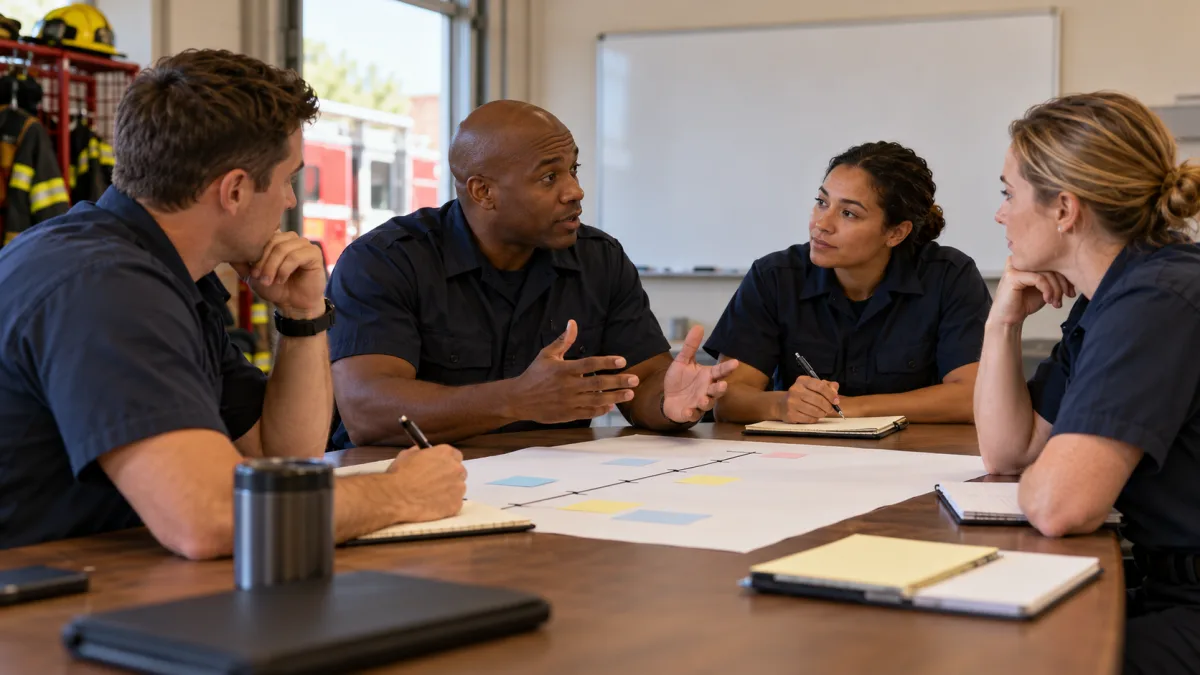
The problem with many after-action meetings is easy to recognize: everyone agrees that communication needs work, someone promises more training, and the same difficulty appears at the next incident. The missing piece is usually a specific change with a responsible owner and a way to check whether it helped.
A useful fire department after-action review connects observations to action. It preserves effective decisions as well as identifying gaps. It does not need an impressive slide deck, and it should not turn into a contest to reconstruct who looked best on the fireground.
Separate the immediate conversation from the full review
A short post-incident discussion can capture observations that would otherwise be forgotten. A more structured review can examine records, compare perspectives and validate the sequence. Neither should delay necessary rehabilitation, equipment restoration, reporting or personnel care.
The timing, participants and depth should fit the event. A routine training evolution may need a brief discussion and one follow-up item. A complex incident may need several agencies, a clearer evidence plan and formal approval of findings. These are editorial planning options, not a mandatory schedule for every department.
FEMA's overview of after-action review purpose emphasizes learning from strengths and areas for improvement. Start by writing the review's purpose in one sentence. “Understand how water-supply information reached command” is a workable scope; “discuss everything that happened” is difficult to finish.
Build a sequence before judging decisions
Collect the records your department is authorized to use: incident documentation, dispatch and radio information, unit assignments and participant accounts. Apply the relevant retention, privacy and investigation procedures. Do not circulate patient details or sensitive recordings merely because they make a presentation more vivid.
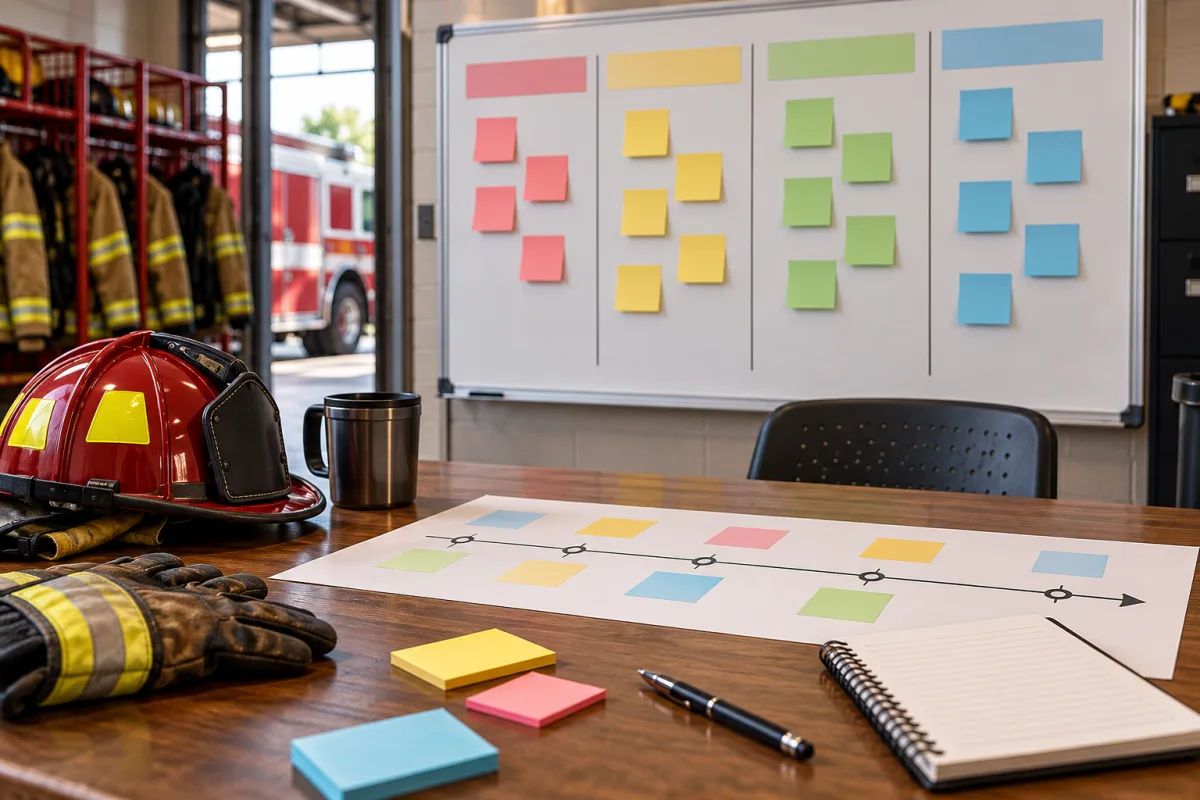
Create a simple timeline with a source beside each entry. Where accounts differ, keep that difference visible until it can be resolved. A time remembered by a tired crew member and a timestamp from a recording should not be silently treated as equally precise.
| Timeline entry | Evidence/source | Confidence or uncertainty |
|---|---|---|
| What was reported or assigned? | Identify the record or participant account. | Was the time recorded or estimated? |
| What information was available then? | Record the message or observation known at that point. | What was learned only afterward? |
| What action followed? | Record the action without assigning a motive. | Are there conflicting accounts to resolve? |
This helps control hindsight. Asking why a crew did not act on information that had not reached it produces a weak finding. A better question is how the information was collected, transmitted and understood at the relevant time.
Use a short agenda that protects the discussion
The following 30-minute agenda is an original example for a limited-scope review. Expand or replace it when the incident requires more time.
- Minutes 0–3: state the scope, learning purpose and ground rules.
- Minutes 3–10: confirm the basic timeline and identify uncertainties.
- Minutes 10–18: examine two or three observations, including at least one practice worth retaining.
- Minutes 18–25: agree on proposed changes and who can own them.
- Minutes 25–30: identify follow-up dates, unresolved questions and the method for sharing outcomes.
Ask participants to distinguish what they observed from what they inferred. Invite the perspective of the people doing the work before finalizing an explanation. A quiet participant may have the detail that changes the finding.
A learning-focused discussion does not eliminate accountability or replace a required investigation. Define those boundaries with department leadership and relevant policies. Do not promise confidentiality or legal protection that the review process cannot provide.
Turn “communicate better” into a testable action
FEMA's continuous-improvement action-planning guidance identifies owners, implementation timing, milestones and barriers as important parts of the process. Use that structure to turn a broad complaint into something that can be delivered.
Illustrative training example: a review finds that two crews understood a water-supply update differently. “Retrain everyone on radios” is too broad to explain what would change. A more useful proposal is to revise the relevant message example in the training package, have the affected roles test it in a tabletop exercise, and document whether both roles reach the same understanding.
| Action field | Example entry |
|---|---|
| Observation | The receiving roles interpreted the same water-supply update differently. |
| Proposed change | Clarify the training example and the expected confirmation, within department procedure. |
| Owner | The designated training officer, with input from the affected crews. |
| Deliverable | A revised example and a short tabletop exercise. |
| Due date | A date agreed by the owner and leadership. |
| Verification | A subsequent exercise demonstrates a shared understanding; unresolved ambiguity is recorded. |
Keep the entry small enough to track. “Improve command” cannot be closed convincingly. A specific training revision can be reviewed, tested and either accepted or sent back for more work.
Record strengths with the same precision
An effective practice can be lost when it is described only as “good teamwork.” Identify what the crew actually did, what supported it and whether it can be repeated. A well-organized access handover, for example, might depend on a particular building information sheet being available in the right place.
The follow-up may be to retain the sheet, include it in another site's pre-plan or teach the handover during an existing exercise. Give positive findings an owner when there is work to preserve or share them. The review should make it easier to reproduce success, not merely congratulate the participants.
Close the loop with evidence, not a checkmark
Completing an activity and improving performance are different outcomes. A presentation being delivered proves that a presentation was delivered. It does not by itself show that crews can perform the intended task under the relevant conditions.
FEMA's continuous-improvement resources include action-plan and action-tracking tools. A department can use the appropriate official template or its existing process. Avoid creating a second spreadsheet that nobody is responsible for maintaining.
- Open: the action has an owner and accepted scope.
- In progress: the deliverable is being developed; barriers are visible.
- Ready for verification: the work exists and the agreed check can occur.
- Closed or revised: record the evidence supporting closure, or explain what still needs to change.
These example status labels are optional. Their value is that “done” must point to an observable result. Schedule a short leadership check on overdue actions and share outcomes with the crews who supplied the observations.
Keep the review separate from incident forms
The ICS forms guide explains documentation used to organize and record incident activity. An after-action review uses relevant records as evidence and asks what the organization should sustain or improve. Rewriting the incident log as a narrative is not the same as producing an improvement plan.
Comments 0
No comments yet. Be the first to share your thoughts!
Leave a Comment