Correction — October 15, 2026: Clarified that a flammability reading is only one part of the entry assessment and that SCBA does not remove explosion hazards.
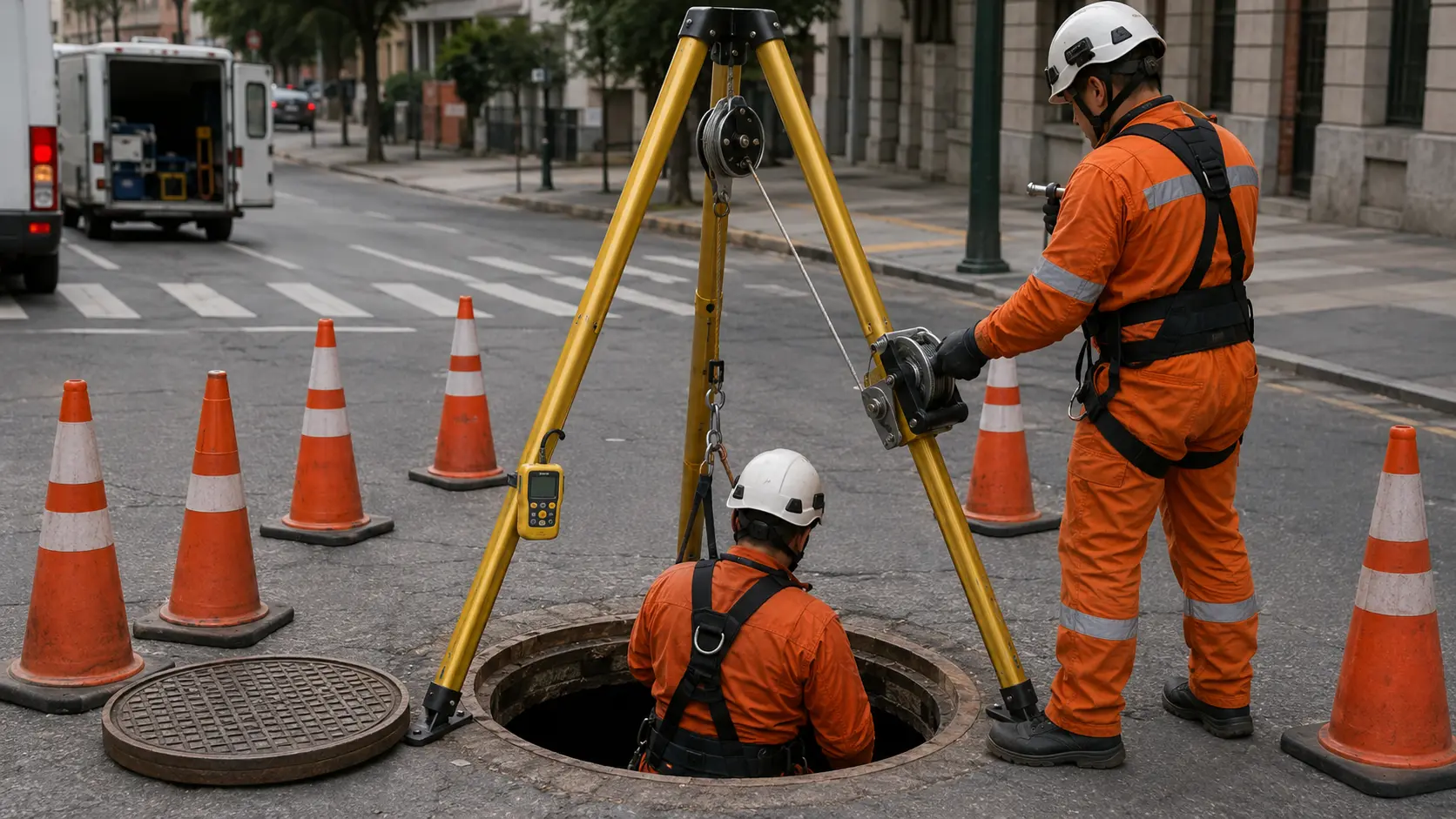
The pattern in fatal confined space incidents is consistent enough to have its own name in occupational safety literature: the multiple victim scenario. A worker collapses in a manhole, a tank, or a storage vessel. A coworker sees them go down, climbs in to help, and collapses. A third person follows. By the time emergency responders arrive, there may be three or four people down in a space where the original hazard has not changed at all. The atmosphere that killed the first person kills everyone who enters without protection.
More than 60 percent of confined space fatalities in the United States are rescuers. Not workers who were doing a job in a hazardous space — people who saw someone in trouble and went in without knowing what had caused that trouble. The confined space rescue protocols that fire departments train on exist specifically to prevent this pattern from repeating, and they require a fundamentally different approach than any other rescue scenario: test before entry, every time, without exception.
In this article:
- What qualifies as a confined space
- The three atmospheric hazards
- Oxygen-deficient atmospheres: what happens to the body
- Permit-required confined spaces
- The rescue sequence: test, ventilate, then consider entry
- Equipment: tripod, retrieval system, and air monitoring
- The attendant's role
- Non-entry rescue: when the retrieval system saves the rescuer
- Historical incidents that changed the protocols
What Qualifies as a Confined Space
OSHA defines a confined space as a space that is large enough for a worker to enter and perform work, has limited or restricted means of entry or exit, and is not designed for continuous occupancy. The definition is deliberately broad — manholes, sewers, storage tanks, grain silos, ship compartments, crawl spaces, and large ductwork all qualify.
A confined space becomes a permit-required confined space when it additionally contains or has the potential to contain a serious hazard. The most common serious hazards are atmospheric — the three conditions covered below — but structural hazards (engulfment in stored material, moving parts, thermal extremes) also create permit-required status. The permit requirement is not bureaucratic overhead. It is the mechanism that forces atmospheric testing, ventilation planning, and rescue equipment staging before anyone enters.
The Three Atmospheric Hazards
Oxygen deficiency
Normal atmospheric oxygen concentration is approximately 20.9 percent. OSHA defines an oxygen-deficient atmosphere as below 19.5 percent. At 16 percent, impaired judgment and coordination begin. At 12 to 14 percent, extreme fatigue and loss of coordination. At 10 percent, nausea and loss of consciousness. Below 6 percent, convulsions and death within seconds to minutes.
The deceptive quality of oxygen deficiency is that there is no smell, no visible sign, and in mild cases, no immediate sensation that anything is wrong. A worker who steps into a space at 16 percent oxygen may notice nothing unusual for 30 to 60 seconds before their judgment is impaired enough to prevent a rational decision to exit. This is why the rule is atmospheric testing before entry — not waiting to see how you feel inside the space.
Oxygen is displaced in confined spaces by heavier gases that accumulate from biological decomposition (methane, CO₂ in sewers), industrial processes (nitrogen purging in tanks), or chemical reactions. A recently "purged" tank — filled with nitrogen or CO₂ to prevent corrosion or explosion — has an atmosphere that is essentially pure nitrogen or CO₂. An entrant who opens the hatch without testing and takes a breath is breathing less than 1 percent oxygen.
Flammable or explosive atmospheres
OSHA 1910.146 identifies flammable gas or vapor above 10% of its lower flammable limit as a hazardous atmosphere. A lower reading is not by itself an entry clearance. The permit must address oxygen, toxic substances, combustible dust, isolation and physical hazards; follow the meter's sensor limitations and sampling instructions. Respiratory protection does not prevent an explosion.
Toxic gas concentration
Hydrogen sulfide — the sewer gas with a rotten-egg odor — is the toxic gas most commonly involved in confined space fatalities. At 100 ppm it causes rapid unconsciousness without warning. At higher concentrations it paralyzes the olfactory nerve, meaning the odor that warned at low concentrations disappears at the concentrations that kill. Carbon monoxide accumulates in enclosed spaces from internal combustion equipment, biological decomposition, and industrial processes. Both are colorless and undetectable without instrumentation.
Oxygen-Deficient Atmospheres: What Happens to the Body
The physiology of oxygen deficiency explains why the rescuer fatality rate is so high. The brain requires a continuous supply of oxygen and has no meaningful reserve — unlike the heart, which can sustain some function on anaerobic metabolism for minutes. When oxygen concentration drops below approximately 16 percent, the brain's first response is to suppress judgment and inhibitions while maintaining the illusion of competence. An affected person does not feel critically impaired — they feel slightly lightheaded, perhaps euphoric, and continue to believe they are making good decisions.
At this stage, they may be unable to formulate the decision to exit, or may decide they are fine and go further into the space. When oxygen drops below 10 percent, motor coordination fails rapidly. The person who was walking moments before cannot now stand or climb. They are in a space they cannot exit under their own power. If the atmosphere continues to drop, loss of consciousness follows within seconds. Cardiac arrest follows within minutes.
A bystander who sees this happen and enters to help is exposed to the same atmosphere at full oxygen deficit — they go down faster because they are not entering at the top of the decline but at its bottom. This is the mechanism behind the multiple-victim scenario that the statistics reflect.
Permit-Required Confined Spaces
An entry permit for a permit-required confined space is a written authorization that documents: the space being entered, the known and potential hazards, the atmospheric test results before entry, the ventilation method in use, the names of entrants and attendants, the rescue team on standby, the communication procedure, and the time of entry and maximum time permitted inside. It is signed by the entry supervisor and physically posted at the entry point.
The permit system is the mechanism that forces every element of safe entry to be verified before anyone goes in. A permit cannot be completed if the atmospheric test has not been done. A permit cannot be completed if there is no rescue team identified. A permit that is signed and posted does not guarantee safety — it guarantees that the required checks were performed. The difference between a completed permit and an assumed-safe space is the difference between documented due diligence and the conditions that produce the multiple-victim incidents.
The Rescue Sequence: Test, Ventilate, Then Consider Entry
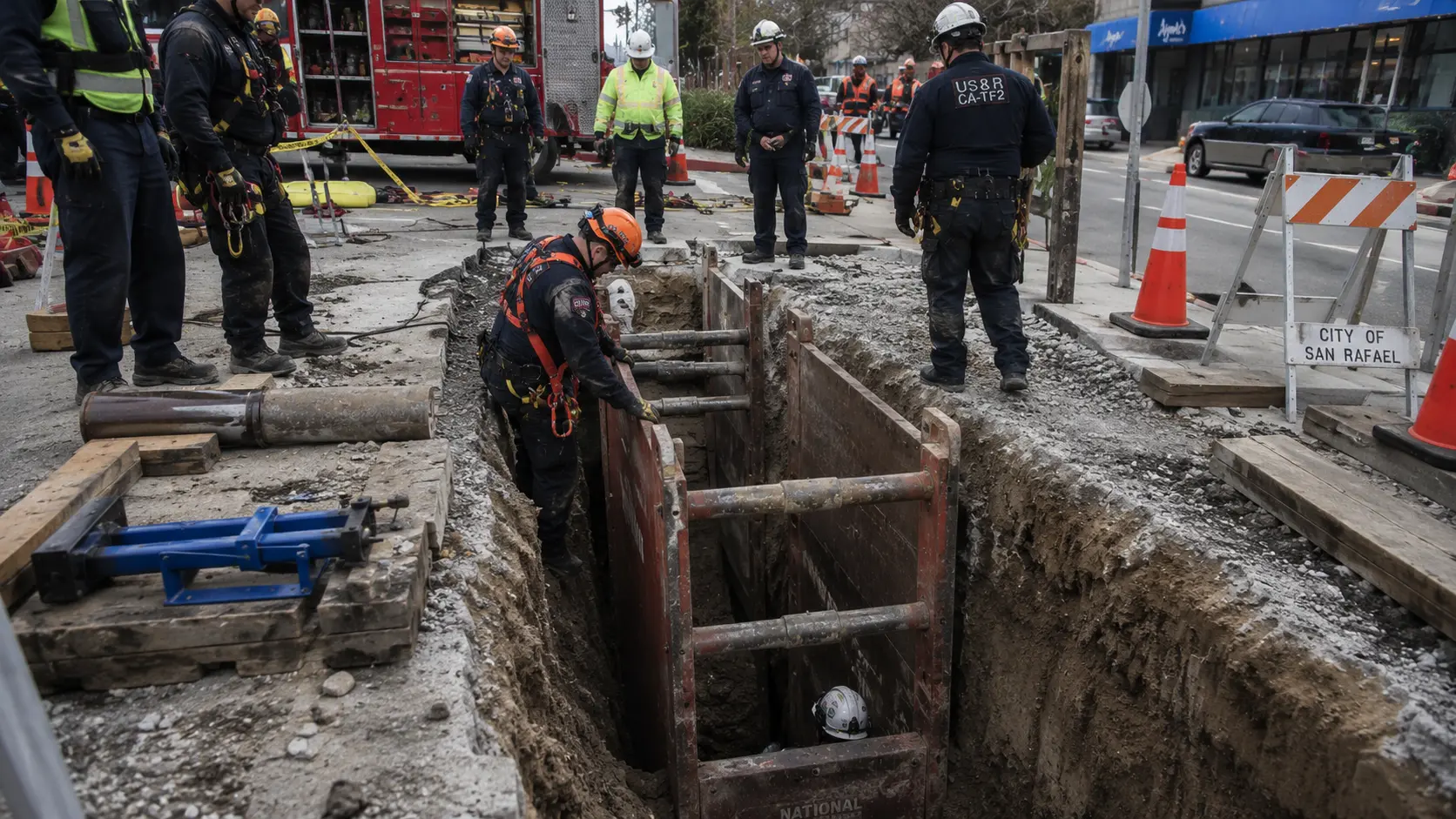
When fire or rescue crews arrive at a confined space incident with a victim inside, the sequence is fixed:
- Stop everyone from entering. Bystanders, coworkers, anyone without CSR training and equipment stays out. Post someone at the entry point if needed.
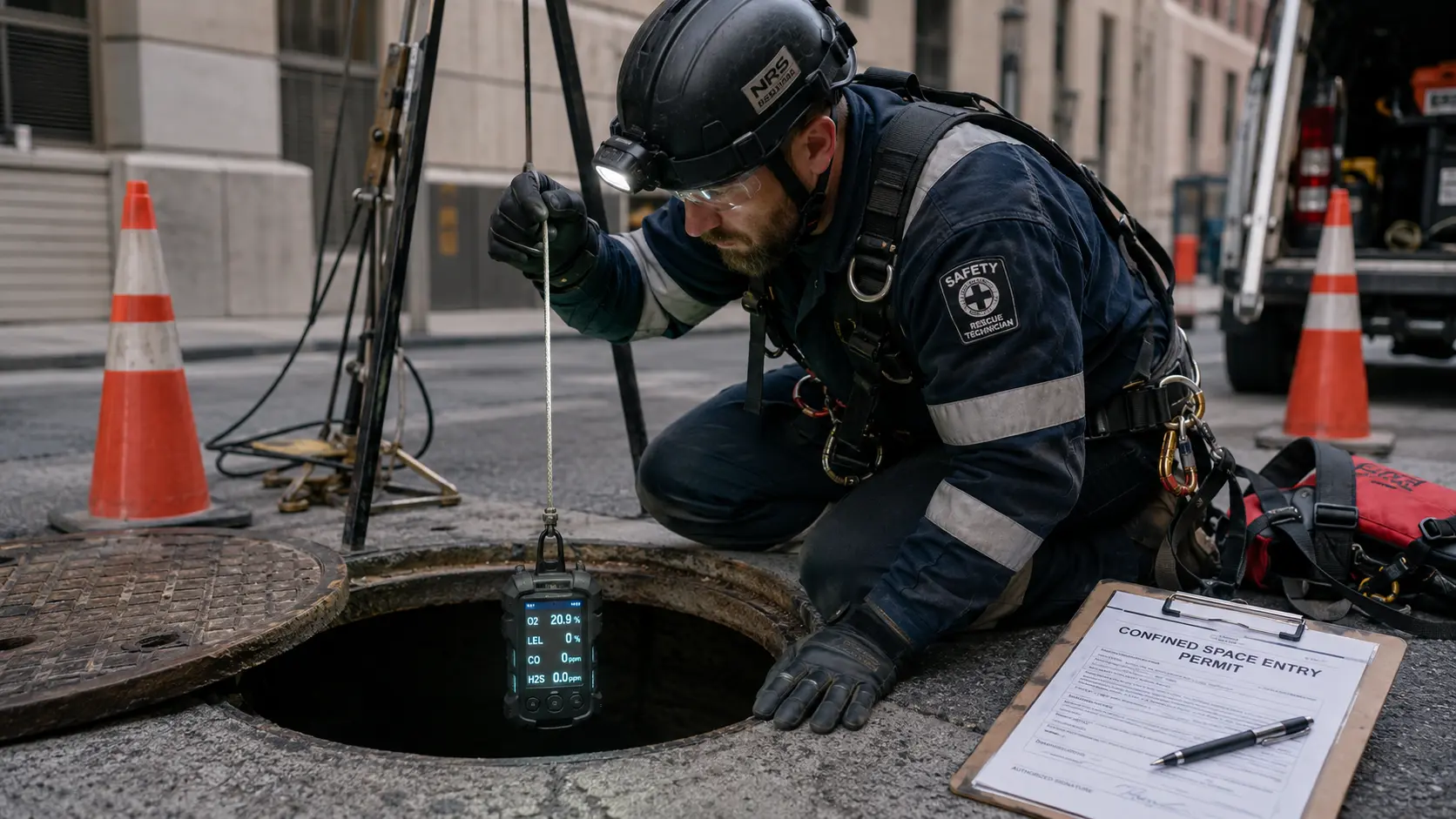
- Test the atmosphere at the entry point and at multiple depths within the space using a multi-gas monitor lowered on a rope. Record the readings.
- If the atmosphere is immediately dangerous to life or health (IDLH), initiate mechanical ventilation — blowing fresh air into the space — and retest after a minimum ventilation period. The ventilation time required depends on space volume and airflow rate.
- Attempt non-entry rescue first. If the victim is within reach of a retrieval hook or rope extended from outside, retrieve without entry.
- If entry is required after testing confirms the atmosphere is safe or a trained entrant with SCBA will be used: the entrant wears a full harness connected to the retrieval system, has a radio or voice communication with the attendant, and is continuously monitored. The attendant does not enter under any circumstances — they manage the retrieval system and call for backup.
Equipment: Tripod, Retrieval System, and Air Monitoring
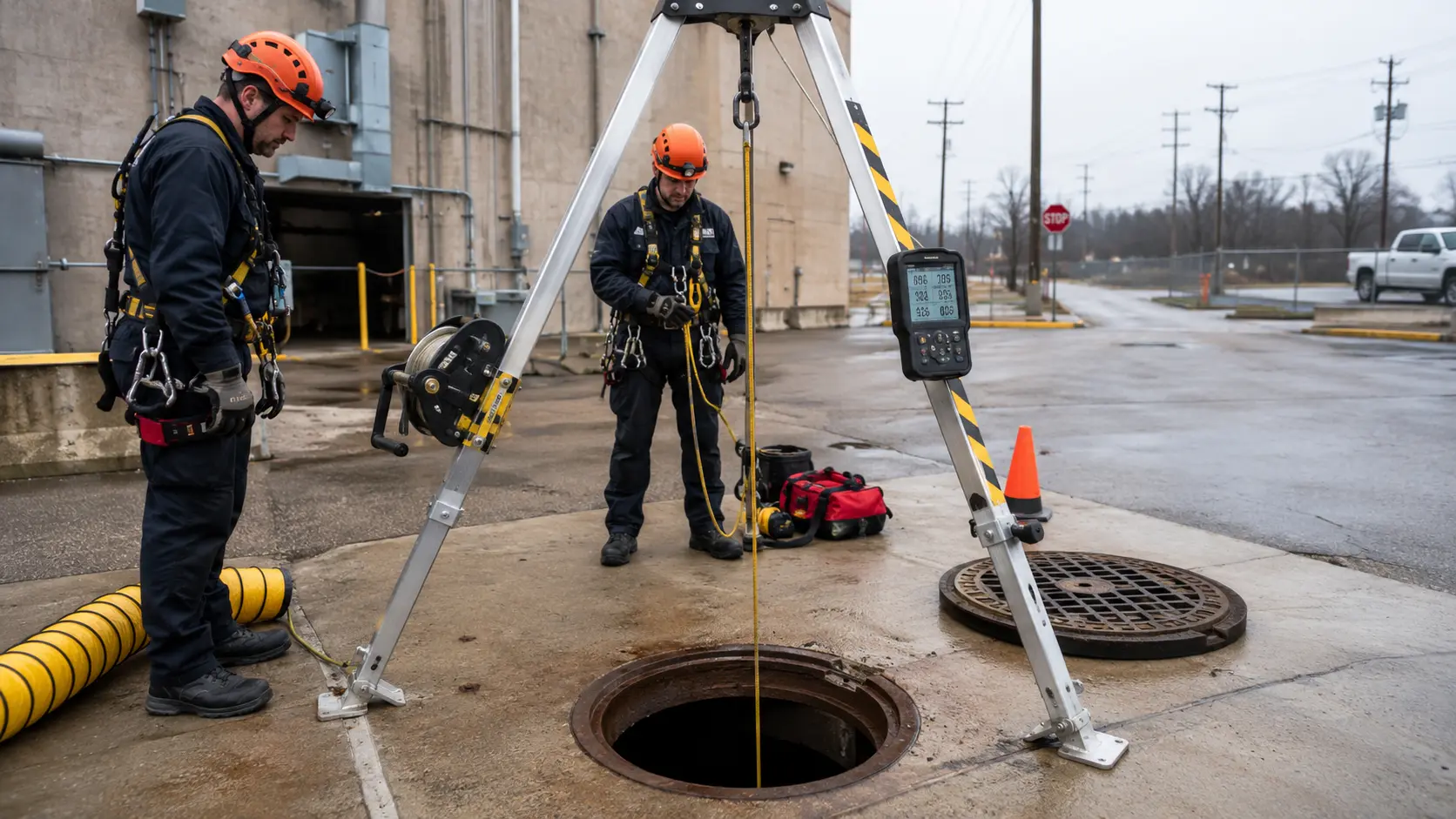
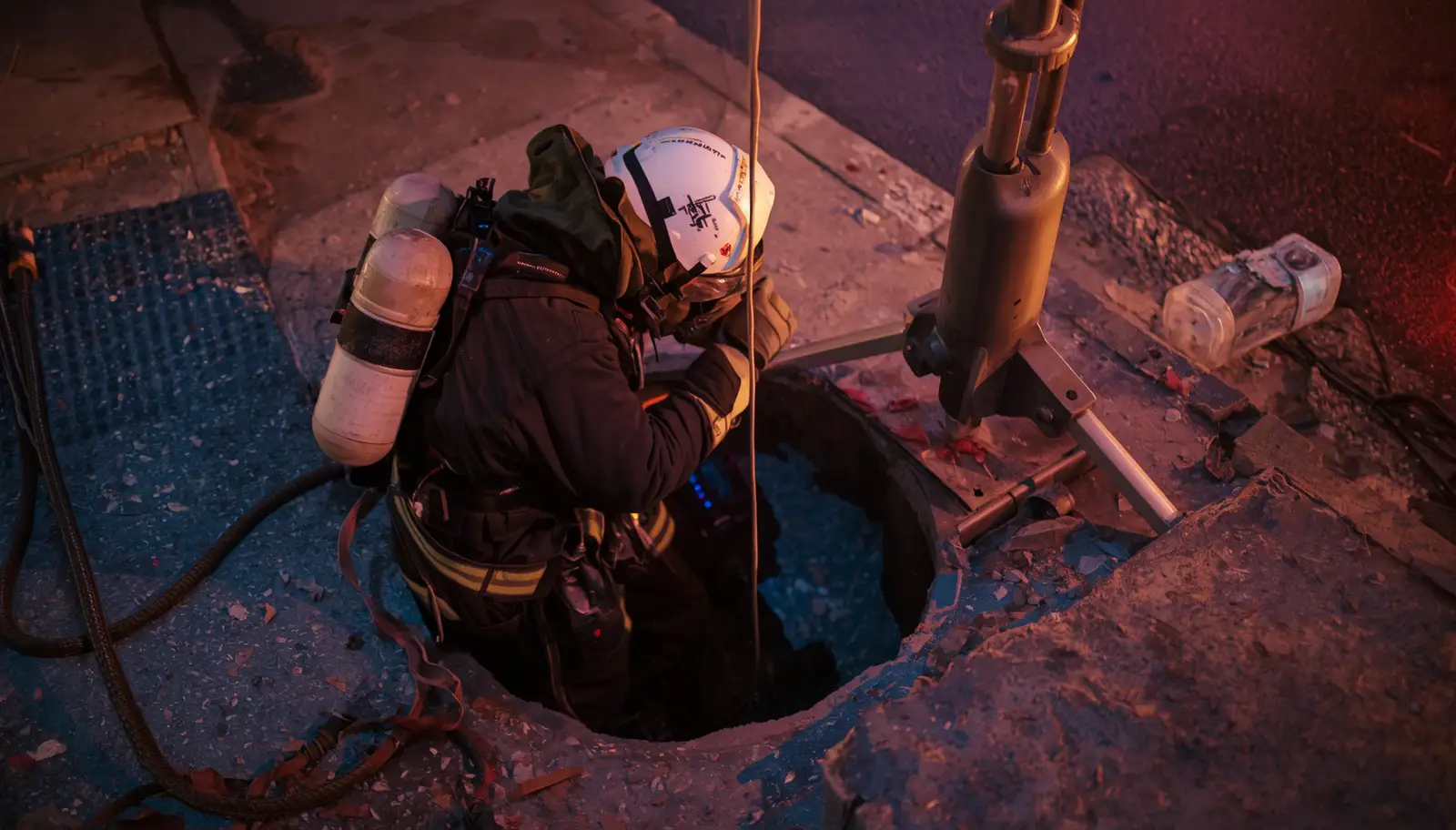
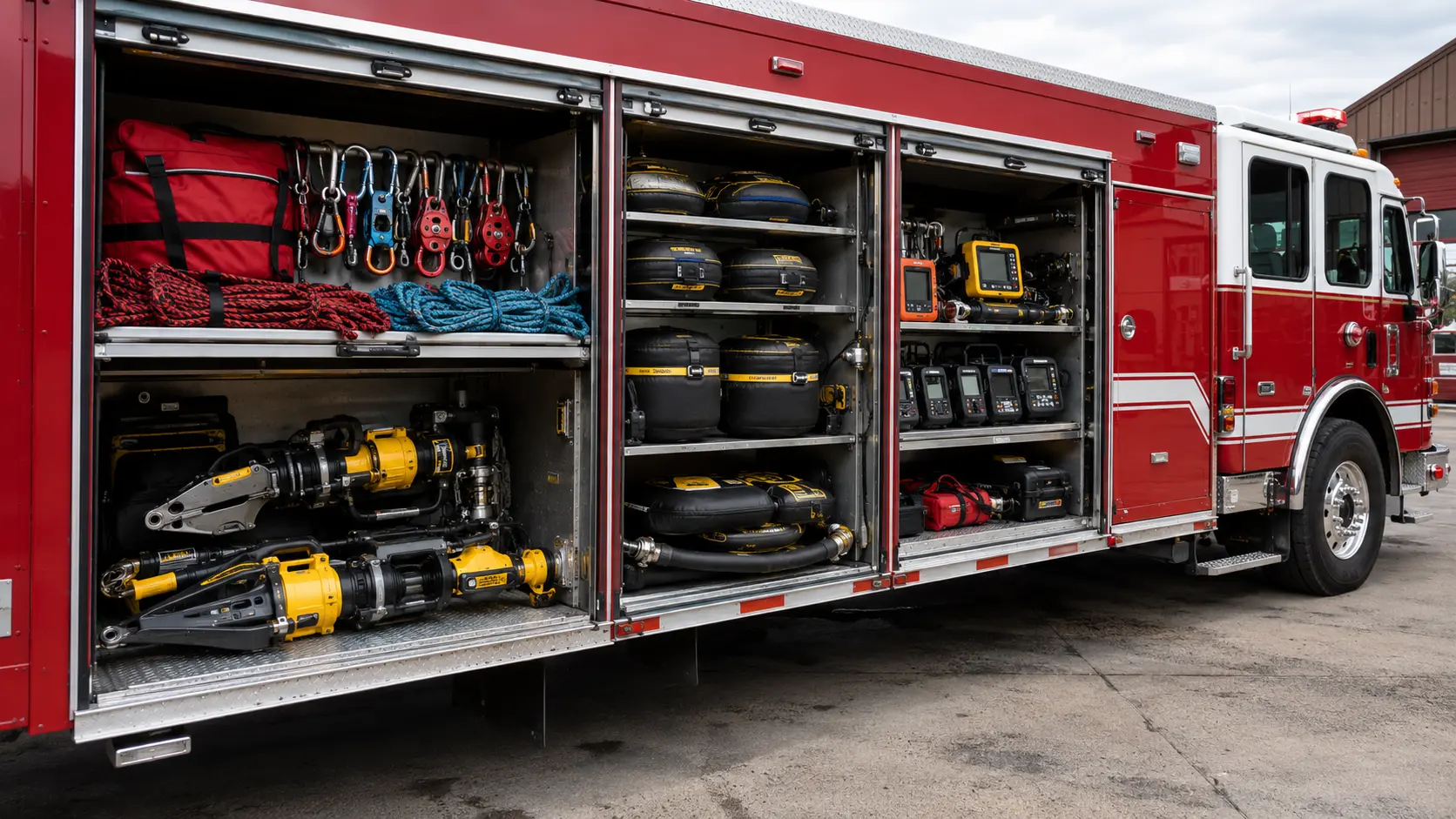
The tripod is the piece of equipment that most visually defines confined space rescue. It is a three-legged aluminum or steel frame positioned over the entry opening with a mechanical lifting device — typically a hand-powered or motor-powered winch — at the apex. The retrieval line from the winch attaches to a D-ring on the front of the entrant's full-body harness. If the entrant becomes incapacitated inside the space, the attendant activates the winch and retrieves them without entering.
The multi-gas monitor is the piece of equipment that determines whether the tripod gets used at all. A four-gas monitor typically measures oxygen percentage, LEL percentage, CO concentration, and H₂S concentration simultaneously. It is lowered into the space before any person is lowered and left running throughout the operation. Continuous monitoring identifies if conditions change after initial clearance — if the space is a sewer with active flow, for example, conditions can deteriorate rapidly as new gases enter from upstream.
The Attendant's Role
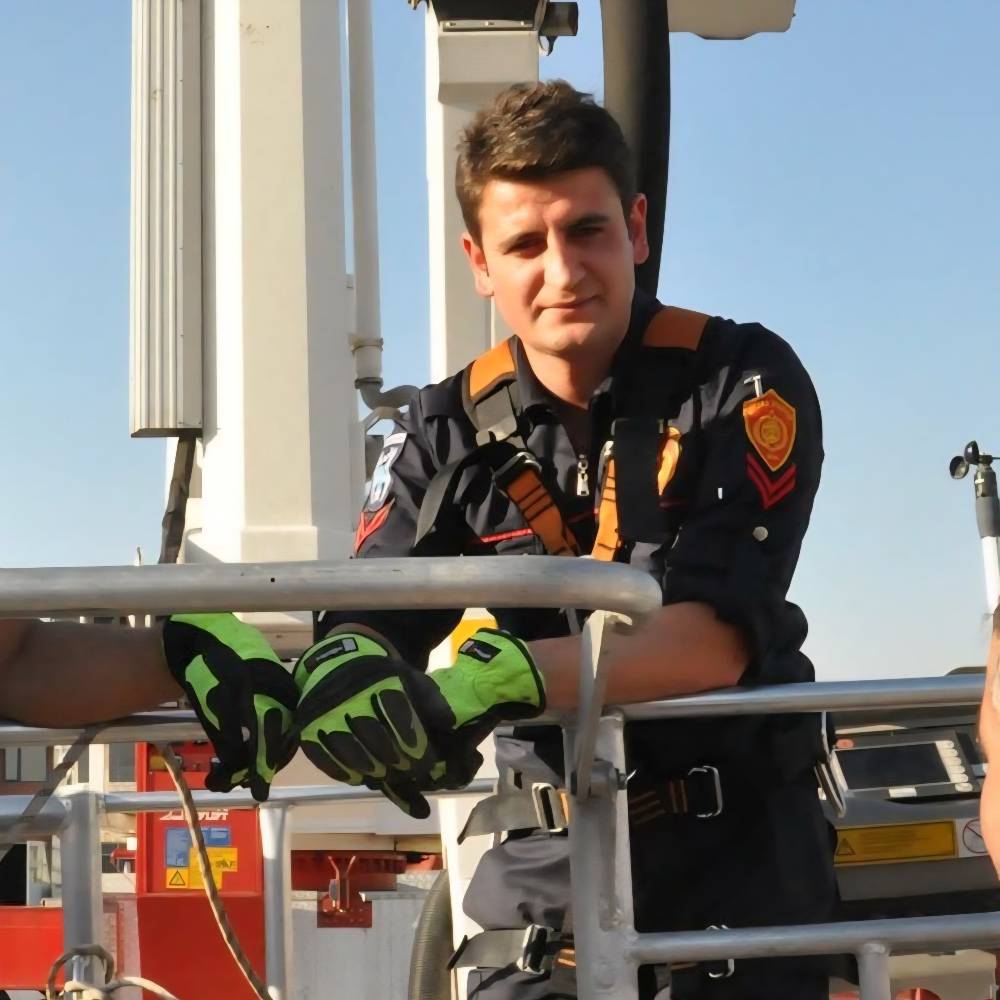
The attendant is the person stationed at the entry point whose only job is to monitor the entrant and manage the retrieval system. The attendant does not perform other tasks. They do not enter the space. They maintain continuous communication with the entrant, monitor the atmospheric readings, track the entrant's position and time inside, and are prepared to initiate retrieval immediately if the entrant fails to respond, gives a distress signal, or if atmospheric conditions change.
The attendant rule — never enter — is the control that breaks the multiple-victim pattern. An attendant who enters to help a downed entrant is no longer an attendant; they are a second victim in the space and there is now no one managing the retrieval system or calling for additional help. Attendants are specifically trained that their job includes watching someone they may know and care about become incapacitated and maintaining their position outside while activating the retrieval system rather than going in.
Non-Entry Rescue: When the Retrieval System Saves the Rescuer
The retrieval system — the harness, the line, the winch, and the tripod — is designed for non-entry rescue first. If a victim is wearing a harness connected to the retrieval line when they go down, or if a rescue hook on the retrieval line can be connected to their harness from outside the space without anyone entering, the victim can be removed mechanically. No one has to go into the atmosphere that incapacitated them.
OSHA requires that retrieval systems be used for permit-required confined space rescues whenever they are feasible and do not increase the overall risk to the entrant. In practice, this means the retrieval system goes up before anyone goes in, and non-entry retrieval is the first-choice response to any victim who does not self-rescue.
Historical Incidents That Changed the Protocols
The confined space safety framework was shaped significantly by a series of industrial fatalities in the 1980s that followed the multiple-victim pattern consistently enough to generate regulatory attention. OSHA's Permit-Required Confined Spaces standard (29 CFR 1910.146) was finalized in 1993 after years of documentation showing that the majority of confined space deaths were occurring because workers and rescuers were entering spaces without testing the atmosphere.
The 1983 incident at a grain storage facility in Kansas, where five people died in a succession of entries into an oxygen-deficient corn storage bin, is frequently cited as a case that illustrates the pattern in its clearest form. Each entrant went in to rescue the previous one. None survived. No atmospheric testing was performed before any entry. The atmosphere that killed the first worker killed each subsequent rescuer within seconds of entry. The investigation produced the specific language about the multiple-victim scenario that now appears in OSHA training materials.
The fire service equivalent is more recent: confined space fatalities involving sewer and utility workers, with fire crews arriving to conduct rescue operations in atmospheres that remain IDLH throughout the incident. The protocols that FDNY, LAFD, and other large departments now use for confined space incidents were developed in response to near-miss and actual fatality events that demonstrated what happens when atmospheric monitoring is delayed or skipped in favor of faster entry.
Comments 0
No comments yet. Be the first to share your thoughts!
Leave a Comment