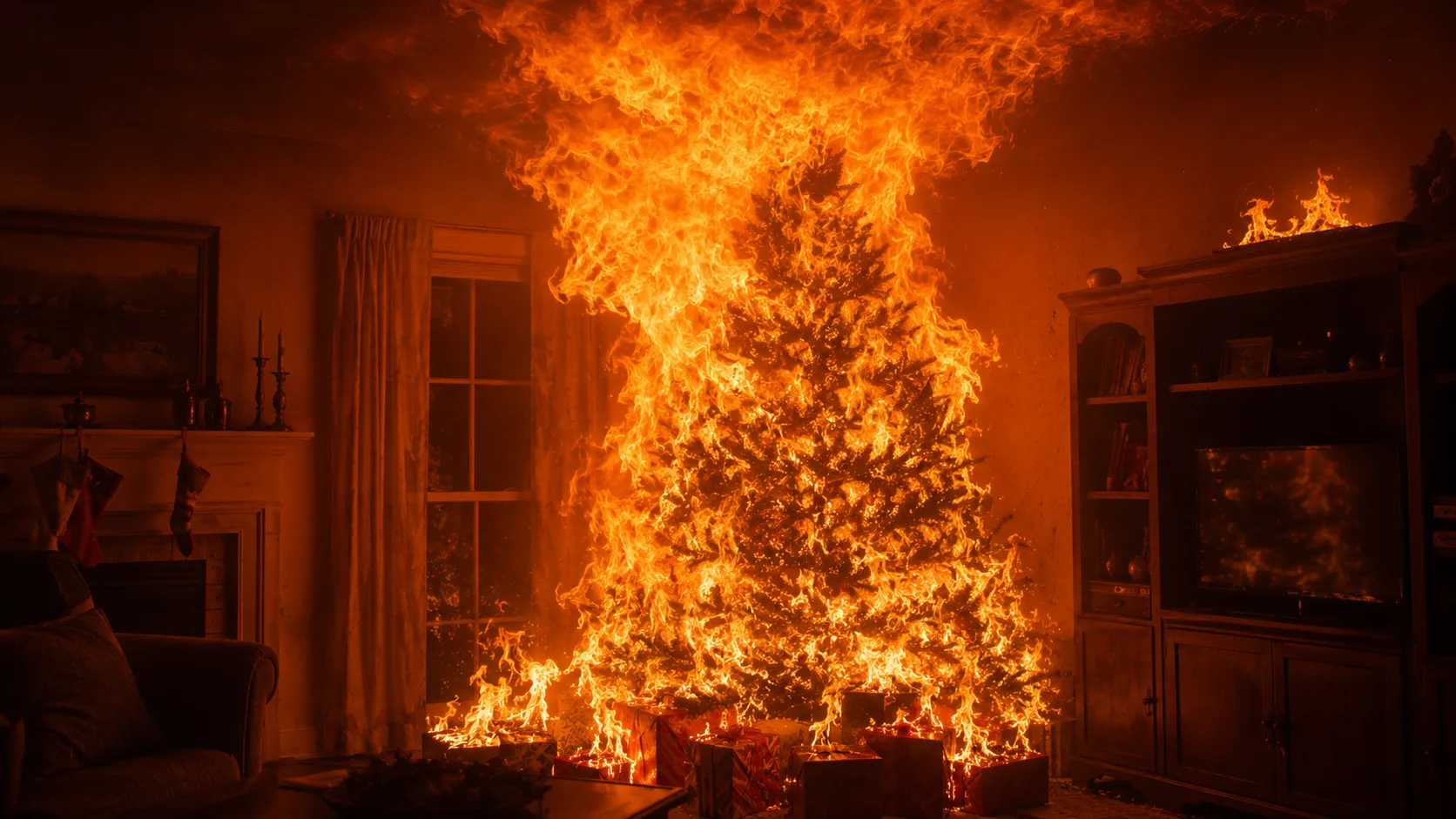

Christmas tree fires are relatively rare in absolute numbers — roughly 160 home fires per year in the U.S., according to NFPA data. That number sounds manageable until you look at what those fires produce: an average of two deaths, 12 injuries, and $10 million in property damage every year, from 160 fires. The math works out to a death rate per fire that is more than ten times the rate for other residential fires. A Christmas tree fire is not a nuisance event — it is among the most lethal ignition scenarios in a residential setting.
The reason is physics. A dry Christmas tree contains an enormous amount of rapidly combustible fuel in a geometry — vertical, branching, continuous — that maximizes flame spread. A living room with a dry tree can reach flashover in under 30 seconds after ignition. The fire is in the room where the family is spending time. The exits are often behind the tree. The ornaments, the lights, and the gifts underneath add fuel and ignition sources. The combination produces fires that are both fast and frequently deadly.
In this article:
- The dryness problem: what actually makes a tree dangerous
- Real vs. artificial: which fire risk is actually higher
- Water and freshness: how much, how often, and how to test
- Light strings: the specific hazards by type
- Where you put the tree matters significantly
- When trees become most dangerous: the disposal window
- Candles near trees: the combination that appears repeatedly in fatality data
- Christmas tree fire safety checklist
The Dryness Problem: What Actually Makes a Tree Dangerous
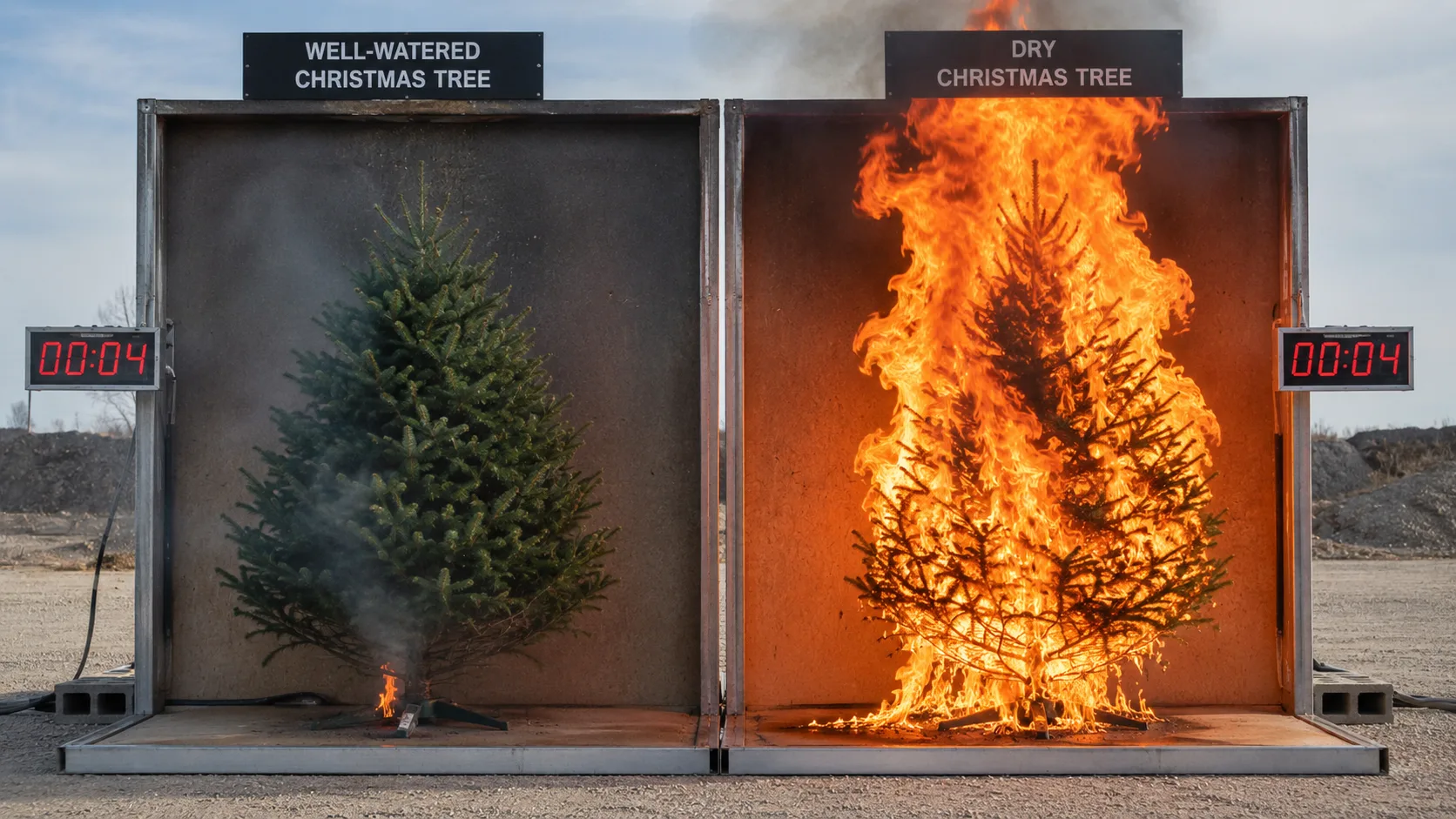
A fresh-cut Christmas tree contains water in its needles and wood tissue — moisture that is fundamental to how slowly or quickly it burns. A well-hydrated tree has a moisture content of 100 percent or higher by dry-weight measurement. At that moisture level, the tree is very difficult to ignite and burns slowly even if ignition is achieved. A dry tree — one that has been in a heated living room for several weeks without adequate water — may have a moisture content below 20 percent. At that level, it ignites readily and burns essentially as fast as the fuel load allows.
The NFPA has conducted and published fire testing that demonstrates this difference in stark visual terms. The test burns a well-watered tree next to a dry tree with the same ignition source. The well-watered tree smolders at the ignition point and may self-extinguish. The dry tree is fully engulfed in flames within 30 seconds. The living room environment in the dry-tree test reaches flashover conditions within roughly 40 seconds of ignition. That is not a fire you escape from if you are in the room when it starts.
The mechanism of drying: a cut tree in a heated room continues to transpire — releasing moisture through its needles — for as long as it is alive. It replaces that moisture from water in the stand reservoir. When the reservoir is empty and not refilled, the tree begins to dry irreversibly. Once needle moisture is gone, it does not return with rehydration. The tree that has been allowed to dry out is not made safer by adding water — the damage is done. The window for keeping a tree safe is continuous watering from the day it is brought in.
Real vs. Artificial: Which Fire Risk Is Actually Higher
Artificial trees do not dry out, do not need water, and cannot ignite the way a dry natural tree can. From a pure ignition-source standpoint, an artificial tree is significantly lower fire risk than a natural tree that is not properly maintained. This is not a controversial position — it is supported by fire data.
The caveat: artificial trees introduce their own hazards. Older artificial trees — particularly those manufactured before flame-retardant standards for decorative trees became more stringent — may ignite from a faulty light string and burn with toxic smoke from the synthetic materials. A new artificial tree from a reputable manufacturer labeled as fire-resistant is the appropriate standard. "Fire-resistant" means the tree is treated to slow ignition and resist flame spread — it does not mean it cannot burn.
The artificial tree also does not eliminate the light-string hazard or the candle hazard. The most common ignition sources for Christmas tree fires — electrical problems with light strings and open flames placed too close to the tree — apply equally to artificial and natural trees. The tree type changes one risk factor (dryness) while leaving the others unchanged.
For people who prefer natural trees and are willing to maintain them properly — checking water daily, using fresh trees, disposing on schedule — the risk of a well-maintained natural tree is manageable. For anyone who is likely to forget the water reservoir for a week or two, an artificial tree from a reputable manufacturer is the more defensible choice.
Water and Freshness: How Much, How Often, and How to Test
A fresh-cut Christmas tree takes up a significant amount of water in the first 24 hours — sometimes a quart or more in the first day alone as the cut end absorbs what it was deprived of during transport and lot storage. After that, consumption typically settles to a cup or more per day depending on tree size and room temperature.
The freshness test before you buy
Before purchasing a cut tree, bend a needle between your fingers. A fresh needle is flexible and does not break cleanly — it bends. A dry needle snaps and may shatter. Pull a branch gently through your closed hand — fresh needles stay on the branch. Dry needles come off easily. Bounce the trunk of the tree on the ground once — if a shower of green needles falls, the tree is already significantly dried and should not be brought home.
The fresh cut
Make a straight cut across the trunk one inch above the original cut immediately before placing the tree in the stand. A cut Christmas tree seals its vascular tissue with resin within a few hours of cutting — a fresh cut reopens the water uptake channels. If you buy a tree that was cut more than 24 hours ago and do not make a fresh cut, the tree may not absorb water effectively regardless of how full the reservoir is.
The reservoir
The stand reservoir should hold enough water to keep the cut end submerged at all times — the cut end exposed to air re-seals. Check the reservoir every day, not every few days. In the first week, a larger tree in a warm room may drink the reservoir dry within 24 hours. A stand that can hold at least a quart of water is the minimum for a standard-size tree.
What to add to the water
Plain tap water. No additives — not aspirin, not sugar, not bleach, not commercial tree preservers. Multiple studies have found that plain water performs as well as any additive formula, and some additives can accelerate bacterial growth that plugs the vascular tissue and reduces uptake. Plain, fresh water, checked daily.
Light Strings: The Specific Hazards by Type
| Light type | Heat output | Fire risk profile | Notes |
|---|---|---|---|
| Incandescent (traditional) | High — bulbs reach 120–200°F surface temp | Higher — hot bulbs on dry needles can ignite; wiring failures more common in older strings | Check for UL listing; discard strings with broken sockets, frayed wire, or damaged insulation |
| LED | Very low — bulbs stay near room temperature | Lower — surface heat insufficient to ignite needles directly; wiring failures still possible | Still requires UL listing check; do not use indoor LED strings outdoors or vice versa |
| Extension cords | Varies by gauge and load | High if undersized — an extension cord not rated for the combined wattage of the light strings will overheat | Use a cord rated for the total wattage; never coil an extension cord under a load; never run under a rug |
The specific light-string practices that appear most frequently in Christmas tree fire investigation reports: using light strings past their service life (cracked insulation, broken sockets, damaged wire), daisy-chaining multiple extension cords to reach the outlet, and leaving lights plugged in overnight or when the home is unoccupied. The last one — leaving lights on unattended — is worth stating directly. A light-string electrical fault that starts a fire at 3am in a home where everyone is asleep is a categorically different scenario from one that starts in the evening when the household is awake. Turn off the tree lights when you go to bed and when you leave the house. Every time.
Where You Put the Tree Matters Significantly
Tree placement involves two separate considerations: proximity to heat sources and proximity to exits.
Heat sources
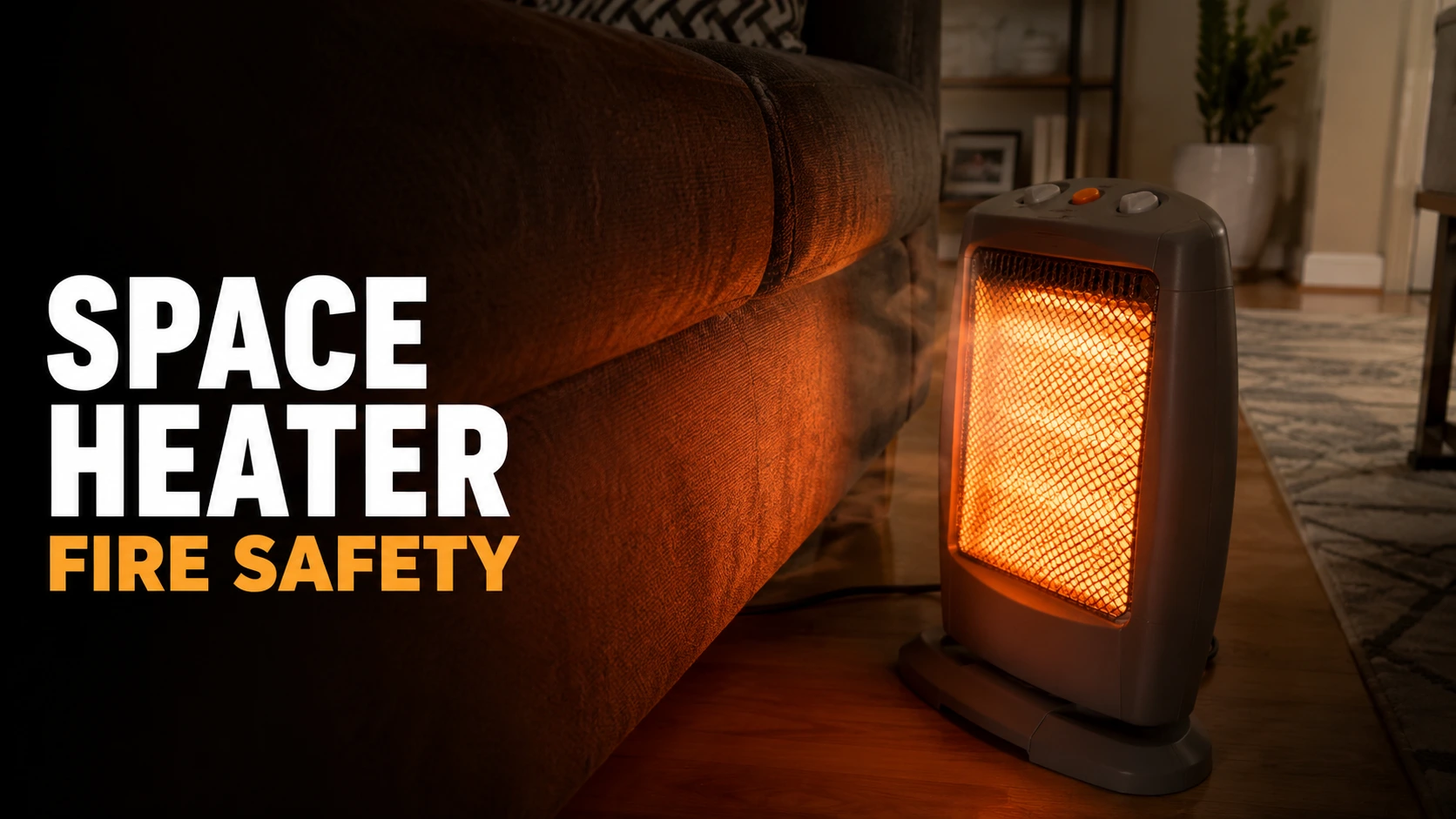
A tree placed near a heating vent, a fireplace, a radiator, a space heater, or direct sunlight through a window dries significantly faster than one in a cooler location. The drying rate is not linear — a tree near a heating vent may reach dangerous dryness in two weeks rather than four. If the tree is near a heat source, the watering frequency needs to increase proportionally, and the timeline for safe display shortens.
Fireplaces deserve specific mention. An operating fireplace emits radiant heat, embers, and sparks. A tree placed within 5 to 6 feet of an operating fireplace is within spark travel distance on a strong draft. The NFPA recommends a minimum of 3 feet between the tree and any heat source — and that is a minimum, not an optimal distance.
Exit proximity
A tree positioned between the primary seating area and the primary exit from the room changes the evacuation geometry if the tree catches fire. In the scenario where the tree ignites, the family's natural exit path may now run through or past the burning tree. Placing the tree in a corner, away from the doorway, and ensuring that at least one clear exit path from the room does not pass the tree — these are positioning decisions that take 30 seconds to think about and have real consequences in a fire scenario.
When Trees Become Most Dangerous: The Disposal Window
December 26 is the peak day for Christmas tree fires — not because more people are using their trees that day, but because trees that went up in late November or early December are now three to four weeks old, have been in a heated room throughout, and may have had intermittent or insufficient watering. The combination produces trees that are at or near maximum dryness at exactly the point when holiday gatherings are still occurring and the household may be distracted by guests, travel, and celebration.
The recommended maximum display time for a natural cut Christmas tree is four weeks from purchase. If the tree was already on the lot for a week before purchase, three weeks in the home is the safer target. Needles that fall at the touch of a branch, a trunk reservoir that seems to never empty (because the tree has stopped drinking), and needles that have turned from flexible to brittle are all indicators that the tree's display time has passed.
Disposal of a dried tree is its own hazard. A dry tree should not go to the curb where it sits as a fire risk — it should go to a municipal composting program, a local fire department chip day, or be chipped immediately. Do not store a dry tree in a garage or shed. Do not burn it in a fireplace or a fire pit — a dry Christmas tree produces an uncontrollable volume of fire that exceeds what any residential hearth is designed for. The YouTube videos of backyard Christmas tree burns should be taken as a demonstration of exactly how fast these fires move, not as a template to replicate.
Candles Near Trees: The Combination That Appears in Fatality Data
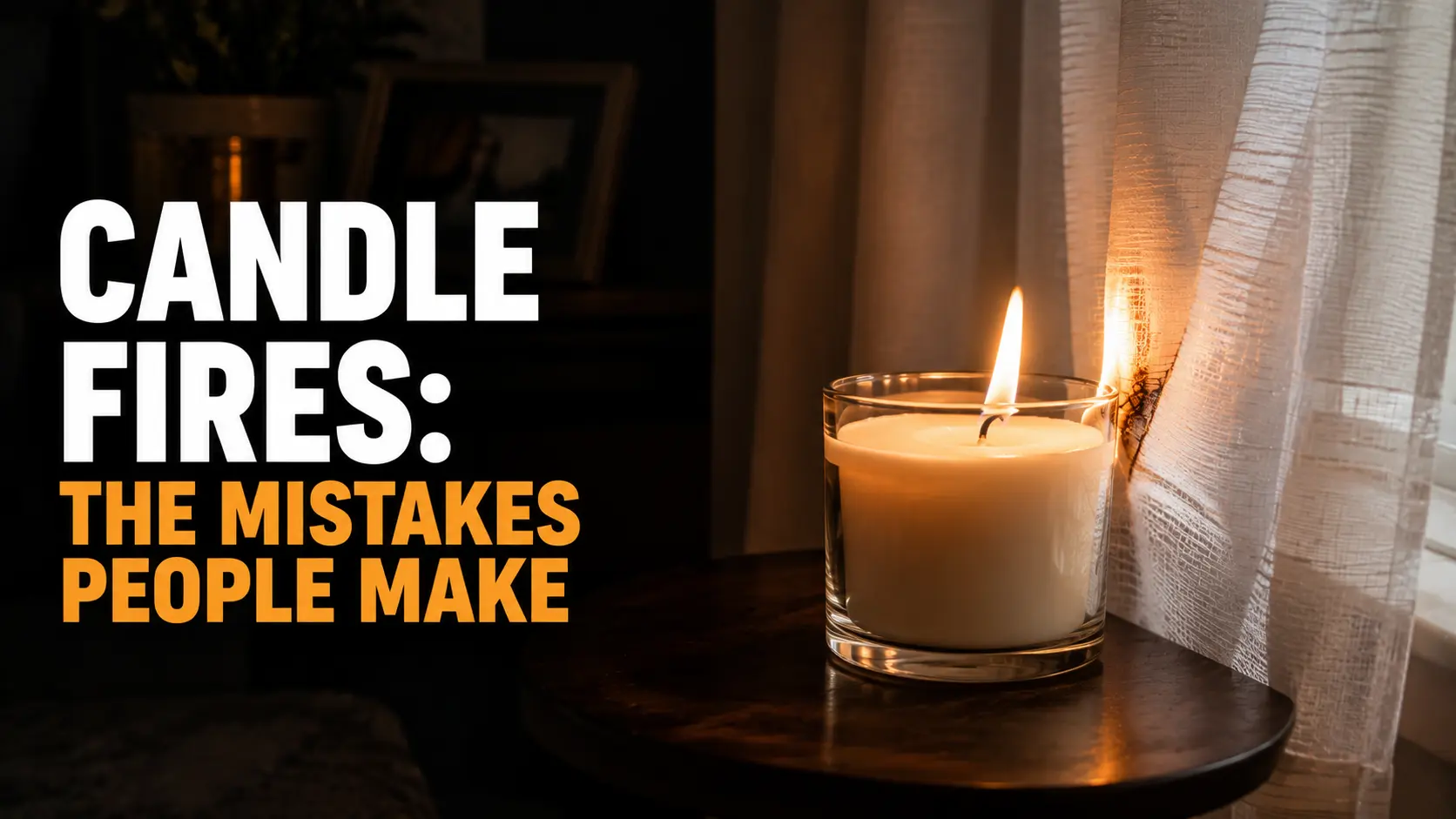
Lighted candles within reach of Christmas tree branches — whether on a mantel near the tree, on a table within branch distance, or attached directly to the tree as some traditional decorations involve — appear repeatedly in fatal Christmas tree fire investigations. The mechanism is simple: a candle flame that touches a dry or moderately dry needle ignites it. The needle's flame travels up the branch. From that point, the fire behavior of a dry tree takes over.
The rule is categorical: no open flames within the reach of any Christmas tree branch, accounting for the full extent of the branch including when it deflects or drops needles. The 3-foot rule used for heating sources applies to candles as well, and arguably the standard should be more conservative given that a candle produces an open flame rather than just radiant heat.
Christmas Tree Fire Safety Checklist
- ✓Test freshness before buying — bend needles, pull branch through hand, bounce trunk. Buy the freshest tree available.
- ✓Make a fresh cut immediately before placing in stand — 1 inch above the original cut, straight across.
- ✓Check the water reservoir daily — the cut end must stay submerged. Plain tap water only.
- ✓Use LED light strings — significantly lower surface heat than incandescent, reducing needle ignition risk.
- ✓Check every light string for UL listing, damaged sockets, frayed wire — discard any string that fails inspection.
- ✓Position tree away from all heat sources — minimum 3 feet from fireplaces, vents, radiators, space heaters.
- ✓Position tree away from the room's primary exit — ensure at least one clear escape path that does not pass the tree.
- ✓Dispose of the tree within four weeks — three weeks if placement is near a heat source.
- ✗Never leave tree lights on when sleeping or when the house is unoccupied.
- ✗No open flames within 3 feet of any tree branch — candles, fireplace, anything.
- ✗Do not burn a Christmas tree in a fireplace or fire pit — the fire rate exceeds any residential hearth capacity.
- ✗Do not use damaged or recalled light strings — check the CPSC recall database annually before decorating.
Christmas tree fires are preventable at every point in their causation chain: the dryness that makes them ignitable, the ignition sources that start them, and the placement decisions that determine how fast the fire affects occupants. The steps above cost nothing beyond attention and a few minutes of daily checking. The fires they prevent are among the fastest and most lethal in residential fire data.

Comments 0
No comments yet. Be the first to share your thoughts!
Leave a Comment