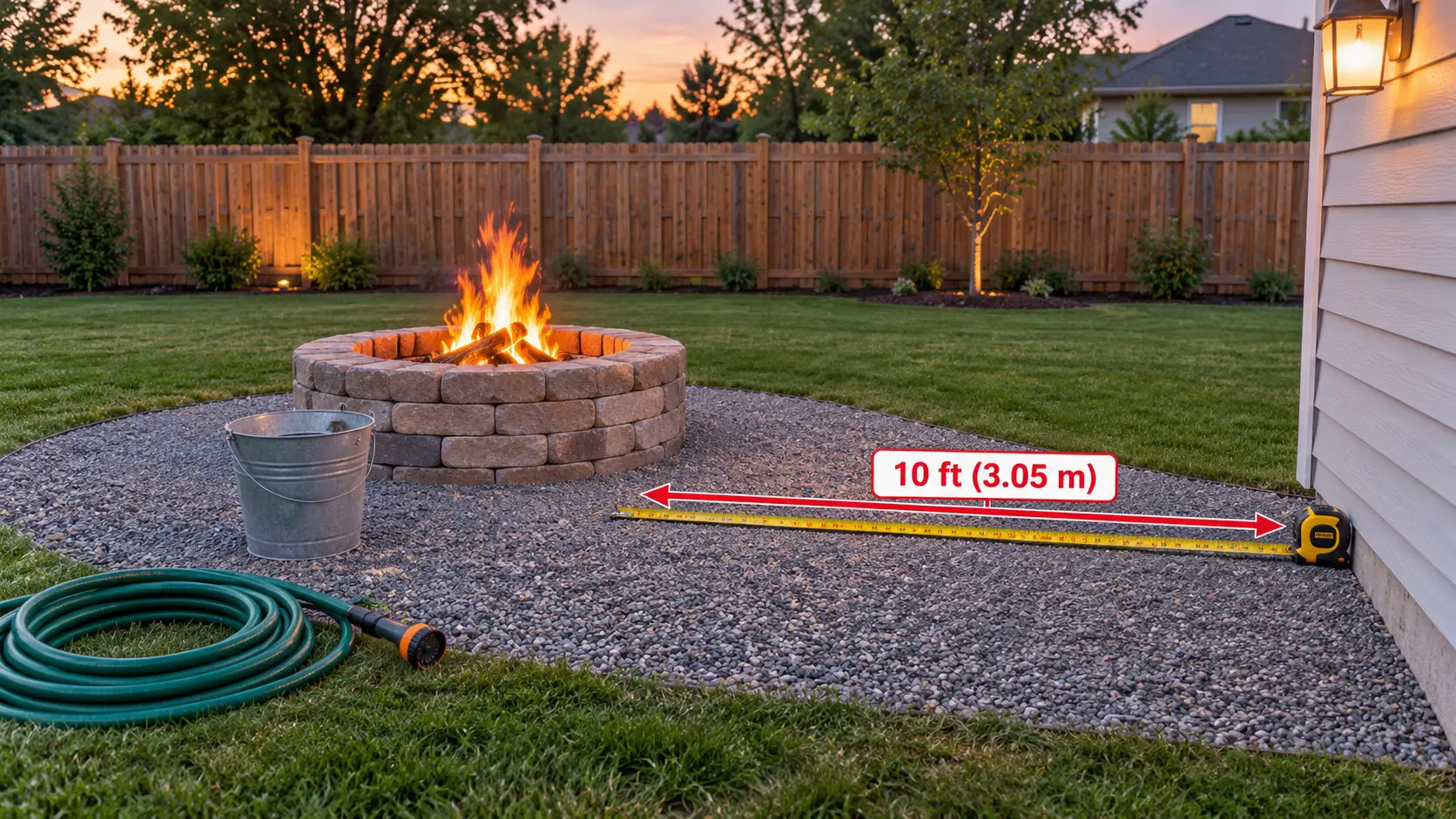

Before you dig: choose the type of fire pit, check the rules for your address, and measure the available space. A clearance recommendation on a website is not permission to build. Your local requirements and, for a purchased unit or insert, the manufacturer’s instructions both matter.
A stone ring can look right and still be in the wrong place. The fence behind it, the branches overhead, and the route people take across the patio all deserve attention before you buy materials. This guide covers those planning decisions so you can work out whether the spot you have in mind is suitable.
How far should a fire pit be from the house?
There is no single distance that applies to every backyard fire pit in the United States. USFA’s general outdoor-fire guidance recommends at least 10 feet from a home or anything combustible. Local rules can require more. For example, Fairfax County’s recreational-fire guidance requires 25 feet from structures or combustible material for fires within that definition. That is a local example, not a nationwide rule.
The type of fire matters as much as its size. An open recreational fire and a manufactured portable fireplace may fall under different rules. Fairfax publishes separate portable-fireplace guidance with its own requirements and exceptions. Tell your fire prevention office exactly what you plan to install instead of asking only whether “fire pits” are allowed.
Can a fire pit go on a wood or composite deck?
Do not build a DIY wood-burning masonry pit directly on a combustible deck. A layer of loose pavers does not establish that the deck can support the weight or withstand the heat. If the deck is your only available location, pause the project and have the proposed installation assessed before buying the pit or its base.
Manufactured devices need a product-specific answer. Some have approved stands or installation arrangements, but those are not interchangeable with a homemade pad. Solo Stove’s own guidance warns that wood and composite decking can char or ignite and that a stand does not remove every risk. Gas equipment also needs approval for the intended surface, clearances and installation. Check the exact model manual and the decking manufacturer’s guidance.
Does a fire pit need a permit?
Ask before building. A permit for construction, approval for a gas connection, and permission to burn are different questions. An exemption from one requirement does not answer the others. Give the authority your address, fuel type, proposed dimensions, and whether the installation is portable or permanent.
Contact the local fire prevention office about burning restrictions and separation distances, then the building or zoning office about construction and property setbacks. Ask whether a site plan or inspection is needed. Keep the written guidance or a record of the conversation with your project notes; it helps you avoid measuring everything against the wrong requirement.
What about HOA rules?
Check your HOA documents, lease, or community rules before ordering materials. They may restrict fuel types, locations or permanent structures even where local burning rules allow them. If approval is required, get it before construction. A suitable location on a drawing is easier to change than a finished masonry ring.
Gas vs. wood: which is safer?
A gas fire pit offers controlled fuel delivery and does not leave a bed of wood ash. It still needs the correct installation, approved components and clearances listed for that model. Do not assume that choosing propane automatically lets you place the pit closer to the house or underneath a roof.
With wood, plan for fuel storage, drifting smoke, flying embers and ash disposal as well as the pit itself. Think about the neighbor’s windows and where your own guests will sit. The best choice is one that fits the space and the way you can realistically supervise it.
Installation mistakes to avoid
- Measuring only to the house. Include fences, sheds, furniture, stored wood and vegetation when checking the proposed location.
- Ignoring what is overhead. Consider branches, awnings and roof edges. Confirm overhead requirements rather than guessing from the height of a small test fire.
- Using whatever blocks are available. Choose materials and a lining intended for the planned fire-pit system. Decorative landscaping stone is not automatically a suitable firebox material.
- Assuming a pad makes a deck suitable. Surface protection does not settle structural loads, clearance requirements or the manufacturer’s restrictions.
- Forgetting access. Leave a clear route around the seating and keep the fuel supply out of that route.
- Checking permission only once. Before each use, check for temporary fire restrictions and conditions that make burning unsuitable.
What to have on hand before you light it
Before the first fire, have the extinguishing equipment required for your setup ready and know the shutdown procedure. Leave room for people to move away without stepping over the pit or fuel supply. For fuel selection, supervision and end-of-night cleanup, use our outdoor fire pit safety guide.
Before you buy materials
A useful plan identifies the fuel, device or construction system, permitted location, base materials, required clearances and shutdown method. If one of those is still a guess, resolve it before building. A small yard may simply not have a suitable location for the wood-burning pit you first pictured.
Frequently asked questions
How far does a fire pit need to be from a house?
Use the distance required for your particular installation. USFA’s general recommendation is at least 10 feet, but local rules and product instructions may call for a greater distance or prohibit the proposed location. Identify which rules apply before marking out the base.
Can I put a fire pit on a wood deck?
Do not treat an ordinary deck as a base for a DIY wood-burning pit. For a manufactured appliance, check the exact model’s installation instructions, the deck material and local restrictions. A mat or stand by itself is not a blanket approval.
Do I need a permit for a fire pit?
It depends on the location and project. Ask separately about construction, gas work where applicable, and permission to burn. A portable unit and a permanent installation may have different requirements.
Are gas fire pits safer than wood?
Gas avoids wood embers and ash, but introduces fuel connections and equipment-specific installation requirements. Neither fuel makes an unsuitable location acceptable. Choose a model and installation you can use according to its instructions.
How close can a fire pit be to a fence?
Include fences when checking separation from combustible materials. Use the applicable local requirement and the model’s instructions; do not measure only to the house and ignore a nearby fence, shed or stored firewood.
What can I use under a fire pit?
For a DIY masonry project, use a base and lining specified for the chosen fire-pit construction system. For a manufactured unit, use its approved surface and accessories. Noncombustible material alone does not prove that an assembly is suitable for repeated high heat.
Sources
- USFA — Outdoor Fire Safety
- Fairfax County — Recreational Fires and Open Burning
- Fairfax County — Portable Fireplaces
- Solo Stove — Product and Surface Guidance
These are planning considerations, not a site approval or a universal code specification. Check current local requirements and the instructions for the equipment you intend to use.

Comments 0
No comments yet. Be the first to share your thoughts!
Leave a Comment