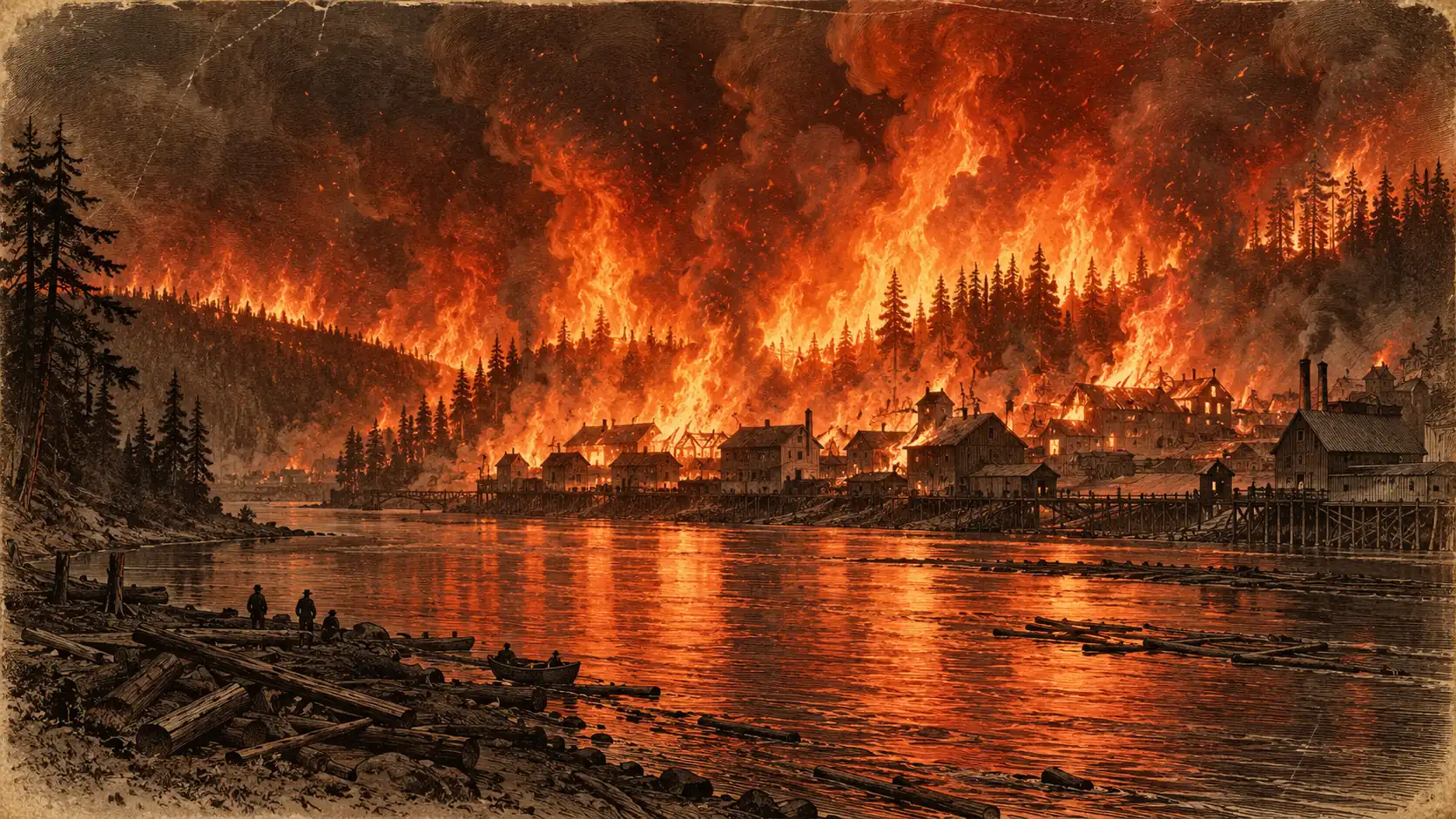

The short answer: The deadliest wildfire in U.S. history is the Peshtigo Fire, which swept through northeastern Wisconsin and part of Michigan on the night of October 8, 1871. Most estimates put the death toll between 1,200 and 2,500 people, and about 1.2 million acres burned. The Great Chicago Fire started the same night, killed roughly 300 people, and received almost all of the attention then and since.
Most Americans know the story of a cow, a lantern, and a city in flames. Far fewer have heard of Peshtigo, a lumber town of wooden houses on the Green Bay shore that was erased in about an hour. The two fires belong together. They were driven by the same drought and the same wind on the same night, and the way they were remembered says as much about how disasters get told as about how fire behaves.
In this article:
Why Two Catastrophic Fires Started the Same Night
The Upper Midwest had gone months with almost no rain by early October 1871. Forests, swamps, and prairie grass were bone dry. The region was also being cleared at speed: loggers left piles of branches and sawdust behind, farmers burned brush to open fields, and railroad crews were pushing track through the woods. Small fires were smoldering across Wisconsin, Michigan, and Illinois all through the fall. Then a strong cold front arrived from the southwest on the evening of October 8, and the wind did what wind does to a landscape that dry. Fires that had been manageable for weeks became uncontrollable in the span of a few hours, in several places at once. Besides Peshtigo and Chicago, towns including Holland, Manistee, and Port Huron in Michigan burned that same night.
What Happened at Peshtigo
Peshtigo was a company town built around a large sawmill and a woodenware factory, with houses, boardwalks, and bridges made of pine and streets covered in sawdust. On the evening of Sunday, October 8, residents heard a distant roar that survivors compared to a train, then watched the sky turn red. What reached the town was not a line of flame creeping along the ground. It was a firestorm, a wall of burning air and embers carried by the wind, with spinning columns that witnesses described as tornadoes of fire. Roofs ignited before the flames arrived, because the embers got there first. The town was largely gone within an hour.
People ran for the Peshtigo River, the one place that could not burn. Many who reached it and stayed in the water survived, ducking under repeatedly as burning debris and superheated air passed overhead. Others were overcome by the heat, the smoke, or the panic in the crowded river. Father Peter Pernin, the town's Catholic priest, left one of the best-known firsthand accounts, describing the sky, the noise, and the scenes at the water's edge. The fire did not stop at the town limits. It ran across roughly 1.2 million acres of forest and farmland, destroying smaller settlements across northeastern Wisconsin and into Michigan's Upper Peninsula.
Why the Death Toll Is Still Uncertain
Most modern sources cite a range, usually from about 1,200 to 2,500, and some earlier accounts went higher. The wide gap is not sloppiness. Records burned along with the buildings, many victims were transient loggers and recent immigrants who were never counted in a census, and entire families disappeared with no one left to report them missing. In Peshtigo, so many bodies could not be identified that roughly 350 of them were buried together in a mass grave, which is now part of the town's fire cemetery. By any reading of the evidence, the toll is the highest of any wildfire in American history, and no U.S. wildfire since has come close. California's Camp Fire in 2018 killed 85 people, and the 2023 Lahaina fire killed more than 100, the worst loss of life from a U.S. wildfire in over a century. Both are still far below Peshtigo.
The Great Chicago Fire, and the Cow That Wasn't to Blame
The fire in Chicago began that Sunday night in or near a barn on the city's southwest side, and it burned until the rain finally came on October 10. It destroyed roughly 17,000 buildings across about three and a third square miles, left an estimated 100,000 people homeless out of a population near 300,000, and killed around 300. The city was built overwhelmingly of wood, with wooden sidewalks and tar-and-shingle roofs, and the Chicago Fire Department was already worn down: a large fire the night before had consumed crews and equipment for hours. Delays and a misdirected first alarm cost more time. The fire then jumped the Chicago River and kept going, carried by the same wind that was driving the fire at Peshtigo.
The story of Mrs. O'Leary's cow kicking over a lantern is almost certainly invented. A Chicago newspaper reporter later admitted he made up the detail for color, and in 1997 the Chicago City Council formally cleared the O'Leary family. What started the fire has never been established. Whatever the spark was, it landed in a city and a season perfectly set up to burn.
Peshtigo vs. Chicago at a Glance
| Peshtigo Fire | Great Chicago Fire | |
|---|---|---|
| Type | Wildfire and firestorm | Urban conflagration |
| Area burned | About 1.2 million acres | About 3.3 square miles |
| Deaths (estimates) | 1,200 to 2,500 | About 300 |
| Buildings lost | Peshtigo and a dozen or more smaller settlements | About 17,000 |
| Public memory | Largely forgotten outside Wisconsin | Famous worldwide |
Why Peshtigo Was Forgotten
Part of it was geography. Chicago was one of the biggest cities in the country, with newspapers, telegraph offices, and the people who wrote the news living inside it. Peshtigo was a remote company town, and the telegraph lines that could have carried word out were themselves burned or cut. News of the Wisconsin fire trickled out over days, by which time the country's attention had settled on Chicago's ruins. Part of it was scale of spectacle: a wildfire through forest produces no skyline to photograph. And part of it was that the dead of Peshtigo were largely working-class laborers and immigrants, whose loss was easier for the rest of the country to overlook. The Peshtigo Fire Museum, built next to the mass grave, exists largely so that the town's story stays told.
What Firefighters Still Take From 1871
Chicago's legacy is easier to trace. The city rewrote its building rules to limit wood construction in the center, and the anniversary of the fire became the basis for Fire Prevention Week, which the National Fire Protection Association has promoted since 1922 and which a presidential proclamation made national in 1925. It remains one of the longest-running public safety observances in the country. Peshtigo's lessons are quieter but just as relevant to wildland firefighters today:
- ✓Wind plus drought plus fuel is the whole equation. The fires of 1871 were not unusual in how they burned, only in how many ingredients lined up on one night. That same combination is what a Red Flag Warning exists to flag.
- ✓Embers do the damage first. Peshtigo's roofs ignited before the flame front arrived. Modern home-hardening guidance, like ember-resistant vents and clearing debris from roofs and gutters, comes from the same observation.
- ✓Leave early. By the time the roar reached Peshtigo, there was no longer time to evacuate. The point of Level 1, 2, and 3 evacuation warnings today is to move people while there is still a road.
- ✓Safety zones matter more than heroics. The river saved lives and also cost them. Survivors of firestorms are consistently the ones who were already somewhere the fuel could not follow them.
Common Questions
What was the deadliest wildfire in U.S. history?
The Peshtigo Fire of October 8, 1871, in Wisconsin and Michigan, with an estimated 1,200 to 2,500 deaths.
How many people died in the Peshtigo Fire?
No one knows exactly. Records were destroyed and many victims were never identified, so historians work from a range, most commonly cited as 1,200 to 2,500.
Did the Peshtigo Fire happen the same night as the Great Chicago Fire?
Yes. Both began on the night of October 8, 1871, along with fires in several Michigan towns, all driven by the same drought and a strong southwesterly wind.
What caused the Peshtigo Fire?
There is no single confirmed ignition. The region was in severe drought, with logging slash, land-clearing fires, and railroad construction fires burning all fall. A strong cold front on October 8 turned those fires into a firestorm.
Is the story of Mrs. O'Leary's cow true?
Almost certainly not. A reporter later admitted to inventing the cow detail, the Chicago City Council cleared the O'Leary family in 1997, and the true cause of the Chicago fire has never been established.
Is the Peshtigo Fire still the deadliest wildfire in the U.S.?
Yes. Even the 2018 Camp Fire (85 deaths) and the 2023 Lahaina fire (more than 100 deaths) fall well below the lowest estimates for Peshtigo.
Every October, Fire Prevention Week asks Americans to remember Chicago. It is worth remembering Peshtigo alongside it. The town's fire cemetery, with its single mass grave, is a reminder that the worst of that night happened where no one was counting.
Comments 0
No comments yet. Be the first to share your thoughts!
Leave a Comment