
The short answer: No federal law says a person with a felony can never be a firefighter, and each department sets its own rules. In practice, many career departments treat any felony conviction as disqualifying, some use time windows instead, and the EMT or paramedic license that most departments require adds a second background check on top of the hiring check. Volunteer departments and some civilian fire-service roles are often more flexible. The one rule that holds everywhere: never lie on an application.
People who ask this question usually fall into two groups: someone with an old conviction who has since built a different life and wants to know if the fire service is still possible, and someone about to apply who is trying to work out what will come up. Both deserve a straight answer, and the honest one is that it depends on the department, the offense, and how long ago it happened. This guide explains how those decisions are actually made.
This article summarizes published department standards for information only. It is not legal advice. Hiring standards change, so always check the current policy of the department you want to join, and talk to a licensed attorney about expungement or record-sealing questions.
In this article:
- How departments decide
- What published department standards actually say
- The EMT license is a second hurdle
- Misdemeanors, DUIs, and driving records
- Expunged and sealed records
- Volunteer and fire-adjacent roles
- The California fire camp pathway
- Why honesty on the application matters most
- What to do next
- Common questions
How Departments Decide
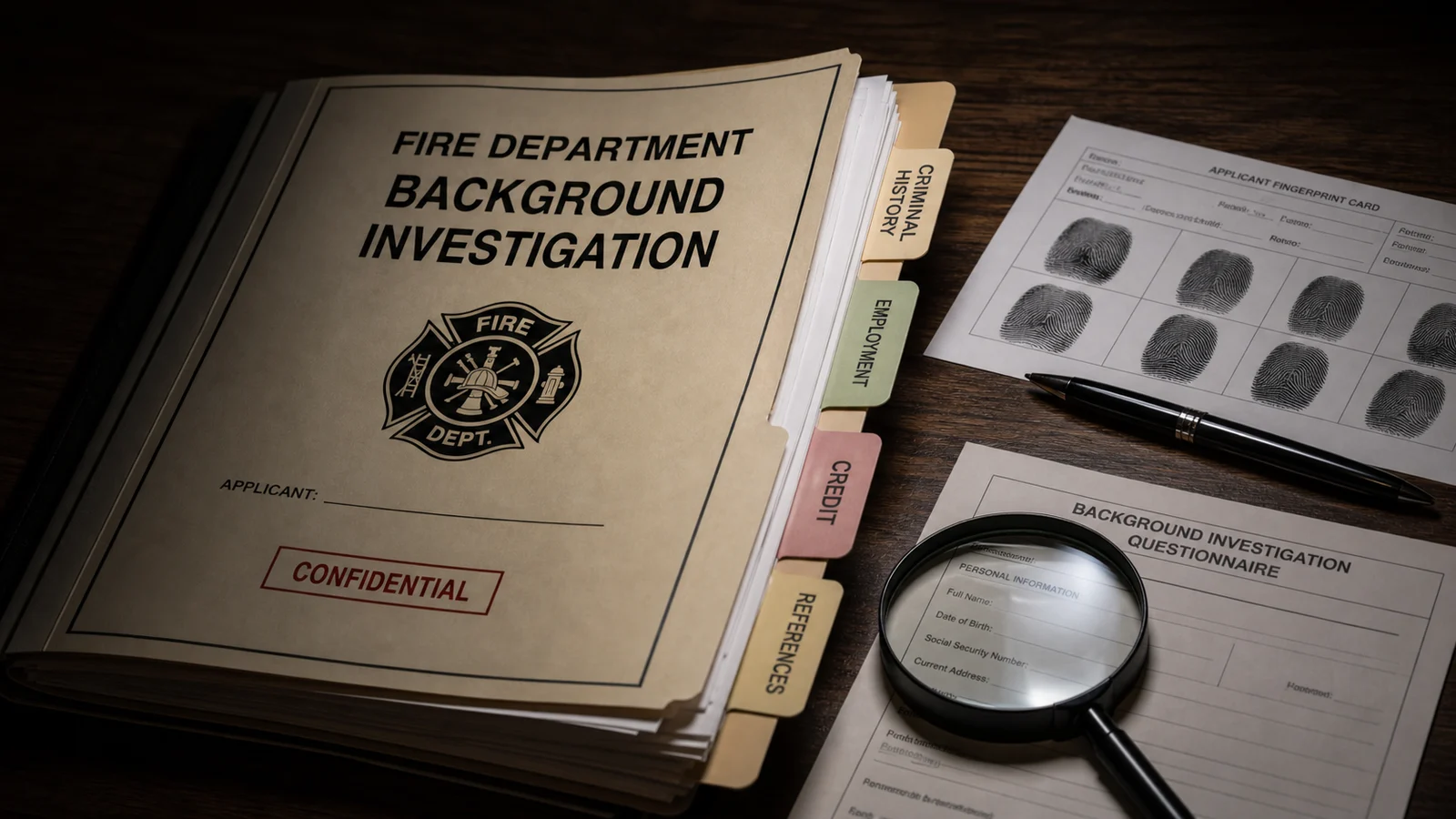
A fire department is a public-trust job. Crews enter homes, handle medical emergencies, carry keys and access to buildings, and often work with minors and vulnerable people. That is why the background investigation is one of the longest steps in the hiring process, usually after the written exam, the physical ability test, and the interviews. It typically covers criminal history, driving record, employment history, and references, and may include a polygraph or a detailed personal-history questionnaire.
Departments generally handle criminal history in one of three ways:
- 1Permanent bar. Any felony conviction ends the application, no matter how old.
- 2Time window. A felony disqualifies you for a set number of years, and older convictions are reviewed case by case.
- 3Whole-person review. Nothing is automatic. The offense type, age at the time, years since, and everything you have done since are weighed together.
Certain categories are treated as nearly universal disqualifiers: arson, sex offenses that require registration, crimes against children, and offenses involving violence or abuse of a position of trust. Crimes of dishonesty, such as theft and fraud, also weigh heavily because the job depends on being trusted inside people's homes.
What Published Department Standards Actually Say
Rules differ a lot, and the best way to understand the range is to read real ones. These are summaries of standards published by individual departments. They are examples, not a national rule, and departments update them.
| Department | What its published standard says |
|---|---|
| Salt Lake City Fire Department (UT) | The chief will not recommend hiring anyone convicted of a felony or of a crime that requires registration under Utah law. A DUI within two years of applying, two DUIs at any time, and a domestic violence or assault conviction also disqualify. |
| Clayton County Fire & Emergency Services (GA) | Any felony conviction, any crime of moral turpitude, any family violence conviction, and any DUI conviction. Misdemeanors are judged on frequency, seriousness, and relevance to the job, and driving violations are scored on a point system. |
| Marietta Fire Department (GA) | Criminal history is checked across federal, state, county, and city records, and a plea of no contest counts as a conviction. A history of felony theft bars an applicant for life, any theft within the prior 12 months also disqualifies, and a reckless driving or racing conviction within five years does too. |
| Departments using time windows | A commonly cited model bars a felony committed as an adult within the past 10 years and reviews older ones case by case, along with limits on repeated misdemeanors and recent license suspensions. |
Two things stand out when you read these side by side. First, a plea of no contest or a deferred outcome often counts the same as a conviction. Second, the felony question is rarely the only one: DUIs, domestic violence, and driving history appear in nearly every list, because firefighters drive apparatus.
The EMT License Is a Second Hurdle
Most career departments require an EMT or paramedic certification, and that license is issued by a state EMS agency, not by the fire department. The state runs its own fingerprint-based criminal history check, under its own rules, completely separate from the department's background investigation. You can pass one and fail the other. A candidate whose record a department is willing to overlook can still be refused an EMS license, and without the license the fire job is usually off the table.
State EMS rules vary widely: some review each case, some look at specific offense types or the time since conviction, and some are stricter about patient-care-related offenses. If you are planning a path into the fire service with a record, find out your state EMS agency's policy on convictions early, before you spend money on a course.
Misdemeanors, DUIs, and Driving Records
A felony is not the only thing that can end an application. Departments routinely look at:
- ✓DUIs. Many have a look-back period (two to five years is common), and several treat a second DUI as disqualifying at any time.
- ✓Domestic violence and family violence. Treated as serious even at the misdemeanor level.
- ✓Drug offenses and recent drug use. Possession or use of controlled substances without a prescription, and any positive pre-employment screening.
- ✓Repeated minor offenses. A pattern of several misdemeanors in a short window can matter more than one older mistake.
- ✓Driving record. A suspended or revoked license, multiple at-fault accidents, or several moving violations in recent years. You will drive a fire engine, so a valid license is a core requirement.
Expunged and Sealed Records
Expungement can help, but it is not a guaranteed clean slate. Laws differ by state, and public-safety employers are often treated differently from private ones: many fire departments are allowed to see sealed or expunged records during a background check, and some applications ask about them directly. Whether you must disclose an expunged conviction depends on your state's law and on the exact wording of the question on the application. Read that wording carefully, and if there is any doubt, get advice from an attorney who handles record clearing in your state before you answer.
Juvenile records are a similar gray area. Some departments review them case by case rather than treating them as automatic bars, but sealed does not always mean invisible to a public-safety investigation.
Volunteer and Fire-Adjacent Roles
Volunteer departments are often more flexible, but they are not a free pass. Many now run state and federal fingerprint background checks on every member; Delaware, for example, requires one for anyone applying to a volunteer company. Standards depend on the individual company and its insurer. Time in a volunteer department can build certifications and a track record, but it will not erase a disqualifier at a later career application.
Roles near the fire service sometimes have less strict requirements than a sworn firefighter position. Civilian fire inspectors, fire protection technicians who service alarm and sprinkler systems, and some dispatch or administrative jobs fall in that group, though many still require a background check. They are worth considering as a way to work in the field while a longer-term plan develops. Federal wildland fire jobs run their own suitability reviews, so check the hiring agency's rules rather than assuming they match a municipal department.
The California Fire Camp Pathway
California runs the most developed route for people with records. Incarcerated people who volunteer for the state's conservation camp program train with CAL FIRE and work on fire crews, and for years they came home with real wildland experience and no way to be hired because of their convictions. Two things changed that.
- ✓AB 2147 (signed September 2020). It created an expedited expungement process for formerly incarcerated people who served on a California conservation camp fire crew, aimed at removing barriers such as EMT certification so they can apply for firefighter jobs. The state describes it as covering non-violent offenses.
- ✓The Ventura Training Center. Opened in 2018 by CDCR, CAL FIRE, and the California Conservation Corps with the Anti-Recidivism Coalition, it gives parolees who served on fire crews enhanced firefighter training and certifications. The state reports that more than half of recent graduates went on to full-time firefighting jobs with state, local, and federal agencies. Eligibility has excluded people convicted of arson, sex offenses, or escape.
This pathway applies to California fire camp participants specifically, and it is not available as a general route for everyone with a record. But it shows what departments will accept when training, supervision, and a legal clearing process are in place, and a non-profit, the Forestry and Fire Recruitment Program, supports people moving through it.
Why Honesty on the Application Matters Most
Background investigators expect to find things. What they do not forgive is finding something you did not tell them. Many departments treat a false or incomplete answer as its own disqualifier, separate from the underlying offense, because the job rests on trust and on reporting accurately. An old conviction that might have been weighed fairly can end an application permanently once it looks like you hid it.
If you have a record, the strongest position is a complete, accurate disclosure, an honest explanation of what happened, and clear evidence of what you have done since: steady employment, completed education, community involvement, and years of clean history.
What to Do Next
- Get your own record. Request your court records and background report so you know exactly what a department will see, including dispositions, dates, and anything dismissed or deferred.
- Read the target department's standards. Most publish a disqualifier list on their recruitment page. Compare yours to it, and check civil service rules where they apply.
- Check your state EMS agency's policy on convictions before paying for an EMT course.
- Talk to an attorney about expungement, sealing, certificates of rehabilitation, or restoration of rights in your state.
- Ask the department directly. Many recruiters will tell you in advance whether a specific conviction is disqualifying, which can save months.
- Consider stepping stones: a volunteer company that accepts your record, civilian fire-service work, or a state program like California's.
Common Questions
Can a felon be a firefighter?
There is no federal ban, but many career departments disqualify any felony conviction, and others apply time windows or review each case. It depends on the department, the offense, and how long ago it happened.
Can you be a volunteer firefighter with a felony?
Sometimes. Volunteer companies set their own standards and are often more flexible, but many now require state and federal fingerprint background checks, and offenses like arson or sex offenses are disqualifying nearly everywhere.
Can you get an EMT license with a felony?
It depends on your state. State EMS agencies run their own criminal background check, separate from the hiring department's, and review convictions under their own rules.
Does an expunged felony still show up for a firefighter job?
It can. Many public-safety employers are allowed to see sealed or expunged records, and some applications ask about them. Rules vary by state, so get legal advice before deciding how to answer.
Does a DUI disqualify you from being a firefighter?
Often, for a period of time. Some departments bar a DUI within two years or more of applying, and some treat two DUIs as disqualifying permanently. Any DUI is a bar at some departments.
How long after a felony can you become a firefighter?
There is no universal waiting period. Some departments use a window such as 10 years, others never allow it, and others decide case by case. At a minimum, you generally need to have finished all sentence, probation, and parole terms.
What crimes automatically disqualify you from firefighting?
Arson, offenses requiring sex-offender registration, and crimes involving violence, abuse, or crimes against children are disqualifying at nearly every department. Dishonesty offenses like felony theft and fraud are also treated very seriously.
The fire service does not forgive everything, and for many people with a felony the honest answer is that a career department is out of reach. But the rules are not identical everywhere, and the difference between a closed door and a long, narrow path often comes down to knowing exactly what a department asks, and answering it truthfully.

Comments 0
No comments yet. Be the first to share your thoughts!
Leave a Comment