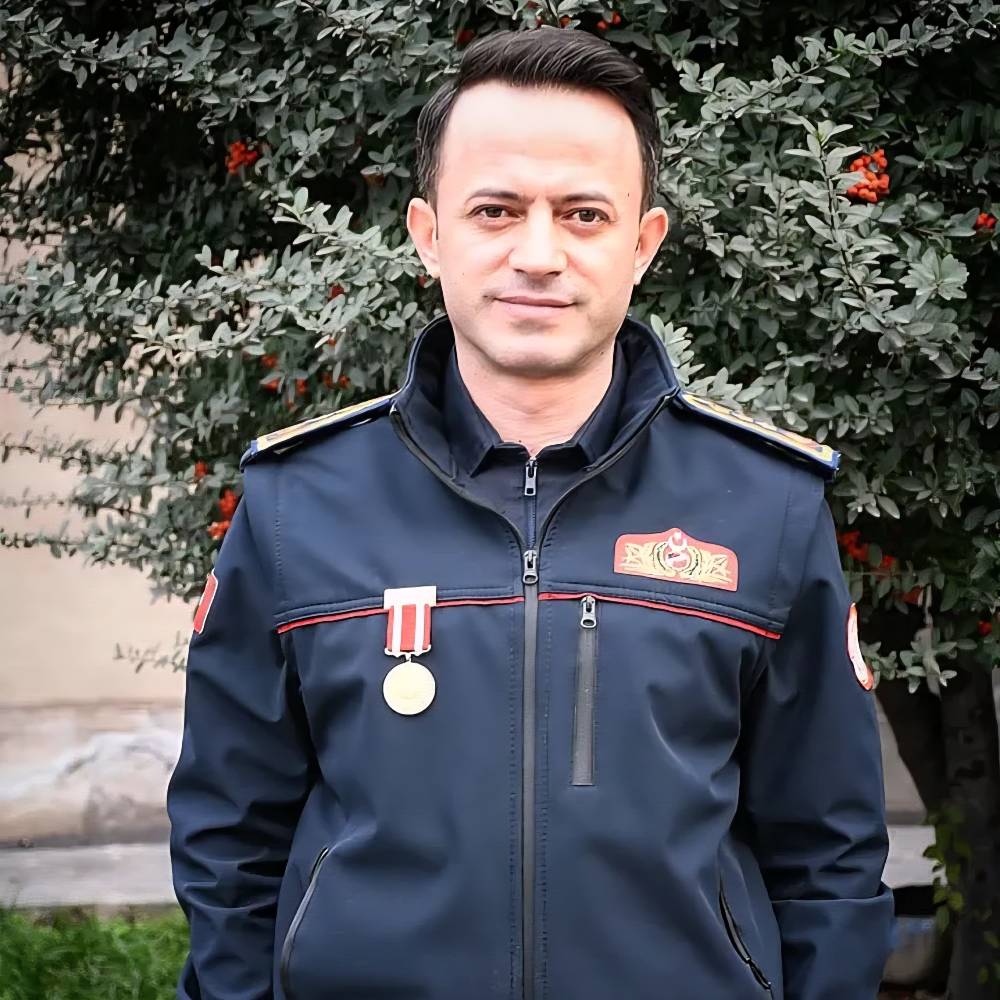
Koray Korkut is the Fire Department Director (İtfaiye Müdürü) of the Karabük Municipality Fire Department, appointed to the position in 2020. Born in 1984 in Karabük, Turkey, he began his career as a Firefighter with the Istanbul Metropolitan Municipality Fire Department in 2007, transferred to the Ankara Metropolitan Municipality Fire Department in 2010 where he served as Firefighter Sergeant and Fire Officer, and was appointed Fire Department Director at Karabük in 2020. He has responded to 1,000+ structural fires and 10+ major incidents including earthquakes, large wildland fires, and hazmat emergencies. He has been awarded the State Distinguished Service Medal of Turkey (Devlet Üstün Fedakarlık Madalyası). He holds an associate degree in Emergency and Disaster Management (Acil Durum ve Afet Yönetimi) and a bachelor\'s degree in Public Administration from Anadolu University. He is a certified Level 4 Fire Instructor and Level 2 Work at Heights Instructor.
Chlorine gas is one of the most common hazmat incidents in the United States — present at water treatment facilities, swimming pools, industrial chemical operations, and in transit as a compressed gas. It is yellow-green, heavier than air, detectable at low concentrations by its distinctive bleach-like odor, and immediately dangerous to life at concentrations achievable from a moderate leak within minutes. This covers chlorine's physical and toxicological properties, how it pools in low areas, the upwind-uphill positioning that determines whether responders become patients, product control vs. dilution options, shelter-in-place vs. evacuation decisions, and what you should do — and not do — if you encounter a chlorine release.
About 160 Christmas tree fires occur in U.S. homes each year — but those fires kill at a rate more than ten times higher than other residential fires. A dry tree in a living room can reach flashover in under 30 seconds. This covers why tree dryness is the primary variable, the real vs. artificial risk comparison, how much water a tree actually needs, light string hazards by type, placement mistakes that change evacuation geometry, and why December 26 is the peak day for tree fires.
Confined space rescue guide: permit-required spaces, atmospheric hazards (O2 deficiency, H2S, CO, flammable gas), atmospheric testing sequence, initial response actions, non-entry vs entry rescue, PPE, and Operations vs Technician-level roles.
The patient trapped under building collapse rubble for hours may be alert, talking, and appear relatively stable — until you free them. The moment compression releases, the accumulated byproducts of muscle destruction flood into circulation and the patient can deteriorate rapidly from kidney failure, dangerous arrhythmias, and metabolic crisis. This covers the physiology of rhabdomyolysis, the 'smiling patient' problem, why aggressive IV fluid loading before extrication is the key intervention, and how EMS manages the time between release and hospital.
Roughly 90 percent of homes that burn in wildfires are ignited by embers — not by direct flame contact with the structure. Defensible space addresses this by creating a buffer that reduces ember accumulation and gives firefighters a position to defend the structure from. Zone 0 (the immediate 5 feet) is the most important and least understood. Zone 1 (5–30 feet) must remove the continuous fuel path. Zone 2 (30–100 feet) reduces fuel density. This covers what each zone requires, what vegetation matters, ember-resistant venting and construction, and the specific mistakes that let homes burn when others survive.
Electrical fires almost never start without warning. Flickering lights, burning smells from outlets, breakers that trip repeatedly, discolored switch plates — your home gives you days or weeks of signals before an electrical fire starts. Here's what each sign means and what to do about it.
The fire apparatus that parks in front of your house fire today is the product of 200 years of iterative engineering, each generation solving the specific problem that killed the generation before it. The hand-pump engines of the 1700s were limited by the number of men available to pump them. The steam pumpers of the 1850s were limited by the time it took to build steam pressure. The motorized apparatus of the 1920s was limited by tire technology. Every limitation that killed people or lost buildings drove the next development. This covers the complete developmental arc — bucket brigades, hand pumpers, horse-drawn steam pumpers, early motorized apparatus, the aerial ladder, post-WWII standardization, and the electronics-integrated apparatus of today — and where electric fire apparatus fits into the next generation.
FDNY has 143 ladder companies and none of them pump water. They force entry, search, ventilate, place ladders, rescue, and overhaul — simultaneously with the engine attack. This covers the LOVERS framework, why the chauffeur's positioning decision determines everything, forcible entry in NYC's specific building stock, the outside vent position, roof operations on a brownstone, and the difference between straight-stick aerials and tower ladders.
FDNY Special Operations Command is the umbrella organization for every specialized unit in the department: five Rescue Companies, four Squad Companies, Hazmat Battalion 1, Marine Division, and Technical Rescue teams. These units respond to the incidents that fall outside what engine and ladder companies are trained and equipped to handle — structural collapse, confined space, trench rescue, water rescue, hazardous materials, and high-angle operations. This covers what each SOC unit does, how they are dispatched, what the training and selection process looks like, and how SOC operates at a major incident alongside regular department companies.
Vacant and abandoned buildings produce firefighter fatalities at a rate that is disproportionate to their share of the fire call volume. They burn hotter, faster, and with less warning of structural compromise than occupied buildings that have been maintained. They have no occupants to rescue — removing the primary justification for offensive interior operations. And they create a tactical problem that is harder to resolve than it sounds: distinguishing a building that is safely vacant from one that has become home to people who cannot or will not be identified on arrival. This covers the structural degradation factors that make vacant buildings dangerous, FDNY's vacant building operations protocol, how the hazardous building database informs the response, and the specific conditions under which FDNY commits to offensive vs. defensive operations in buildings known to be abandoned.
The first apparatus to arrive at a working structure fire makes a positioning decision that every subsequent company must work around. An engine parked in front of the door blocks the aerial. An engine parked over the hydrant prevents supply. An engine parked in the collapse zone may not leave. Positioning is not a secondary consideration to be sorted out on arrival — it is part of the tactical decision that begins with the dispatch and ends with the outriggers down or the wheels chocked. This covers collapse zone calculation, aerial positioning angles, hydrant approach sequence, how multiple companies coordinate positioning, and the specific mistakes that produce operational problems at working fires.