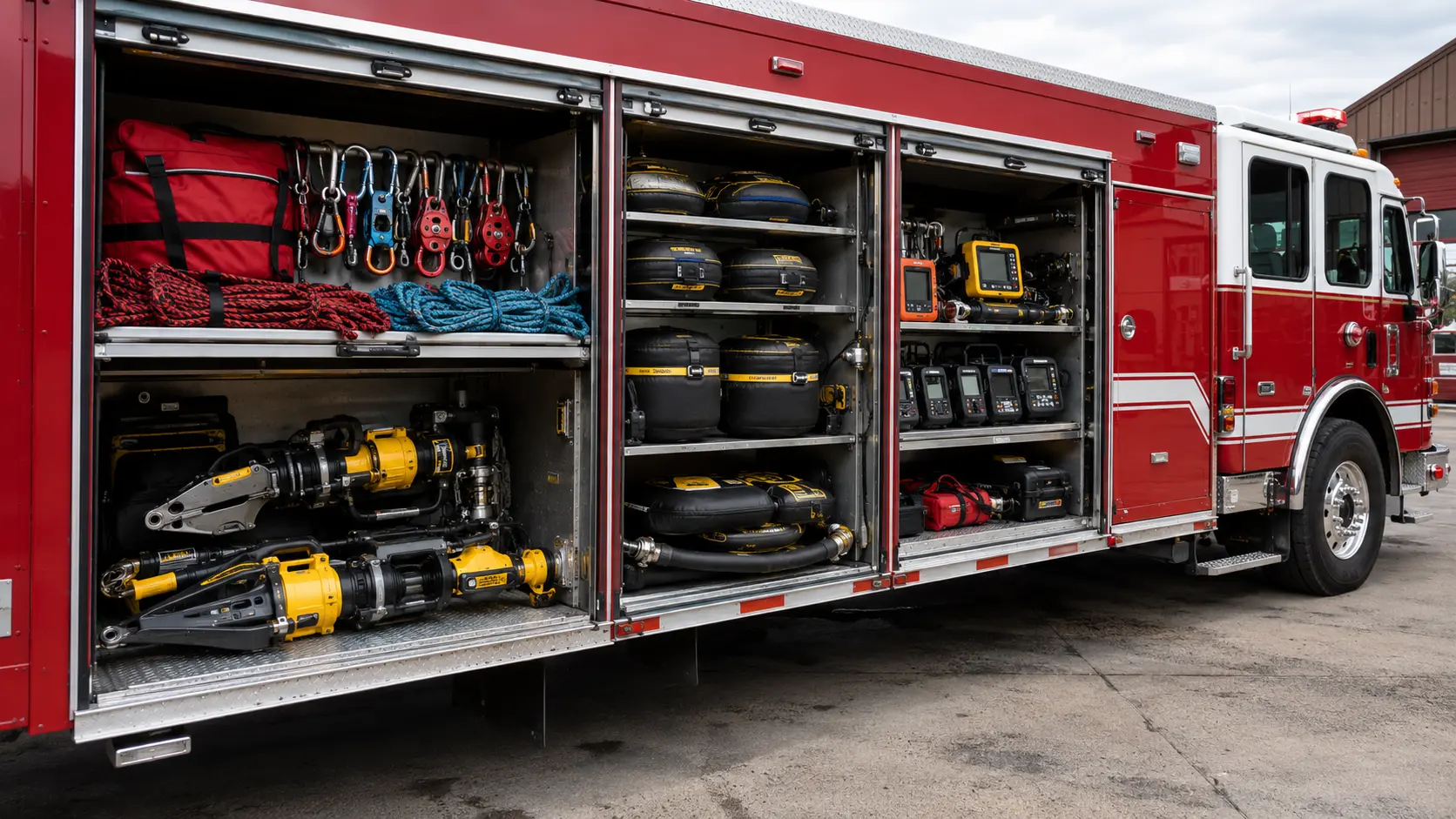

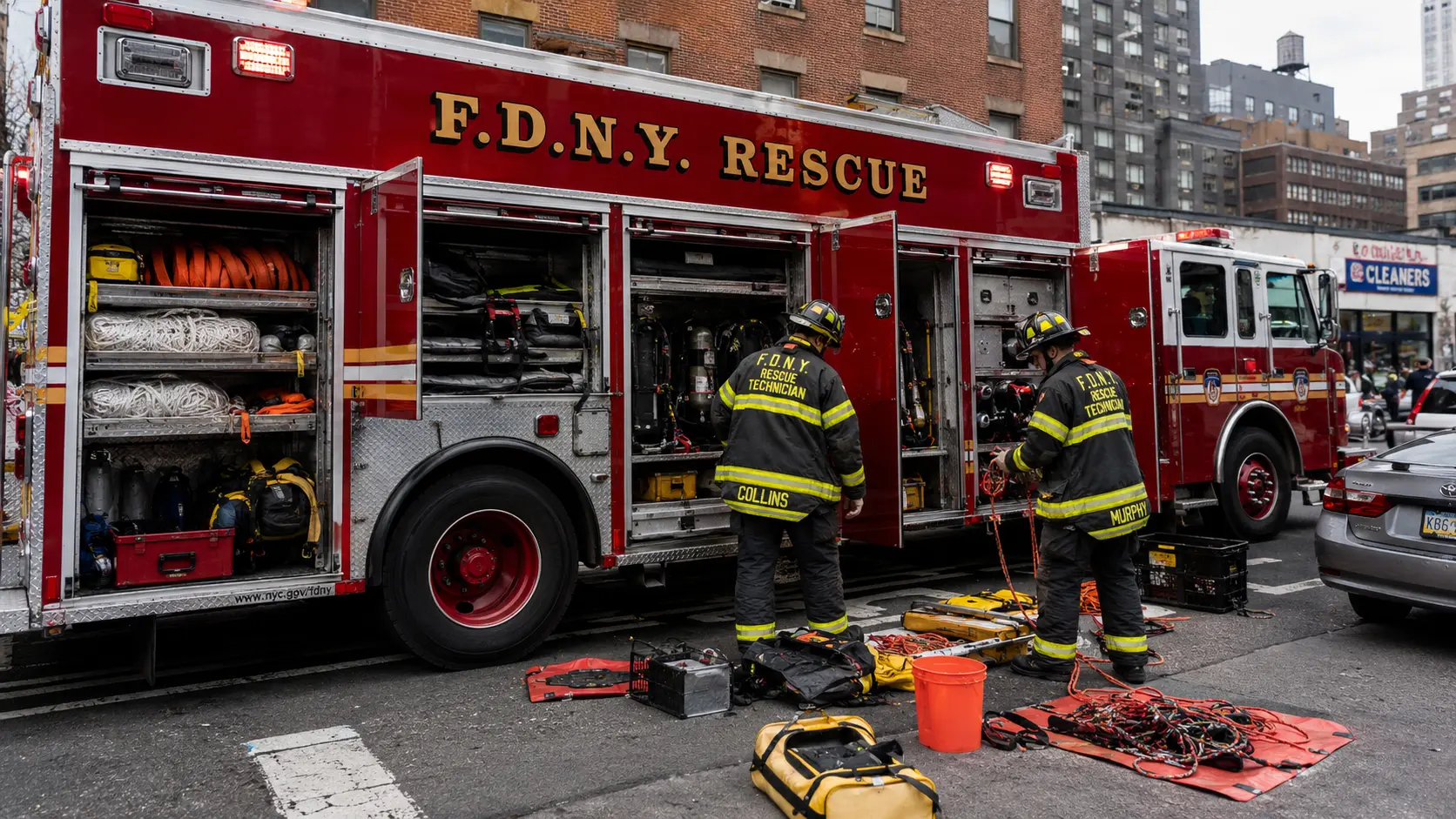
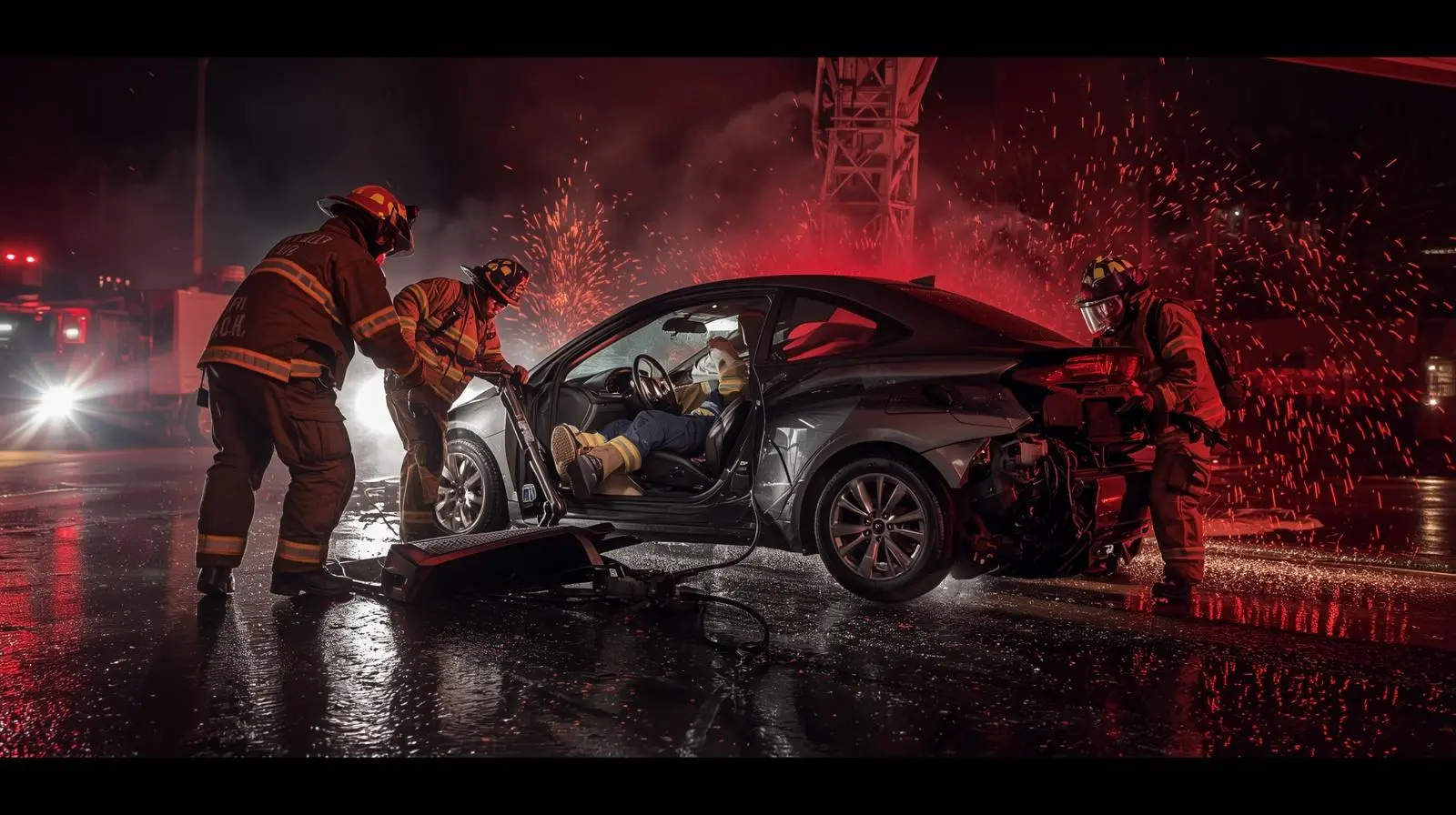
The first time most people see a heavy rescue unit is at a major vehicle accident on the highway, when a large box-bodied truck parks perpendicular to traffic and firefighters start pulling hydraulic cutters, spreaders, airbags, and tool boards from compartments that seem to hold an implausible quantity of equipment. What they are seeing is the result of decades of deliberate curation — every item on that truck earned its place by being necessary for a specific scenario that the rescue crew trains for repeatedly and that no other apparatus is equipped to handle.
A heavy rescue unit represents a fundamentally different apparatus category from engines, ladders, and tankers. The others carry equipment for a defined primary mission. The rescue carries equipment for many different specialized missions, each requiring dedicated tools and dedicated training, and each relatively infrequent but catastrophically important when it occurs.
In this article:
Vehicle Extrication Equipment
Vehicle extrication — removing victims who are trapped in a motor vehicle following an accident — is the most frequent technical rescue deployment for most heavy rescue units. The core equipment:
- Hydraulic rescue tools (HRT/Jaws of Life): Spreaders that open jammed doors or create space between structural elements, cutters that sever vehicle structural members including A, B, and C pillars and the roof, and rams that push or pull components to create working space. Modern HRT uses battery-powered hydraulics that eliminate the hose management complexity of older gas-powered systems.
- Pneumatic lifting airbags: High-pressure bags (up to 150 psi) that can lift enormous loads — a fully loaded dump truck — from minimal height clearance. Used to lift vehicles off trapped victims, stabilize overturned vehicles, and create space under collapsed structures where hydraulic rams cannot be positioned.
- Vehicle stabilization equipment: Step chocks, cribbing lumber in various sizes, Rescue 42-style stabilization struts, and ratchet straps — used to prevent a damaged vehicle from shifting during extrication, which could increase patient injury.
- Reciprocating and rotary saws: For cutting vehicle body panels, windshields, and components that hydraulic tools cannot address effectively. Glass management tools — spring-loaded center punches, window pulls — for controlled glass removal.
Structural Collapse Tools
Structural collapse rescue — finding and extracting victims from partially or fully collapsed buildings — requires a different tool set from vehicle extrication, though some overlap exists in lifting and cutting capability.
- Search equipment: Acoustic listening devices that amplify sound through concrete and rubble, fiber-optic search cameras that can be extended into void spaces too small for human entry, electronic victim search devices, and trained search dogs in some departments.
- Breaching and breaking: Electric rotary hammers, pneumatic chisels, and diamond-blade saws for controlled breaching of concrete and masonry walls to reach void spaces without destabilizing the remaining structure.
- Shoring and stabilization: Pneumatic shores, hydraulic shores, and engineered timber shoring systems for stabilizing unstable structural elements before crews work in or near them. Rescue shores, Paratech Airshore systems, and custom-cut timber are all carried.
- Rigging equipment: Chain hoists, come-alongs, high-lift jacks, and rigging hardware for moving structural debris under controlled conditions.
Confined Space Rescue Equipment
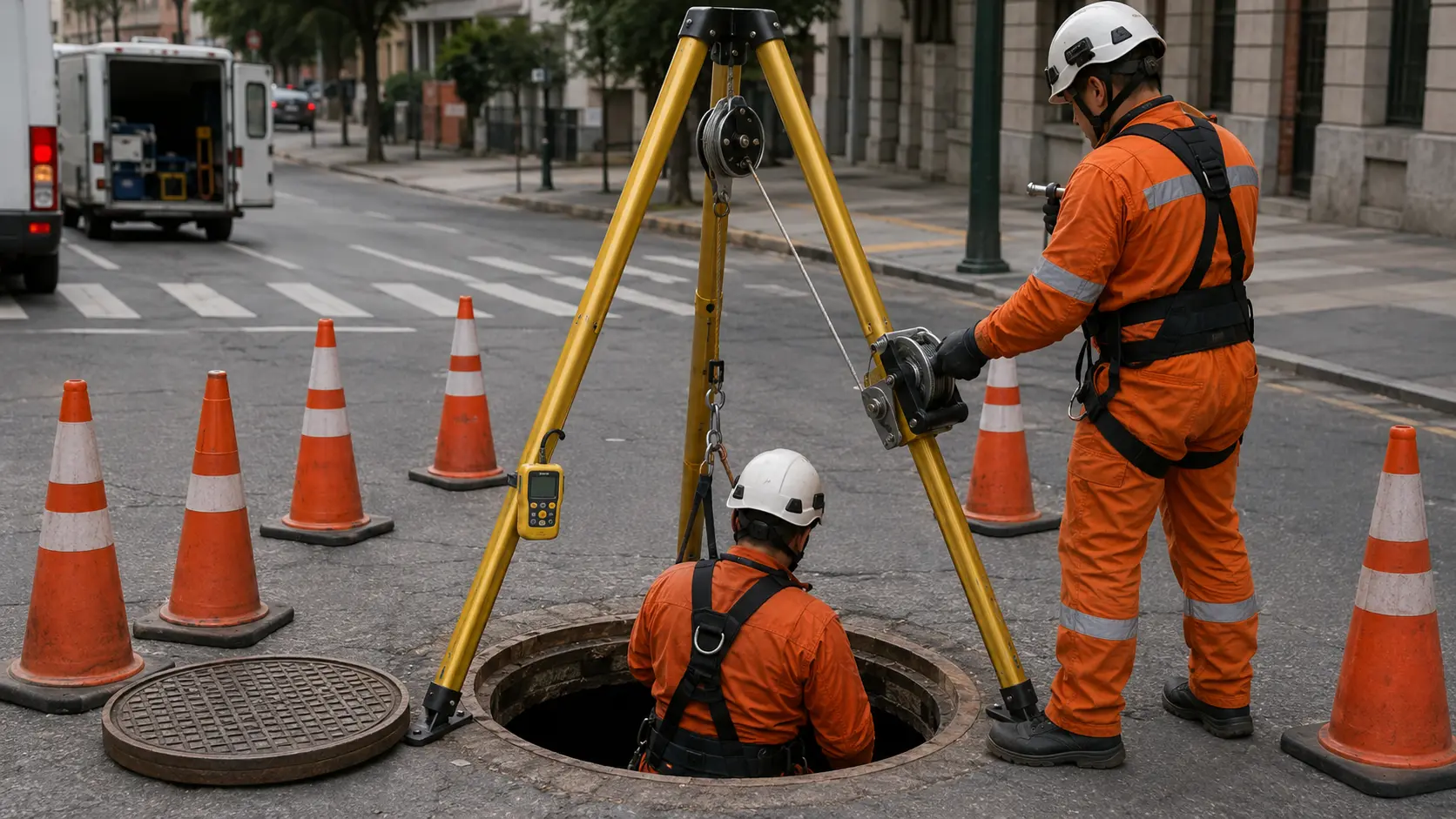
Confined space rescue requires atmospheric monitoring, retrieval systems, and appropriate respiratory protection — equipment not carried on standard engine or ladder companies.
- Multi-gas atmospheric monitors: Devices measuring O2%, LEL%, CO ppm, and H2S ppm simultaneously, with logging capability for incident documentation. Multiple units are carried — one for pre-entry monitoring lowered on a rope, one worn by the entry team.
- Rescue tripod and mechanical advantage retrieval system: Aluminum tripods of various sizes, winches, and rope systems for non-entry retrieval and for recovering a downed entrant from the surface without additional entry.
- Supplied air breathing apparatus (SABA): Alternative to SCBA for extended confined space entry — a long hose supplying air from a large compressor or cylinder at the surface, eliminating the 30-minute time limit of an SCBA cylinder. Can supply a confined space entrant for hours rather than minutes.
- Ventilation equipment: Electric explosion-proof blowers and ducting for purging confined space atmospheres before entry.
Rope Rescue Systems
High-angle and low-angle rope rescue — recovering victims from cliff faces, steep terrain, elevated structures, and deep vertical shafts — requires technical rigging equipment that ladder-based rescue cannot provide.
- Life safety rope: Static kernmantle rope in 200 to 600-foot lengths, rated for the dynamic loads of rescue operations. Multiple ropes for main line and belay system operation.
- Rigging hardware: Aluminum and steel carabiners, pulleys, descenders (ATCs, rappel racks, Munter hitches), ascenders (Jumars), and progress capture devices (Prusiks, Ropemans) for mechanical advantage systems.
- Edge protection: Aluminum edge rollers and pads to prevent rope abrasion over building edges and cliff lips.
- Rescue litters: SKED flexible litters for victim packaging in confined spaces, Ferno-Washington basket litters for open-air lowering operations, and shorty litters for elevator shaft rescues.
- Descender/ascender harnesses: Full-body rescue harnesses rated for the dynamic loads of lowering and raising operations.
Trench Rescue Equipment
As covered in the trench rescue article elsewhere on this site, trench rescue requires shoring before any entry can be made. Heavy rescue units carry the complete shoring inventory:
- Pneumatic shores in multiple extension ranges
- Hydraulic shores for larger trenches
- Timber shoring lumber and wedges for custom configurations
- Trench boxes or panel systems for wider excavations
- Soil assessment tools and reference guides for OSHA soil classification
Water Rescue Equipment
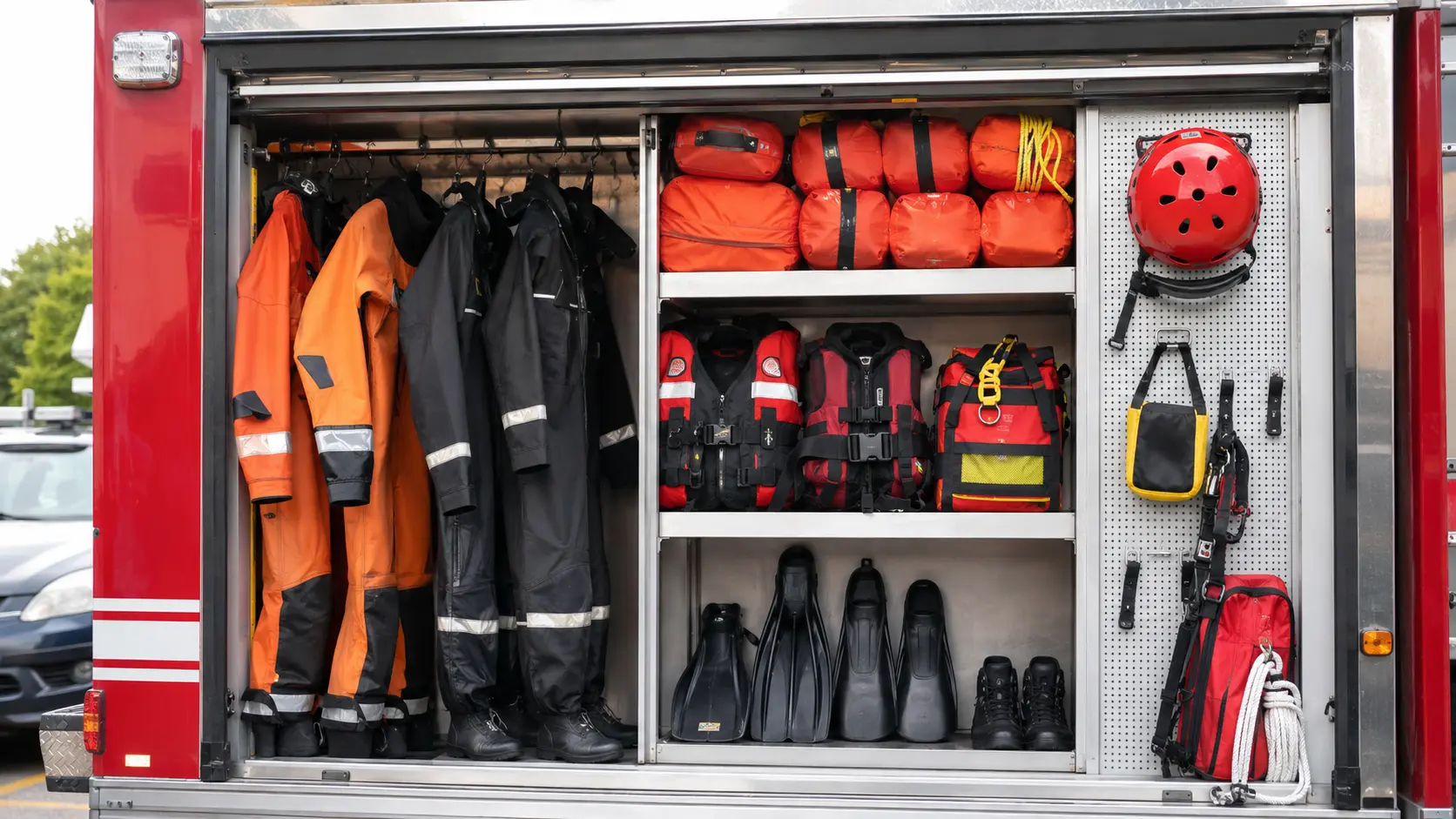
Water rescue capability on a heavy rescue unit includes surface water rescue equipment (throw bags, rescue boards, ring buoys, PFDs), swift water rescue suits and helmets, and in many departments, underwater dive rescue equipment — full public safety diving gear including dry suits, regulators, tanks, and underwater search equipment. The dive capability allows recovery operations in rivers, lakes, harbors, and flooded structures where surface rescue techniques are insufficient.
Advanced Medical Equipment
Heavy rescue units carry medical equipment beyond the standard BLS kit on engines and ladders. Because rescue calls frequently involve victims who have been trapped for extended periods, require specialized extrication that takes significant time, or have injuries requiring advanced management before hospital arrival, the rescue carries ALS-level equipment including:
- Cardiac monitor/defibrillator with 12-lead EKG capability
- Advanced airway management equipment (video laryngoscope, surgical airway kit)
- IV access and fluid infusion
- Advanced pain management and sedation medications for prolonged extrications
- Crush syndrome IV fluid protocol supplies (for extended entrapment)
- Tourniquet and hemorrhage control supplies beyond standard first aid kits
Apparatus Design and Layout
Heavy rescue units are typically built on commercial truck chassis — Freightliner, International, or similar — with custom body work that maximizes usable compartment space while maintaining structural integrity for tool mounting loads. A standard heavy rescue body is 16 to 20 feet in length, with compartments on both sides and at the rear, and a walk-in body configuration that provides interior working space for crew equipment preparation en route.
Tool organization is systematized to the point where any crew member can find any piece of equipment in the dark, under stress, having just arrived at a scene. Toolboards with painted outlines show exactly where each tool belongs. Drawers with labeled contents prevent the "where is the ___" problem during an operation. Equipment is restocked after every use and checked at the start of every shift.
Training and Selection Requirements
Assignment to a rescue company in departments with competitive processes requires documented training at the technician level in multiple rescue disciplines. NFPA 1670 defines operations and technician levels for each technical rescue discipline — structural collapse, vehicle extrication, trench rescue, confined space, rope rescue, and water rescue each have their own NFPA standard. A rescue company member is expected to hold technician certification in all of them.
The training load is substantial. Rope rescue technician certification alone typically requires 40 hours of field-based training beyond basic firefighter certification. Structural collapse technician adds another 40 hours. Confined space and trench each add similar requirements. The complete training path to a fully qualified rescue company assignment can represent several hundred hours of specialized training beyond basic firefighter and EMT certification.
Integration With Engine and Ladder Companies
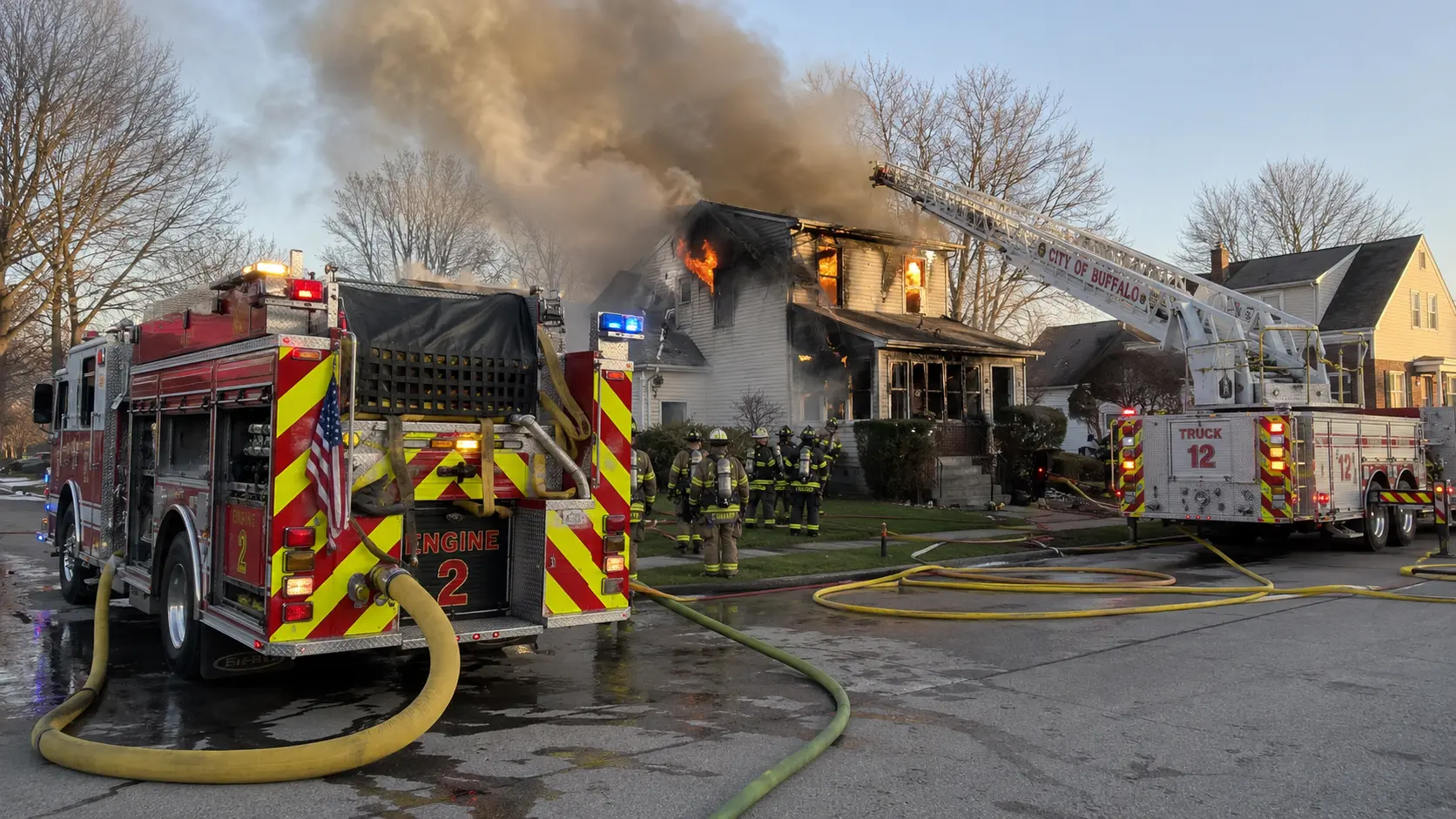
At most incidents, the rescue company works alongside the engine and ladder companies rather than independently. At a vehicle accident, the rescue handles extrication while an engine provides fire suppression standby and EMS manages patient care. At a structural fire, the rescue performs the highest-risk search operations and any technical rescue that the ladder cannot handle, while engines attack the fire and ladders perform their standard functions.
The rescue company officer is typically the most technically experienced officer on scene for incidents within their specialty, and they may assume operational command of the rescue operation while the incident commander manages overall scene coordination. The coordination between rescue operations and fire suppression — ensuring that suppression actions do not compromise rescue operations, and vice versa — is the incident commander's responsibility, coordinated in real time with the rescue officer.

Comments 0
No comments yet. Be the first to share your thoughts!
Leave a Comment