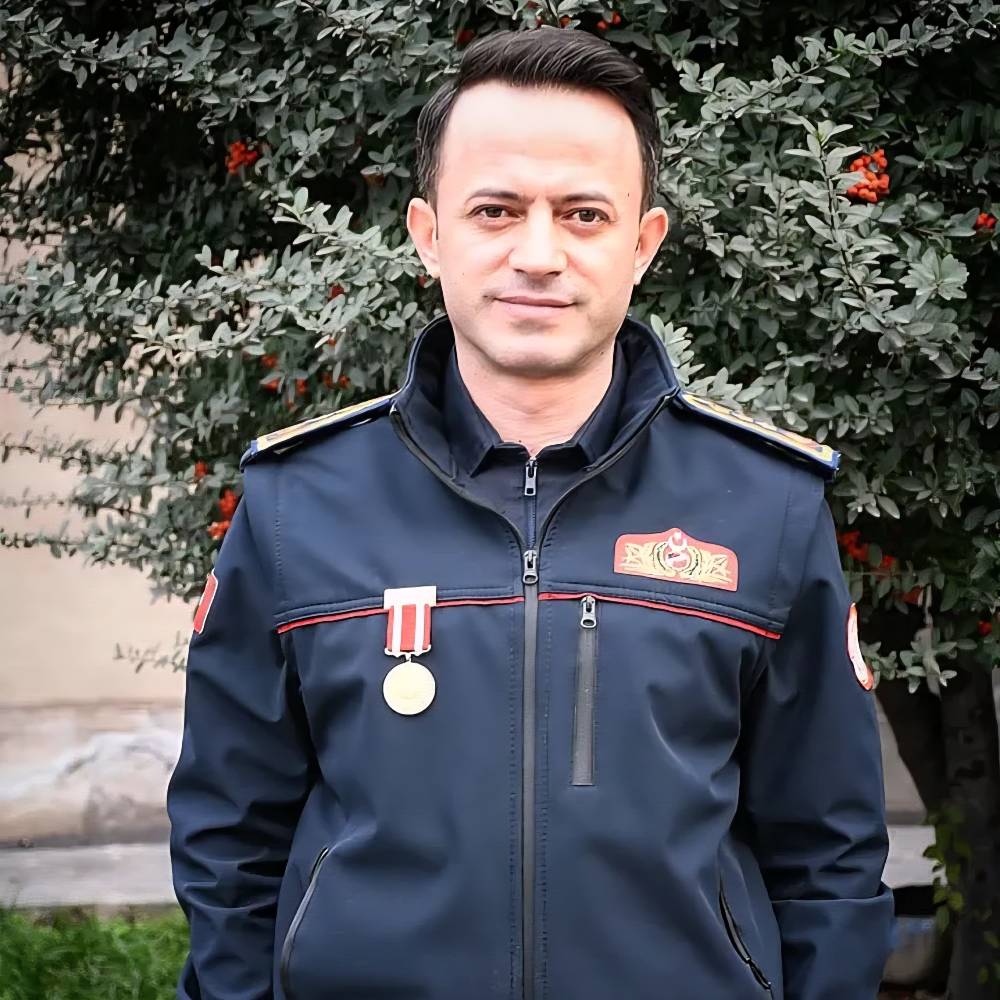
Koray Korkut is the Fire Department Director (İtfaiye Müdürü) of the Karabük Municipality Fire Department, appointed to the position in 2020. Born in 1984 in Karabük, Turkey, he began his career as a Firefighter with the Istanbul Metropolitan Municipality Fire Department in 2007, transferred to the Ankara Metropolitan Municipality Fire Department in 2010 where he served as Firefighter Sergeant and Fire Officer, and was appointed Fire Department Director at Karabük in 2020. He has responded to 1,000+ structural fires and 10+ major incidents including earthquakes, large wildland fires, and hazmat emergencies. He has been awarded the State Distinguished Service Medal of Turkey (Devlet Üstün Fedakarlık Madalyası). He holds an associate degree in Emergency and Disaster Management (Acil Durum ve Afet Yönetimi) and a bachelor\'s degree in Public Administration from Anadolu University. He is a certified Level 4 Fire Instructor and Level 2 Work at Heights Instructor.
A modern fire pumper carries between 2,000 and 3,000 individual items — every one of them there because a specific operational need demanded it. The hose beds hold the attack lines and supply hose in a specific configuration that allows deployment in seconds. The tool compartments hold forcible entry, overhaul, and utility control equipment in a location that allows the right person to access it without crossing the hoseline. The EMS compartment holds life-saving medical equipment that may be needed before the fire is even reached. This covers the layout logic, what each compartment zone typically carries, the pump panel, the booster system, SCBA storage, foam systems, and the specific design decisions that explain why modern pumpers are built the way they are.
The same battery chemistry that burns in EV fires is in your phone, your laptop, your kid's hoverboard, and your e-bike charger. Lithium-ion battery fires in the home are increasing every year as these devices multiply. Here's what causes them, what a battery fire looks like in its early stages, and what to do when one starts.
MCI guide: what defines a mass casualty incident, START triage algorithm step-by-step, triage tag color system, JumpSTART for pediatrics, sector assignments, ICS structure at MCI, transport priority, hospital coordination, and special MCI types.
Hazmat training focuses heavily on Level A suit operations, chlorine emergencies, nerve agent protocols, and industrial chemical releases. The actual hazmat call volume in most fire departments is dominated by natural gas leaks, carbon monoxide alarms, fuel spills, and unknown odor calls — incidents that require atmospheric monitoring, safe work procedures, and clear decision-making about when to act and when to call for the hazmat team. The gap between what training emphasizes and what calls actually occur produces departments that are technically prepared for rare complex incidents but under-practiced on the common ones. This covers the actual distribution of hazmat call types, the operational decisions each type requires, and what the most common calls actually involve.
Opioid overdoses have become one of the most common EMS calls in the United States. Here's exactly what firefighters and paramedics do when they arrive on scene — from naloxone dosing and airway management to crew safety and harm reduction.
A quint is a single piece of fire apparatus that carries the five capabilities defining both an engine and a ladder: a pump, a water tank, hose, ground ladders, and an aerial device. It was designed as a cost-reduction and staffing-efficiency tool for departments that cannot justify separate engine and ladder companies. It works well in that context. It does not work well as a replacement for both company types in a department that responds to frequent simultaneous incidents — because one apparatus with one crew cannot perform engine and ladder functions at the same time. This covers the five-capability definition, when the quint makes operational sense, what it cannot replace, the ISO rating implications, the staffing mathematics, and why FDNY and other high-volume urban departments do not use them.
When a firefighter calls Mayday, seconds matter. This guide explains how Rapid Intervention Teams (RIT) operate, the tactics they use, the equipment they deploy, and how departments train for firefighter rescue operations.
Complete firefighter rope rescue guide: high-angle vs low-angle classification, essential knots and hitches, mechanical advantage systems, anchor building, patient packaging, cliff and confined space rope applications, NFPA 1006 certification levels, and rescue team size-up checklist.
When the hallway is blocked, the window is the exit. An uncontrolled 12–15 foot jump is a serious injury risk. The hang-and-drop technique cuts that fall to 6–7 feet. A commercial escape ladder eliminates it entirely for $30–60. This covers when window escape becomes the right call, the hang-and-drop technique step by step, escape ladder types and storage, whether knotted sheets actually work, window assessment, the children-first question, and the specific pre-plan that makes all of this executable under stress.
Smoke inhalation kills more fire victims than burns — and feeling okay at the scene is not a medical clearance. Three distinct injury mechanisms operate at different timescales: thermal upper airway injury that swells over hours, toxic gas injury from CO and cyanide, and particle deposition that produces pulmonary edema 24 to 48 hours later. This covers the specific symptoms that require immediate emergency care, why standard pulse oximeters miss CO poisoning, what the ER actually evaluates, hydroxocobalamin as cyanide antidote, and the long-term effects of significant exposure.
Stroke EMS guide: ischemic vs hemorrhagic stroke, BE-FAST, Cincinnati Prehospital Stroke Scale, LAMS for LVO screening, field assessment sequence, pre-hospital treatment, PSC vs CSC transport, stroke mimics, and TIA.