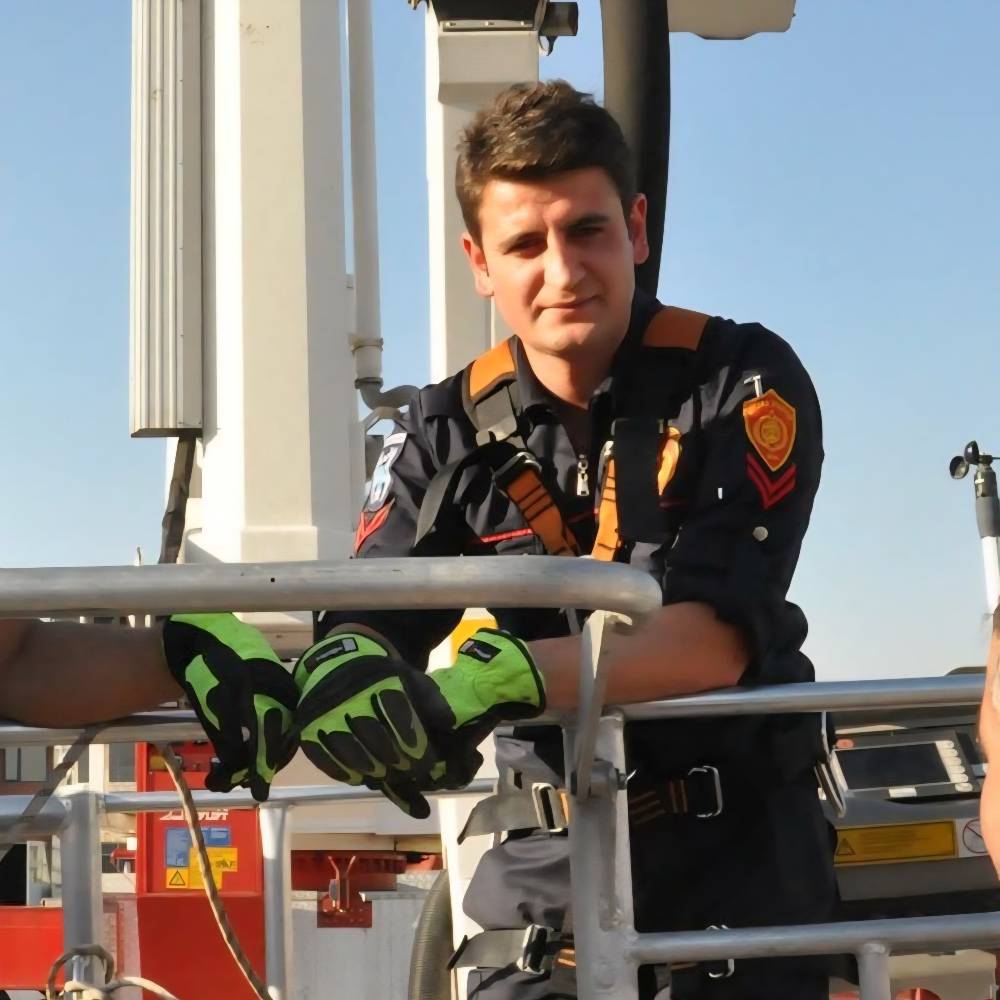
Ertuğrul Öz is a career firefighter serving with the Ankara Metropolitan Municipality Fire Department since 2011, currently holding the rank of Firefighter Sergeant (İtfaiye Çavuşu). He has responded to more than 1,000 structural fire incidents and served across three major earthquake response operations in Turkey, as well as numerous flood and water rescue deployments. He holds an associate degree in Civil Defense and Firefighting from Çankırı Karatekin University (on-campus program) and a bachelor\'s degree in Public Administration from Anadolu University (open education). His certifications include Basic Firefighter, Intermediate Search and Rescue (USAR), Hazmat/CBRN Response, First Aid, and Fire Instructor Levels 1 through 4. He has delivered 50+ firefighter training courses and serves as one of AllFirefighter\'s two editorial leads.
The diamond-shaped placard on a tank truck or rail car is the first piece of hazard information available to anyone who arrives at a transportation accident involving hazardous materials. It predates the arrival of hazmat teams, the download of safety data sheets, or the identification of the shipper. A first responder who can read a placard — who knows what the nine hazard classes mean, how to look up a four-digit UN number in the Emergency Response Guidebook, and what the orange panel system means on European-style placards — has actionable information in the first 30 seconds. This covers the DOT placard system, all nine hazard classes, UN numbers and how to use them, the ERG lookup sequence, orange panel markings, rail car specific indicators, and the specific placards that should produce immediate maximum-distance positioning.
Home fire sprinklers activate within the first minute of a fire — before the fire department arrives, before flashover, while the fire is still containable. They are not like the movies. They are not expensive. And the data on what they do to survival rates and property loss is unambiguous. Here's what a residential sprinkler system actually involves.
The three-zone structure of a hazmat incident is not a courtesy to bystanders — it is the physical and procedural mechanism that prevents the contamination inside the hot zone from spreading to the personnel and resources in the cold zone. Every person who crosses from warm to cold zone without decontamination is a potential secondary contamination vector. Every piece of equipment that moves from hot to cold without processing carries the hazard with it. The zones are the containment system, and they fail when they are bypassed, inadequately established, or not enforced. This covers what each zone is, how boundaries are set and moved, who can be where, the entry control point that manages hot zone access, how zones change as the incident evolves, and what the three-zone structure looks like across different hazmat incident types.
Most hotel fire deaths happen in hallways, not rooms — because guests left without checking the door, or did not know where the stairs were. This covers the 90-second check-in habit that changes your odds, the door-feel test, shelter-in-place procedure in a hotel room, high-floor fire rules, and what to grab and what to leave.
Modern homes burn faster than homes built 30 years ago. Research shows occupants may have as little as 3 minutes from the time a smoke alarm sounds to escape safely — down from 17 minutes in older construction. Here's what drives the timeline, what actually happens inside a burning structure, and what changes about your chance of survival at each minute mark.
The average U.S. fire department response time is seven to eight minutes. A modern furnished room reaches flashover in three to five minutes. Understanding what that gap means — and what actually determines the response time at your specific address — is more useful than the department's published average. This covers dispatch, turnout, and travel time components, how NFPA 1710 works and what it does not guarantee, the urban-suburban-rural gap, volunteer department response dynamics, and how to find your actual number.
Most people have a fire extinguisher and have never used one. When you need it, you have about five seconds to recall how it works before the fire makes the decision for you. This covers the PASS technique step by step, what A, B, C, and K class ratings actually mean, how to know if your extinguisher is still good, and the specific situations where using one will make things worse.